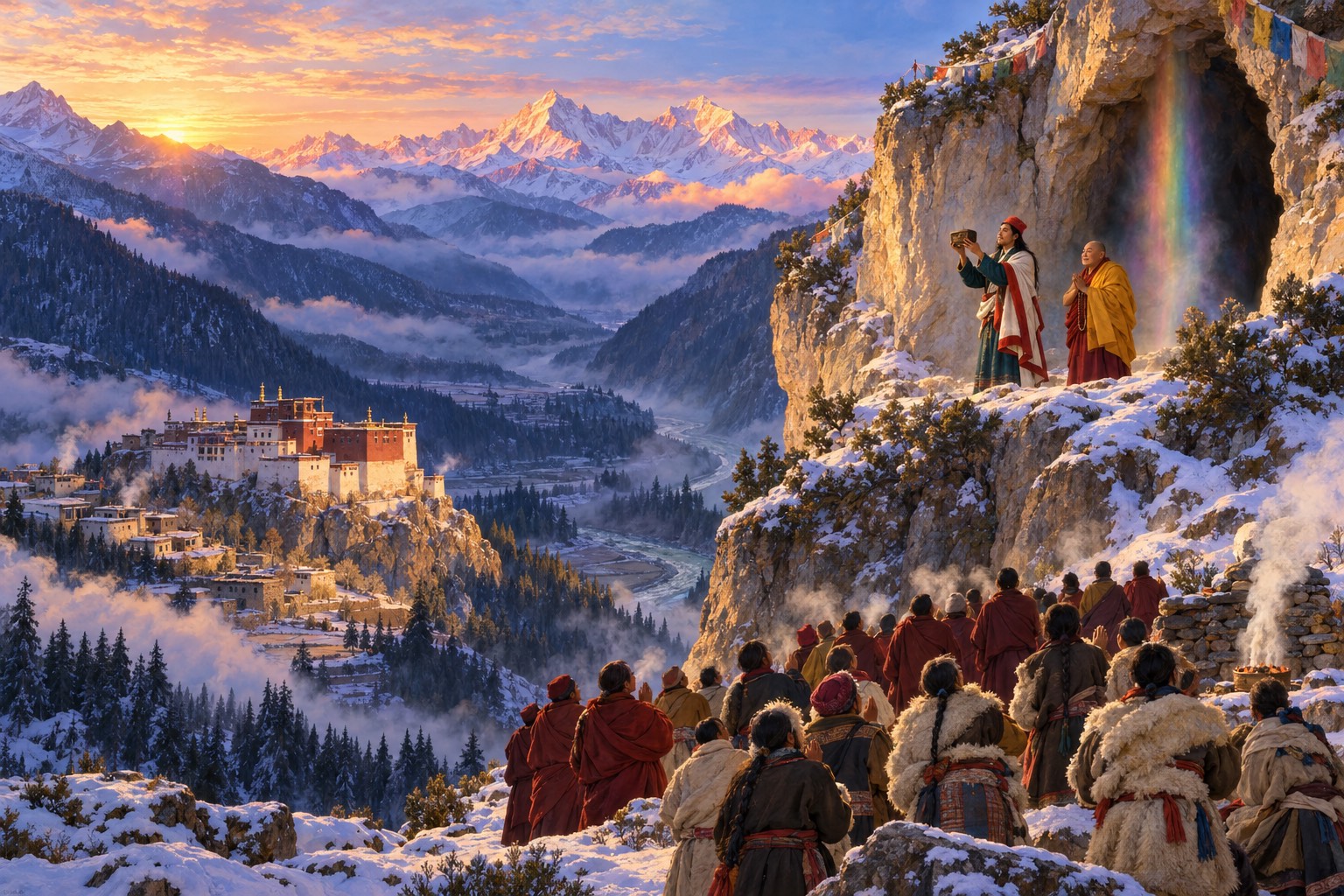
In 1886, on the southern bank of the Dzing river in Tromtar, a district of Kham in eastern Tibet, a camp began to gather around a long-haired yogi. People came with their tents and their yaks, monks and nuns and householders together, and they stayed to listen.
The camp was called Adzom Gar. A gar is an encampment, a teaching camp that can grow and shift like a nomad settlement. Its teacher was Adzom Drukpa (1842–1924), a treasure revealer and one of the great teachers of the Longchen Nyingtik, the "Heart Essence of the Great Expanse" that Jigme Lingpa revealed in the eighteenth century (Story 10).
A fortunate family
The Treasury of Lives, an online encyclopedia of Tibetan lives, tells how the family got its name. Long before, one of its lamas had five brothers, all named Tashi, and all five were recognized as reborn lamas. A servant is said to have cried out that this was a fortunate thing, adzompo. The family house became the Adzom household, and its lamas took the name.
He was born in 1842 at Tashi Dungkargang in Tromtar. A verse life by his disciple Lhundrup Tso gives the very hour: before dawn on the fifteenth day of the sixth month. Her verses say a warmth spread over the countryside, flowers opened, and the light of dawn filled the house.
 Illustration in preparation
The sources name his parents differently. The Treasury of Lives calls his father Adzom Sönam Gyatso, an accomplished practitioner, and his mother Aga. Lhundrup Tso calls them the yogi Namkha and Yeshe Drönma, a treasure revealer's daughter. Her translator notes that most lives give the mother's name as Aga.
One child, several names
While he was still an infant, two lamas of Katok Monastery recognized him as the rebirth of Adzom Rigdzin Sangye Tashi, a lama of his own family. A lama of the Drukpa Kagyu school said the child was also a rebirth of Pema Karpo (1527–1592), a great head of that school. That is where the name Drukpa comes from, though, as the Treasury of Lives notes, he never became a holder of the Drukpa teachings.
He was also remembered as a rebirth of Ma Rinchen Chok, one of the first Tibetans ordained as monks, and one of Guru Rinpoche's twenty-five close disciples (Story 22).
Lhundrup Tso writes that when he was almost seven, the wandering yogi Do Khyentse Yeshe Dorje (Story 29) accepted him as a student and named him Drodül Pawo Dorje, "hero vajra who tames beings." The Treasury of Lives remembers another early name, given by a lama of Shechen Monastery when the boy took refuge, the first vow of turning to the Buddha, his teaching and his community.
Illustration in preparationIn his writings he sometimes called himself Natsok Rangdröl, roughly "all things freeing themselves."
A circle of teachers
His list of teachers reads like a gathering of the age. At twelve, the Treasury of Lives says, he received teachings from the Second Katok Situ, Chökyi Lodrö, of Katok Monastery (Story 51). It also names masters of Palyul, Dzogchen and Mindrolling, among them a woman, Jetsünma Trinlé Chödrön of Mindrolling, who later trained him in Chöd, a practice of cutting through clinging to the self.
The great yogi Nyala Pema Dündul of Nyarong gave him striking advice: remain a layman and let your hair grow long, in the way of a ngakpa, a householder yogi of the tantras. A khenpo of Dzogchen Monastery later told him the same.
Illustration in preparationTwo teachers stand above the rest. Patrul Rinpoche (Story 11) taught him the preliminary practices, the foundations with which the path begins, from his own book, The Words of My Perfect Teacher. Jamyang Khyentse Wangpo (Story 16) gave him the Longchen Nyingtik and many other treasure lines.
Illustration in preparationAt Khyentse's suggestion he received the great collections gathered by Jamgön Kongtrul (Story 54). Later he studied with Mipham (Story 12), who taught him many of his own works.
Practices like these are passed on in person, from teacher to student. If they call to you, the site's Find a Teacher page can help you begin.
A prophecy, slowly understood
At twenty-two, the Treasury of Lives says, he faced a choice: repair Kegu, the monastery of his previous life, damaged in the wars of Nyarong, or build a new one. In retreat he received a prophecy from a dakini, a female embodiment of wisdom, but its meaning was unclear. A local yogi told him to mend the old monastery first, and he did.
Around then he went to Katok to pray for his elder brother, who had died. Katok Situ gave him gifts standing for enlightened body, speech, mind and activity: five bronze statues, texts of Guru Rinpoche, an old master's bell and a ritual instrument. Then he asked him to teach.
Illustration in preparationLater he set out on a long pilgrimage through Kham and central Tibet, India, Nepal and Bhutan. Lhundrup Tso's verses say that while he made offerings in the Turquoise Hall at Samye, Tibet's first monastery, Guru Rinpoche appeared to him as Dewa Chenpo, "Great Bliss," and gave him advice. At the old homes of Longchenpa and Jigme Lingpa, she says, he met both masters in vision.
Illustration in preparationThe treasure
A tertön is a revealer of terma, teachings that Guru Rinpoche is said to have hidden for the right person to find in a later age. Rigpa Wiki, a reference site kept by a Buddhist community, names Adzom Drukpa's treasure as the Ösal Dorje Sangdzö, the "Secret Treasury of the Vajra of Clear Light."
Lhundrup Tso says he opened it fully after three years of retreat at Tashi Dungkar Khyilwa, "the auspicious coiling white conch," near the later camp. The Treasury of Lives places one of his revelations at Dungrel Drakkar, a white rock to the south of the camp linked with Guru Rinpoche.
Illustration in preparationThe camp by the river
Some twenty years after the dakini's prophecy, the Treasury of Lives says, its meaning finally came clear: he was to build something new. In 1886 he founded Adzom Gar, not far from where he was born.
Illustration in preparationIn its main temple stood an image of Guru Rinpoche in the form called Nangsi Zilnön, "Outshining All That Appears and Exists." It was said to have been made by the hand of the treasure revealer Rinchen Lingpa.
Illustration in preparationIn his lifetime, the Treasury of Lives says, Adzom Gar was a loose encampment more than a formal monastery. He began with the basics: bodhicitta, the wish to awaken for the sake of others, and training the mind. Only gradually did he lead students on into Dzogchen, the Great Perfection, the heart teaching of the Nyingma.
Students came from Kham and central Tibet, from Bhutan, Nepal, China and Mongolia. Lhundrup Tso, one of them, says they came "like bees enticed by nectar." She counts thirty-eight times that he gave the whole Longchen Nyingtik, most often in the summers.
Illustration in preparationOn Jamgön Kongtrul's advice he married Tashi Lhamo, a merchant's daughter. Their son Gyurme Dorje, born in 1895, became a respected master and carried the camp forward.
Patience
In 1917 soldiers raided the camp and badly damaged it. But their commander, Lobzang Tashi, was so moved by the old yogi that he became his devotee. He returned the stolen animals and goods and paid those who had been harmed.
When the commander apologized, the Treasury of Lives records that Adzom Drukpa answered with a question: "How can we practice patience if there are no enemies?"
Illustration in preparationThe last journeys
Then, past seventy-five, he set out again. He sent his texts and printing blocks to Katok and Palyul, gave his disciples a long teaching, and sent them home. For several years he travelled and taught through Dzachukha, Golok and Serta, to students of every tradition.
At Shechen Monastery he took a small boy under his protection and gave him novice vows. The boy grew up to be Dilgo Khyentse Rinpoche (1910–1991), one of the great teachers of the last century.
Back at Adzom Gar, early in 1924, he fell ill. He urged his disciples to study and practise, and told them of his visions. The traditional accounts say strange lights were seen in the night before he died, and that he remained in meditation for days afterwards. Lhundrup Tso writes of rainbow clouds and of thunder at the cremation.
Illustration in preparationThe dates differ a little. The Treasury of Lives places his death in February or March 1924. Lhundrup Tso's translator notes that the life written by his son gives a winter dawn that falls on 10 January 1924, and her own verse gives a different day again.
The circle he left
His students included Tertön Sogyal (Story 58) and Jamyang Khyentse Chökyi Lodrö (Story 77), who wrote a prayer to him saying his voice resounded "like the thunderous roar of a dragon," perhaps a play on druk, "dragon," in his name. Chögyal Namkhai Norbu (1938–2018), who taught Dzogchen widely in the West, was recognized as his rebirth.
The fifth line of the Seven-Line Prayer pictures Guru Rinpoche surrounded by a great retinue of dakas and dakinis, male and female embodiments of wisdom. On a riverbank in Kham, a long-haired yogi devoted to Guru Rinpoche drew a gathering of his own: monks and nuns, nomads and mothers, scholars and yogis, all listening together.
Illustration in preparationAbout the art
Adzom Drukpa is drawn after his mural portrait at Shechen Monastery, shown on his Lotsawa House author page. He is bare-headed, with his long black hair drawn up into a topknot bound with white cloth. He wears an ochre-brown upper robe trimmed in teal green, a white shawl edged with red and blue, and a dark maroon lower robe. Long hair and a white shawl mark the ngakpa, the householder yogi, who keeps tantric vows without becoming a monk. That is why he never wears monastic robes on this page. The mural's halo and throne are left out, because on this site rainbow light belongs only to Guru Rinpoche and to wonders.
Do Khyentse, the yogi who named him, also has a lay yogi's long hair and white robe. Patrul Rinpoche wears the worn sheepskin of the nomads he lived among. The bell in the Katok still life has a five-pronged half-vajra on its handle and a small calm face beneath it, the usual form of the Tibetan ritual bell. The books are long loose pages kept between wooden boards. As everywhere on the site, their pages are blank, because the art never shows script.
The statue in the main temple shows Guru Rinpoche in his main form, the form the tradition also calls Nangsi Zilnön, "Outshining All That Appears and Exists." He wears the lotus hat, holds a five-pronged vajra at his heart and a skull cup with a long-life vase in his left hand, and has the khatvanga staff in the crook of his left arm. Adzom Gar is shown as the sources describe it in his lifetime, a loose camp of tents and huts around one temple, not the large monastery that stands there today.
Why this matters for practice
The fifth line of the Seven-Line Prayer pictures Guru Rinpoche surrounded by his retinue of dakas and dakinis. Adzom Drukpa, devoted to Guru Rinpoche all his life, gathered monks, nuns, nomads and yogis into one camp to hear the teachings handed down from him. Reciting the seven lines, even once, is a way of joining that gathering. Anything beyond recitation is best learned from a teacher.
If something in this story moved you, perhaps a camp of tents beside a river, or an old man who met his enemy with patience, you might pause tonight and recite the prayer once.
Sources and further reading
- The First Adzom Drukpa, Drodul Pawo Dorje, by Alexander Gardner and Samten Chhosphel (2011), Treasury of Lives (Internet Archive snapshot, October 2014)
- The Hook of Blessing and Compassion, by Lhundrup Tso, trans. Adriano Clemente, Lotsawa House (2016, from Rainbow Body, Shang Shung Publications)
- Adzom Drukpa Drodul Pawo Dorje, Rigpa Wiki (Internet Archive snapshot, 2024)
- Adzom Drukpa Series, Lotsawa House
- The Ambrosia of Blessings: A Prayer to Drodül Pawo Dorje, by Jamyang Khyentse Chökyi Lodrö, trans. Adam Pearcey (2020), Lotsawa House
- A Marvelous Garland of Rare Gems, by Nyoshul Khenpo, trans. Richard Barron (2005), Padma Publishing (book)
- Masters of Meditation and Miracles, by Tulku Thondup (1999), Shambhala Publications (book)
This retelling is waiting to be read by a knowledgeable practitioner. Where the traditional accounts differ, the story says so; if you notice a mistake, please tell us through Share Your Story.