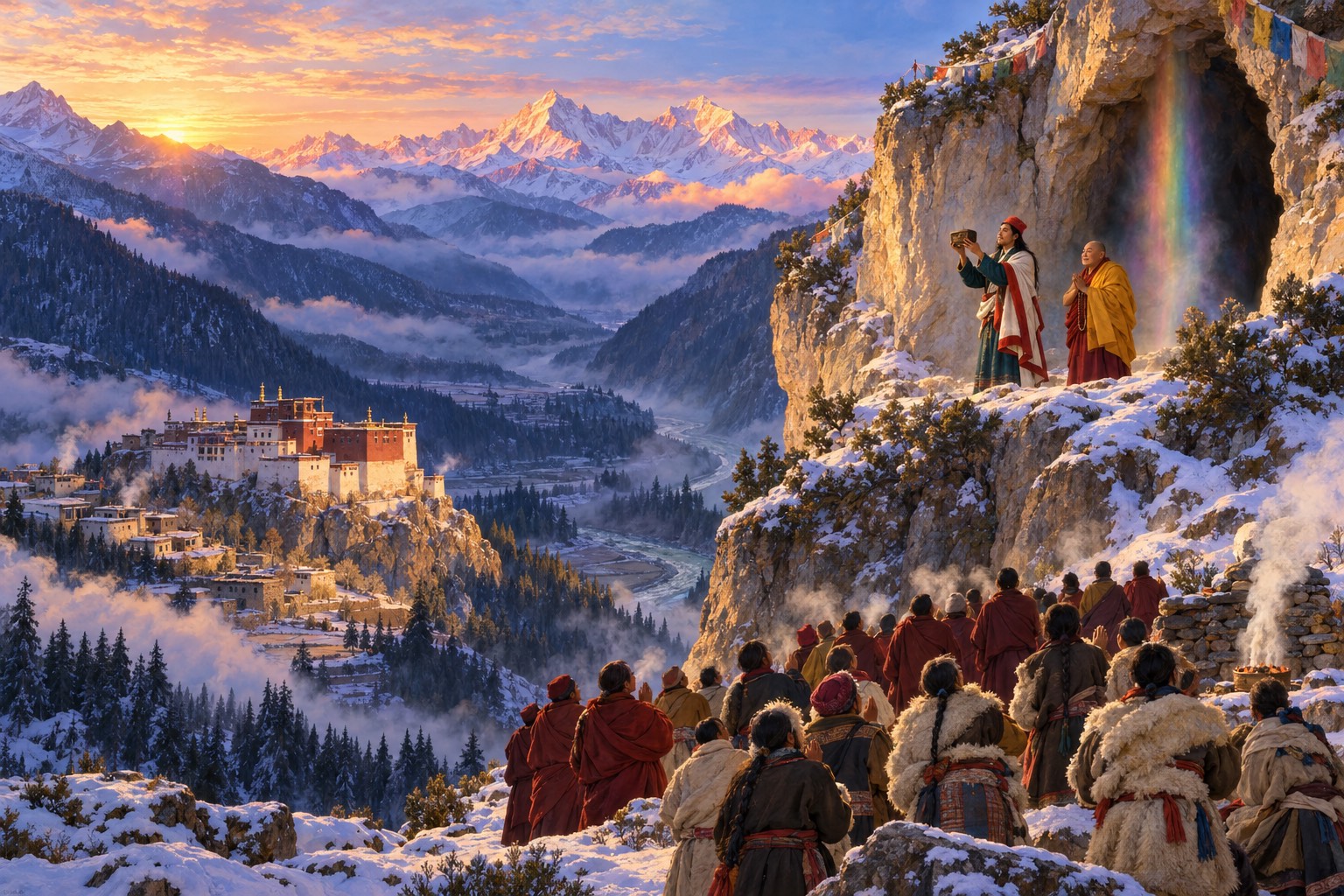
High above Palpung Monastery, in Kham, the far eastern region of Tibet, a cliff of rock and juniper looks out over forested valleys. A monk named Jamgön Kongtrul lived up there for most of his long life, and from that small hermitage came some of the largest collections of teachings ever gathered in Tibet.
Kongtrul (1813–1899) is one of the three friends in The Treasure Friends of Kham, with Jamyang Khyentse Wangpo and the treasure revealer Chokgyur Lingpa. This page follows Kongtrul himself: the boy from a quiet valley, the scholar, the hermit, and his lifelong love for Guru Rinpoche.
His names carry meanings. Jamgön is a title of honour, "gentle protector". Lodrö Thayé means "boundless intelligence", and another of his names, Yönten Gyatso, means "ocean of good qualities".
A boy from Rongyab
He was born in 1813 in Rongyab, a hidden valley in the Derge kingdom of Kham, in front of a mountain called Pema Lhatse, as Alak Zenkar Rinpoche's short biography tells it. His father, Tendzin Yungdrung, came from the Khyung clan, known for its accomplished practitioners. His mother, Tashi Tso, is remembered as a yogini, a woman devoted to meditation.
The family's tradition was Bön, Tibet's other ancient religion, with its own teachers and scriptures alongside Buddhism. Wikipedia's summary says his first vows were taken at a Bön monastery. It was a fitting start for someone who would spend his life honouring many traditions.
 Illustration in preparation
He began learning his letters at five, Alak Zenkar writes, and from about ten he studied on an enormous scale, with teachers of many different lineages.
Shechen and Palpung
At about twenty he became a monk at Shechen, a great monastery of the Nyingma, the "old school" whose teachings go back to Guru Rinpoche. There his teacher was Gyurme Tutob Namgyal.
In 1833 he moved to Palpung, the seat of the Tai Situ lamas of the Karma Kagyü, a school led by the Karmapas. He took the Ninth Tai Situ, Pema Nyinje Wangpo, as his teacher, and Palpung became his monastery.
Illustration in preparationHe studied almost everything a Tibetan scholar could: philosophy and monastic discipline, the tantras (the esoteric teachings of the Vajrayana), medicine, Sanskrit grammar, poetry and the arts and crafts. By thirty, Wikipedia notes, he had received teachings from more than sixty masters of different schools.
His modern biographer, Alexander Gardner, pictures him as "an hourglass", because so many of the teachings that passed through Tibet passed through him (Tricycle).
Illustration in preparationThe Jewel Cliff
Above Palpung is a place called Tsadra Rinchen Drak, "the Jewel Cliff that resembles Tsari", after a famous holy mountain in the south of Tibet. In the eighteenth century the great Situ Panchen had built a retreat there.
When Kongtrul first climbed up to it, in 1842 by Rigpa Wiki's account (Treasury of Lives says 1843), it lay abandoned and in ruins. He repaired a small hermitage for himself and began a personal three-year retreat. The cliff became his home, and most of his great works were written there.
Illustration in preparationFriends and a fear of loss
At the end of 1840 he had met the young Khyentse Wangpo, and in 1853 the treasure revealer Chokgyur Lingpa. How the three came to trust one another is told in The Treasure Friends of Kham. Chokgyur Lingpa later named Tsadra among the twenty-five great sacred sites of Kham, and on his advice Kongtrul built a small temple there.
Kongtrul and Khyentse loved the many lineages of practice they had received, Gardner explains, and they rightly saw that some were in danger of vanishing.
Illustration in preparationThe Treasury of Precious Treasures
Guru Rinpoche, the tradition says, hid teachings for later ages as terma, "treasures", and over the centuries treasure revealers brought a great many of them to light. By Kongtrul's time they were scattered across Tibet, and some had become rare.
Fearing that they would be lost, Rigpa Wiki says, Kongtrul began to gather them in 1855 with Khyentse's blessing. He sought out the transmissions, received them, and arranged the texts with their rituals. The work was finished in 1889.
Illustration in preparationThe result is the Rinchen Terdzö, the "Treasury of Precious Treasures". It opens with the life of Guru Rinpoche and the lives of the treasure revealers, which Kongtrul wrote himself. Receiving all its empowerments (ceremonies that authorize practice) and readings takes four to six months, Rigpa Wiki notes. Editions differ in size: one listing gives sixty-three volumes, and later printings run to seventy or a hundred and eleven.
It is one of his Five Great Treasuries. The others gather the whole range of Buddhist learning, the key instructions of eight great practice lineages, the rituals of the Kagyü and older lineages, and his own revelations and writings. Together they fill about ninety volumes by Alak Zenkar's count; Rigpa Wiki speaks of a hundred.
Without bias
Kongtrul is remembered with Khyentse as a founder of the Rimé movement. Rimé means "without bias": respecting and preserving the teachings of every school rather than favouring one's own.
Gardner adds a gentle caution. Kongtrul did not set out to found anything new or to mix the schools; he wanted each lineage kept exactly as it was, and many scholars now prefer to speak of a Rimé period rather than a movement.
Five retreatants
In 1860 Kongtrul opened a three-year retreat at Tsadra for just five meditators, according to Rigpa Wiki and the Tsadra Foundation; Treasury of Lives gives 1861. Its programme drew on several traditions in turn, and it became famous for the quality of the lamas it trained.
Illustration in preparationThe retreats followed one after another until the 1950s. The buildings were destroyed in the Cultural Revolution and rebuilt in the 1980s, and Rigpa Wiki says three-year retreats have run there again since 1988.
Calling Guru Rinpoche
Devotion to Guru Rinpoche runs through all of this work. Kongtrul was a treasure revealer himself, with the treasure name Chimé Tennyi Yungdrung Lingpa. Among his revelations is a life of Guru Rinpoche in ten short chapters, said to have been recorded by Yeshe Tsogyal, which he received, the colophon says, "as a siddhi", a gift of spiritual accomplishment (Lotsawa House).
At Khyentse's request he wrote The Nucleus of Blessings, a prayer for the tenth day of the lunar month, when Guru Rinpoche's deeds are remembered. He wrote it, he says, out of intense devotion.
Illustration in preparationRigpa Wiki cites a treasure Kongtrul revealed in which Guru Rinpoche speaks of the Seven-Line Prayer itself. Countless dakinis, wisdom beings in female form, sang as one voice, he says, and invited him into this world with the melody of those seven lines.
Kongtrul also wrote Calling the Guru from Afar, a song of devotion still sung in many communities. It calls on the masters of every lineage and asks the guru's help with one's own faults.
Feet on the ground
His life was not spent only on a cliff. In the 1860s a warlord from the Nyarong valley, Gönpo Namgyal, fought his way across Kham, and an army from central Tibet came to defeat him. Kongtrul was asked to perform rituals and divinations, first for one side and later for the other, Gardner relates, and Wikipedia says he helped save Palpung when that army occupied Kham in 1865.
Illustration in preparationHe left a diary, and Gardner notes that in it he writes not as a flawless buddha but as a person: anxious about the armies, honest that he simply said what came to mind. Gardner sees a man with his feet on the ground, and a better teacher for it.
In those years, after Khyentse told him how much regular prayer for peace mattered, Kongtrul wrote a Prayer for Peace and Stability for his own practice. Lotsawa House says it has been loved ever since, especially when Tibet faces hard times.
The last years
His students came from every school and every part of Tibet, among them the Fourteenth and Fifteenth Karmapas, the Sakya master Jamyang Loter Wangpo and the Nyingma scholar Mipham. When Khyentse died in 1892, Kongtrul led his funeral rites.
In 1898, when he was eighty-five, a student commissioned a painting of him with his hand and foot prints, Himalayan Art Resources notes. It shows him white-haired, in a scholar's hat.
Illustration in preparationHe died the next year, at eighty-seven by Tibetan reckoning, which counts a child as one year old at birth. The year is usually given as 1899; the Tsadra Foundation gives 1900. For many people practising in the Kagyü and Nyingma traditions today, as Gardner puts it, their teacher's teacher's teacher was Kongtrul.
Illustration in preparationAbout the art
Kongtrul is shown in the orange and red robes of a monk, as in the two traditional portraits described by Himalayan Art Resources (items 799 and 73405). In his last years he wears the red pandita hat, a scholar's hat whose long side flaps fall past the shoulders; its three thin bands are explained by HAR as mastery of the three "baskets" of the Buddhist canon. The portraits also show him holding two flowers that bear a sword on a book and a vase; these are left out here to keep the hands simple. None of the pictures is a likeness.
The long, narrow books are Tibetan pecha: loose leaves stacked between boards and wrapped in cloth, with a coloured tab at one end. No writing is shown in any image, because generated script is unreliable.
In the shrine and the closing image Guru Rinpoche appears in his main form: the lotus hat topped with a half-vajra and a single feather, a five-pronged vajra in his right hand at his heart, a skull cup with a small vase of long life in his left, and the khatvanga staff in the crook of his left arm. In the shrine he is a gilt statue, so there is no rainbow light; in the closing image the rainbow sphere marks a devotional picture, not a scene from history.
The buildings of Palpung and Tsadra are painted as they might have looked in the nineteenth century. Both were damaged in the twentieth century and rebuilt, so present-day photographs were not used as models. Kongtrul's childhood valley of Rongyab is not described in any source we found; its picture is an informed guess.
Why this matters for practice
Kongtrul spent his life making sure that others could still follow the paths he had received, including the treasure teachings of Guru Rinpoche, which is the wish of the prayer's sixth line. He gathered them without bias, practised them in retreat, and kept calling on Guru Rinpoche in prayer. For anyone returning to practice, his life is a reminder that devotion and patient effort go together, and that a few seven lines said with longing belong to the same stream. For empowerments, retreat or anything beyond recitation, please seek a qualified teacher.
If something in this story moved you, perhaps a scholar who could not bear for precious things to be lost, or a hermit who kept calling on Guru Rinpoche to the end, you might pause and recite the prayer once. The seven lines he loved are short enough to say on a cliff, in a retreat cell, or wherever you are tonight.
Sources and further reading
- A Brief Biography of Kongtrul Yönten Gyatso, by Alak Zenkar Rinpoche (trans. Adam Pearcey), Lotsawa House
- Jamgön Kongtrul Lodrö Tayé series (author page) and individual texts, Lotsawa House
- Jamgön Kongtrul Lodrö Tayé, Rigpa Wiki (Internet Archive snapshot, 2025)
- Tsadra Rinchen Drak; Rinchen Terdzö; Seven Line Prayer; Rimé, Rigpa Wiki (Internet Archive snapshots, 2024–2025)
- Jamgon Kongtrul, the Man and the Myth: an interview with Alexander Gardner, Tricycle (2019)
- Jamgon Kongtrul Lodro Taye, by Alexander Gardner (2015); institution pages Tsadra Rinchen Drak and Pelpung, Treasury of Lives (Internet Archive snapshots, 2016–2017)
- Jamgon Kongtrul Lodro Thaye (item 799) and Jamgon Kongtrul with hand and foot prints (item 73405), Himalayan Art Resources (Internet Archive snapshots, 2022–2023)
- Tsadra Rinchen Drak (past programs page), Tsadra Foundation (Internet Archive snapshot, 2021)
- Jamgön Kongtrül, Rangjung Yeshe Wiki (Internet Archive snapshot, 2024)
- Jamgön Kongtrul, Wikipedia
- The Autobiography of Jamgön Kongtrul: A Gem of Many Colors, trans. Richard Barron (Snow Lion), Book (publisher's page only)
- The Life of Jamgon Kongtrul the Great, by Alexander Gardner (Snow Lion, 2019), Book (used only through the Tricycle interview)
This retelling is waiting to be read by a knowledgeable practitioner. Where the traditional accounts differ, the story says so; if you notice a mistake, please tell us through Share Your Story.