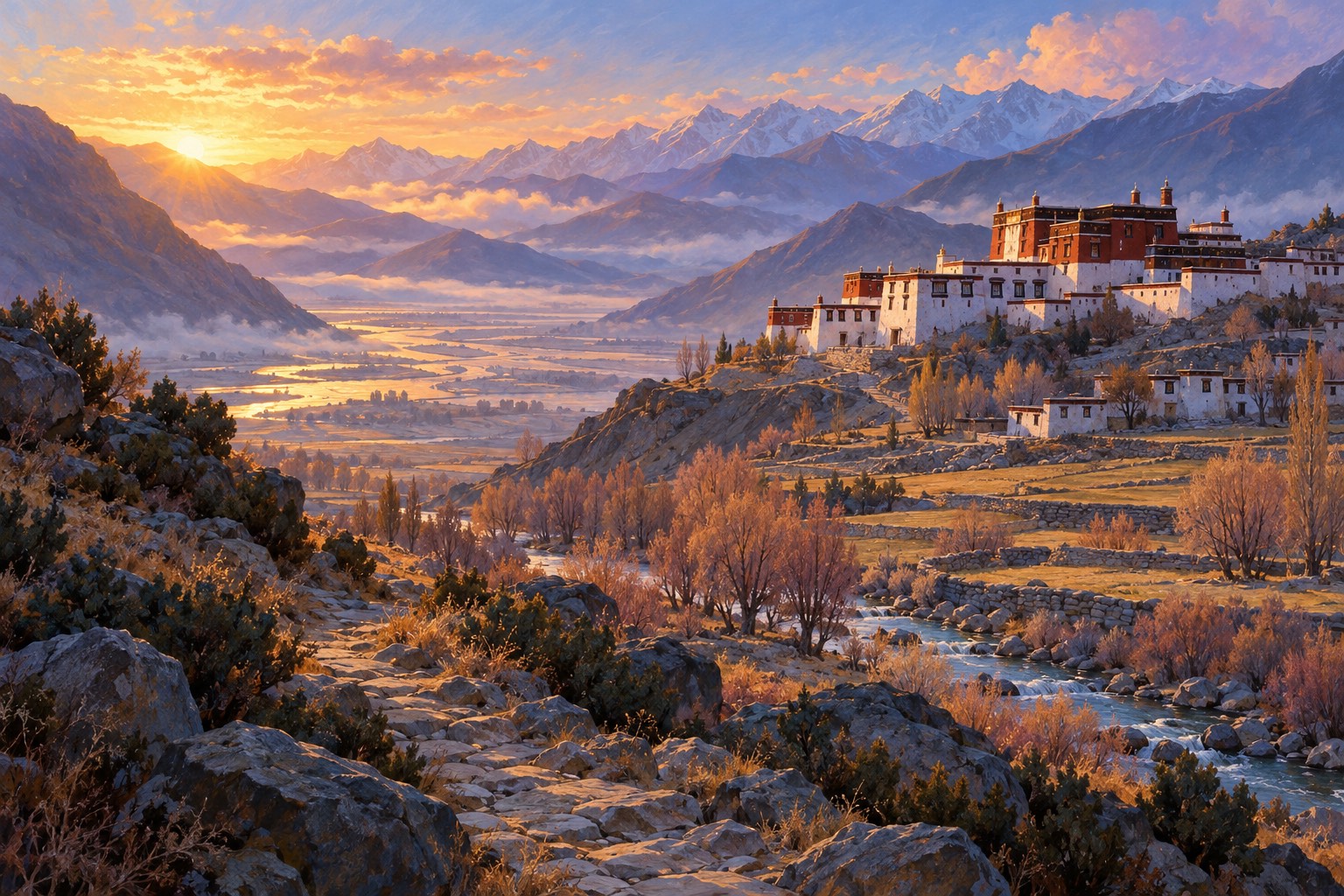
Before dawn in central Tibet, the great Tsangpo river runs grey and wide between bare hills. In a dry side valley to the south stands Mindrolling, the monastery two brothers founded in 1676. This is the story of the younger brother, a monk who spent his life making sure that what he had been given would not be lost.
His name was Ngawang Chöpal Gyatso. He is remembered as Lochen Dharmashri, or simply Minling Lochen, "the great translator of Mindrolling." Dharmashri is the Sanskrit form of Chöpal, "glory of the Dharma." He lived from 1654 until the war of 1717–18.
Story 40 tells of his elder brother, the treasure revealer Terdak Lingpa, and Story 28 of their niece, Jetsün Mingyur Paldrön. Here we stay with Lochen himself.
A younger brother
He was born into the Nyö, an old family of Nyingma teachers. His father, Sangdak Trinlé Lhundrup, died in 1662, when the boy was about eight. His brother, eight years older, became his teacher as well as his brother.
Mindrolling calls Terdak Lingpa his principal guru. From him Lochen took refuge, the first step of a Buddhist life, and the bodhisattva vow, the promise to work for the good of all beings.
At twelve, Mindrolling's account says, he received from his brother an empowerment, a ceremony that formally opens a practice to a student. It was for the Rigdzin Tukthik, the first treasure Terdak Lingpa had found. A treasure, or terma, is a teaching the tradition says Guru Rinpoche hid long ago for later times. Mindrolling dates that find to the tenth day of a lunar month, the day kept for Guru Rinpoche.
 Illustration in preparation
The same account says this empowerment ripened the boy's mind, so that every vow he took afterwards grew from it.
An old translator
Mindrolling and Rigpa Wiki both name him as an emanation, a rebirth in the tradition's sense, of Yudra Nyingpo. Yudra Nyingpo was one of Guru Rinpoche's twenty-five close disciples: a prince of Gyalmorong, in the far east of Tibet, who studied with the exiled translator Vairotsana and became a great translator himself.
Illustration in preparationLochen means "great translator," a title of honour for a scholar. Lotsawa House notes that the Tibetan word for translator is said to come from a Sanskrit phrase meaning "eye of the world."
Robes from the Great Fifth
At fifteen he took the vows of a novice monk from the Fifth Dalai Lama, who governed Tibet and was close to the brothers. At twenty he received full ordination from him.
Illustration in preparationThe Dalai Lama also asked him to receive a particular line of the Vinaya, the Buddha's code of conduct for monks and nuns. Mindrolling explains that this "Lower Tibetan Vinaya" had come down through Kham, in the east, and survived the persecution of Buddhism under King Langdarma in the ninth century.
Lochen became its great keeper, teaching it and living by it. Mindrolling says he gave full ordination to about five hundred monks. At Mindrolling he served as khenchen, the senior monk-abbot, beside his brother, the lay head. Treasury of Lives counts him the second to hold that seat.
Illustration in preparationA mind like a library
Mindrolling remembers him as one of the most learned people in Tibet's history. Its list of what he mastered is long: ritual, Indian and Chinese astrology, the chants and sacred dances of the Nyingma, monastic discipline, Buddhist philosophy, the whole collection of Nyingma tantras, and grammar, prose and poetry.
His collected writings fill twenty volumes by Rigpa Wiki's count and twenty-four by Mindrolling's. They open with long commentaries on two great Nyingma scriptures. His two explanations of the Guhyagarbha, the "Secret Essence" tantra, are still praised for their clarity.
Illustration in preparationHis commentary on the three kinds of vows, called the Wish-Fulfilling Grain, was still being taught at Mindrolling in the twentieth century, Treasury of Lives notes.
Not everything he wrote is long. In one short piece, translated on Lotsawa House, he looks back to the eighth century, when the abbot Shantarakshita taught Tibet's king the ten virtuous actions. Lochen suggests, modestly, that beginning with those simple rules was a way to give people sound understanding and trust in cause and effect.
Two streams
The Nyingma school keeps two great streams of teaching. Kama, "the spoken word," is the long line passed from teacher to student since Guru Rinpoche's time. Terma are the treasures, found again by later revealers.
Lochen worked on both. Rigpa Wiki says the kama teachings the brothers gathered were later expanded and, in the twentieth century, printed in some forty volumes by Dudjom Rinpoche. Treasury of Lives notes that they also compiled the Döjo Bumzang, "the Wish-Granting Vase," a great collection of treasure practices.
Mindrolling adds how such teachings survive. Terdak Lingpa gave his treasures to Lochen, and Lochen passed them on to Terdak Lingpa's son Rinchen Namgyal. A lineage, in this sense, is not so much a library as a chain of people, each handing on what they were given.
Sixteen years of teaching
Mindrolling says he taught every subject he had studied, with its empowerments and instructions, at least three or four times. From the age of forty-eight until he was sixty-four, he taught the Guhyagarbha without a break, to a circle of about sixty students.
Illustration in preparationAmong those Treasury of Lives lists as his students are his niece Mingyur Paldrön, his nephew Rinchen Namgyal, and the young nobleman Polhané, who would one day govern Tibet. It also lists the Sakya throne-holder Kunga Tashi, who was both his student and his teacher.
A thread of devotion
No source I found records Lochen's private prayers. But Guru Rinpoche runs through his life like a thread.
The tradition counts him as the rebirth of one of Guru Rinpoche's own disciples. His first empowerment was a treasure that Guru Rinpoche is said to have hidden. The tantra he taught for sixteen years is one that Guru Rinpoche himself is credited with explaining, in a short work called The Garland of Views.
And he lived at a monastery that, from his brother's time, gathered on the tenth day of the lunar month to offer the Lama Sangdü, the treasure cycle that holds the Seven-Line Prayer.
Illustration in preparationThe Fifth Dalai Lama wrote a short prayer for Lochen's long life. It opens by asking the compassion of Ngayab Lingpa to clear away all harm. As I understand it, that is a name for Guru Rinpoche, "the one of Ngayab," the island of his Copper-Coloured Mountain. Those who prayed for Lochen turned to Guru Rinpoche to do it.
His brother wrote a four-line prayer to him, at the request of a community of monks. It praises his learning and his realization, and ends, in Adam Pearcey's translation for Lotsawa House: "Chöpal Gyatso, at your feet I pray."
Illustration in preparationThe storm of 1717
In 1717 war came to central Tibet. An army of Dzungar Mongols from the north reached Lhasa that autumn and took the city. They favoured the Gelug school, and they turned against the older schools, damaging Nyingma monasteries and putting several of their leaders to death.
Illustration in preparationMindrolling was among the places attacked. Lochen Dharmashri, then in his sixties, lost his life, and so did his nephew Pema Gyurme Gyatso, Terdak Lingpa's eldest son.
The sources remember his death a little differently. Mindrolling's history says he was killed the day the monastery was attacked, in 1717. A biography quoted by Treasury of Lives says he, his nephew, the Dorje Drak master Pema Trinlé (one of his own teachers) and other Nyingma leaders were put to death beside the Kyichu river, near Lhasa. Rigpa Wiki says only that he was killed in the war of 1717–18.
Illustration in preparationThere is no need to dwell on how it happened. What his students carried away with them was what he had taught.
Many streams
Within a few years two of those students, Mingyur Paldrön and Rinchen Namgyal, were raising Mindrolling's walls again, and a third, Polhané, gave much of the funding, as Story 28 tells.
Mindrolling quotes Dudjom Rinpoche's history of the Nyingma school, which says that from the two brothers, as master and disciple, the lineage branched into many streams. They ran east to the great monasteries of Kham, Katok, Palyul, Shechen and Dzogchen, to Golok in Amdo, and as far as Gyalmorong, the homeland of the old translator Yudra Nyingpo.
Illustration in preparationThe empowerments, tantras and vows in this story belong with a qualified teacher, and the site's Find a Teacher page lists places to begin. The Seven-Line Prayer itself is open to anyone.
About the art
Lochen Dharmashri is drawn after a painting of his brother Terdak Lingpa now in the Rubin Museum, shown on Himalayan Art Resources, in which he sits below his brother: a round-faced, clean-shaven monk in deep red and golden-yellow monastic robes and an orange cloak, wearing what HAR calls the lotus hat of the Nyingma tradition, here red-orange with a gold pattern. One hand is raised at the chest in a teaching gesture and a long loose-leaf book rests in his lap. His hat has no feather and no vajra on top, so that it is never mistaken for Guru Rinpoche's. In the scenes of his youth he is drawn bareheaded, because no portrait shows him young.
Terdak Lingpa appears once, as a young man, bareheaded, in the white robes of a married lay master, with the small square casket that marks a treasure revealer. The Fifth Dalai Lama is drawn as in seventeenth-century portraits, with a thin moustache, a yellow pandita hat (here set aside) and the lotus and long-life vase that HAR describes. Yudra Nyingpo has no known portrait; he is drawn simply, in the plain wool robe of his forested borderland, as on the Vairotsana page.
Guru Rinpoche appears once in his best-known form: the lotus hat with a half-vajra and one vulture feather, a five-pronged vajra at his heart, a skull cup with a small long-life vase in his lap, and the slender staff called the khatvanga on his left shoulder. His death is shown only by an empty seat, with his hat and a wrapped book resting on it beside a lamp. Mindrolling's early buildings are not described in detail in the sources, so they are drawn from the general architecture of central Tibet in that period. No book in these pictures shows any writing.
Why this matters for practice
The seventh line of the prayer asks Guru Rinpoche to come and grant his blessings. Lochen spent his life receiving teachings and handing them on, and those who loved him prayed for him, and to him, in that same spirit. The tantras and vows he kept belong with a teacher, but the seven lines are open to anyone, and saying them once is a simple way to ask for that blessing too.
If something in this story stayed with you, you might pause tonight and recite the prayer once, for every teacher who kept the spoken word alive so that it could reach you.
Sources and further reading
- Lochen Dharmashri, Mindrolling International
- Lochen Dharmashri, Mindrolling Monastery in India (mindrolling.org)
- Chögyal Terdag Lingpa, Mindrolling International
- Lochen Dharmashri, Rigpa Wiki (Internet Archive snapshot, 2026)
- Yudra Nyingpo; Guhyagarbha Tantra; Terdak Lingpa, Rigpa Wiki (Internet Archive snapshots, 2025–26)
- Nyingma Kama, Rigpa Wiki (Internet Archive snapshot, 2026)
- Lochen Dharmaśrī (person page), Treasury of Lives (Internet Archive snapshot, 2024)
- Polhane Sonam Tobgye, by J. Arya Moallem (2022), Treasury of Lives (Internet Archive snapshot, 2025)
- Lochen Dharmaśrī (author page), Lotsawa House
- Prayer to Lochen Chöpal Gyatso, by Minling Terchen Gyurme Dorje, trans. Adam Pearcey (2026), Lotsawa House
- Long-Life Prayer for Lochen Dharmaśrī, by the Fifth Dalai Lama, trans. Adam Pearcey (2019), Lotsawa House
- A Brief Explanation of the Ten Virtues and Eighteen Elements, by Lochen Dharmaśrī, trans. Adam Pearcey (2019), Lotsawa House
- Terdak Lingpa with Lochen Dharmashri and Pema Gyurme Gyatso (item 65032); Lochen Dharmashri (item 66259), Himalayan Art Resources (Internet Archive snapshots, 2025)
- Dzungar conquest of Tibet, Wikipedia
This retelling is waiting to be read by a knowledgeable practitioner. Where the traditional accounts differ, the story says so; if you notice a mistake, please tell us through Share Your Story.