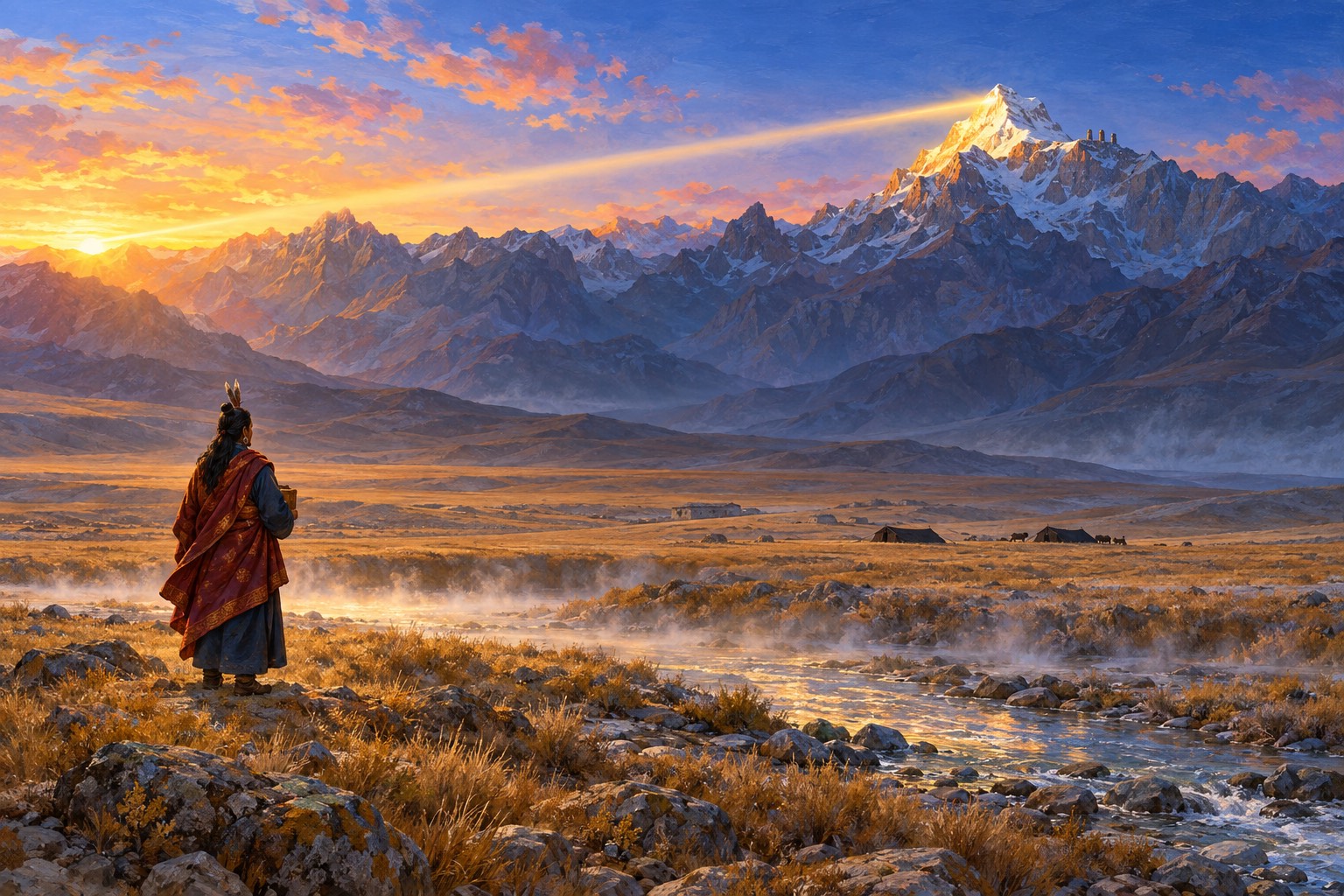
Far to the west of central Tibet, where the Kali Gandaki river cuts a dry, wind-carved valley through the Himalaya, lies the old kingdom of Lo. Today it is called Upper Mustang and belongs to Nepal. Five hundred years ago it had its own kings and a walled capital, Lo Monthang.
Tibetans counted this high country as part of Ngari, the great western region. So when a boy from Lo grew into one of the most learned men of his age, people called him Ngari Panchen, “the great scholar of Ngari.”
A boy named Lotus
He was born in 1487, in a fire-sheep year. His father, Jamyang Rinchen Gyaltsen, was a scholar and practitioner who traced the family back to Marpa the Translator. His mother was called Drompa Gyen. There were eight sons, and his father named this one Pema Wangyal. Pema means “lotus,” the flower that gave Guru Rinpoche his own name, the Lotus-Born.
Some retellings link the family to the royal house of Lo. The biography drawn on here speaks instead of Marpa's line, so this page leaves that question open. All the accounts agree that Lo was his home, and that he died there.
When he was eight, his father gave him the vows of a lay Buddhist and the bodhisattva vow, the promise to live for the good of every being. Then his schooling began. His father taught him the great texts of the Nyingma, the “Ancient” school that traces itself to Guru Rinpoche's time.
 Illustration in preparation
He also studied monastic discipline and the sutras with a teacher named Norten Zangpo. By twenty, it is said, he had mastered more than a hundred textual traditions, above all the Middle Way, logic and the Perfection of Wisdom. That earned him the title Panchen, the Tibetan form of a Sanskrit word for “great scholar.”
Illustration in preparationA monk of Lo
Lo was a stronghold of the Sakya school, another great Tibetan tradition, and he learned from its masters too. At twenty-five he took full monastic ordination from the renowned Sakya abbot Lowo Khenchen Sonam Lhundrub, at a monastery called Samdrub Ling.
He went on studying, too: grammar, logic and the tantras of the later translation schools, with teachers from as far as Guge, the old kingdom to the west.
He kept his monastic vows so carefully that he is remembered as one of the great upholders of monastic discipline in his day. Hold on to that. It matters later in the story.
Illustration in preparationTwo brothers on the road
Pema Wangyal had a brother, Lekden Dorje, who was recognized as the rebirth of Rigdzin Gödem, the fourteenth-century revealer of the Northern Treasures. Rigpa Wiki calls Lekden the younger brother; the Treasury of Lives calls him the elder. The dates given for him differ by sixty years, so it is best to hold the details lightly.
The brothers went on pilgrimage together. From a master named Shakya Zangpo they received the teachings of the Northern Treasures. Then they went on to the Kathmandu valley and studied with Tibetan and Newar teachers there.
Illustration in preparationAfterwards Pema Wangyal went into retreat again. During that retreat, his biography says, he had many visions of Guru Rinpoche. He also came to remember a past life as King Trisong Detsen, the eighth-century Dharma king who invited Guru Rinpoche to Tibet and built Samye, its first monastery.
Illustration in preparationThe tradition places him in a long line of that king's rebirths. Centuries later Jigme Lingpa named both Trisong Detsen and Ngari Panchen in a prayer to his own past lives, which Gyurme Avertin has translated for Lotsawa House.
Back to the king's temple
At thirty-eight he began to teach widely. With his father's blessing and the permission of the officials at home, he set out for central Tibet with Lekden Dorje. His biography says they hoped to restore teaching traditions that had grown weak.
Illustration in preparationOn the way they passed Zangzang Lhadrak, where Rigdzin Gödem had found his treasures, and prayed at the Jokhang temple in Lhasa. Then they came to Samye, the temple Trisong Detsen had built. For seven days they lived in a nomad's tent there, performing rituals that included a great blessing of the land.
There they gathered a small community of tantric practitioners called Evam Chokgar. Generations later it moved to the north bank of the Tsangpo river and became Dorje Drak, one of the great Nyingma monasteries.
Illustration in preparationHe meditated in the caves of Drak Yangdzong and of Chimphu, high above Samye. Then he travelled south to Lhodrak, invited by a descendant of Guru Chöwang, the treasure revealer through whom the Seven-Line Prayer is often traced. One practice mattered to him especially there, the Deshek Düpa, “the Gathering of the Sugatas,” a cycle of the eight great wrathful deities of the Nyingma. His biography says he received its empowerment, the ceremony that formally opens a practice, twenty-five times. Then he entered solitary retreat.
Illustration in preparationThe treasure behind the image
Two words help here. A terma is a “treasure,” a teaching the tradition says Guru Rinpoche hid for the future. A tertön is the person who finds it. Ngari Panchen began to reveal treasures at forty-six.
His most famous find, the accounts say, came from inside Samye itself. In the temple's upper hall stood an image of Vairocana, a buddha shown with four bodies facing the four directions. Lodged in its back was the Rigdzin Yongdü, “the Gathering of All the Awareness-Holders.” The Treasury of Lives calls it his most famous treasure cycle. An awareness-holder, or vidyadhara, is a realized master of the Vajrayana, and Guru Rinpoche is counted foremost among them.
Illustration in preparationThen he invited the abbot of Drigung, Rinchen Puntsok, to help reconsecrate Samye. In the tradition's way of seeing, the king who first built the temple came back, in another life, to bless it again.
Himalayan Art Resources notes that his collected treasures picture Guru Rinpoche in many unusual forms, among them a healing form like the Medicine Buddha. These are practices that belong with a teacher, so this page only names them. The Find a Teacher page can help.
Three vows, one life
Ngari Panchen is remembered most of all for a book, the Domsum Namngé, the “Ascertainment of the Three Vows.” A Buddhist of his tradition may hold three sets of commitments at once.
The first are the vows of individual liberation, which monks, nuns and lay followers take to turn away from harm. The second is the bodhisattva vow to work for others. The third are the sacred commitments of the Vajrayana, the path of secret mantra.
Rigpa Wiki passes on Dudjom Rinpoche's simple summary of what they share. The first means giving up whatever would harm others. The second means doing whatever good one can for them. The third, at the root of both, means taming one's own unruly mind and learning to see the world as pure.
Illustration in preparationHow can one person keep all three without conflict? His treatise answers in five chapters, and the last one takes up exactly that question. He wrote it as a strict monk who was also a tantric master and a treasure revealer, so it was a question he lived. In his view, as the treatise's full title suggests, all three serve the path of the Great Perfection, Dzogchen, the Nyingma teaching on the nature of mind.
The book is still studied in Nyingma colleges. Later masters, among them Minling Terchen and Dudjom Rinpoche, wrote commentaries on it, and an English translation with Dudjom Rinpoche's commentary appeared in 1996 as Perfect Conduct.
Home to Lo
His last years brought him home. He died in Lo in 1542, at fifty-six. According to the accounts, many who came to his funeral saw an orb of light rising into the sky.
Illustration in preparationHis rebirth, Tashi Tobgyal, carried on his work. Lekden Dorje's rebirth, Ngakgi Wangpo, built the monastery of Dorje Drak. And the boy named Lotus is still read today, wherever students try to keep a careful life and a devoted heart together.
Illustration in preparationAbout the art
Ngari Panchen is drawn from his portrait in the Nyingma Icons drawings (Himalayan Art Resources item 66253): a monk-scholar in a tall, pointed pandita hat with long lappets, monastic robes, a lotus beside his right shoulder bearing a book, and a small vase in his left hand. The hat and the book on the lotus are the signs of a great scholar; the drawing has no colour, so the deep red hat and maroon and gold robes follow the usual dress of Nyingma and Sakya monks. He is shown without a hat in the early scenes, before he became known as a teacher, and he never carries any of Guru Rinpoche's implements.
His brother Lekden Dorje has no portrait that I could find, so he is drawn plainly as a lay mantra-holder of the Northern Treasures, with braided hair and a striped white shawl, to keep him distinct from his monk brother. Guru Rinpoche appears once, in the vision during retreat, in his main form with the lotus hat, vajra, skull cup and khatvanga, inside a rainbow sphere that dissolves into the night so it reads as a vision. The symbolic image of the three vows places a monk's robe and bowl, a lotus, and a vajra with bell side by side: simple, familiar emblems rather than practice objects.
Lo and its walled capital are painted as they stood around 1500, with town walls, a tall palace and a great red temple hall, but no prayer flags, roads or modern buildings. Samye in the sixteenth century keeps the circular plan and coloured stupas of the eighth-century sheet, weathered and repaired, with a modest gilt roof on the top storey. The image of Vairocana with four bodies facing the four directions is drawn only in outline, as the account describes it, and the treasure is a small silk-wrapped bundle with no writing.
Why this matters for practice
Ngari Panchen's life joins two things people often think pull apart: careful, everyday ethics and wholehearted devotion to Guru Rinpoche. The fourth line of the Seven-Line Prayer gives Guru Rinpoche's name, the Lotus-Born, and this boy named Lotus spent his life finding him in many forms. Reciting the seven lines with a kind and careful mind is a simple way to hold both together.
If something in this story moved you, perhaps the thought that care and devotion can live in one heart, you might pause and recite the Seven-Line Prayer once. Anything beyond recitation is for a qualified teacher to give, and the Find a Teacher page can help.
Sources and further reading
- Teacher: Ngari Panchen Pema Wangyal (set), with the Treasury of Lives biography by Harry Einhorn (2013) and a note by Jeff Watt (2015), Himalayan Art Resources
- Ngari Paṇchen Pema Wanggyel, by Harry Einhorn, Treasury of Lives (Internet Archive snapshot, 2024)
- Ngari Panchen Pema Wangyal; Ascertainment of the Three Types of Vows; Three sets of vows; Lekden Dudjom Dorje; Changdak Tashi Tobgyal, Rigpa Wiki (Internet Archive snapshots, 2024)
- Teacher (Lama): Ngari Panchen Pema Wangyal, item 66253 (Nyingma Icons), Himalayan Art Resources
- Padmasambhava: Ngari Panchen Yontan Terdzo (set), by Jeff Watt, Himalayan Art Resources
- Prayer to Rigdzin Jigme Lingpa Invoking His Previous Incarnations, trans. Gyurme Avertin (2017), Lotsawa House
- Dorje Drak; Lo Manthang; Samye, Wikipedia
- Perfect Conduct: Ascertaining the Three Vows, by Ngari Panchen, with commentary by Dudjom Rinpoche (Wisdom Publications, 1996), Book
This retelling is waiting to be read by a knowledgeable practitioner. Where the traditional accounts differ, the story says so; if you notice a mistake, please tell us through Share Your Story.