
In the forested valleys of south-eastern Tibet, in the year 1364, a young man of twenty-five is said to have brought out of a great cave a treasure that would fill thirteen volumes. It was called the Lama Gongdü, "the Gathering of the Guru's Intentions," and at its heart stood Guru Rinpoche.
The young man is remembered as Sangye Lingpa. This is his story, told as simply as I can from the old accounts.
A boy of Kongpo
Guru Rinpoche, Padmasambhava, is the "Lotus-Born" master to whom the Seven-Line Prayer is addressed. The tradition holds that in the eighth century he and his disciple Yeshe Tsogyal hid teachings in rocks, lakes and the minds of students, to be found when the time was right. These are called terma, "treasures," and the people who find them are tertöns, treasure revealers.
Sangye Lingpa was born in 1340, the Iron Dragon year, in Kongpo, a green region of south-eastern Tibet where forested valleys run down toward the great Tsangpo river. Jamgön Kongtrul, the nineteenth-century master who gathered the lives of the treasure revealers, places his birth in the Nyangpo area of Kongpo, near a hermitage linked with Guru Rinpoche.
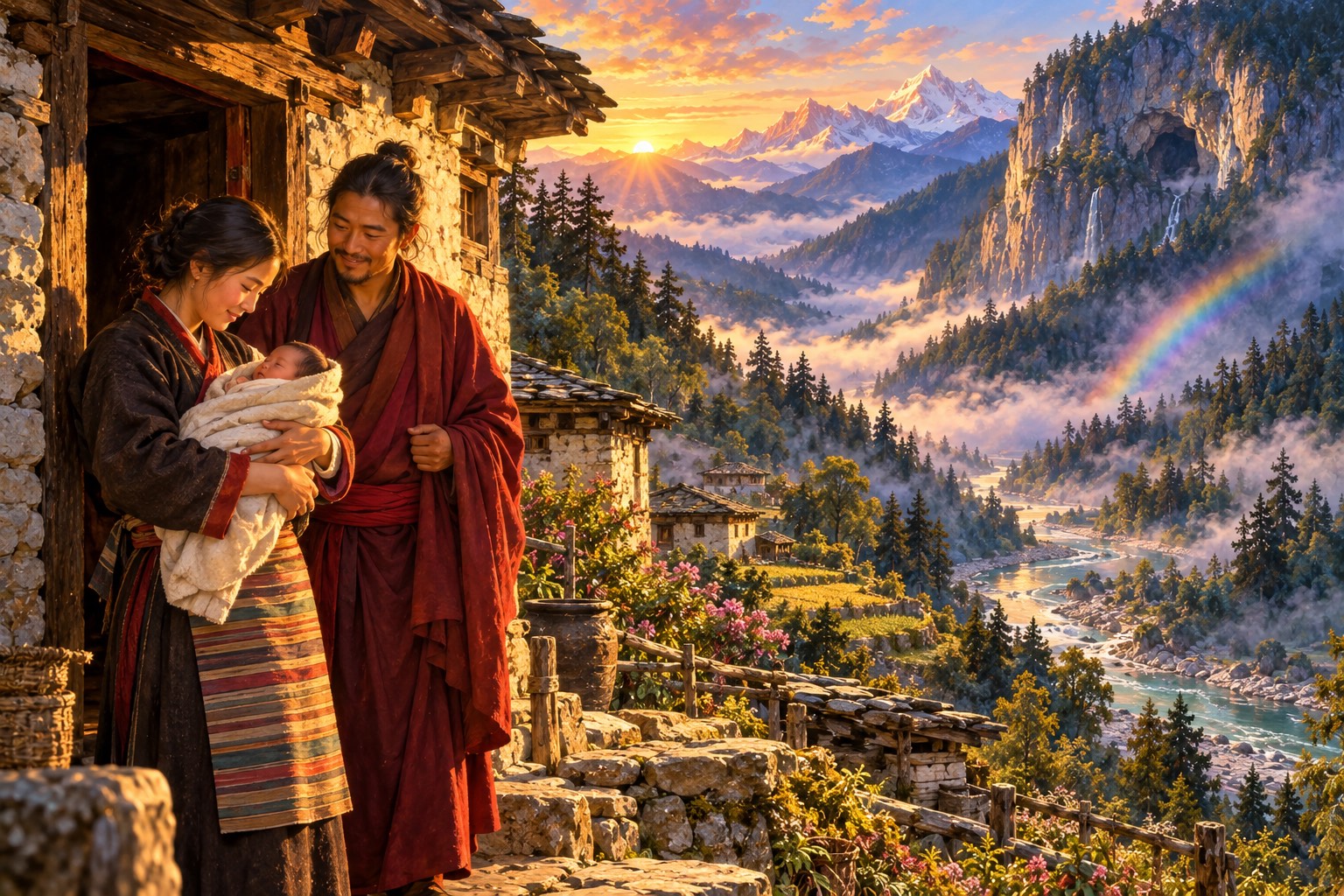
Kongtrul's account says the birth came with wondrous signs. It names his father, a yogi called Taklung Nyönpa, and his mother, Ahüm Gyen, and it treats both parents as touched by blessing. The baby was named Rigdzin, "awareness-holder."
The tradition also remembers him as the rebirth of Prince Yeshe Rolpa Tsal, second son of King Trisong Detsen, the eighth-century king who invited Guru Rinpoche to Tibet. In this way of seeing, the child had been present long ago when the treasures were hidden.
At five, Kongtrul writes, he took the vows of a lay Buddhist from an abbot named Zhönnu Pal. He is said to have had a pure vision of Avalokiteshvara, the bodhisattva of compassion, and to have learned to read and write almost as soon as he was shown the letters.
A hard childhood
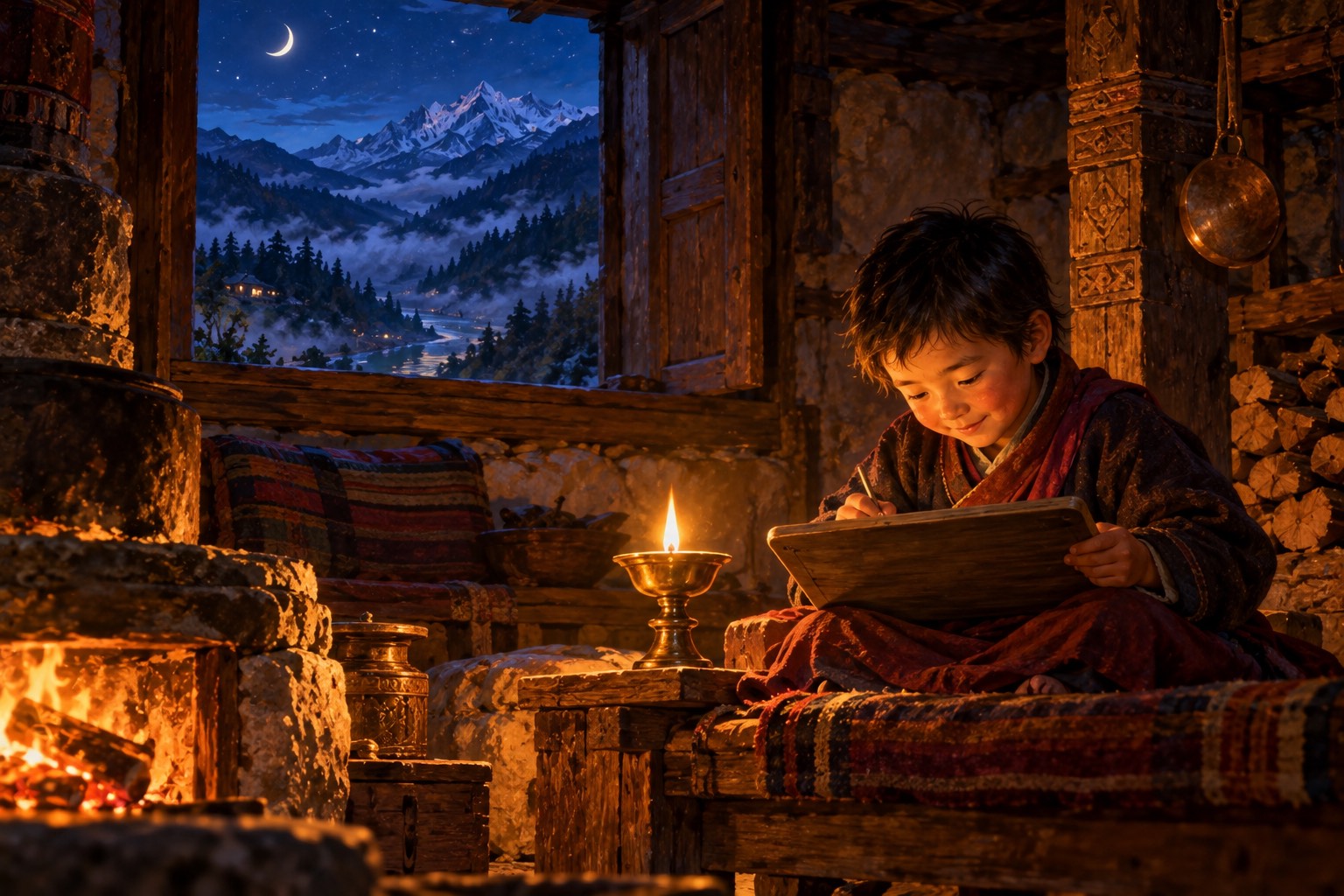
Then his father died. His mother married again, and Kongtrul says plainly that the stepfather was hostile to the boy. It is one of the few places where these old lives let us see an ordinary sorrow.
While he was in that distress, the account says, a woman dressed in red spoke a prophecy that told him where to go. The tradition often understands such figures as dakinis, wisdom women who appear at the turning points of a practitioner's life.

He went to Longpo, where the Fourth Karmapa, Rolpe Dorje, was staying. The Karmapa was the head of the Karma Kagyu, one of the great teaching lineages of Tibet, and, as later summaries of his life note, he had been born in the very same year as Sangye Lingpa.

Robes, and a blessing
Near Tsari, a holy mountain on Kongpo's southern edge, at a monastery called Jangchub Ling, the boy was ordained as a monk by the abbot Jangchub Dorje and the master Shakya Yeshe. They named him Sangye Zangpo, "Excellent Awakened One," and he received many teachings from them.
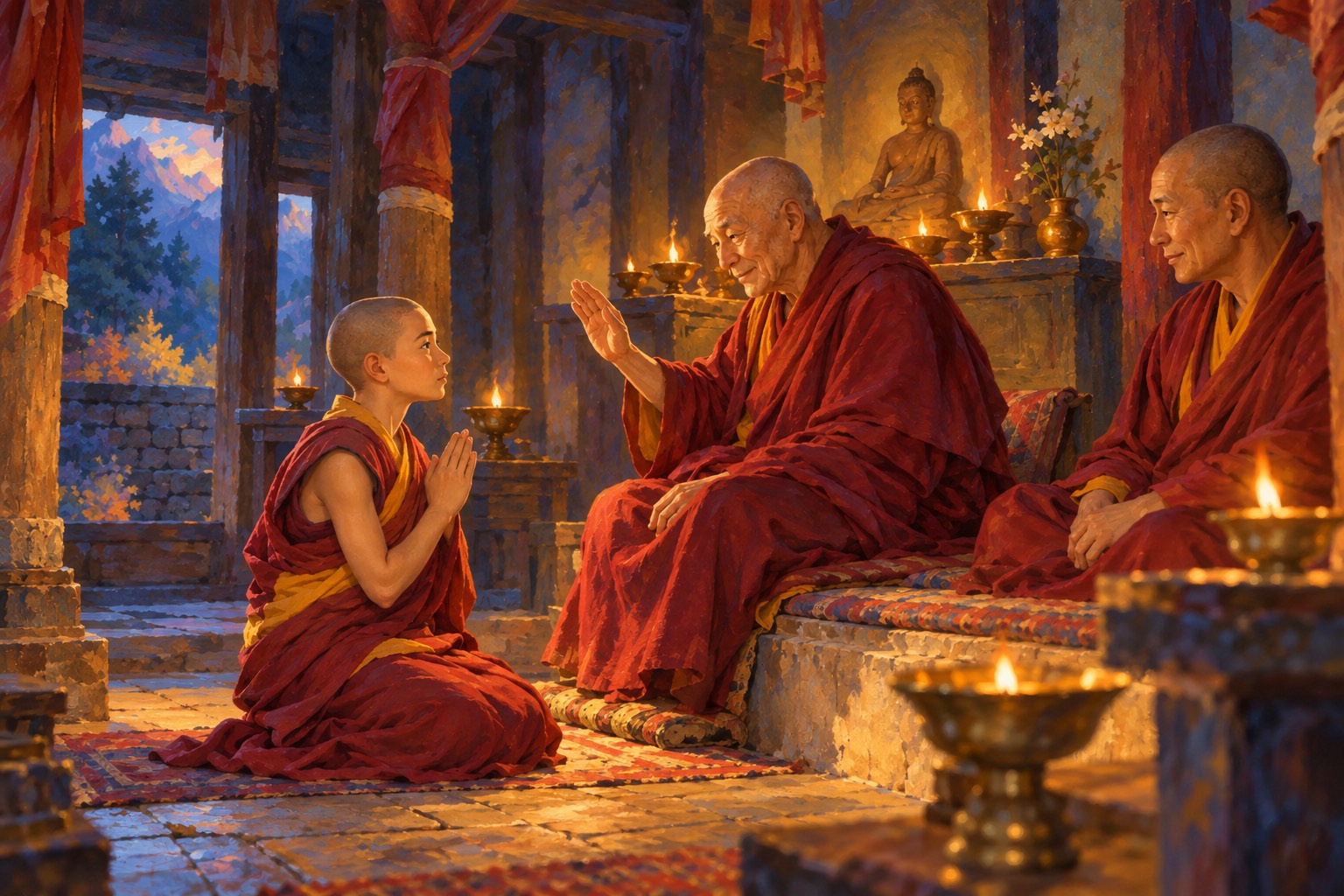
Kongtrul tells a small, warm story here. When the Karmapa came back from central Tibet, he asked Jangchub Dorje to give him this young nephew of his, and the lama did. The Karmapa was delighted, the account says, and foretold that the young monk would one day guide many beings.
The sources picture the bond from both sides. Kongtrul shows the Karmapa as the boy's early guide and later names him the foremost holder of Sangye Lingpa's treasure, and the Treasury of Lives lists Rolpe Dorje among Sangye Lingpa's students. The two were the same age, and in time the blessing seems to have flowed both ways.
On a visit to Lhasa, the accounts say, he saw Avalokiteshvara and, above all, Guru Rinpoche, not once but again and again. Afterwards he vowed to spend three years in retreat.
Three scrolls in the night
After his abbot died, he went to Tsari to study with a master named Chökyi Lodrö and became his close disciple. One night, while his teacher was away, Kongtrul says, a guardian of the treasures placed three paper scrolls in his hands: a list of hidden treasures, a prophecy, and advice on how to bring them out.
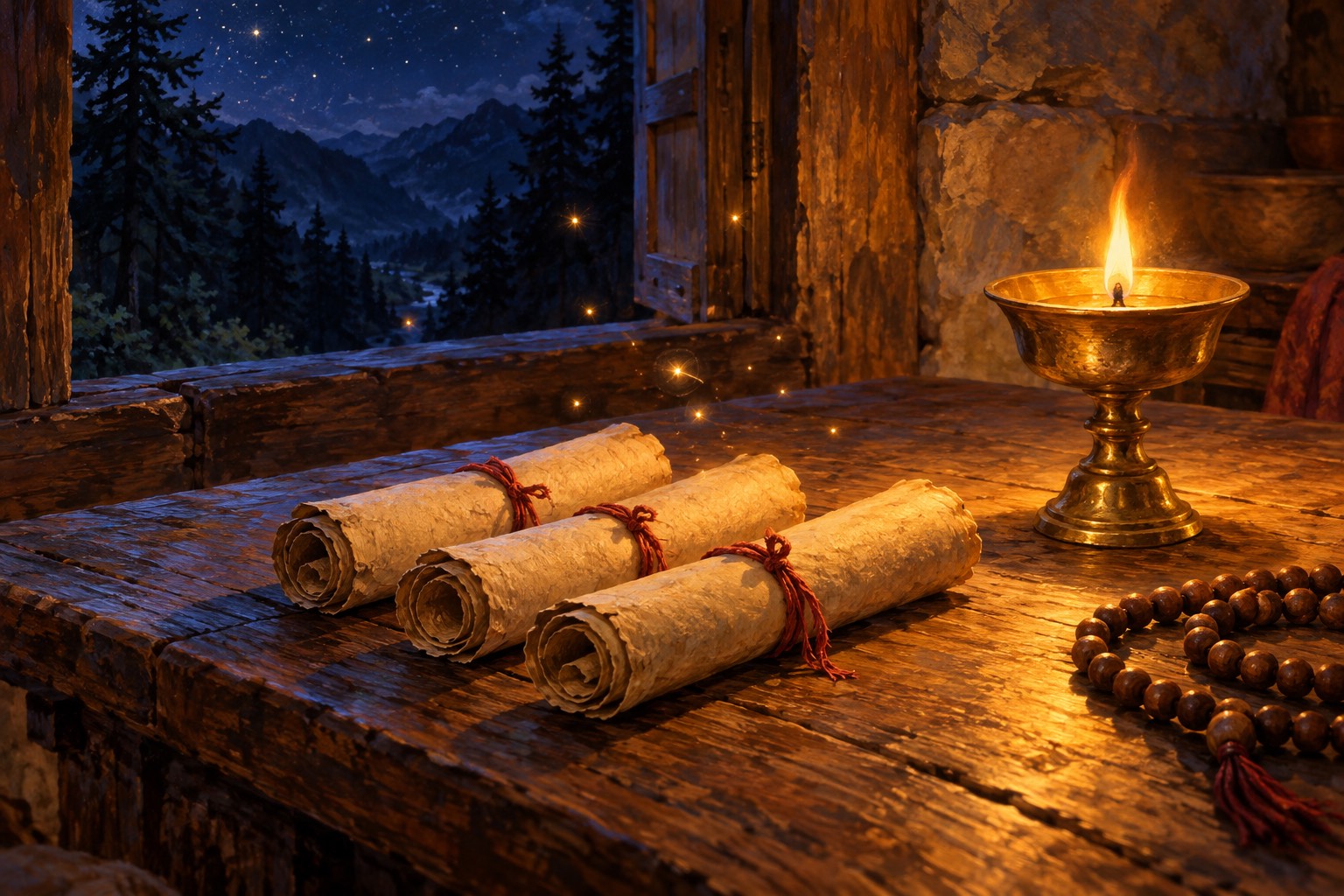
When his teacher returned, he did not wave this away. He gave the young man what he would need and let him go ahead, carefully and in the proper way.
The cave at Puri
On the twenty-fifth day of the first autumn month of 1364, when he was twenty-five, Sangye Lingpa went to the great cave of Puri. Kongtrul calls it Puri Phukmoche, "the Great Cave of Puri"; Himalayan Art Resources names the site Puri Rinchen Barwa, "Blazing Jewel." One dictionary places Puri in Puwo, the forested district just east of Kongpo. The names may belong to one place or to neighbouring ones, so I have kept both.
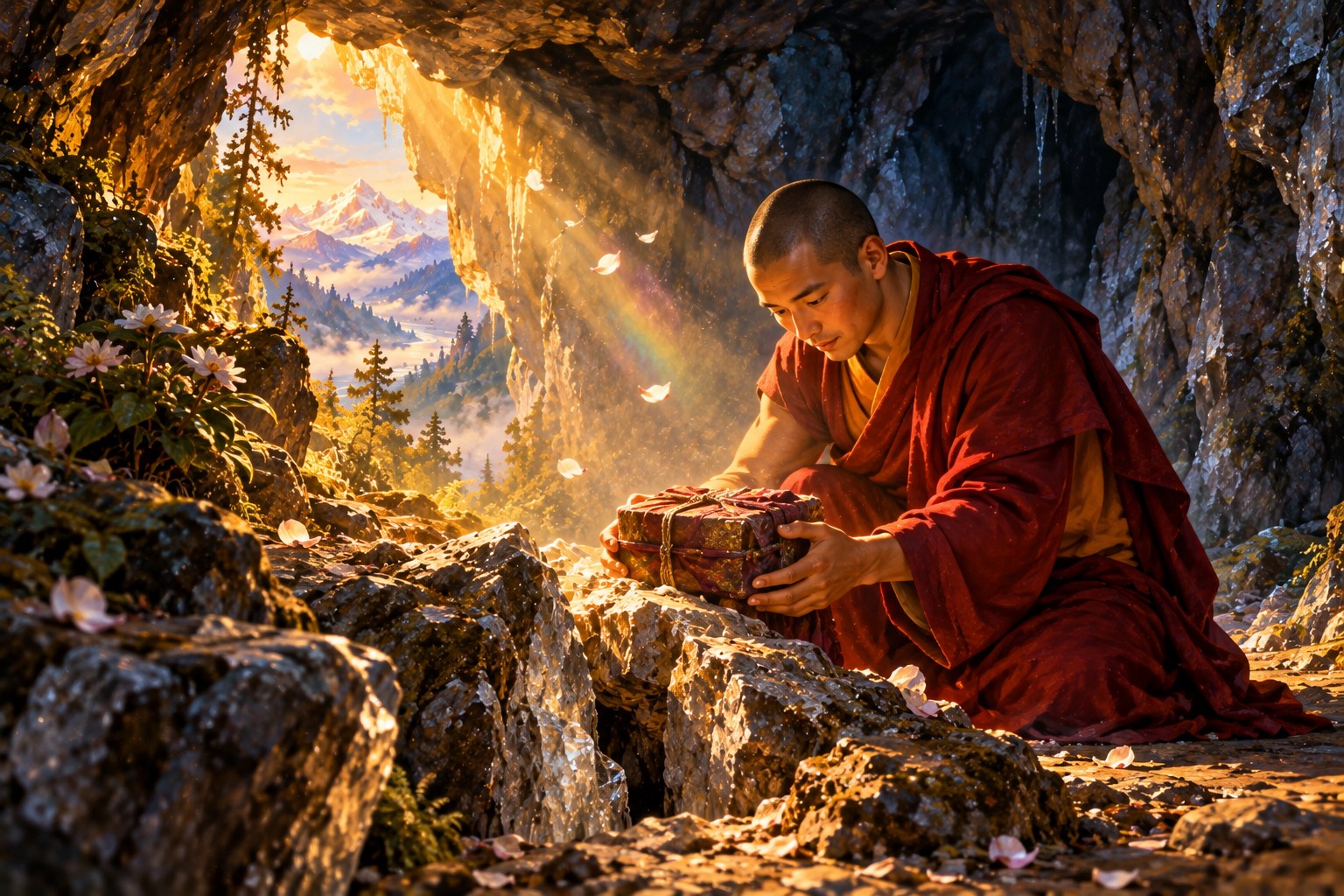
From the cave he brought out the Lama Gongdü with its key instructions, together with teachings on Avalokiteshvara. The name means something like "the gathering of the guru's intentions": a vast cycle in which Guru Rinpoche, the guru himself, stands at the centre. It is meant to be received from a qualified teacher, so this page names it and says nothing of its practices.
He offered it first to his teacher, Chökyi Lodrö, who received it with joy and, Kongtrul says, became its first holder.

The accounts say that over the next seven years he found eighteen major treasures and countless smaller ones, in Kongpo, at Tsari and at Chimphu above Samye. They also tell of rains of flowers, tents of rainbow light, the sound of music, and dakinis showing themselves. These are the tradition's ways of saying how precious those moments were.
One of the treasures was the Kathang Sertreng, the "Golden Garland Chronicle": a long life of Guru Rinpoche, the Lotus-Born, in more than a hundred chapters of verse and prose. Tradition says Yeshe Tsogyal wrote it down and hid it, and that it too came from the crystal cave at Puri.
A garland of teachers
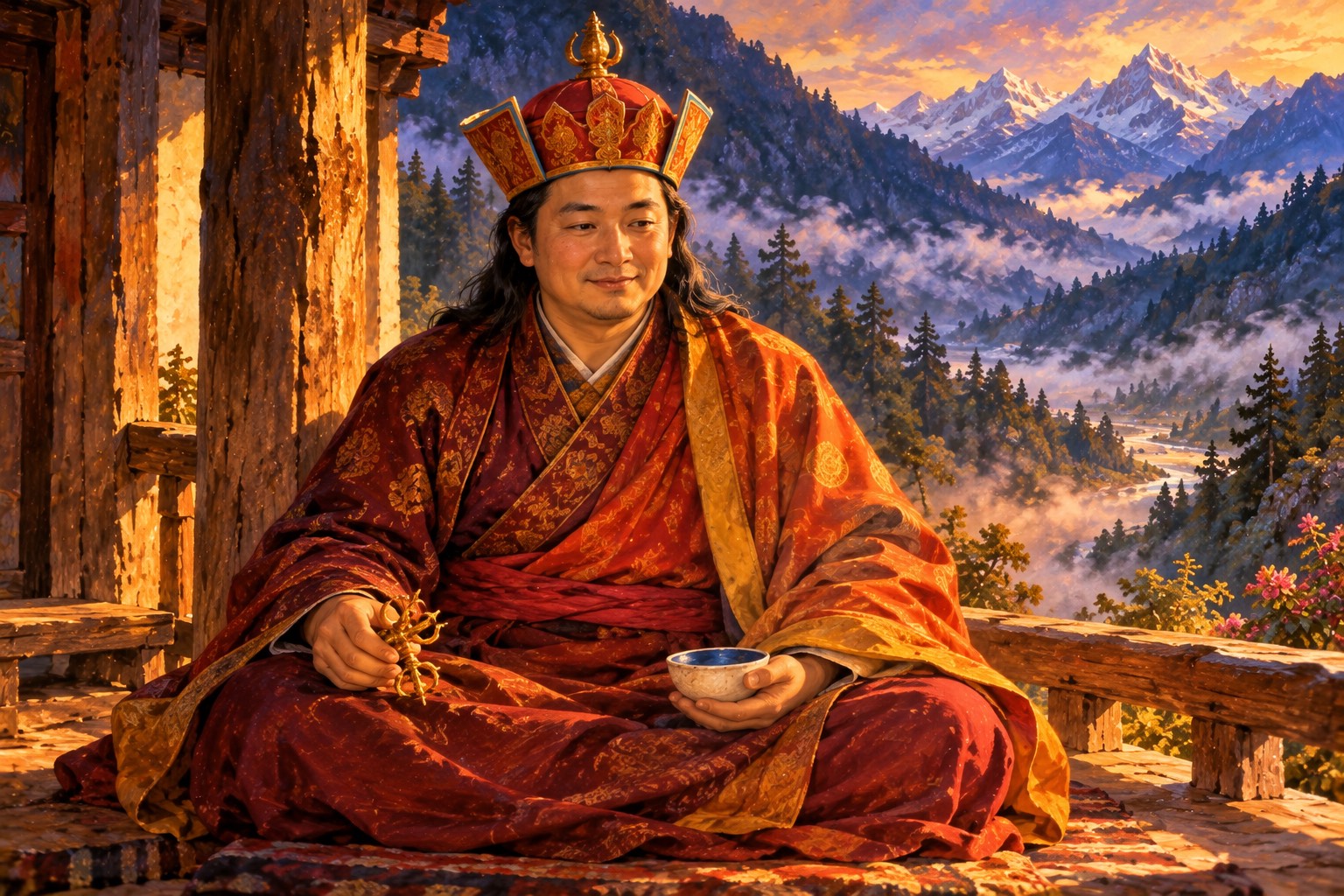
Sangye Lingpa founded a monastery called Nyimphu Dechen Samdrub as his seat. Portraits made long afterward show him seated in a tall hat, his hair falling to his shoulders, with a small vajra in his right hand. The vajra is a ritual sceptre that stands for what cannot be broken.
The Lama Gongdü spread quickly. Kongtrul says it flowed in some twenty great streams of transmission. Among its holders he names the Fourth Karmapa himself, the Second Shamarpa, another great Karma Kagyu lama, the Phagmodru ruler who then governed central Tibet, and the Sakya master Lama Dampa Sönam Gyaltsen. His son Yeshe Dorje and his chief disciple, Jakhyungpa Palden Senge, carried it on.
Kongtrul also passes on a story that it reached China. When the Ming emperor invited the Fifth Karmapa, Dezhin Shekpa, he is said to have asked for a pure treasure teaching of Padmasambhava, and the Karmapa brought him the Gongdü.
Sangye Lingpa died in 1396, aged fifty-seven by Tibetan reckoning, at Jangchub Ling, the monastery where he had first put on robes.

In the later collections
The cycle lived on, though not always easily. Rigpa Wiki notes that by the nineteenth century its practice had faded, and that Jamyang Khyentse Wangpo, Chokgyur Lingpa and Jamgön Kongtrul held great group practices to renew it. Kongtrul placed it in the Rinchen Terdzö, his vast collection of the treasure teachings, and wrote the life story this page mostly follows. The Treasury of Lives counts it among his own main practices.
Rigpa Wiki adds that it is still kept in parts of Bhutan, and that the fourth Dodrupchen Rinpoche, regarded as an incarnation of Sangye Lingpa, began holding a great practice of it every three years at Chorten Monastery in Sikkim. Masters of the last century, among them Namkhai Norbu, are recorded as receiving it.
A prayer that is still spoken
From the Golden Garland comes a short prayer that Princess Mandarava, one of Guru Rinpoche's closest disciples, is said to have offered him. In the version by Samye Translations, published on Lotsawa House, she tells him again and again, "never do I tire of gazing" on you. It is a prayer of simple longing, and anyone may read it.
I found no source tying Sangye Lingpa to the Seven-Line Prayer itself, so I will not claim one. What joins them is simpler: both turn the heart toward Guru Rinpoche and ask for his blessing. If the Lama Gongdü itself calls to you, that is a door to open with a teacher, and the Find a Teacher page can help.
About the art
Sangye Lingpa is drawn from two portraits that agree with each other: a painting from Tashiding Monastery reproduced on Lotsawa House, and a modern line drawing on Himalayan Art Resources (item 66249). Both show a round-faced man with hair to his shoulders, a tall hat with stiff upturned flaps and a small vajra on top, a small vajra in his right hand resting on his knee, and a small bowl in his left hand. The colours of his red, orange and gold robes follow the painting. A seventeenth-century gilt statue on Himalayan Art Resources (item 202844) shows him differently, with the vajra raised at his chest and a small vase in his lap. In the scenes of his youth he wears no hat: first a village boy's plain robe, then the maroon and saffron robes of a young monk.
The vajra (dorje) is a small ritual sceptre with five curved prongs at each end, a symbol of what cannot be broken. Guru Rinpoche appears once, in his main form: the lotus hat with a half-vajra and a single vulture feather, the vajra at his heart, the skull cup holding a long-life vase, and the staff called the khatvanga resting in his left arm, all within a sphere of rainbow light.
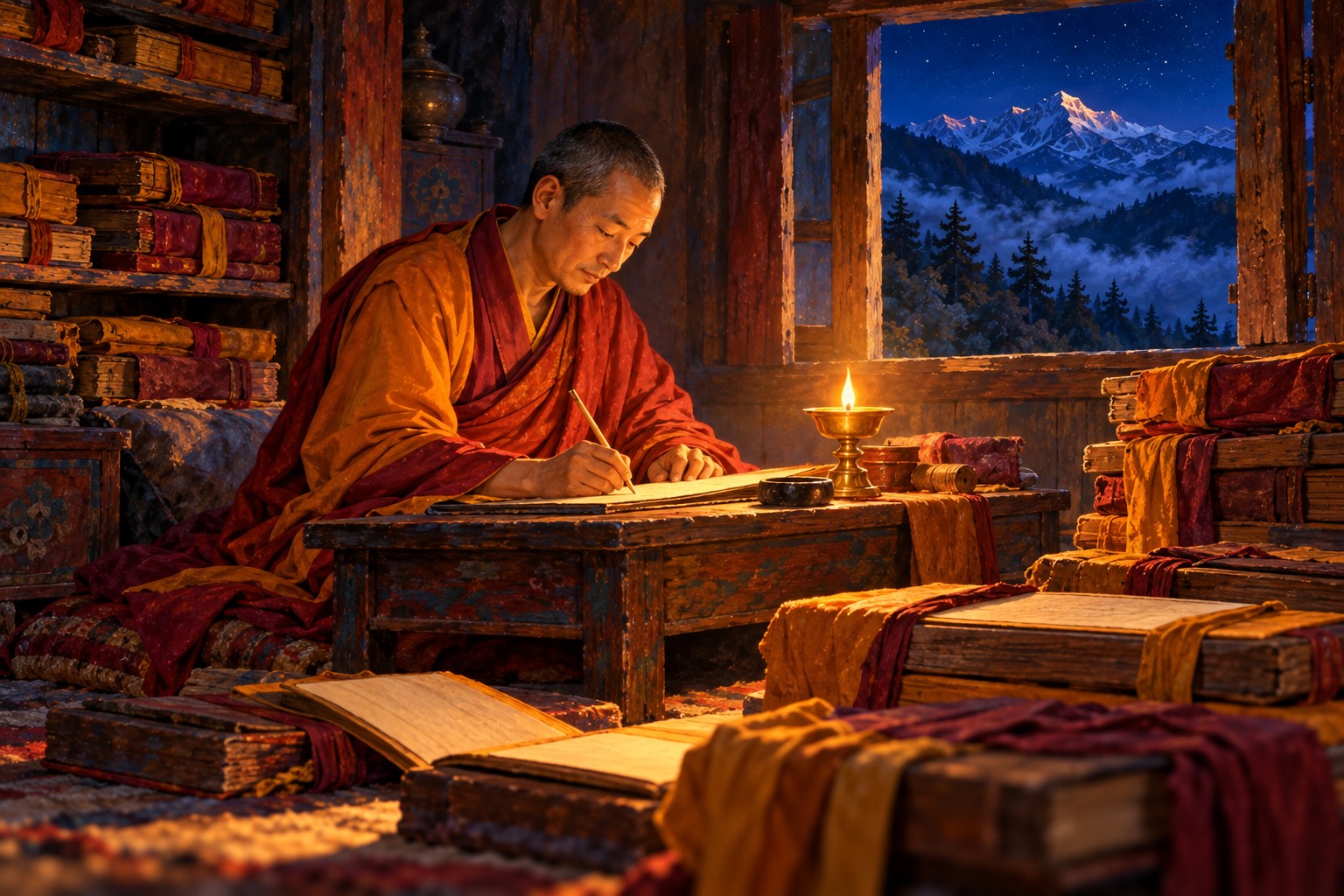
Kongpo is shown as it is: lower, wetter and far greener than central Tibet, with spruce, fir, old cypress and rhododendron forests and a clear green river. No photograph or description of the cliff and cave of Puri was available, so the crystal-veined cliff is a careful reconstruction based on the cave's name. Books are shown as Tibetan pecha, long loose leaves kept between boards and wrapped in cloth, and lamps as brass butter lamps on a stem. No writing appears anywhere, because this site never places script in its pictures. The practices of the Lama Gongdü are not pictured.
Why this matters for practice
The Lama Gongdü gathers everything around one figure, Guru Rinpoche, the same master the Seven-Line Prayer calls on, and its revealer's Golden Garland kept the story of the Lotus-Born alive for later readers. Sangye Lingpa's life also shows that the path can begin in grief and confusion: a boy who lost his father found his way, one guide at a time. You do not need a treasure to begin; reciting the prayer once is a way of turning toward the same blessing.

If something in this story stayed with you, perhaps the boy who lost his father or the three scrolls in the night, you might pause here and recite the prayer once. You do not need a cave or a treasure, only a moment and a willing heart.
Sources and further reading
- Sangye Lingpa, from Jamgön Kongtrul's Lives of the Hundred Tertöns (Rinchen Terdzö vol. 1, pp. 491–497), Tibetan text with Rangjung Yeshe summary, Tsadra Foundation, Khyentse Lineage wiki
- Sanggye Lingpa (person page), Treasury of Lives
- Sangye Lingpa; Lama Gongdü, Rigpa Wiki (via web.archive.org)
- Sangye Lingpa (author page); Princess Mandāravā's Prayer, Samye Translations (trans. Oriane Lavolé, ed. Libby Hogg), 2020, adapted 2024, Lotsawa House
- Lama Gongdu Terma Cycle (Main Page), Jeff Watt; Teacher: Sanggye Lingpa; items 202844 and 66249, Himalayan Art Resources
- Golden Garland Chronicles; spu ri phug mo che shel gyi brag phug, Rangjung Yeshe Wiki
- Sangye Lingpa (author page), Rangjung Yeshe Publications
- Kongpo, Wikipedia
This retelling is waiting to be read by a knowledgeable practitioner. Where the traditional accounts differ, the story says so; if you notice a mistake, please tell us through Share Your Story.