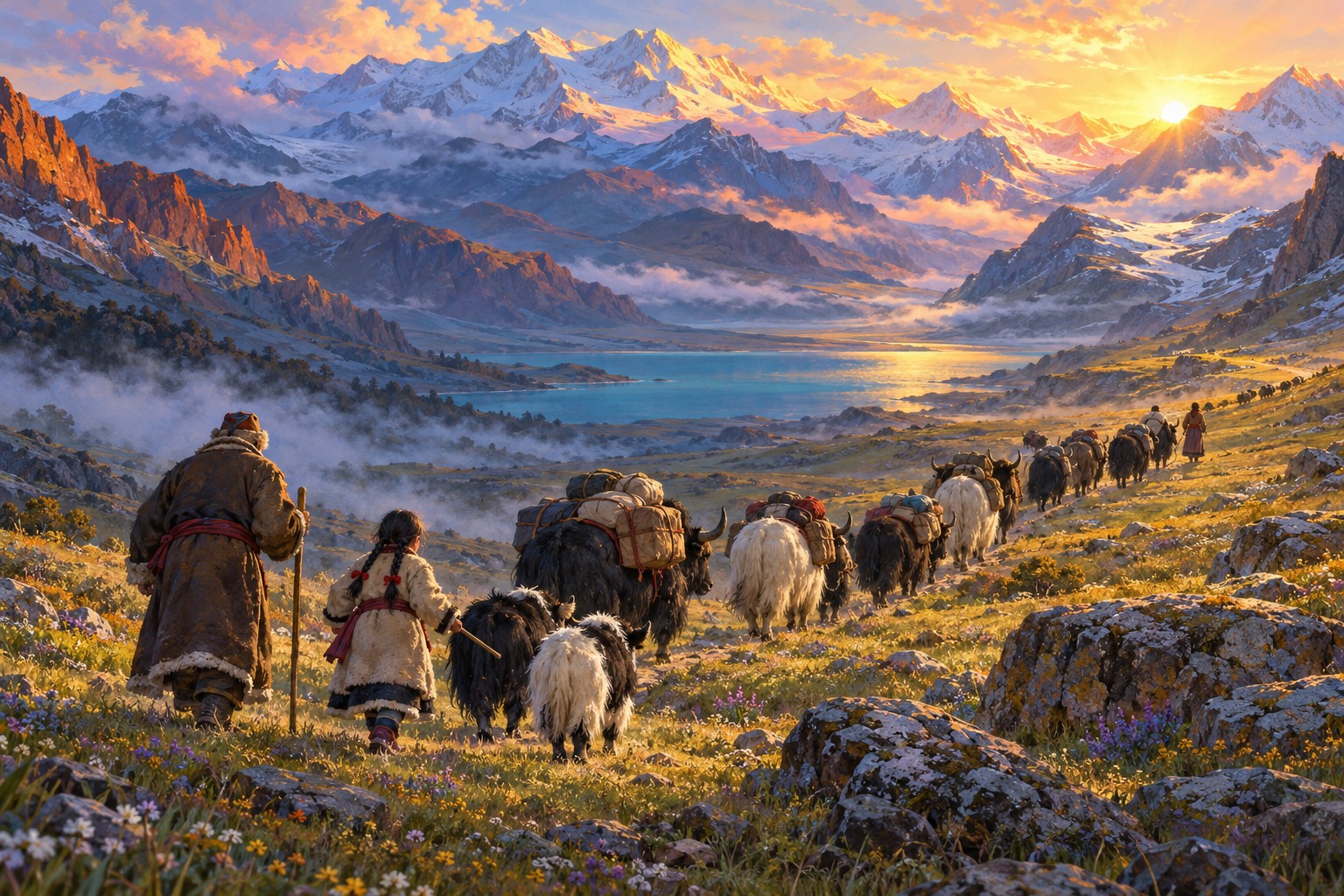
This is an original story, written for this site. It is fiction, not a teaching or a traditional account. Diego, his family and their house are invented. Phoenix, Dharamsala, the Beeline Highway and the rare snows outside Phoenix are real, and what is said about them and about the prayer comes from the sources listed below.
Never
Diego Tsering Wangdu was eleven and had never seen snow.
This was embarrassing, because he was half Tibetan, and Tibetans call their country Khawachen, the Land of Snows. Being half Mexican did not help: his mother's family came from Sonora, which is mostly desert too.
He lived with his dad in Phoenix, Arizona, in a small stucco house with a gravel yard and a lemon tree. Phoenix sits in the Sonoran Desert, and snow there is rare: the heaviest fall since records began in 1898 was a few inches in 1937.
 Illustration in preparation
His dad, Karma, fixed air conditioners. In Phoenix, Dad said, an air-conditioning man is like a doctor: people cry when they see you. Dad had grown up in Dharamsala, in the Himalayan foothills of north India, and had seen plenty of snow.
His mother lived two hours south in Tucson with his abuela, his stepdad and a baby sister who mostly shouted. His parents had split up when he was five, and got on better now than before.
Sundays
Diego's grandfather lived in McLeod Ganj, the upper part of Dharamsala, home since 1960 to the Tibetan government-in-exile, so full of Tibetans that people call it Little Lhasa. Diego called him Pola, Tibetan for grandfather. They had met in person once, when Diego was two, which Diego said didn't count.
Mostly they met on Sundays, on the tablet propped against the cereal box. Phoenix and Dharamsala are twelve and a half hours apart. Neither Arizona nor India changes its clocks in summer, so the gap never moves, and the half hour delighted Diego. “Pola lives in the future,” he said. “But only by a bit.”
Sunday breakfast in Phoenix was Sunday dinner in McLeod Ganj, which Pola found hilarious.
Illustration in preparationThat December, Pola said it was time Diego learned the Seven-Line Prayer: the prayer to Guru Rinpoche, the eighth-century teacher also called Padmasambhava, the Lotus-Born, whom Tibetans remember for helping Buddhism take root in their mountains. Dad had known it as a boy and admitted, from the stove, that it had gone rusty.
“One line every Sunday,” said Pola. “Seven Sundays. Then you have it.”
Diego wrote each line down as it sounded, in the only notebook on the table: his Spanish one.
Spanish
This was a mistake. Spanish and Tibetan got into the same notebook and caused trouble.
In the first line, which names where Guru Rinpoche came from, is the word nub, west. Diego heard nube, Spanish for cloud, and for a week believed Guru Rinpoche came from a cloud. “For Guru Rinpoche,” said Pola, “it is not the worst guess.” But it was west: the north-west of a land called Oddiyana.
The second line ends with a little word, la. In Spanish, la makes a word a girl. Here, Pola said, it means in: in the heart of the lotus. “And when we put la after a name, it makes it polite. Pola-la.” “Diego-la,” said Diego. “Too polite,” said Pola. “You are eleven.”
Illustration in preparationThe fifth line has mangpo in it, which means many: the many dakinis, female embodiments of enlightened energy, gathered round Guru Rinpoche. Diego heard mango. In Diego's head, Guru Rinpoche sat surrounded by fruit.
Seguir
In the third week of January, the Spanish homework was the verb seguir, to follow. Yo sigo, tú sigues, él sigue. That same Sunday, Pola reached the sixth line.
The sixth line is the wish to follow in Guru Rinpoche's footsteps. In it, Pola said, is a short word, jé: a trace, a track, the mark a foot leaves behind. Jé su means going after, in the tracks.
“Like seguir,” said Diego. “Exactly like seguir,” said Pola, who had never heard of seguir.
Diego wrote the sixth line under yo sigo. His Spanish teacher put a small, polite question mark beside it.
That weekend in Tucson, his abuela heard him practising jé su under his breath and asked, with some hope, whether he was learning about Jesús. No, said Diego, it means following. “Well,” said Abuela Licha, “that's good too.”
“But footprints in what?” Diego asked. In Phoenix the wind took everything.
“In snow,” said Pola, “you can see where everybody went.” Behind him, through his window, the snowy Dhauladhar mountains stood over McLeod Ganj. On the screen they were only a bright blur. It was the nearest Diego had ever been to snow.
Illustration in preparationSo Diego practised snow. He stood in front of the open freezer with his eyes shut until Dad told him he was air-conditioning the whole of Maricopa County.
Illustration in preparationThe seventh line, which asks Guru Rinpoche to come, ends with sol. Sol is Spanish for sun. A prayer ending with the sun seemed exactly right for Phoenix. Pola laughed until he coughed. In Tibetan, he said, sol is the respectful word for asking; it is even in the prayer's own name.
“So you end by asking,” said Diego. “Every time,” said Pola.
By the last Sunday in January, Diego could say all seven lines without the notebook, fast and a bit wrong in the middle, the way you say your own phone number.
The forecast
In February a cold storm rolled in. It rained all Thursday. On the news a weatherman said the snow level could come down to three thousand feet. Dad looked up from the sink and said nothing, which was suspicious.
At half past four on Friday morning he switched on Diego's light. “Shoes,” he said. “Real shoes. Two pairs of socks.”
Illustration in preparationThey drove north-east on the Beeline Highway, past Fountain Hills, towards the Mazatzal Mountains. In Phoenix, Dad said, snow does not wait for you. By lunchtime it would be gone.
Illustration in preparationThen the sky went grey, then pink, and the hills had changed colour. Above them all stood Four Peaks, the mountain that Phoenix sees on its eastern skyline, white from top to bottom. Lower down the snow lay on the boulders, the shrubs and the saguaros, the tall cactuses with upturned arms. Each one wore a white cap, like someone who had stepped outside without thinking and been caught.
Dad pulled into a wide gravel turnout. Half of Phoenix had had the same idea: children in shorts shrieking, and a man building a small snowman on the hood of his car to drive it home.
Snow
Diego got out. The cold went straight up his nose. He knelt and put both bare hands flat in the snow, and said nothing for so long that Dad got worried.
Illustration in preparation“It's wet,” Diego said at last. “Nobody told me it was wet.” “It's frozen water,” said Dad. “Yes, but nobody told me.”
It squeaked. It hurt his fingers in a good way and then in a bad way. He threw a snowball at Dad and missed, then hit. Dad threw one back, got him in the ear, said he was sorry and was not.
Illustration in preparationFootprints
Above the turnout the snow lay smooth and untouched. Diego walked up it slowly. Behind him he was leaving something he had never left in his life: footprints that stayed.
He looked back. Dad was coming up after him, setting his big work boots carefully into Diego's small prints, one by one. “It's easier,” said Dad. “Somebody already did the work.”
Illustration in preparationJé, thought Diego. Jé su. Going after, in the tracks. Yo sigo, tú sigues.
At the top of the rise he took out Dad's phone to call Pola. In McLeod Ganj it would be half past seven in the evening. There was one bar, then none.
Seven lines
So Diego said it for him anyway. He faced the white hills, with the sun just coming over Four Peaks, and said the Seven-Line Prayer, all of it, out loud: where Guru Rinpoche came from, the lotus, the wonderful accomplishment, the name, the many gathered round him, the wish to follow in his tracks, and at the end, the asking. He got the middle a bit wrong. He got the sol right.
Partway through he noticed a second voice, lower, a little behind his and a little rusty. Dad was saying it too. He had not said it aloud since he was a boy. He had followed Diego in.
Illustration in preparationNothing happened, the way nothing happens when the sun comes up. A saguaro dropped its white cap with a soft thump. Down by the cars a child shrieked with joy. That was all, and it was plenty.
Sol
Before they left, Diego packed snow into the lid of Dad's steel thermos to show Pola. The signal came back near Fountain Hills, and Pola's voice came warm and close from twelve and a half hours in the future. Diego held up the lid. It was full of water.
Illustration in preparationPola looked at it for a long time. “Very good snow,” he said gravely. Then Diego said the prayer again, with Pola this time, and Dad joining in from the driver's seat: three voices and a lot of road noise, right to the end, to sol.
By noon the snow was gone from the low hills. The prayer ended with asking. The sun was just a bonus.
About the art
This is an original story, written for this site; it is fiction, not a teaching or a traditional account. Diego, his father Karma and his grandfather Pola are invented, so the pictures show invented people, painted as gentle storybook figures and never as likenesses: small in the landscape, at mid-distance, from behind, as feet in the snow, and once in a close portrait of Diego in soft three-quarter view. The grandfather is never drawn at all. He appears only as the warm glow of a screen turned away from us, because what Diego sees on it belongs to him. Guru Rinpoche does not appear anywhere on the page, and nothing shown is a vision or a sign. No halo or rainbow light is used; the light is a Phoenix winter morning, a kitchen at night, the freezer, a rainy street before dawn and a desert sunrise on snow.
The places are real. The tall cactus with upturned arms is the saguaro, which grows in the Sonoran Desert from sea level up to about 4,500 feet, so in a rare cold storm the snow can settle on its arms. The mountain with four summits on the skyline is Four Peaks, in the Mazatzal Mountains east-north-east of Phoenix, which wears snow in many winters; the road is the Beeline Highway, State Route 87. The hill town under the snowy wall of the Dhauladhar range is McLeod Ganj, above Dharamshala in northern India, painted from a distance with no temples or flags so that it stays simply a place where someone's grandfather lives. Following the site's rule against text in images, there are no road signs, licence plates, notebook pages, packets or readable screens anywhere.
No prayer beads, butter lamps, prayer flags, statues or sacred pictures appear. Diego recites standing in the snow with his hands at his sides, and his father with his hands in his pockets. The footprints in scene 11 are the story's picture of the sixth line: one person's tracks, and another's set carefully inside them.
Why this matters for practice
The sixth line of the Seven-Line Prayer is the wish to follow in Guru Rinpoche's footsteps, and the Tibetan words for it speak of going after, in the tracks. In this story following runs in more than one direction: a boy follows his grandfather's voice line by line, and then a father who had let the prayer go rusty follows his son back into it, boot into sneaker print. This story is fiction, and nothing in it is a reward or a sign; the snow was going to melt by noon whatever anyone said. You do not need to get every word right to say the prayer once, and sometimes someone is following you in.
If something in this story made you smile, you might recite the prayer once today, even if you get the middle a little wrong, and let someone follow you in.
Sources and further reading
- Seven-Line Prayer (topic page), Lotsawa House
- Seven Line Prayer, Rigpa Wiki (via web.archive.org)
- Land of Snows, Rigpa Wiki (via web.archive.org)
- Dakini, Rigpa Wiki (via web.archive.org)
- Climate of Phoenix, Wikipedia
- Arizona State Route 87, Wikipedia
- Four Peaks, Wikipedia
- Mazatzal Mountains, Wikipedia
- Saguaro, Wikipedia
- Time in Arizona, Wikipedia
- Indian Standard Time, Wikipedia
- McLeod Ganj, Wikipedia
- Dharamshala, Wikipedia
- Dhauladhar, Wikipedia
This retelling is waiting to be read by a knowledgeable practitioner. Where the traditional accounts differ, the story says so; if you notice a mistake, please tell us through Share Your Story.