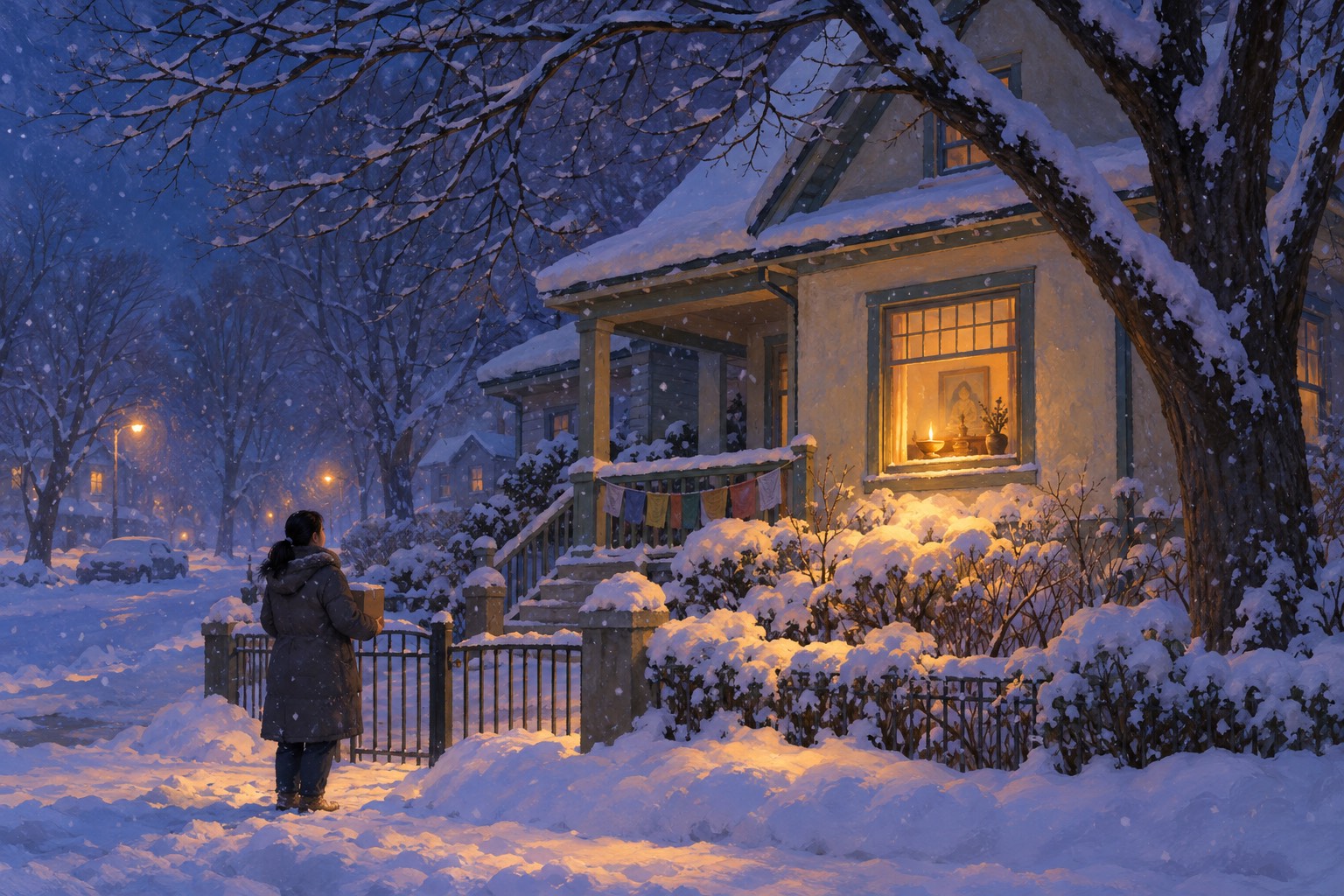
This is an original story, written for this site. It is fiction, not a teaching or a traditional account. Lhakdon, her parents, her son, her friends and both restaurants are invented. Kathmandu, Thamel and the Seven-Line Prayer are real, and what is said about them comes from the sources listed below.
The room on the lane
In 1984 Thamel was a tangle of narrow brick lanes in the north of Kathmandu, still half an old Newar neighbourhood and half something new. The hippie travellers of Freak Street had mostly gone. Trekkers had come instead, with their boots, their maps and their enormous appetites.
Paljor's restaurant had four tables, one window and no name anyone could remember. He had come out of Tibet as a young man, one of the more than twenty thousand Tibetans who reached Nepal in the years after 1959, and had worked at many things before this one.
His wife, Tsamchoe, made the momos, small steamed dumplings, at a speed that made trekkers stop and stare. “Tibetan,” she told the Newar lady from the house opposite, every time. “Newar,” said the Newar lady. People still argue about which way the momo travelled across the mountains, so neither of them ever had to lose.
 Illustration in preparation
Their daughter, Lhakdon, was fifteen, and she waited the tables. She was quick, she was good at it, and she was mortified by almost everything her parents did.
The radio
On a high shelf above the counter sat a radio with a fabric front and a dial that glowed amber. All evening it played Radio Nepal, the state station, on the air since 1951: news, announcements, and the modern Nepali songs that Lhakdon and her friends knew by heart, Narayan Gopal's voice drifting out through the steam.
At about nine the last trekker paid. Tsamchoe stacked the bowls. Lhakdon wiped the four tables with a wet cloth and then dried them. And Paljor reached up and switched off the radio, whatever it was in the middle of.
Illustration in preparationClick. The song stopped halfway through a word. The steamer ticked as it cooled. And the three of them stood among the clean tables and said the Seven-Line Prayer together, once.
Seven lines
The prayer is addressed to Guru Rinpoche, the Lotus-Born, the teacher Tibetans remember for bringing the Buddha's teaching to Tibet in the eighth century. It was first revealed in the thirteenth century by a master called Guru Chökyi Wangchuk, and it has become one of the best-loved and most widely chanted prayers to him, the one most commonly used in the Nyingma tradition.
Its seven short lines say where he came from and how he was born in a lotus. They speak of what he attained and give his name. They picture the dakinis, female figures of wisdom, gathered around him, and wish to follow where he went. The last line asks him to come and bless.
Illustration in preparationPaljor said it in a low, unhurried voice, facing the room, not the wall. Tsamchoe said it with her hands still floury. Lhakdon said it to the window, fast and half under her breath, and hoped nobody passing in the lane could hear.
Saturday
One Saturday in October her friends came to call for her: Sarita, whose Newar family lived three houses down, and Ongmu, who had the best laugh in the neighbourhood. They were going to sit on Sarita's roof and listen to the radio until somebody's mother sent them home.
They reached the door just as Paljor reached up. The song that went off was their favourite song.
Illustration in preparationHe did not stop. He did not even glance at the door. He simply began, and Tsamchoe joined in, and Lhakdon stood between the tables with her face on fire and said the seven lines faster than she had ever said anything.
Illustration in preparationOut in the lane afterwards, Ongmu said, “Your father is so serious.” Lhakdon said it was just a thing he did, an old thing, a village thing. Sarita said nothing at all, and Lhakdon was too busy being embarrassed to notice.
Why here?
The next morning she found her father on the roof among the drying chillies, with his tea. Why, she asked, did they have to do it downstairs, in the restaurant, in front of anybody who happened to walk in? Why not upstairs, like a normal family?
Illustration in preparationPaljor thought about it for longer than she liked. “The day happens down there,” he said at last. “So that is where I close it.”
“Close it how?”
He shrugged. “I don't know what it does. I only know what it feels like to lock the door without it.” Lhakdon rolled her eyes so hard she nearly fell off the roof, and went downstairs to fold napkins.
Far away
At nineteen she left for a job in a hotel kitchen in Delhi. After that came other kitchens, a husband, a son, and in 2001 a flight to Melbourne, where Tibetans are one small community among very many. In time the restaurant on the lane was sold, and her parents retired to a flat near Boudha, where the Tibetan neighbourhood had grown up around the great stupa and its many monasteries.
Illustration in preparationBy 2015 Lhakdon had a place of her own: a dumpling kitchen with eight tables on a busy street in Melbourne's inner west. Above the sink stood a small radio, because a kitchen without one felt too quiet. Her momos were very good. Her mother, on the phone, said they were nearly as good as hers.
Closing time
Illustration in preparationIt was a wet Tuesday in June, winter in Melbourne, with rain running down the front window. The last customers left at ten. Her helper went home. Lhakdon put the chairs up, wiped the eight tables and dried them, and reached up and switched off the radio in the middle of a song.
Illustration in preparationClick. Rain. The fridge humming. And into the quiet, before she had thought about it at all, came her own voice saying the first line of the Seven-Line Prayer: low, unhurried, at exactly her father's pace.
She stopped at the third line and laughed out loud in the empty room. Then she started again from the beginning and said all seven lines through, facing the tables where strangers had eaten all day.
Illustration in preparationShe understood it then, the way you understand a recipe only after your hands have made it a hundred times. It had never been for the people in the doorway. Every night, with that last line, her father had been asking for a blessing on the plainest room in Kathmandu: four tables, a steamer and a radio. The day had happened there, so that was where he closed it.
She thought of Sarita, too, saying nothing in the lane, and wondered for the first time whether her friend's family had their own way of ending the day.
The doorway
When she turned round, her son Rabten was standing in the doorway with his headphones round his neck, come to walk her to the car. He was fifteen. He was carefully looking at the ceiling.
She did not explain. He held the door and said, “Ready?” in a voice so exactly like her own at fifteen that she had to look away to keep from laughing.
Illustration in preparationEarly evening in Kathmandu
At home she rang her father. In Kathmandu it was early evening. He was on the roof of the flat with his tea, he said, and her mother had fallen asleep in front of the television.
She told him. There was a long pause on the line, and then he laughed, a big, delighted laugh she had not heard in years. “Did the tables mind?”
Illustration in preparationShe asked him whether he had always known she would do it one day. “No,” he said. “I didn't know anything. I only did it.” Then he admitted that at nine o'clock every night he still says it, standing in the sitting room. “Your mother says I am closing a restaurant that was sold ten years ago.”
The next night Lhakdon said the prayer again at closing. The night after, she forgot. She does not know yet what sort of habit it will become, and nobody has promised her anything. But she knows now how her father closed the day, and why.
About the art
This is an original story, written for this site; it is fiction, not a teaching or a traditional account. Lhakdon, her parents Paljor and Tsamchoe, her friends Sarita and Ongmu and her son Rabten are invented and modelled on no one, so the pictures show invented people, painted as gentle storybook figures and never as likenesses: at mid-distance among the tables, small in a doorway or a lane, from the side or behind, as a single hand on a radio, and twice, Lhakdon at fifteen and at forty-six, in a soft three-quarter close portrait with her eyes lowered or closed. Lhakdon is drawn at two ages with the same round face and high cheekbones so that readers can recognise her across thirty years, and her father likewise at forty-six and at seventy-seven.
Guru Rinpoche does not appear anywhere on the page, not as a picture, statue or vision, and no figure has a halo or rainbow light. There are no shrines, butter lamps, prayer beads, prayer flags or prayer wheels in any picture; a real family would very likely keep a small shrine upstairs, and it is simply out of frame. When the family prays, they stand among the wiped tables with their palms quietly together or their hands folded, facing the room, which is the point of the story. The prayer lives only in the text.
Following the site's rule against writing in images, there is none anywhere: no signboards, menus, price lists or calendars in either restaurant, no labels on tins or bottles, no number plates, and both radios have a plain glowing dial window with no numbers or markings. The two radios, an old transistor set in 1984 and a small modern one in 2015, are drawn in matching close-ups (scenes 3 and 10) so that the same gesture can be seen on two sides of the world. Thamel is drawn as old red-brick houses with carved wooden windows in the Newar style, as it largely was before the tourist boom; the restaurant, the Melbourne street and both roofs are invented. In the last picture the great stupa of Boudha is deliberately left out of frame, so that its painted eyes do not appear.
Why this matters for practice
The seventh and last line of the Seven-Line Prayer asks Guru Rinpoche to come and bless. In this story a father makes that request every night over four wiped tables, not in a temple but in the room where the day's work happened, and his daughter only understands why when her own hands have done a day's work in a room of her own. It is fiction, and it promises nothing: the prayer does not change the restaurant, and Lhakdon does not know what kind of habit it will become. One recitation, at the end of an ordinary day, is enough to begin.
If something in this story brought back a kitchen, a shop or a room where someone you love ended the day in their own way, you might, when your own work is done tonight, switch something off and recite the prayer once.
Sources and further reading
- Seven-Line Prayer (topic page), Lotsawa House
- Seven Line Prayer, Rigpa Wiki (via web.archive.org)
- Thamel, Wikipedia
- Freak Street, Wikipedia
- Hippie trail, Wikipedia
- Refugees in Nepal (Tibetan refugees in Nepal), Wikipedia
- Kathmandu, Wikipedia
- Radio Nepal, Wikipedia
- Momo (food), Wikipedia
- Tibetan diaspora, Wikipedia
This retelling is waiting to be read by a knowledgeable practitioner. Where the traditional accounts differ, the story says so; if you notice a mistake, please tell us through Share Your Story.