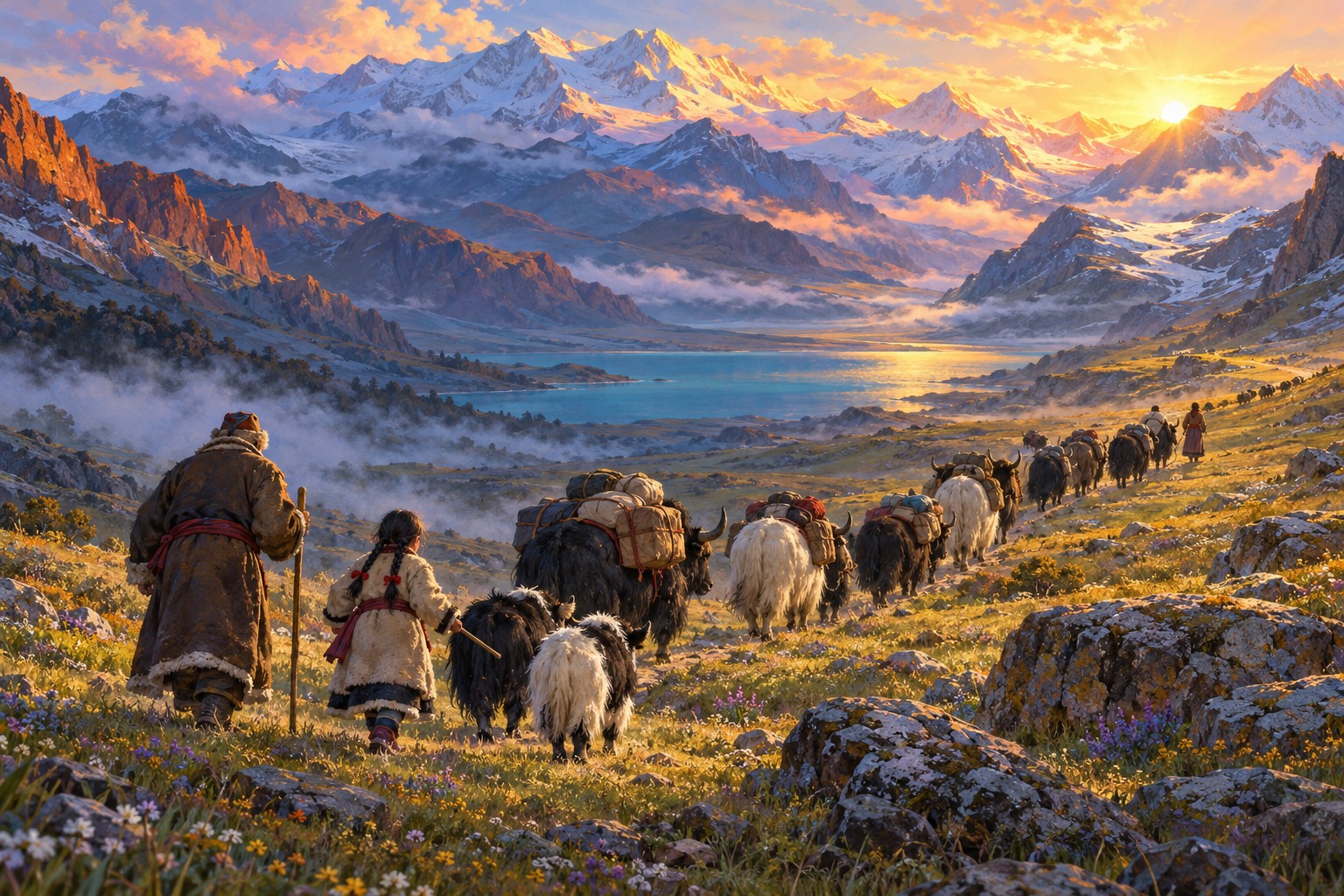
This is an original story, written for this site. It is fiction, not a teaching or a traditional account. Kelsang, Kunchok and their family are invented, and so is their journey, though it follows the shape of many real ones. The departures from Tibet in 1959, the crossing of the Himalaya and the Tibetan community of Dharamsala are real, and what is said about them and about the prayer comes from the sources listed below.
The rain
In Dharamsala the monsoon does not so much fall as move in. It comes up the Kangra Valley in grey walls, swallows the whole Dhauladhar range, and stays from June until the middle of September. Some years it brings close to three metres of rain.
On the Saturday of this story it had rained since breakfast. At two o'clock the power went off, and the wifi went with it.
Kunchok was eleven, and he took it personally. He lay across his grandmother's bed with his dead phone on his chest and announced, every few minutes, that there was nothing to do.
 Illustration in preparation
His grandmother, Kelsang, was seventy-four. He called her Mola, grandmother; the -la on the end is the small Tibetan word that makes a name respectful and fond at once. She lived in two rooms on the steep hillside below McLeod Ganj, the upper part of Dharamsala, which people call Little Lhasa because so many Tibetans live there. Popo-la, his grandfather, had gone down to the clinic about his knee and would be stuck there until the rain eased.
Mola made tea on the gas ring and watched him kick the wall, gently, with one heel. Then she said, “When I was seven, I walked to India.”
Kunchok said he knew. Everybody's grandmother had walked to India.
“Then you know the story,” said Mola. She blew on her tea, and waited.
Illustration in preparationHe held out for nearly a minute. “Fine,” he said. “How far?”
Leaving
She did not remember all of it, she said. Some of it was her mother's telling, repeated so often over the years that it had become her own. That is how old memories work, and she wanted him to know it.
Their village was in Lhoka, south of Lhasa: flat-roofed houses of stone and earth, barley fields, a stream with a willow over it. In March 1959 there was an uprising in Lhasa. Over that year and the next, some eighty thousand Tibetans left their country and crossed the Himalaya into India. Her family was among them.
“I didn't understand any of it,” said Mola. “I understood that my father was packing at night, and that we were not to say goodbye to anyone.”
They left before dawn: her father leading the yak, her mother with baby Pemba tied on her back, and Kelsang holding the end of her mother's sash. She looked back once at the house. She has not seen it since.
Illustration in preparationThe pass
For days they walked south, and up. Other families joined them on the trail; some went other ways. What Mola remembered most was the cold: a dry cold that came through her boots and through her chuba, the long wrapped Tibetan robe, and a wind that never stopped.
Illustration in preparationThen came the pass. She was too small to know its name, only that it went up and up into the white, and that the top kept not arriving. Halfway up, her legs stopped. She sat down on a stone and said she was not going any further.
Illustration in preparationHer mother did not argue. She crouched beside her in the wind and said, “Don't look at the top. Look at your foot. Put one line in each step.”
Then she began the Seven-Line Prayer to Guru Rinpoche, the eighth-century teacher also called Padmasambhava, the Lotus-Born, whom Tibetans remember for helping the Buddha's teaching take root in their land. Kelsang had heard it every morning of her life without really listening. Now she said it with her feet.
One step for where he came from, a far country called Oddiyana. One step for his birth in the heart of a lotus. One step for the wonderful things he attained, one for his name, one for the great company of dakinis, female figures of wisdom, gathered round him. One step for the wish to follow him, and one to ask him to come. Then back to the beginning.
“Seven steps,” said Mola. “Then seven more. You can't think about a whole mountain. You can think about one line.”
Illustration in preparationHer mother told her one more thing on that pass, between breaths. The prayer begins with where Guru Rinpoche came from, she said, because he came from far away too, and crossed great mountains to reach Tibet. “Now we are crossing them the other way.” Kelsang thought about that for a long time, one step at a time.
The room
Kunchok had stopped kicking the wall. At some point he had sat up, then pulled his knees in, and now his chin was resting on them. The phone had slid off the bed, and he had not picked it up.
“Did it work?” he said.
Mola thought about it properly. “My legs worked. My father carried me some of the way. The prayer didn't carry anybody.” She drank her tea. “It gave me something to hold that wasn't the cold.”
Illustration in preparationThe river
On the far side of the pass, she said, there was a river that came straight off the ice. It was wide, the colour of milky tea, and it roared.
There was no bridge. The men said it must be crossed at first light, when the water is lowest, because the sun melts the ice all day and by afternoon the river rises. So they slept beside it, and listened to it all night.
Illustration in preparationAt dawn everyone took hands in a long line, the strongest at each end. Her father had Pemba on his back now and the yak's rope in his other hand. Her mother held Kelsang. The water was so cold it did not feel like water; it felt like being bitten. It came up to her waist and pulled sideways.
Illustration in preparation“Say it,” said her mother, and they said it together, one line for each step on the stones under the water, which they could not see. In the middle, Kelsang lost her place and went back to the first line, and her mother went back with her, without a word.
Illustration in preparationOn the far bank everyone sat in a row and shook, and someone coaxed a fire out of the dried dung they had carried. Nobody had been taken by the river. Mola said it plainly, the way you say a thing you have been grateful for every day for sixty-seven years.
Down
After that the path went down and down, and then there were trees: a few twisted junipers first, then real forest, dripping and green and loud with birds, and air so thick she could taste it. Somewhere in that forest they came into India, though nothing marked it.
Illustration in preparationThe rest she told quickly, because it was another story: the hot lowland camps, where she had never imagined such heat; years of moving from place to place; hard work. Since 1960 Dharamsala has been home to the Tibetan government-in-exile, and in time her family came up here, to these wet green slopes under the mountains, and stayed.
The steps
By five the rain had thinned to a fine grey drizzle. Mola looked out of the window and said the shop at the top of the steps would close soon, and there was no milk.
Kunchok groaned, on principle. Then he got up. The house stood near the bottom of a long concrete stair that climbs the hill between the houses. He had never counted the steps; they were just there.
Halfway up, his legs began to complain, the way they always did. He did not look at the top. He looked at his foot, and put the first line in it, and then the second. He lost his place at the dakinis, and went back to the beginning, the way you are allowed to.
Illustration in preparationAt the top, the cloud had pulled back for a moment, and there was the Dhauladhar, dark rock streaked with white, the mountain that had been behind the rain all day. He looked at it for a while. Then he bought the milk.
When he came back down, he did not tell Mola what he had been doing on the stairs. But he put the milk on the table and said, “Seven steps. Then seven more.” She laughed, and put the tea on again.
About the art
This is an original story, written for this site; it is fiction, not a teaching or a traditional account. Kelsang, her parents, her baby brother, Kunchok and the other travellers are invented, so the pictures show invented people, painted as gentle storybook figures and never as likenesses. Kelsang appears twice over: as a seven-year-old girl in a small sheepskin-lined chuba, the long wrapped Tibetan robe, in 1959, and as a woman of seventy-four in present-day Dharamsala. Guru Rinpoche does not appear anywhere on the page, and nothing shown is a vision or a sign. No figure has a halo or rainbow light; the light is the weather's own: monsoon cloud with a rift of gold, a blue dawn over a village, dusk on a high pass, starlight over a glacial river, and morning in the forest.
The journey is drawn the way it is told, as a memory of weather and distance. There are no soldiers, weapons or pursuers in any picture; the dangers shown are the cold, the wind, the height of the pass and the river. The village has the flat-roofed, whitewashed stone and earth houses and bare March barley fields of the farming valleys of Lhoka in southern Tibet; the family travels with one black pack yak; the river is a braided glacial river, milky with ground rock, of the kind that rises through the day as the sun melts the ice, which is why it is crossed at first light. The forest on the south side of the mountains has mossy firs and rhododendron trees in spring flower. The small cairn of stones on the pass is the kind travellers add to as they cross.
The present-day pictures show the hillside below McLeod Ganj, the upper part of Dharamsala, in the monsoon, and the Dhauladhar ("White Range"), the dark granite wall streaked with white that rises above the town and is so often hidden in cloud. No real temple, monastery or residence is drawn. Following the site's rule against text in images, there are no signs, shop names, lettering or screens anywhere, and Kunchok's phone is always dark. No prayer beads, butter lamps, prayer wheels, statues or sacred pictures appear: the prayer in this story is said with the feet, one line to a step, and nothing else is needed for it.
Why this matters for practice
The first line of the Seven-Line Prayer names where Guru Rinpoche came from, a far country beyond the mountains, and in this story a mother on a high pass tells her daughter that he crossed great mountains to reach Tibet, just as they are crossing them the other way. This is fiction, and the prayer carries nobody over the pass or the river; legs, a father's back and a line of joined hands do that. What the prayer gives a cold, tired child is something to hold, one line to each step. You do not need a whole mountain's worth of faith to say it once; you need only the next line, and then the next.
If something in this story stayed with you, you might recite the prayer once, one line at a time, on the next stairs you climb, or whenever the top seems not to arrive.
Sources and further reading
- Seven-Line Prayer (topic page), Lotsawa House
- Seven Line Prayer, Rigpa Wiki (via web.archive.org)
- Padmasambhava, Rigpa Wiki (via web.archive.org)
- Tibetan diaspora, Wikipedia
- 1959 Tibetan uprising, Wikipedia
- Dalai Lama's escape from China, Wikipedia
- Tibetans in India, Wikipedia
- Buxa Fort, Wikipedia
- Shannan, Tibet, Wikipedia
- Chuba, Wikipedia
- Dharamshala, Wikipedia
- McLeod Ganj, Wikipedia
- Central Tibetan Administration, Wikipedia
- Dhauladhar, Wikipedia
This retelling is waiting to be read by a knowledgeable practitioner. Where the traditional accounts differ, the story says so; if you notice a mistake, please tell us through Share Your Story.