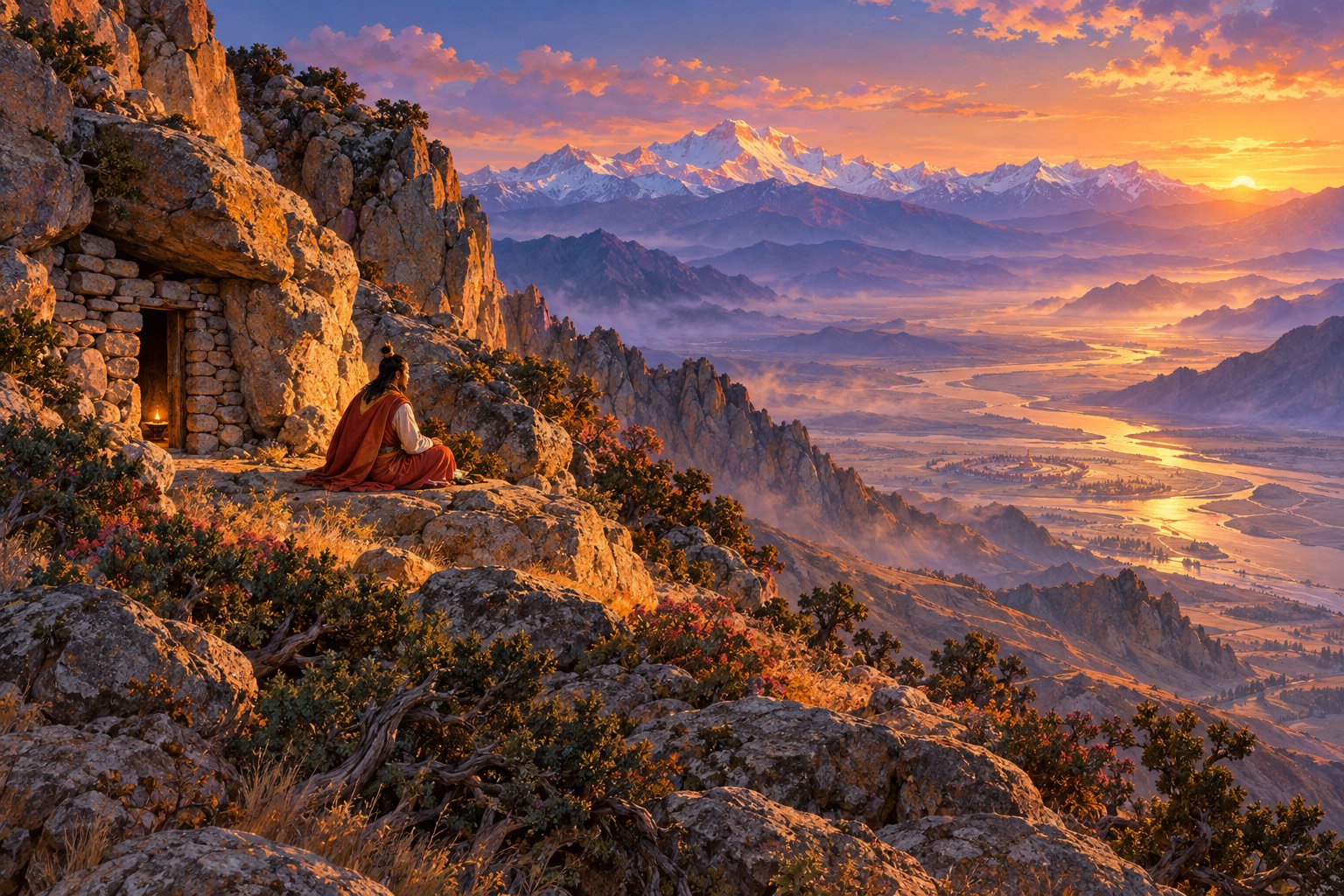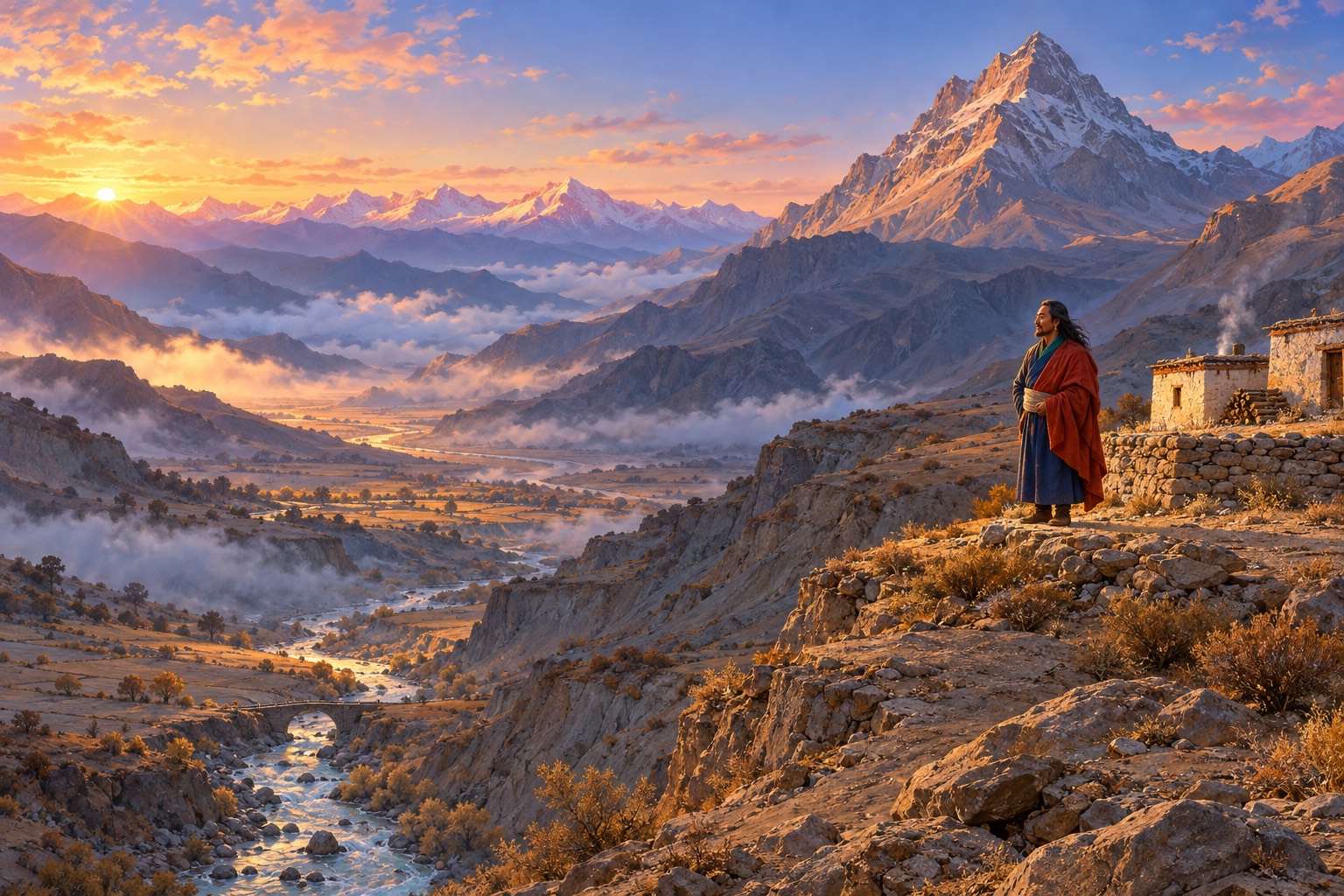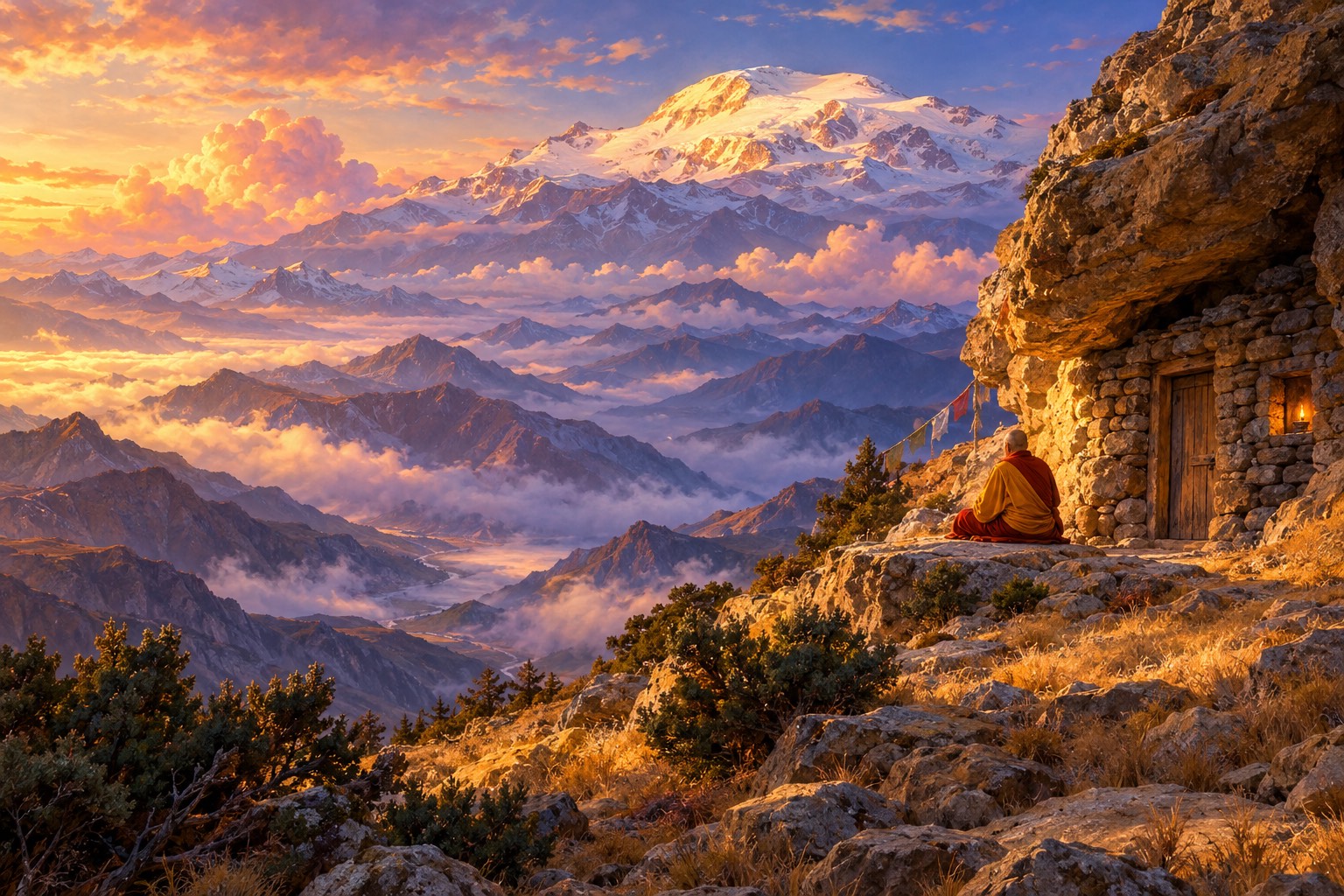
South of Lhasa rises a mountain that Tibetans call Gangri Thökar, the "White Skull Snow Mountain," for the pale snow that rounds its summit. In the fourteenth century a monk lived in the small caves high on its side, and there, by the light of butter lamps, he wrote some of the best-loved books in Tibetan Buddhism.
He is remembered as Longchenpa, or Longchen Rabjam, a name usually translated as "Vast Expanse." He also signed his writings Drimé Özer, "Stainless Light." This is the story of how a brilliant student became a beggar in the mountains, and then one of the great teachers of the Nyingma, the "Ancient" school that traces itself to Guru Rinpoche.
A princess and a promise
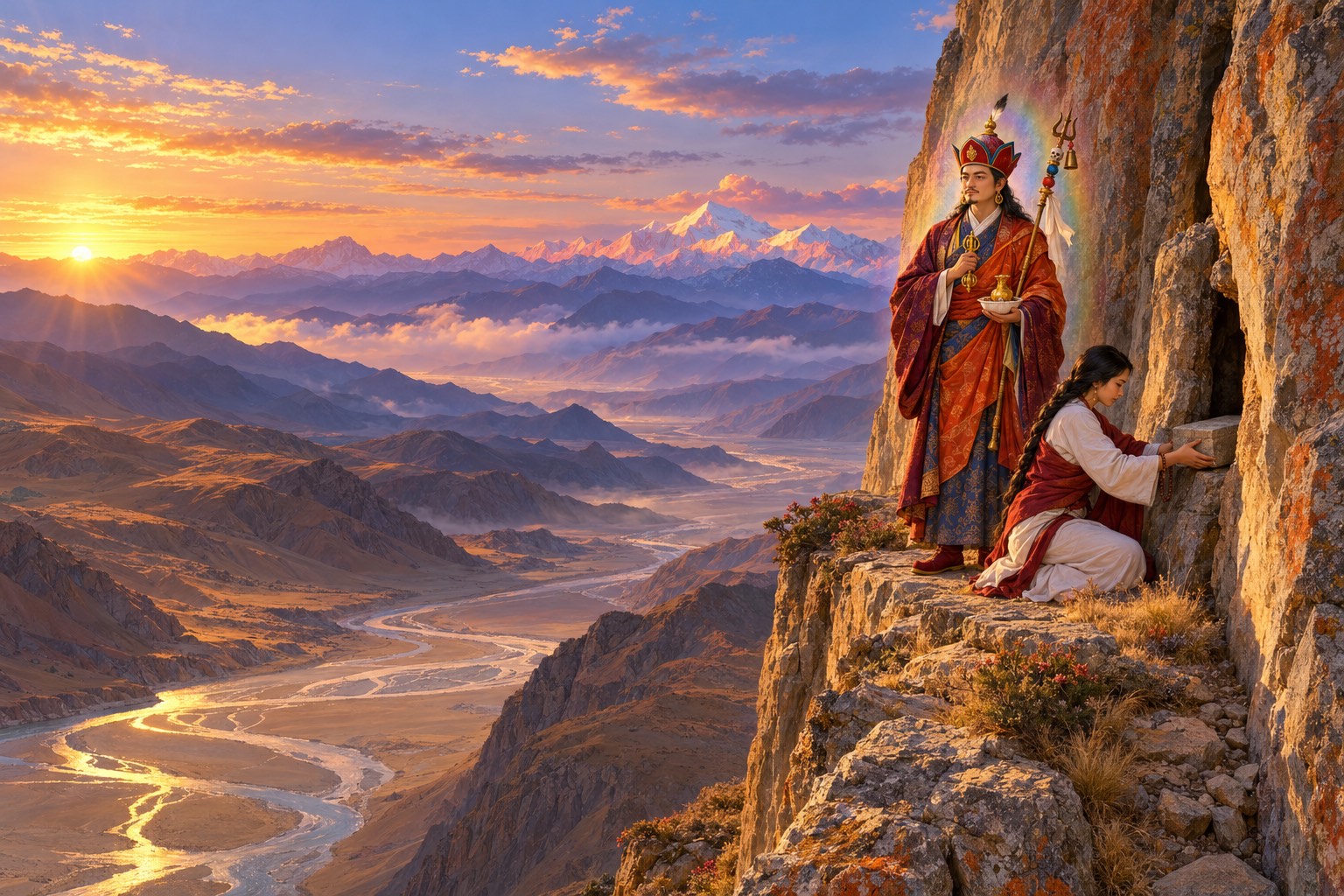
The tradition begins his story five centuries before his birth. King Trisong Detsen, who invited Guru Rinpoche to Tibet, had a daughter named Pema Sal. Rigpa Wiki relates that she died at the age of eight, and that Guru Rinpoche called her back to life for a short while and gave her a teaching later known as the Khandro Nyingtik, the "Heart-Essence of the Dakinis." Dakinis are female embodiments of enlightened wisdom.
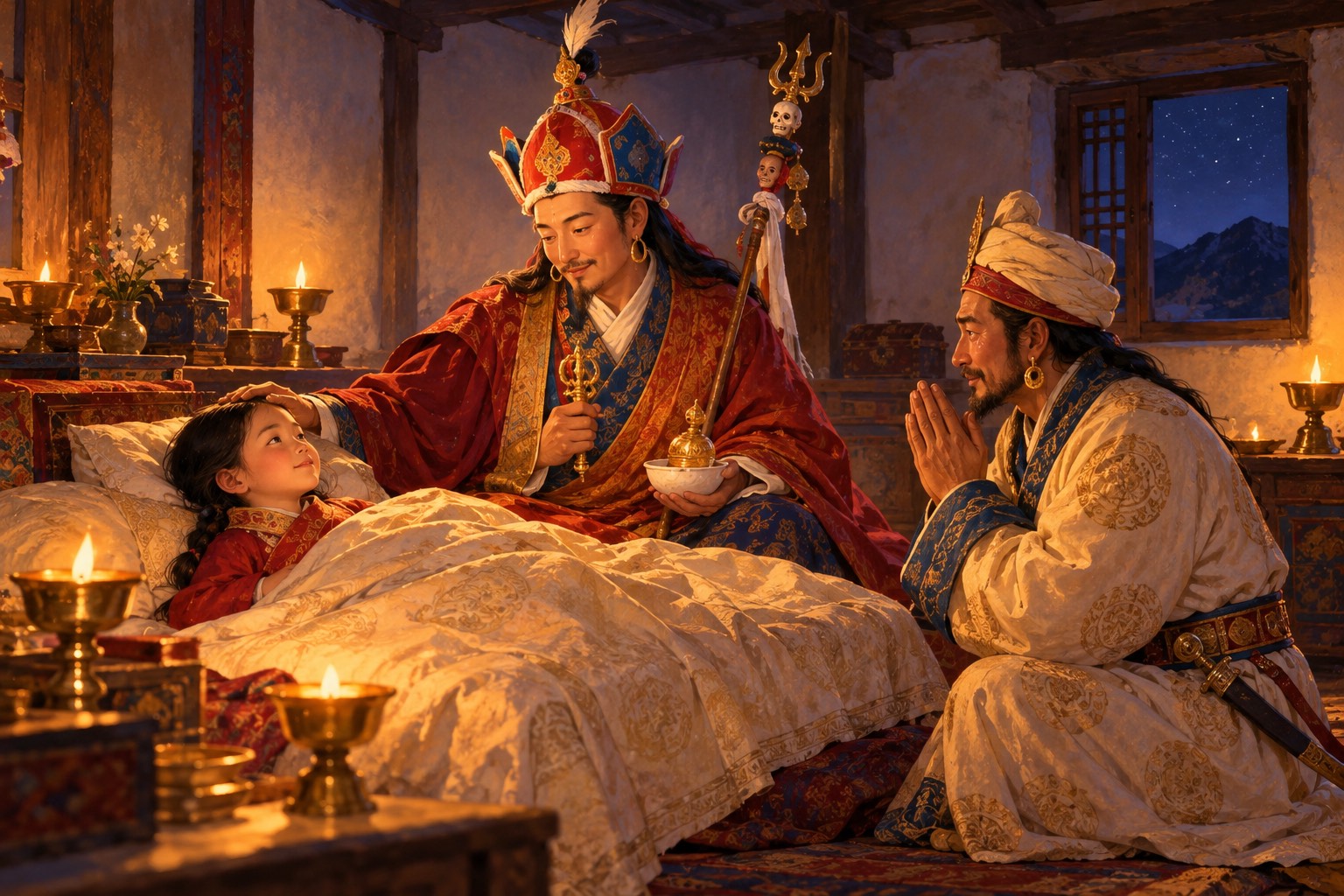
That teaching was hidden away as a treasure, or terma, to be found when the time was right. The accounts say Pema Sal was reborn as the treasure revealer Pema Ledrel Tsal, who brought it to light, and that Longchenpa was his next birth. So his story begins with Guru Rinpoche's kindness to a grieving king's child.
A boy who loved to learn
Longchenpa was born in 1308 in the upper Dra valley in south-central Tibet. His father, Tenpa Sung, was a tantric yogi who also taught his son medicine and astrology. His mother was Sönam Gyen.
In a short account of his own early life, Longchenpa says that by seven he could read and had learned several practices, among them a practice of Guru Rinpoche.
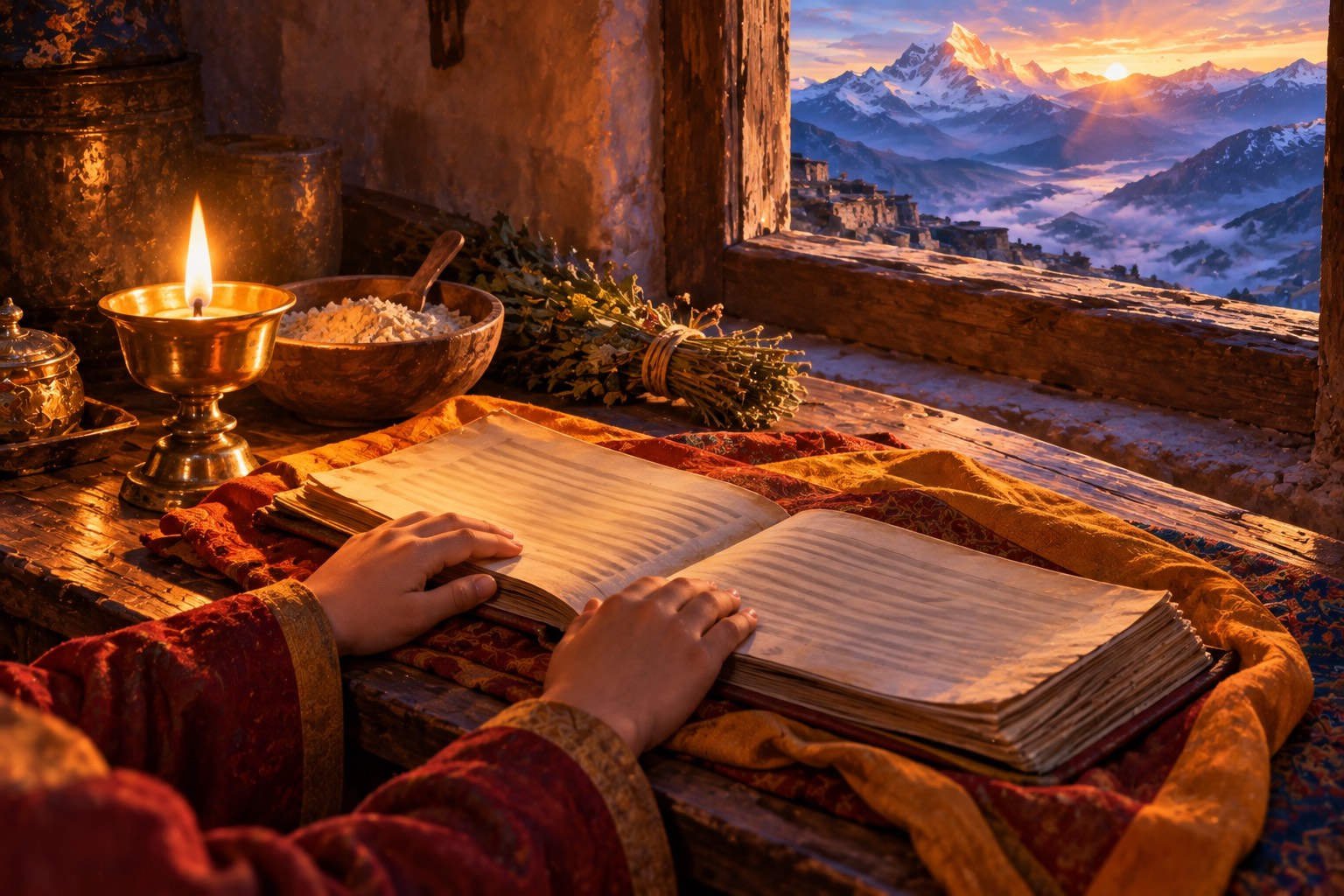
At twelve he became a novice monk at Samye, Tibet's first monastery (Rigpa Wiki says eleven; ages are counted differently in different accounts). By fourteen, he writes, he was already explaining the rules of monastic discipline to others.
The great college
At nineteen he entered Sangphu Neutok, a famous monastic college in the hills just south of Lhasa, founded in 1072. For six years he studied the great Indian treatises on philosophy and logic. He read so widely that he became known as Samye Lungmangwa, "the one from Samye with many scriptures."
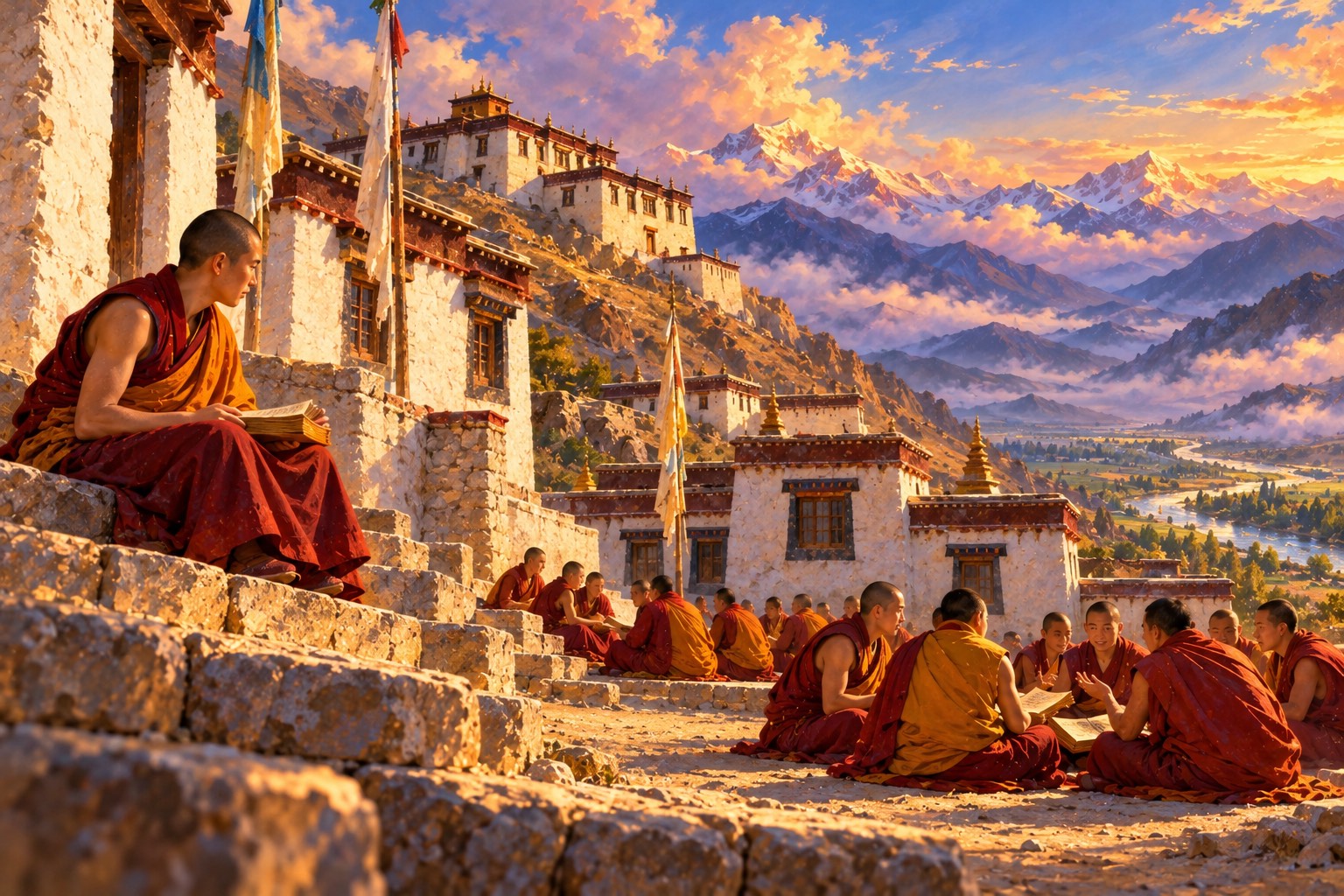
Yet he grew unhappy there. Rigpa Wiki says he was disillusioned by the behaviour of some scholars, and Treasury of Lives mentions conflict with a group of monks from Kham, in eastern Tibet. On leaving, he wrote a sharp little poem built on the thirty letters of the Tibetan alphabet, and it was passed around central Tibet.
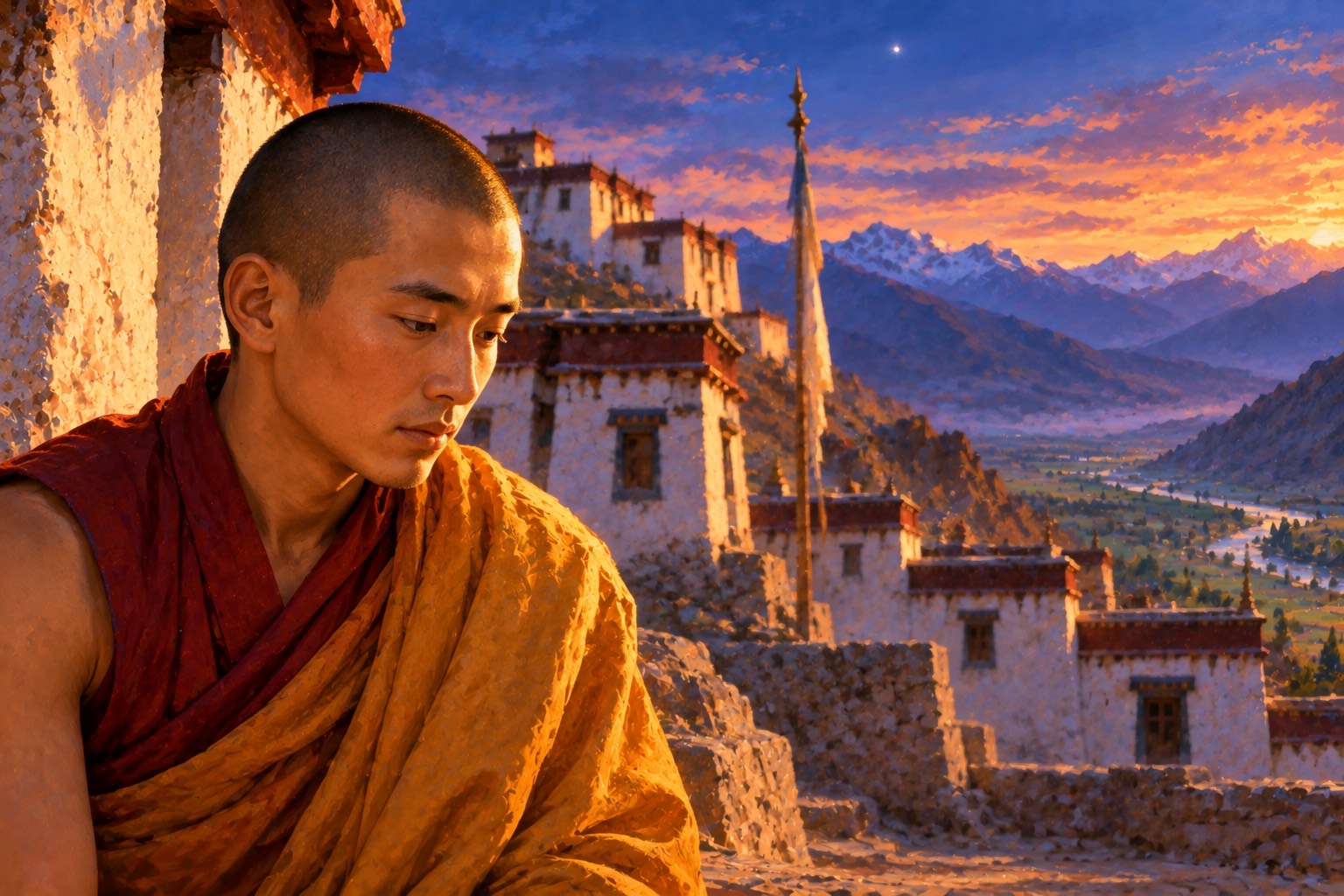
He kept learning from more than twenty teachers of different schools, among them the Third Karmapa, head of the Karma Kagyu school. But his heart was turning toward the mountains.
The rider in the golden veil
Around 1332, during five months of retreat in darkness in a cave at Chokla, he dreamed one morning of a sandy valley with small hills and waterfalls. In his own account, a girl of about sixteen rode toward him on a horse hung with bells, her face hidden behind a golden veil. He caught the reins and asked her to keep him in her care. She took off her jewelled crown, set it on his head, and promised him her blessings from then on.
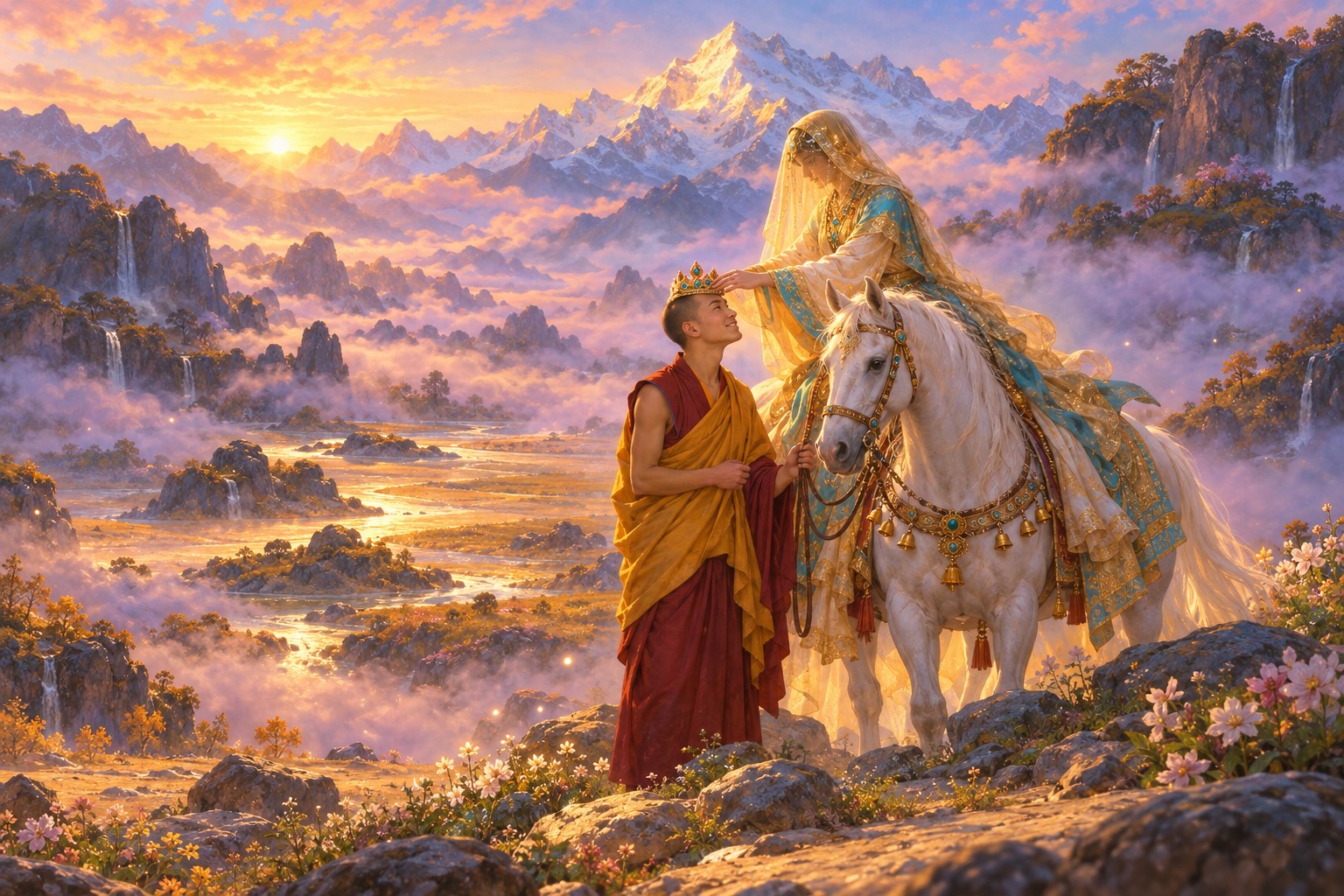
He writes that its bliss and clarity stayed with him for three days. Tradition took the dream as a sign that he would soon receive the deepest teachings of the Great Perfection, or Dzogchen, the heart of the Nyingma path.
The teacher who kept moving
Then, one spring near Samye, he met Rigdzin Kumaradza (1266–1343), an old yogi who held the Vima Nyingtik, the "Heart-Essence of Vimalamitra." Longchenpa was about twenty-five to twenty-seven (the sources differ). He remembered that Kumaradza had dreamed the night before of a wondrous bird, and welcomed him with delight as someone who would hold his lineage.
Longchenpa had nothing to give. Treasury of Lives says he was too poor to make the customary offering and almost turned away. Kumaradza took him anyway and, over about two years, passed on everything he had.
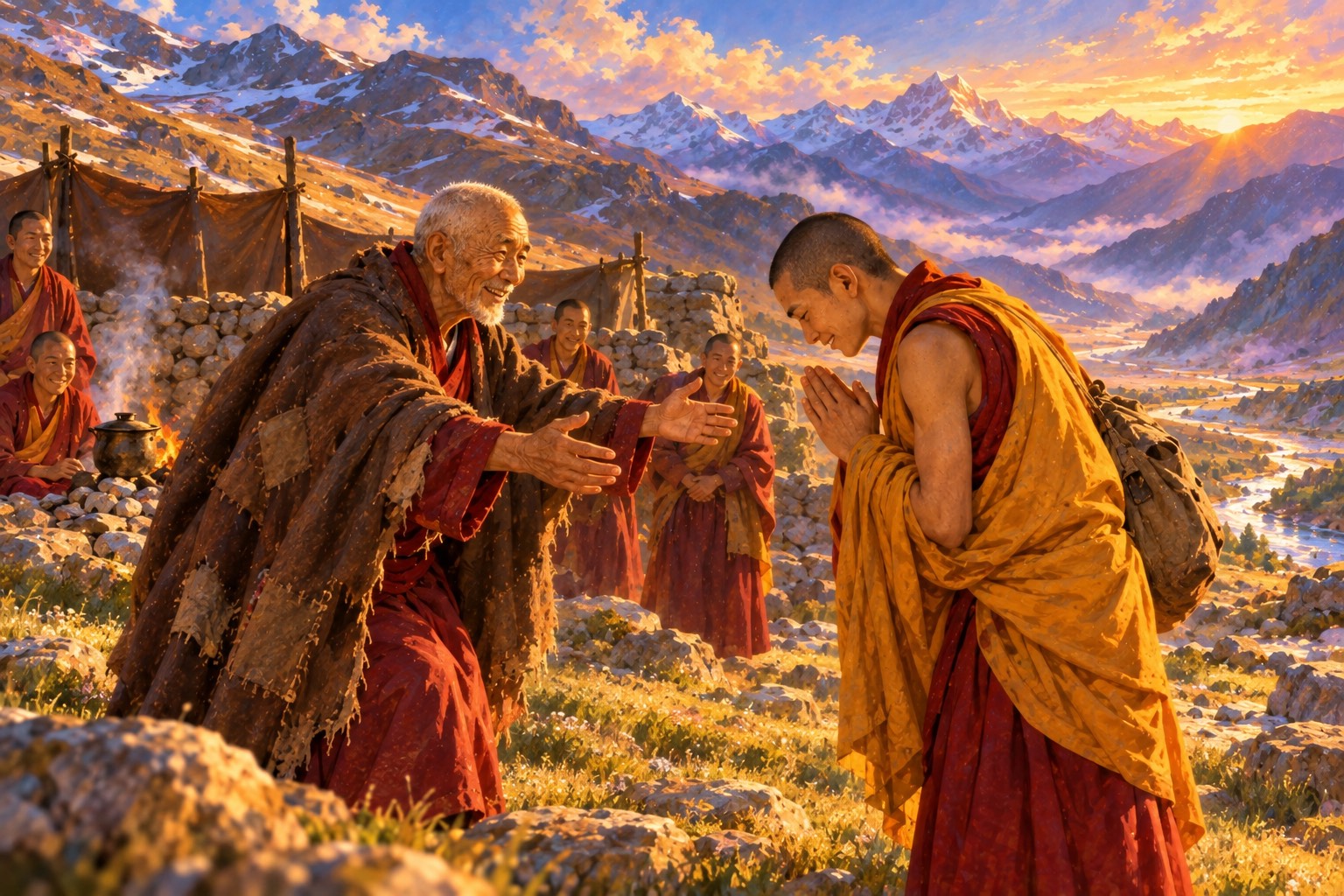
Kumaradza never stayed anywhere long. That spring, Longchenpa writes, the camp moved from one empty valley to another nine times. For two months he lived on three measures of flour and twenty-one medicinal pills.
He had one large sack. In his own words it served as both his coat and his seat, and whenever snow fell he climbed inside it. Later retellings drawing on Tulku Thondup say it was both his clothing and his bed. He vowed to keep up this hard life for three years for the sake of the teachings.
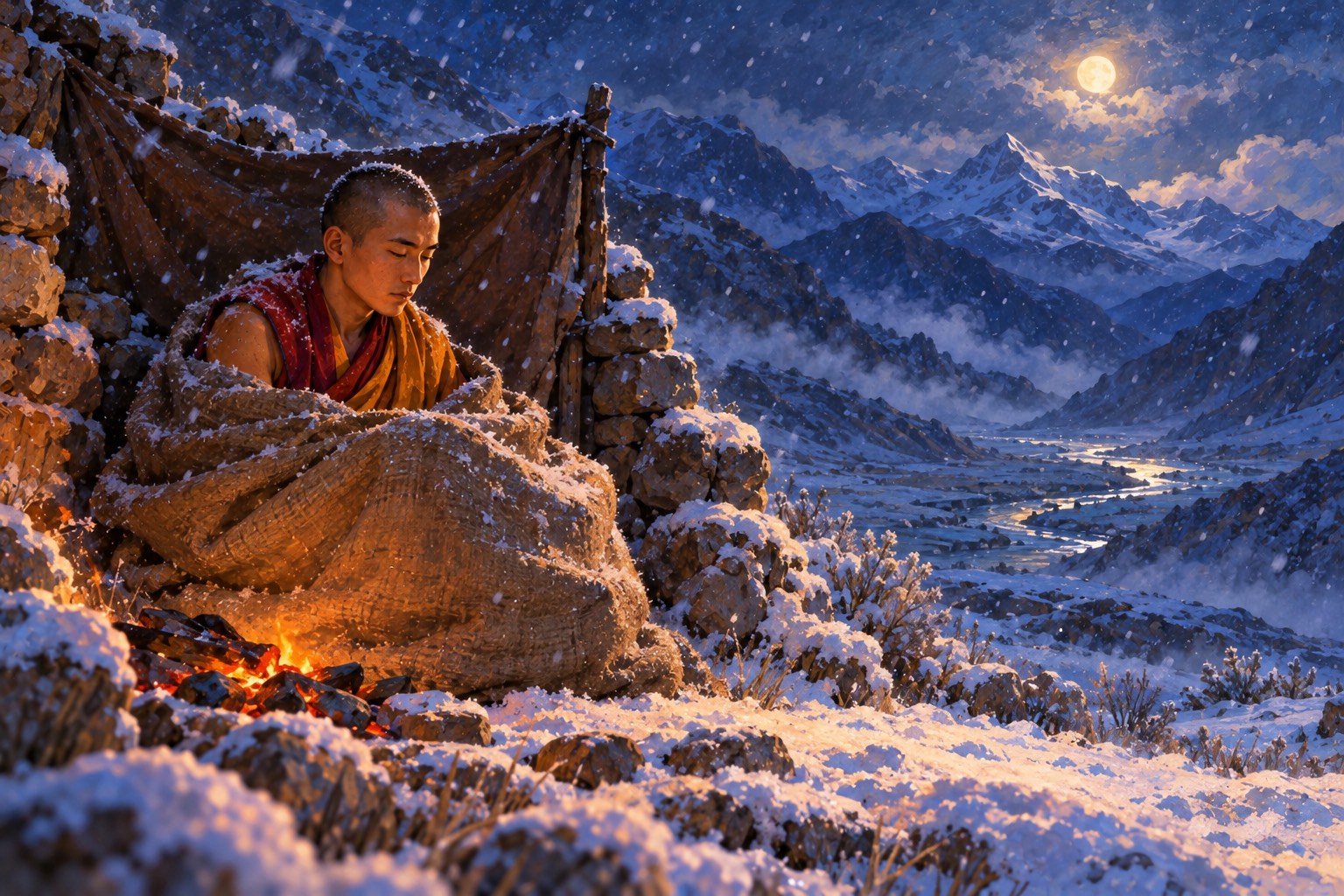
He recorded these details not to make poverty sound romantic, but to show how little a person needs in order to practise.
Two streams meet
At about thirty-two he taught the Vima Nyingtik to a small group of eight, men and women, in a cave at Chimphu, the retreat mountain above Samye where Guru Rinpoche and Yeshe Tsogyal are said to have meditated. One of those students, Özer Gocha, brought him the texts of the Khandro Nyingtik, the princess's teaching from long ago.
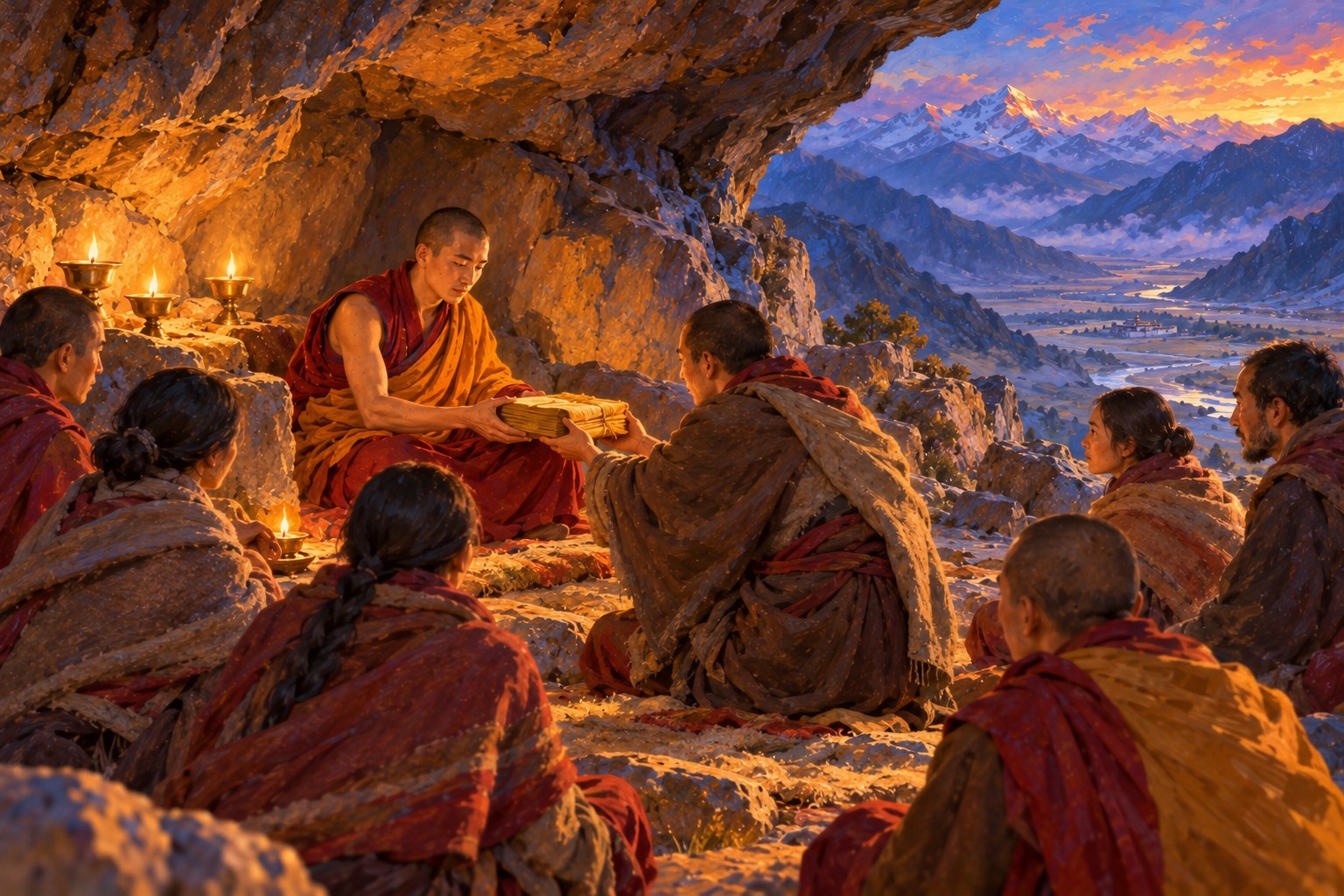
He wrote a commentary on each of the two streams, Vimalamitra's and Guru Rinpoche's. Together the four collections became the Nyingtik Yabzhi, the "Heart-Essence in Four Parts," still at the root of Nyingma Dzogchen. Around this time, the accounts say, he had visions of Guru Rinpoche and Yeshe Tsogyal.
What these teachings contain is something to receive from a qualified teacher; the Find a Teacher page can help.
The Seven Treasuries
His main home became the hermitage on Gangri Thökar. Describing the mountain, he wrote that it had once seemed "adorned by a mane of ice and dressed in moon-like whiteness" (as quoted by Treasury of Lives).
There he wrote much of his life's work, more than two hundred texts by one count, many now lost. The best known are the Seven Treasuries. Put very simply, they are seven books that lay out the whole Buddhist path as the Nyingma understand it: the views of the different schools, the stages of practice and, above all, the nature of mind as Dzogchen describes it, open and clear like the sky.
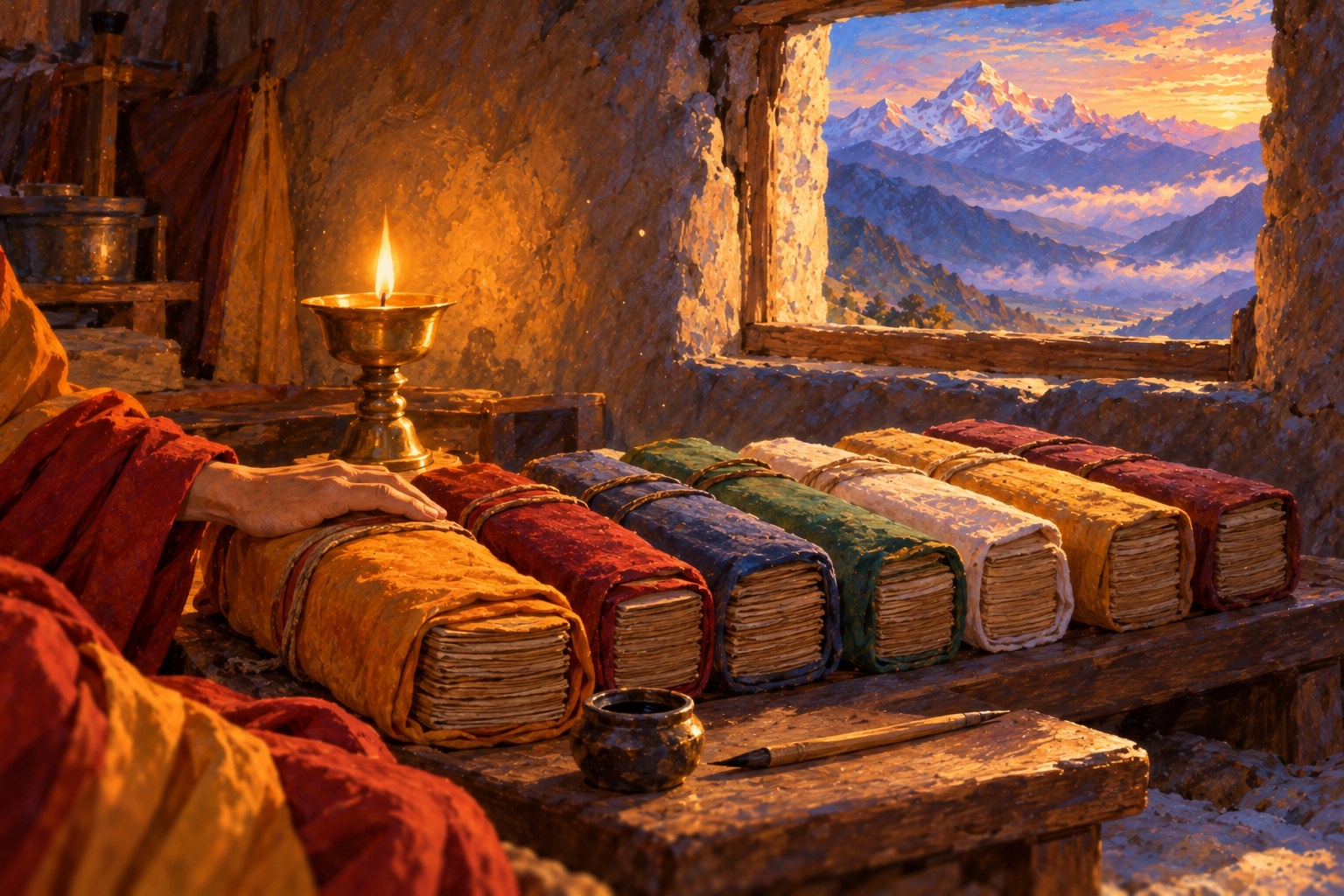
Tibetan accounts generally say he wrote them at Gangri Thökar; Bhutanese historians say he wrote them in Bhutan and rewrote them later. Readers with no taste for philosophy love him too, for short works such as Thirty Pieces of Heart Advice, which praises simplicity, humility and steady practice.
Exile in Bhutan
Tibet was changing. In the middle of the century a new ruler, Tai Situ Jangchub Gyaltsen, took power. Treasury of Lives says Longchenpa tried without success to make peace during a revolt by Drigung, whose leader had been his patron, and the ruler sent him out of Tibet.
He went south to Bumthang, in what is now Bhutan. One tradition says the journey was prompted by a vision of Guru Rinpoche, white in colour and surrounded by five dakinis. There he made his home at Tharpa Ling, the "Place of Liberation," on a forested ridge above the Chumey valley.
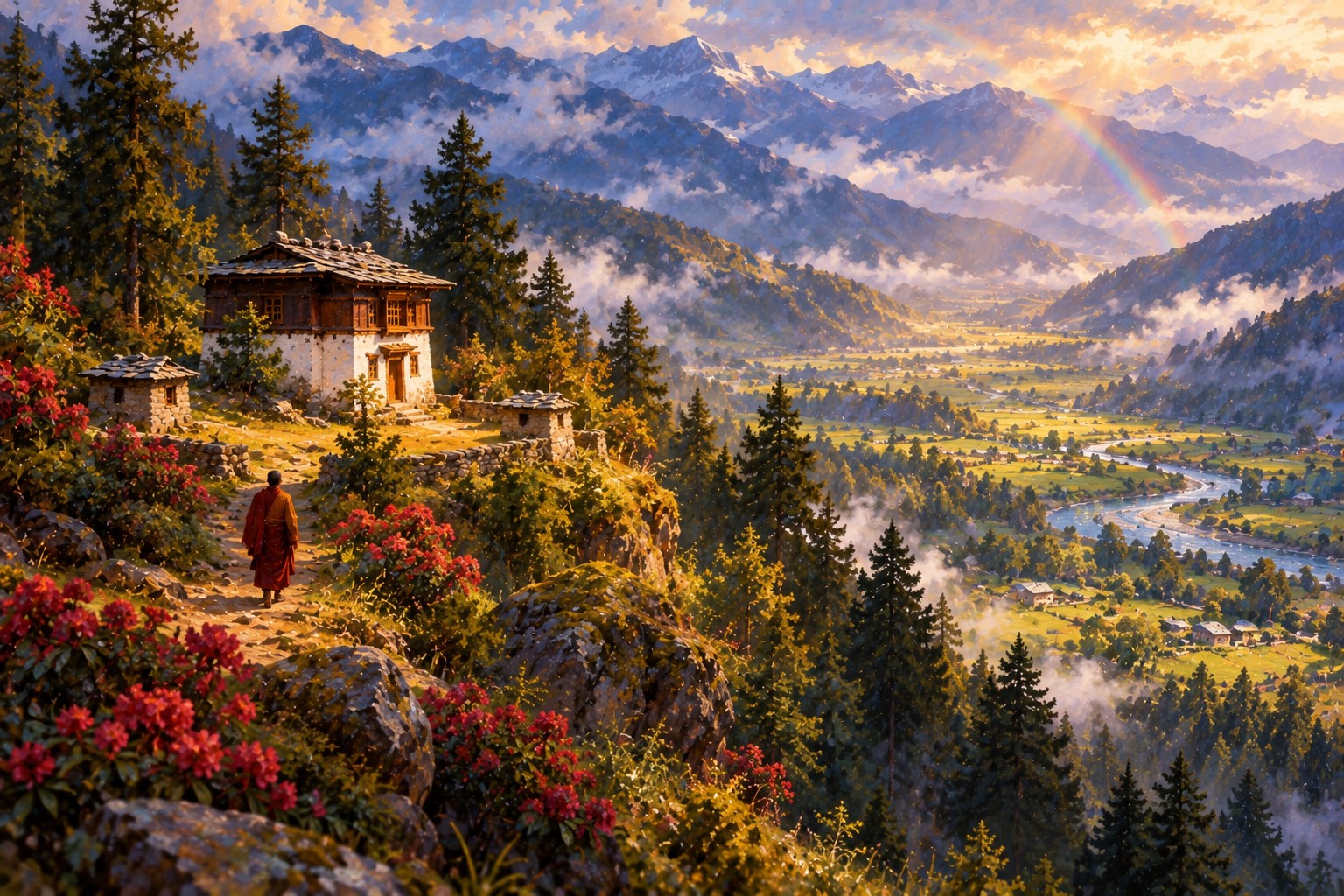
Accounts differ on whether he founded the temple or rebuilt an older one as a Nyingma seat. He is remembered for founding eight hermitages in Bhutan and for teaching Dzogchen to ordinary lay people there.
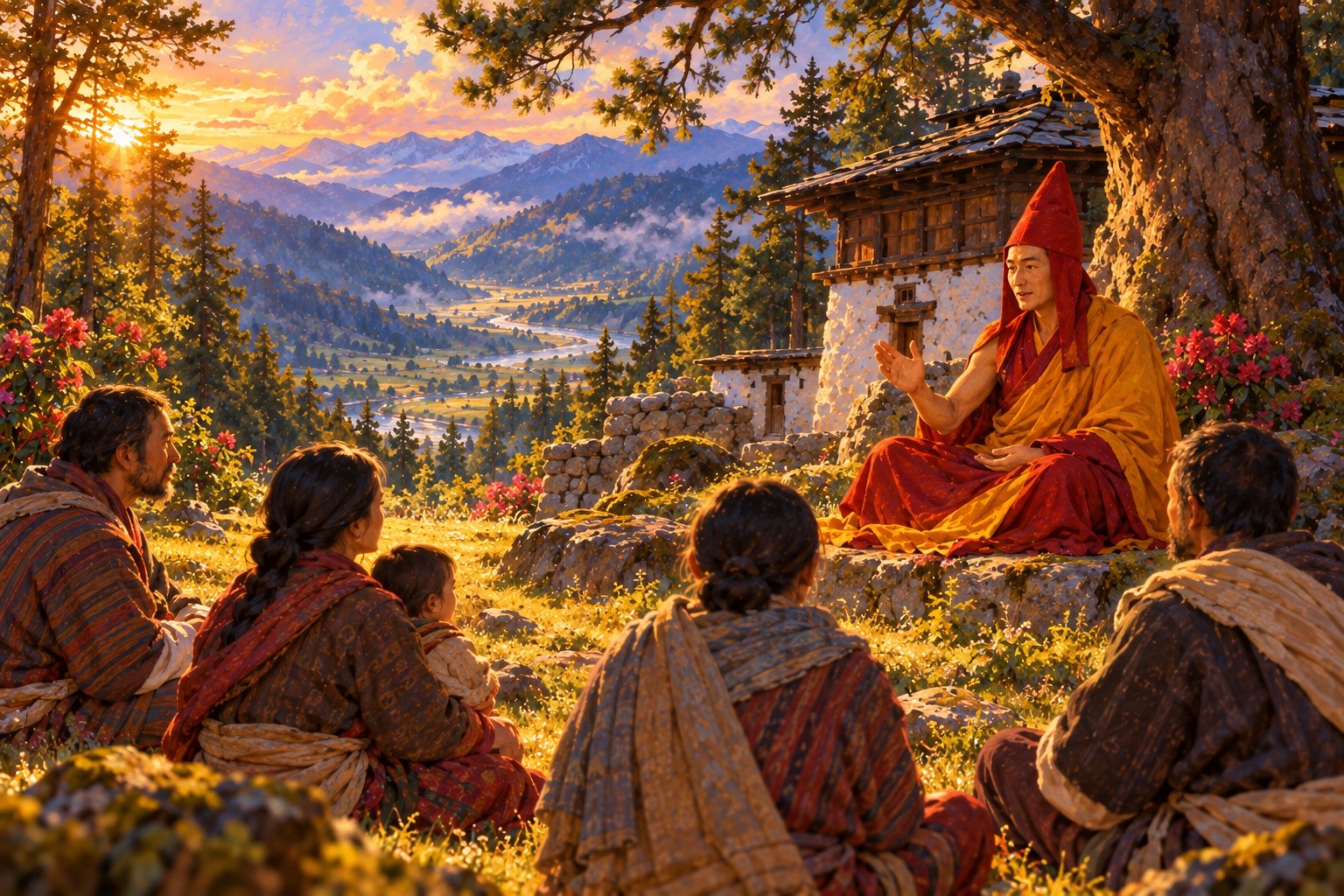
In Bhutan he also had a family: his son Drakpa Özer, born in 1356, became a holder of his teachings. The sources do not agree on when the exile began or how long it lasted. In the end his patrons made peace with the ruler, who, Treasury of Lives says, then received teachings from him and may even have given him the name Longchen Rabjam.
Going home to Chimphu
In his mid-fifties his health began to fail. He travelled back to Chimphu, teaching along the way, and wrote his last words of advice. In one of them, translated on Lotsawa House, he calls himself "an aimless beggar who is going to die as he likes," and asks his students not to mourn but to keep on praying.
At midday on the eighteenth day of the twelfth Tibetan month, early in 1364, he asked his attendants to set out offerings and leave him to rest. As Nyoshul Khenpo tells it, he sat upright in meditation and passed away in that posture, at the age of fifty-six. The anniversary of his passing is still remembered.
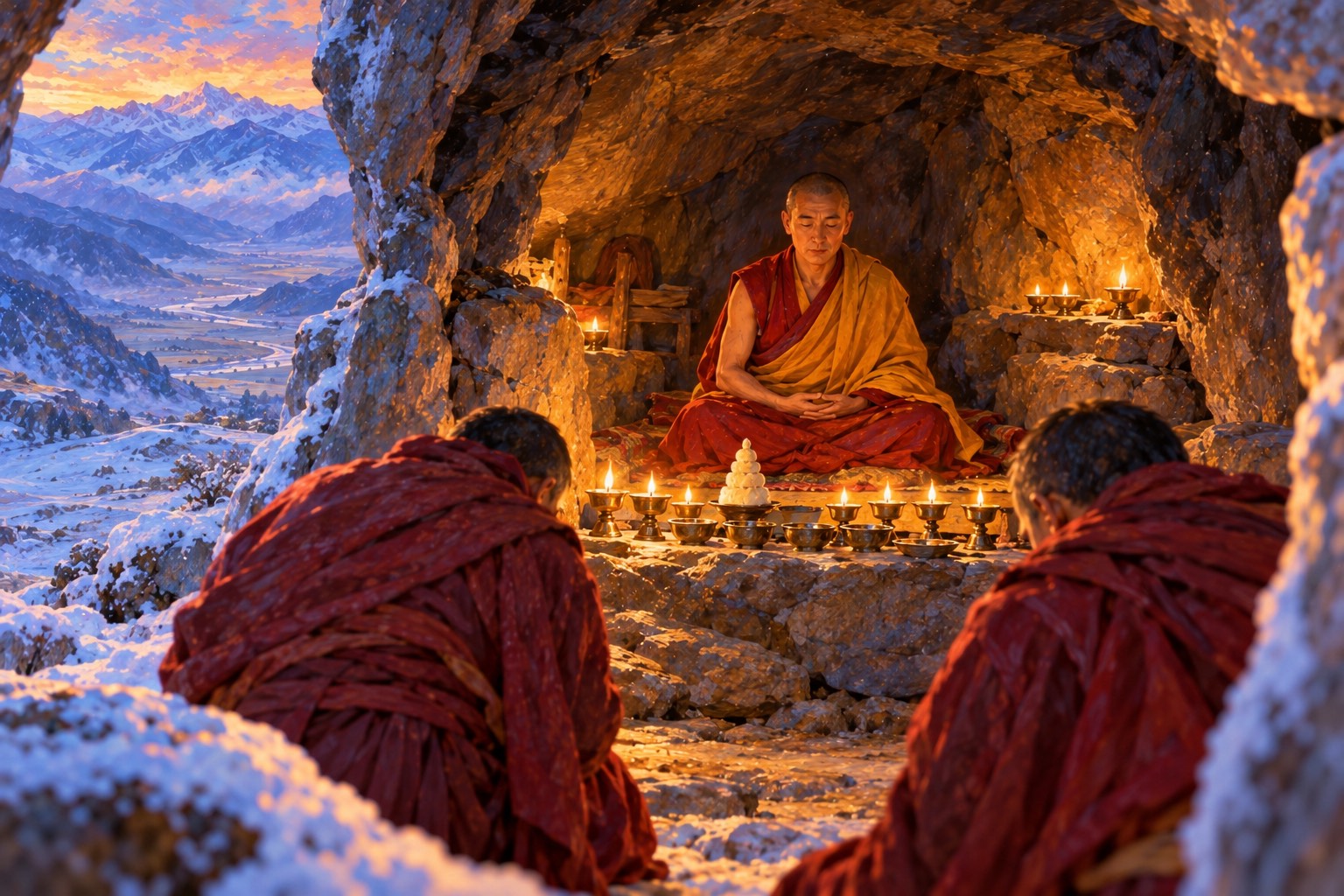
Four centuries later, at Chimphu, the yogi Jigme Lingpa is said to have met Longchenpa in three visions. That story is told in Story 10, "Jigme Lingpa's Visions and the Longchen Nyingtik."
A vast expanse
The sources used here do not link Longchenpa directly to the Seven-Line Prayer. But Guru Rinpoche runs all through his story, from the princess to the caves of Chimphu to the vision that led him into Bhutan.
The third line of the prayer speaks of a wondrous, supreme accomplishment. Longchenpa's life shows one way it can look in a human being. It was not wealth or fame. It was a mind as open as the sky, and great learning carried lightly by a man content with a sack in the snow.
About the art
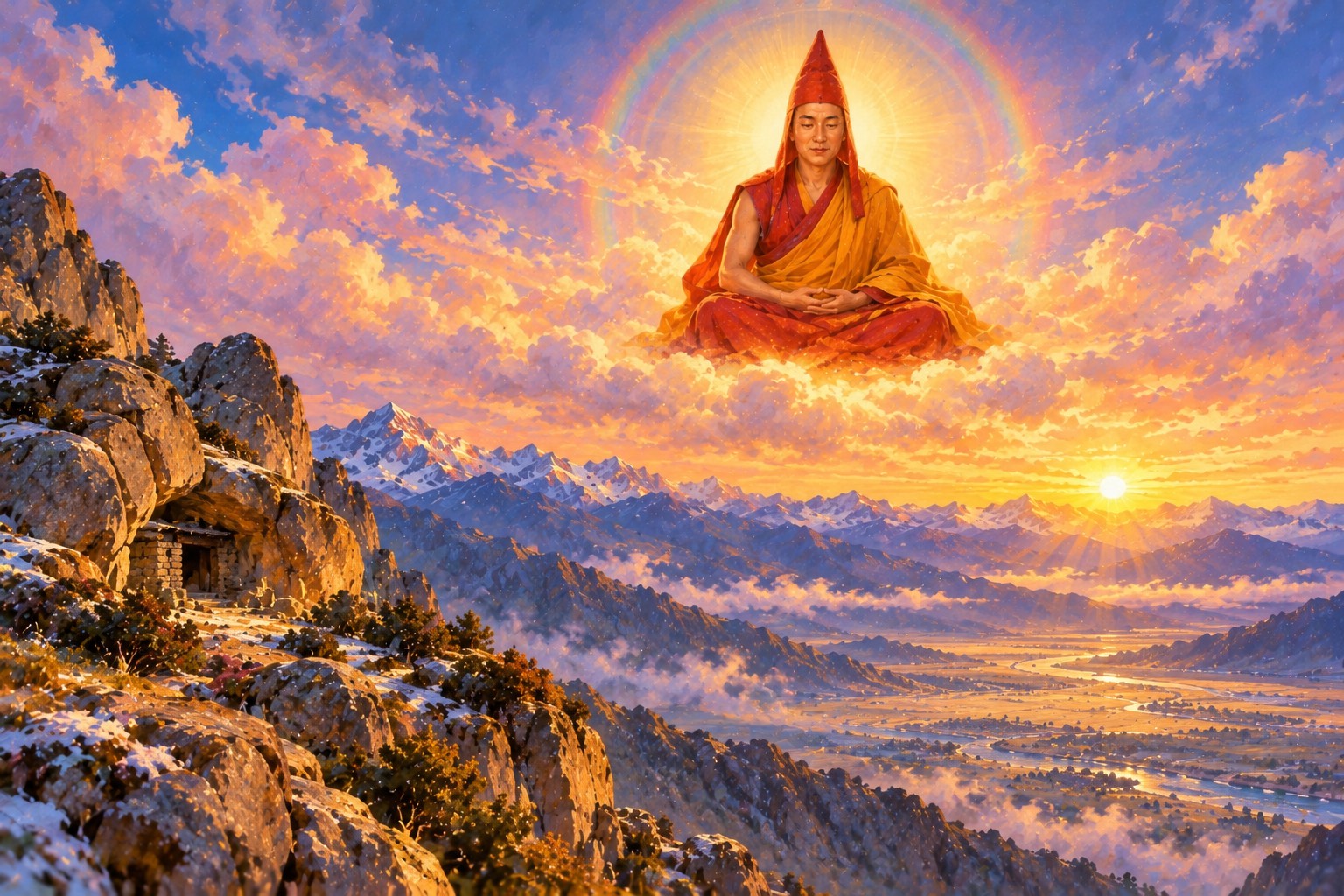
Longchenpa is shown in three stages. As a young student and wanderer he is a monk with a shaved head in plain red and yellow-gold robes and no hat. As the mature teacher he wears the tall, pointed red pandita hat with long side flaps that his traditional portraits show, a sign of a learned master, with a red-orange lower robe and a yellow-gold upper robe over the left shoulder. This follows paintings and a metal sculpture on Himalayan Art Resources (items 631, 64042 and 44009) and a Bhutanese mural (82040). In the closing image he appears as he does in devotional paintings, seated in meditation and softly radiant.
No traditional portrait of Rigdzin Kumaradza was found, so he is painted from his life story: an old monk who lived as a wandering yogi in the mountains, in faded, patched red robes and a heavy woollen cloak. The windbreaks of his camp and Longchenpa's sack are drawn simply, from Longchenpa's own account.
Guru Rinpoche appears once, with Princess Pema Sal and King Trisong Detsen, in his best-known form: the lotus hat with a half-vajra and a single vulture feather, a five-pronged vajra at his heart, a skull cup with a long-life vase, and a slender khatvanga staff at his left shoulder. The king wears the cream turban and patterned silk robe of eighth-century Tibetan court dress. No syllable or letter is drawn in any image, including the scene with the princess.
The books in these pictures are Tibetan pecha: long, narrow loose leaves kept between boards and wrapped in cloth. The seven coloured bundles in scene 10 are a symbol of the Seven Treasuries, not a record of how they were wrapped. The settings, Sangphu, Gangri Thökar, Chimphu and Tharpa Ling, are careful reconstructions of how these places may have looked in the fourteenth century, without the later buildings that stand there now.
Why this matters for practice
The third line of the Seven-Line Prayer honours a wondrous, supreme accomplishment, and Longchenpa's life is one of the clearest pictures the Nyingma tradition offers of what that can mean: great learning, held lightly, and a mind as open as the sky. His story begins, the tradition says, with Guru Rinpoche's kindness to a young princess, and it passes through the Guru's own caves. It is also a reminder that practice needs very little: Longchenpa had a sack, a teacher and his devotion.

If something in this story moved you, you might pause tonight and recite the prayer once, as simply as he lived.
Sources and further reading
- Longchenpa Drime Wozer, by Renée Ford (2021), Treasury of Lives
- Gangri Tokar; Sangpu Neutok; Tarpeling (institution pages), Treasury of Lives
- Autobiography of Longchen Rabjam, from The Jewel Rosary History, translated by Adam Pearcey (2024), Lotsawa House
- Biography of Kumārādza, from The Jewel Rosary History, translated by Adam Pearcey (2024), Lotsawa House
- Immaculate Radiance: A Testament, translated by Adam Pearcey (2024), Lotsawa House
- Longchen Rabjam (author page), Lotsawa House
- Longchenpa; Pema Sal; Gangri Thökar, Rigpa Wiki
- Lineage Holders of Inherent Truth, by Lama Drimed Norbu (Windhorse, Fall 1996), Chagdud Gonpa
- Buddha Mind and Masters of Meditation and Miracles, by Tulku Thondup, Snow Lion / Shambhala (books)
- Teacher: Longchen Drime Ozer (set 309) and items 631, 44009, 64042, 82040, Himalayan Art Resources
- Tharpaling Monastery, Tour My India (travel page)
This retelling is waiting to be read by a knowledgeable practitioner. Where the traditional accounts differ, the story says so; if you notice a mistake, please tell us through Share Your Story.