
Some stories in this library tell of great journeys. This one tells of a short life. It is about a little girl who died, and what the tradition says happened next.
It is told gently, as the tradition tells it, and it makes no promise about anyone else's loss. If you are carrying a loss of your own, please read slowly, or stop whenever you need to.
The king's daughter
In the eighth century King Trisong Detsen ruled Tibet. He invited Guru Rinpoche, Padmasambhava, from India, and with the abbot Shantarakshita they founded Samye, Tibet's first monastery, in the wide sandy valley of the Tsangpo river.
The king had a daughter named Pemasal, also spelled Pema Sal or Pema Sel. Pema means "lotus" and sal means clear or bright, so her name can be read as "Clear Lotus" or "Lotus Light." Rigpa Wiki names her mother as Queen Droza Changchub, of the Dro clan.
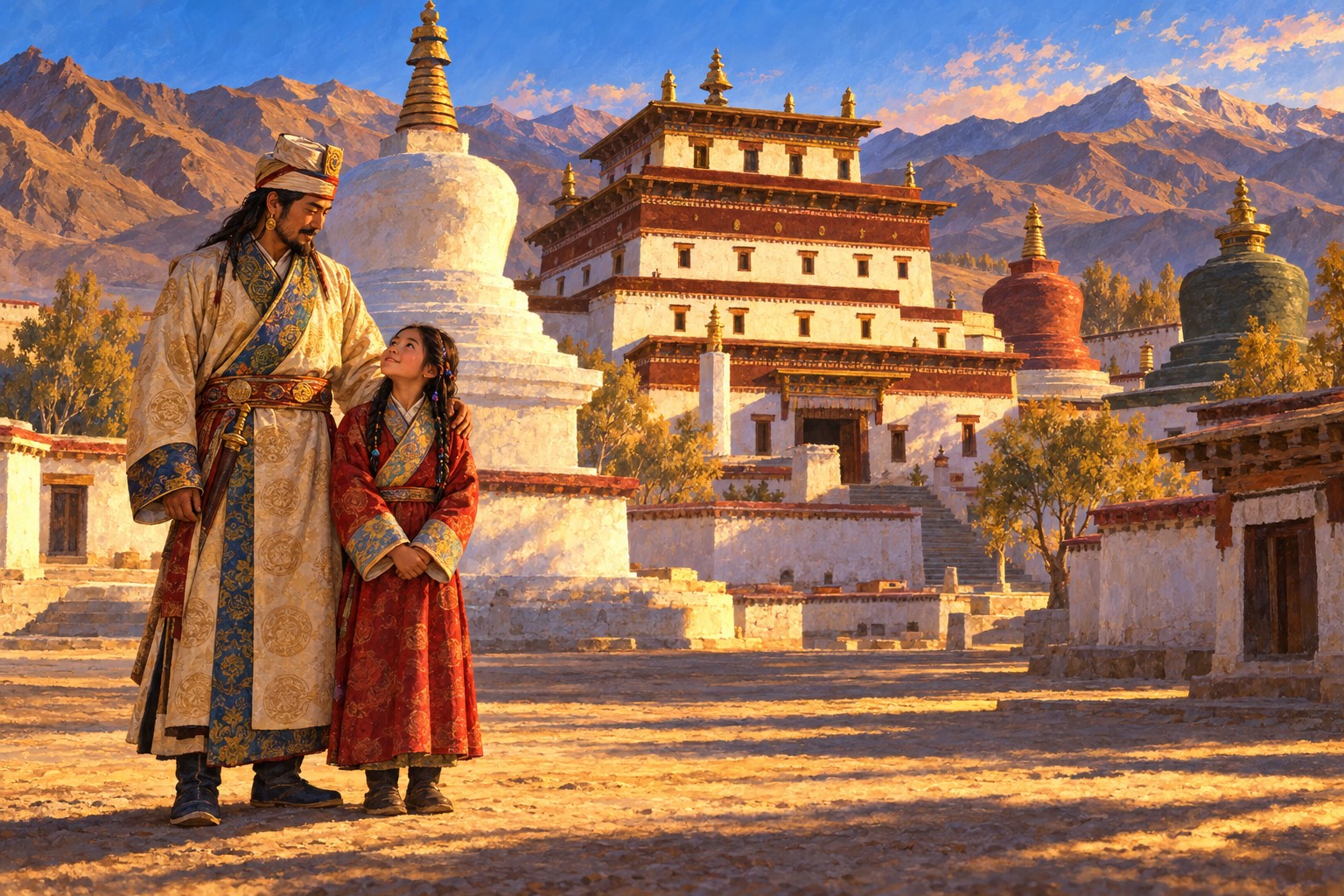
The old accounts say very little about her days. We are not told what games she played or which songs she knew. We know only that she was the king's child, and that she was young.
A lamp goes out
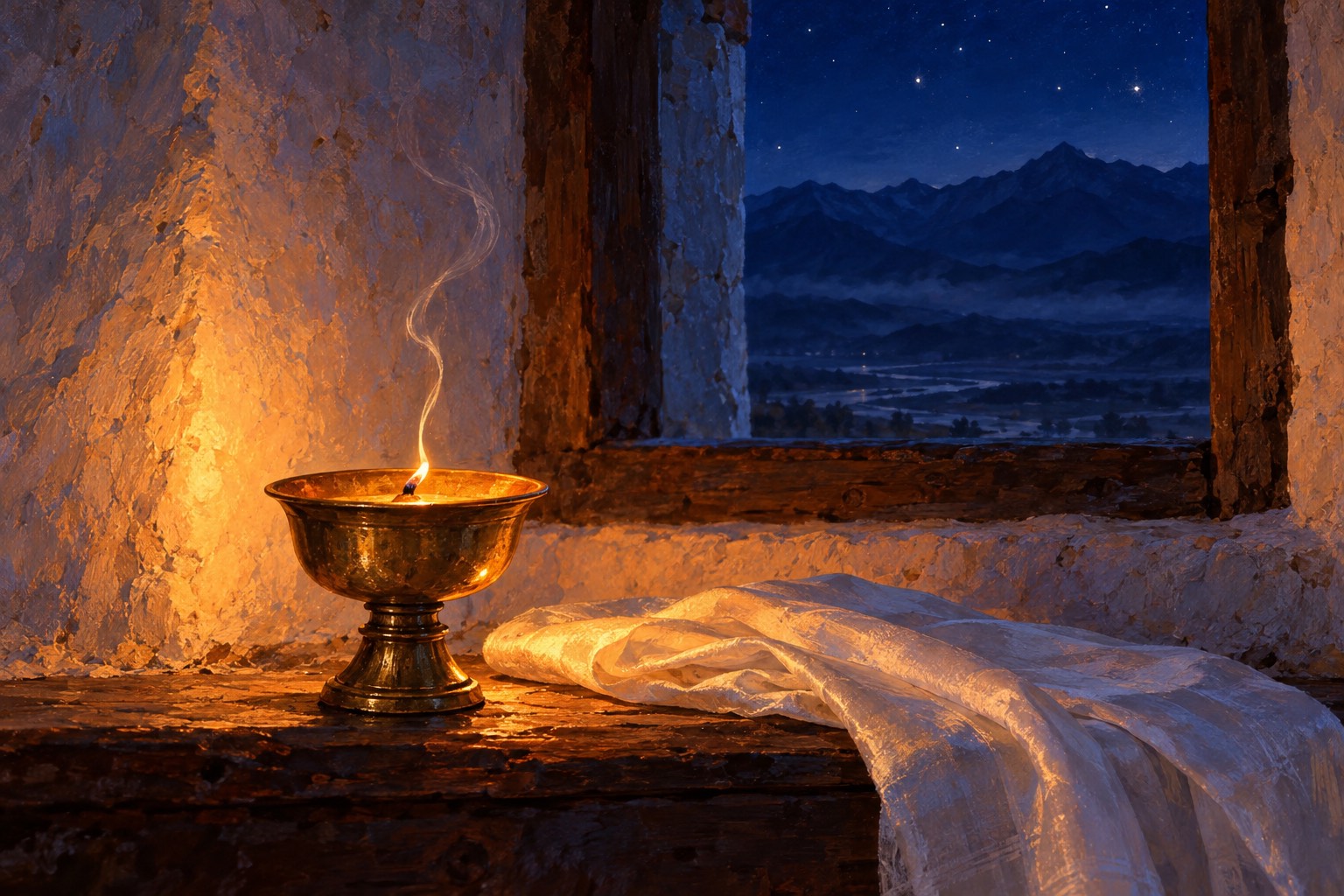
When she was about eight years old, Pemasal died. Rigpa Wiki says it was unexpected. The accounts do not dwell on it, and neither will we.
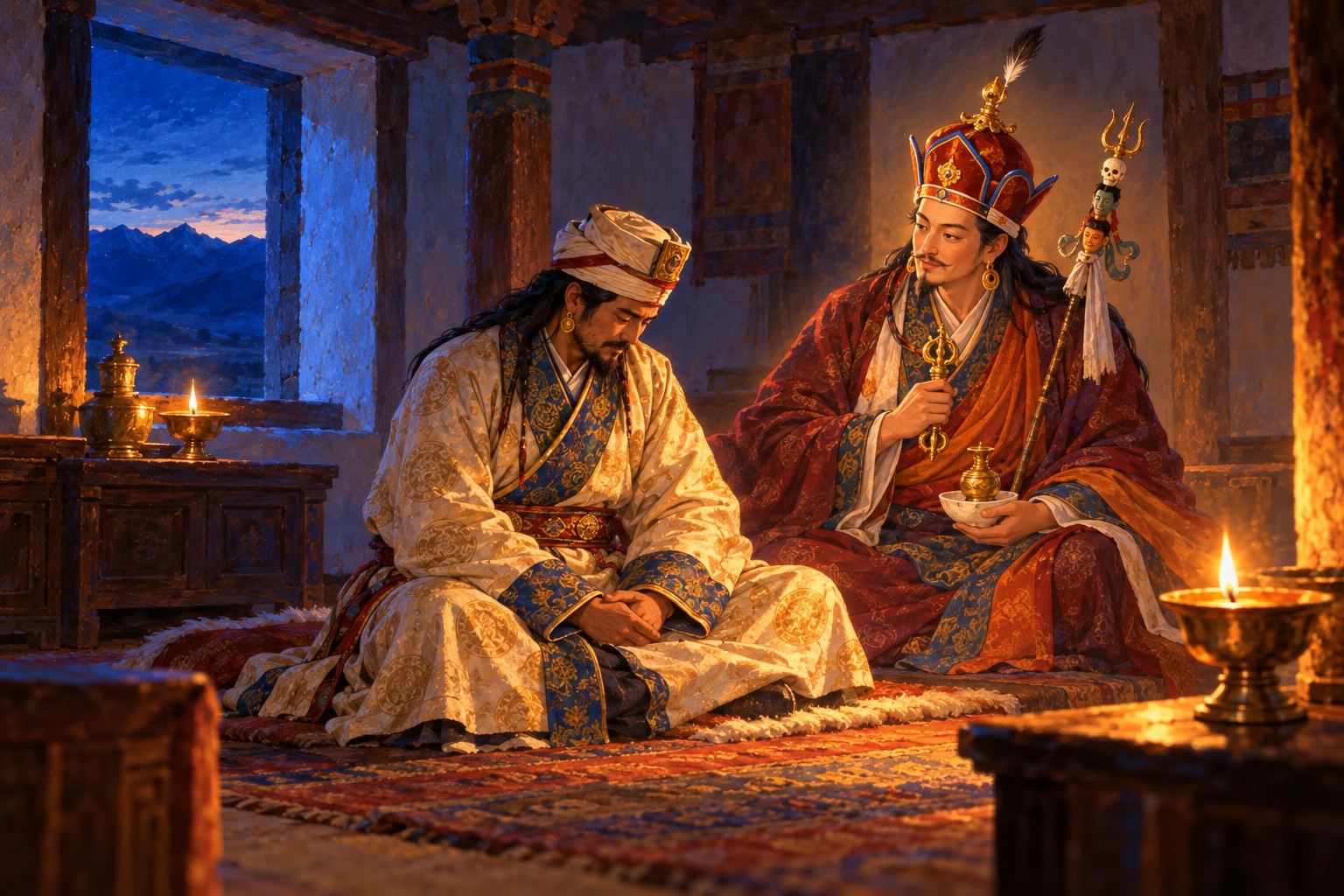
Her father's grief was very great. Rigpa Wiki's page on her teaching says simply that the king was overcome, and that Guru Rinpoche acted to console him.
It is worth pausing there. Before anything wondrous happens in this story, there is a father sitting with his sorrow, and a teacher who comes to sit with him.
Called back for a little while
What happened next is told as a wonder. It is the tradition's account, and this page does not try to explain it.
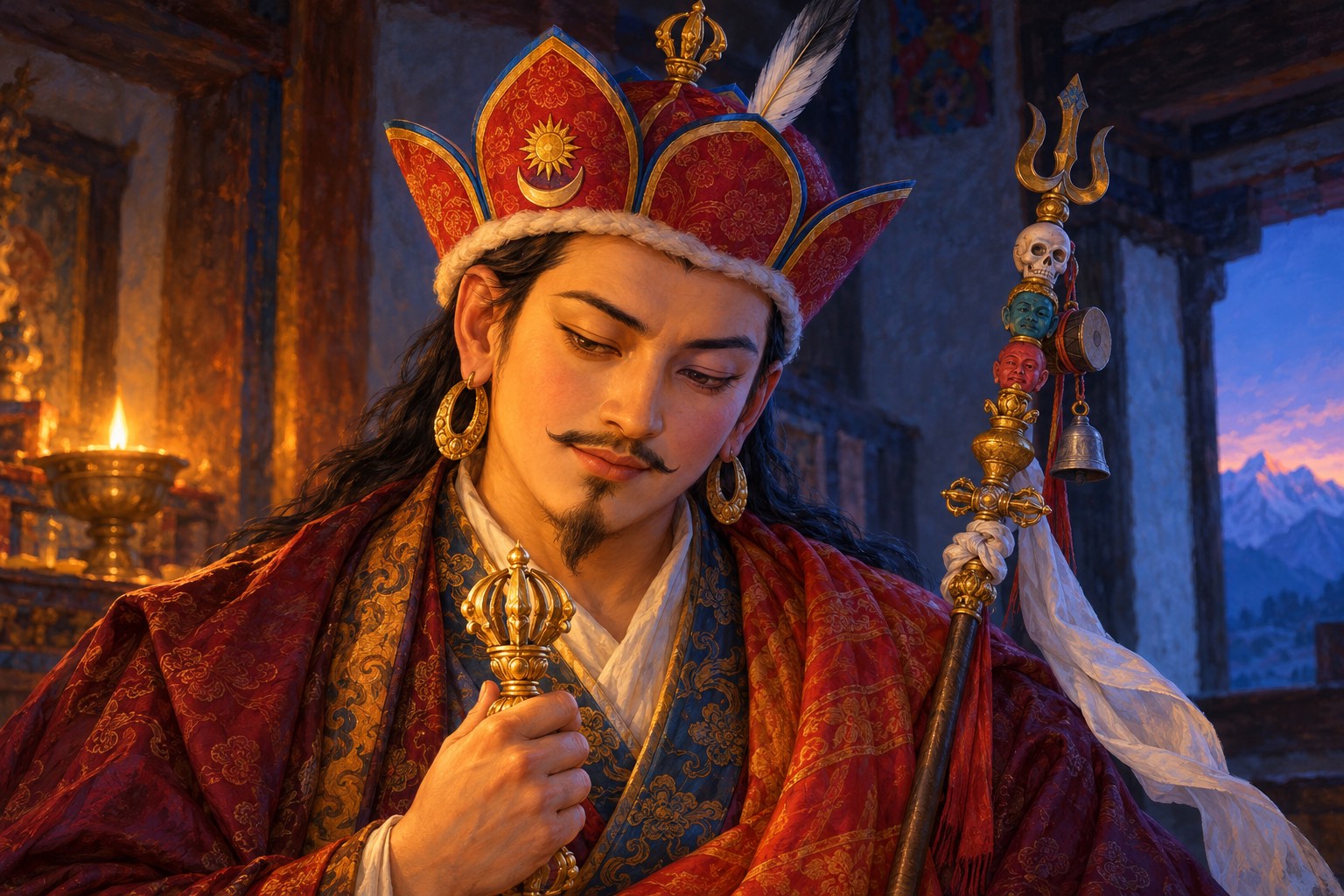
The accounts say Guru Rinpoche traced a sacred syllable over the girl's heart and, by the power of his meditation, called her mind back. She opened her eyes, and she could speak again.
Every telling agrees that it was only for a short time. It was not a cure. It was a meeting, held open just long enough for something to be given.
What he gave her
The gift is remembered as the Khandro Nyingtik, the "Heart-Essence of the Dakinis." A dakini is a female embodiment of enlightened wisdom. A translator's note on Lotsawa House, citing Khenchen Namdrol Rinpoche, explains the name: the teaching was first given to two dakinis, Yeshe Tsogyal and the princess, and a female protector guards it.
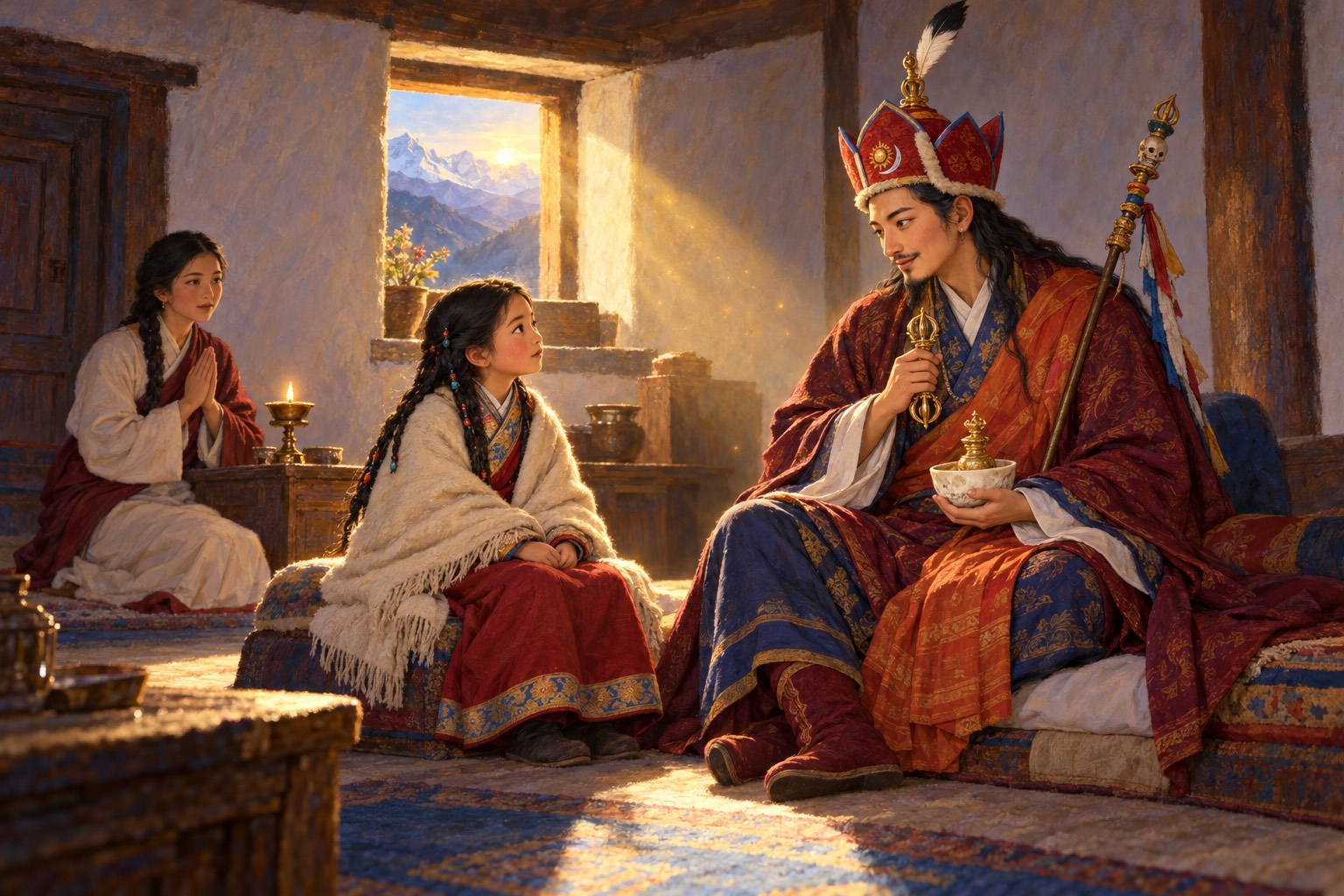
The sources describe the gift in different ways. Rigpa Wiki says he gave her the whole cycle at once, through his power to pass on blessing directly. The Treasury of Lives speaks of instructions and transmission, entrusted to her as her inheritance.
A history kept within the Khandro Nyingtik itself, translated on Lotsawa House, says that Guru Rinpoche and his consort gave her the direct realization of the teaching, and a secret name: Pema Ledrel Tsal.
None of them describes a book placed in her hands. The teaching was given to her mind, the way a seed is set in the ground to wait for its season. Guru Rinpoche, Rigpa Wiki says, empowered her to bring it to light again in a future life.
The sources do not agree on where this happened, either. The Khandro Nyingtik history names Chimphu, the hermitage in the mountains above Samye; the other accounts used here name no place. What the teaching itself contains is for a qualified teacher to give, and the Find a Teacher page can help.
Then, soon after, the accounts say, Pemasal passed away again. The tradition does not tell us how the king bore this second parting. It remembers, instead, what she carried with her.

A treasure in the rock
The teachings were hidden as terma, or "treasure": teachings concealed so that the right person could find them at the right time. Rigpa Wiki and the Treasury of Lives both say that Yeshe Tsogyal, Guru Rinpoche's closest disciple, was given the task of concealing them.
Rigpa Wiki also names the place where they were later found: Tramo Drak, a rock in the region of Dakpo, downstream along the Tsangpo from Samye.

The boy who found it
Centuries passed. Jamgön Kongtrul, the great nineteenth-century collector of treasure teachings, writes that the princess had five pure rebirths. The fifth, by the dates on Lotsawa House and the Treasury of Lives, was born in 1291, into a family descended from the treasure revealer Nyangral Nyima Özer. Rigpa Wiki gives earlier dates.
He was named Rinchen Tsuldor, and when he became a monk, Tsultrim Dorje. When he was sixteen, the Treasury of Lives says, he met an old man, apparently an emanation of Guru Rinpoche, who gave him a list of places where treasures lay hidden. More lists came to him at twenty-one.

At twenty-three he went to Tramo Drak in the Dang valley of Dakpo and brought the Khandro Nyingtik out of the rock. He is remembered by the secret name the princess had been given long before: Pema Ledrel Tsal.

Rigpa Wiki says he decoded the teaching only in part. He passed it to his close disciple Gyalse Lekpa and to the Third Karmapa, Rangjung Dorje. His own life was short. He died at about twenty-five, and Kongtrul writes that after his passing the whole valley was filled with rainbow light for a week.
Longchenpa
Tradition holds that his next birth was Longchenpa (1308–1364), one of the most beloved masters of the Nyingma, the "Ancient" school of Tibetan Buddhism. Rigpa Wiki says Longchenpa received the Khandro Nyingtik from Gyalse Lekpa, so the teaching came back to the one who had first found it.
He wrote commentaries on it that became part of the Nyingtik Yabzhi, the "Heart-Essence in Four Parts." His life is told in Story 14, "Longchenpa, the Vast Expanse." He taught at Chimphu and died there, on the same mountain where, by one account, the princess received her gift.

Pema Lingpa
The thread goes on. Rigpa Wiki calls the Bhutanese treasure revealer Pema Lingpa (1450–1521) the last of Pemasal's five incarnations and, quoting Nyoshul Khenpo, the first of Longchenpa's. Kongtrul, as we saw, counted Pema Ledrel Tsal as the fifth. The sources count differently, and the difference is left here as it stands.
Pema Lingpa's story, with its burning lake and its lamp, is Story 15, "Pema Lingpa and the Burning Lake." It also mentions one of his treasures, a conversation in which the young princess asks Guru Rinpoche how to awaken.
A promise kept
You may notice one word that runs through these names: Pemasal, Pema Ledrel Tsal, Pema Lingpa. Pema, lotus. The second line of the Seven-Line Prayer remembers Guru Rinpoche born on the heart of a lotus. In this story the tradition sees something like a lotus opening again and again across the centuries, still carrying what a little girl was given.
The tradition does not say what this means for anyone else's child, and this page will not say it either. What it offers is a picture of care: a teacher who came to a grieving father, a gift that was not lost, and a promise remembered for centuries.

About the art
This story concerns a child's death, so the death itself is never shown. It is told through symbols instead: a butter lamp going out, a white silk scarf carried off on the wind, and dawn light returning. The princess appears only twice, alive and fully dressed, and always from a respectful distance.
No traditional portrait of Princess Pemasal was found. She is shown in a child-sized version of eighth-century Tibetan court dress, a long robe with wide triangular lapels like the one worn by Yeshe Tsogyal in her youth, but in deep red, so the two are not confused. King Trisong Detsen wears the cream turban and patterned silk robe seen in early paintings of the Tibetan emperors.
Guru Rinpoche appears in his best-known form: the lotus hat with a half-vajra and a single vulture feather, a five-pronged vajra held at his heart, and a slender khatvanga staff at his left shoulder. At the king's side he sits on a simple cushion rather than his lotus throne. The tradition says he traced a sacred syllable over the princess's heart. As on every page of this site, no letter or syllable is drawn in any image.
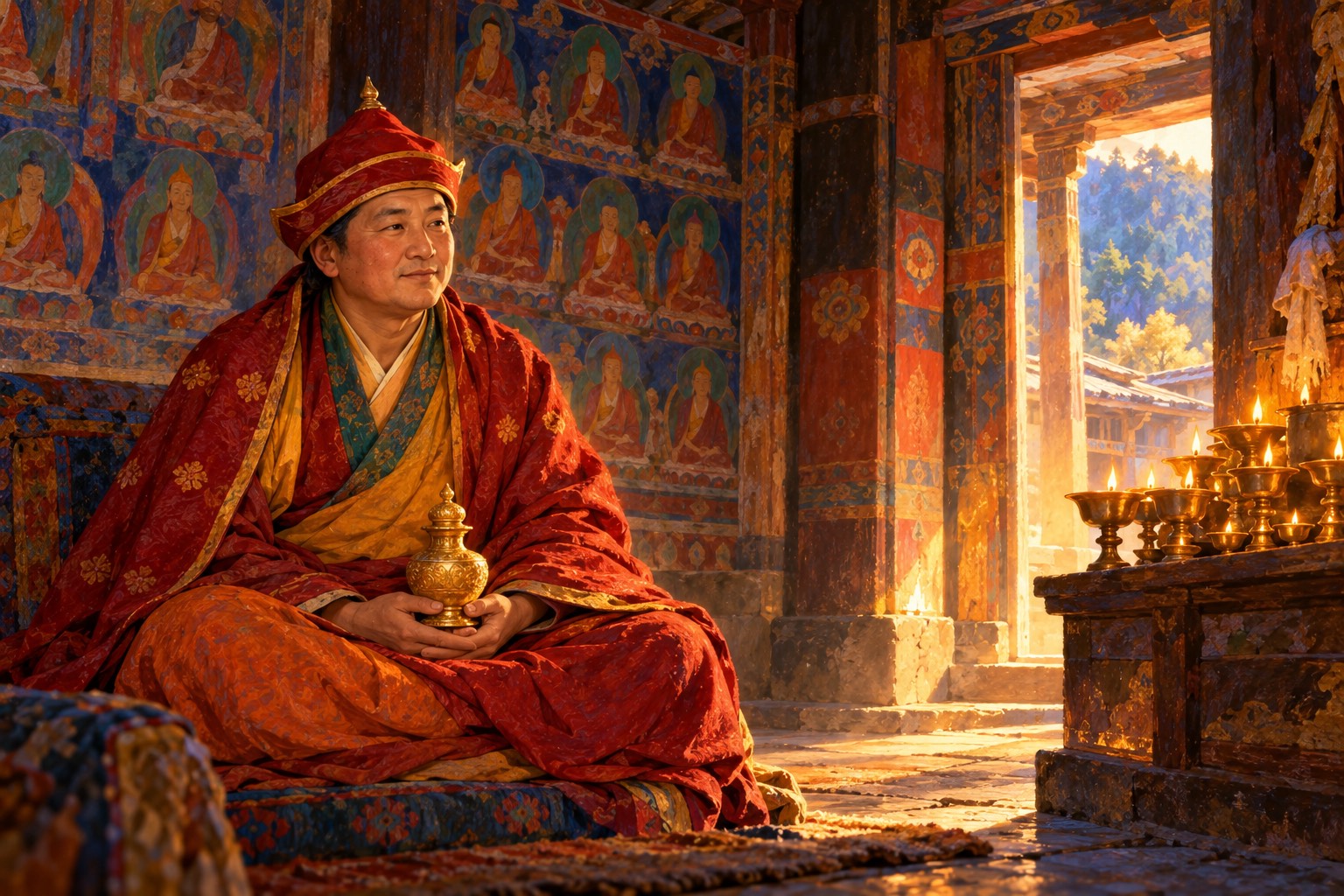
Pema Ledrel Tsal is painted after a small figure at the top of an eighteenth-century painting in the Rubin Museum (Himalayan Art Resources item 65864): a young teacher in a soft dark-red cap, a blue-grey inner garment, an ochre shawl and a red lower robe. Longchenpa wears the tall pointed red hat of a learned master, and Pema Lingpa the red hat with gold trim and the red cloak of his Bhutanese portraits. The scrolls are yellow, the colour traditionally linked with treasure texts, and the brass butter lamps are simple bowls on short stems in the early scenes and the classic chalice shape in the last.
Why this matters for practice
The second line of the Seven-Line Prayer remembers Guru Rinpoche born on the heart of a lotus, and this story follows a lotus name, Pema, from a little princess through the lives the tradition says came after her. It gives a picture of a teacher whose kindness meets a grieving father, and of a gift kept safe across centuries until it could be found. Reciting the prayer is a simple way to turn toward that same kindness, with no more than the wish to remember.

If something in this story touched you, you might light a lamp, or simply pause, for someone you love, and recite the prayer once.
Sources and further reading
- Pema Sal, Rigpa Wiki
- Khandro Nyingtik, Rigpa Wiki
- Pema Ledrel Tsal, Rigpa Wiki
- Trisong Detsen, Rigpa Wiki
- Pema Lingpa, Rigpa Wiki
- Pema Ledrel Tsel, by Ron Garry (2007), Treasury of Lives
- Biography of Pema Ledrel Tsal, by Jamgön Kongtrul, translated by Adam Pearcey (2025), Lotsawa House
- History of the Heart-Essence of the Ḍākinīs, from the Khandro Nyingtik, translated by Adam Pearcey (2026), Lotsawa House
- History of the Lineage of Gurus of the Heart-Essence of the Ḍākinīs, translated by Adam Pearcey (2023), Lotsawa House
- Pema Ledrel Tsal series, Lotsawa House
- Rahula (Buddhist Protector), item 65864, Himalayan Art Resources
This retelling is waiting to be read by a knowledgeable practitioner. Where the traditional accounts differ, the story says so; if you notice a mistake, please tell us through Share Your Story.