
In the fifteenth century, in the deep southern valleys of Tibet, a treasure revealer named Ratna Lingpa took on a task with no visions in it at all. He went looking for old books.
The books were the tantras of the Old School, the Nyingma, scriptures that had come to Tibet in Guru Rinpoche's time. Many survived only in scattered copies, and some scholars doubted they were genuine. Ratna Lingpa gathered them together. This is his story, told as simply as I can from the old accounts.
A boy of Lhodrak
Guru Rinpoche, Padmasambhava, is the "Lotus-Born" master to whom the Seven-Line Prayer is addressed. The tradition holds that in the eighth century he hid teachings to be found in later times. These are called terma, "treasures," and the people who find them are tertöns, treasure revealers.
Ratna Lingpa was born in 1403 at Drushul in Lhodrak, a region of steep green valleys just north of today's Bhutan. Jamgön Kongtrul, the nineteenth-century master who wrote short lives of the treasure revealers, names his father as Dode Dar, a wealthy man, and his mother as Sitar Men. The birth fell, he says, on the fifteenth day of the first autumn month of the Water Sheep year.
He was regarded as the rebirth of Langdro Könchok Jungne, a translator and one of Guru Rinpoche's twenty-five close disciples.
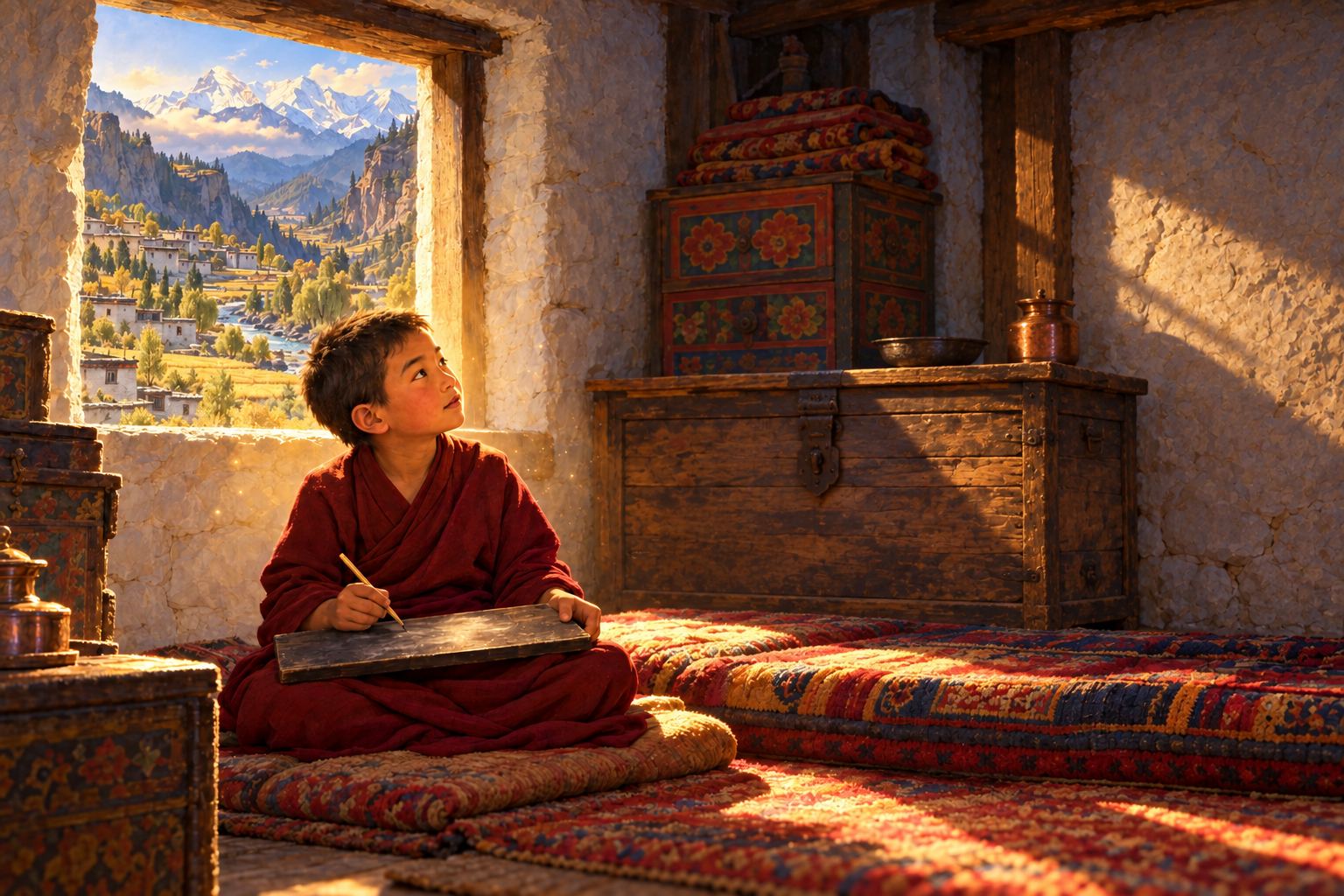
The accounts remember a quick child. Kongtrul says he learned to read and write without effort, and that from about the age of ten he began to have pure visions, glimpses of the world as sacred. He also studied the Dharma widely.
Three scrolls
When he was twenty-seven, the traditional accounts say, Guru Rinpoche came to him in disguise. Kongtrul describes a wandering renunciant from Kham in a yellow hat and yellow robes. The Treasury of Lives speaks of a yogi dressed in yellow raw silk.
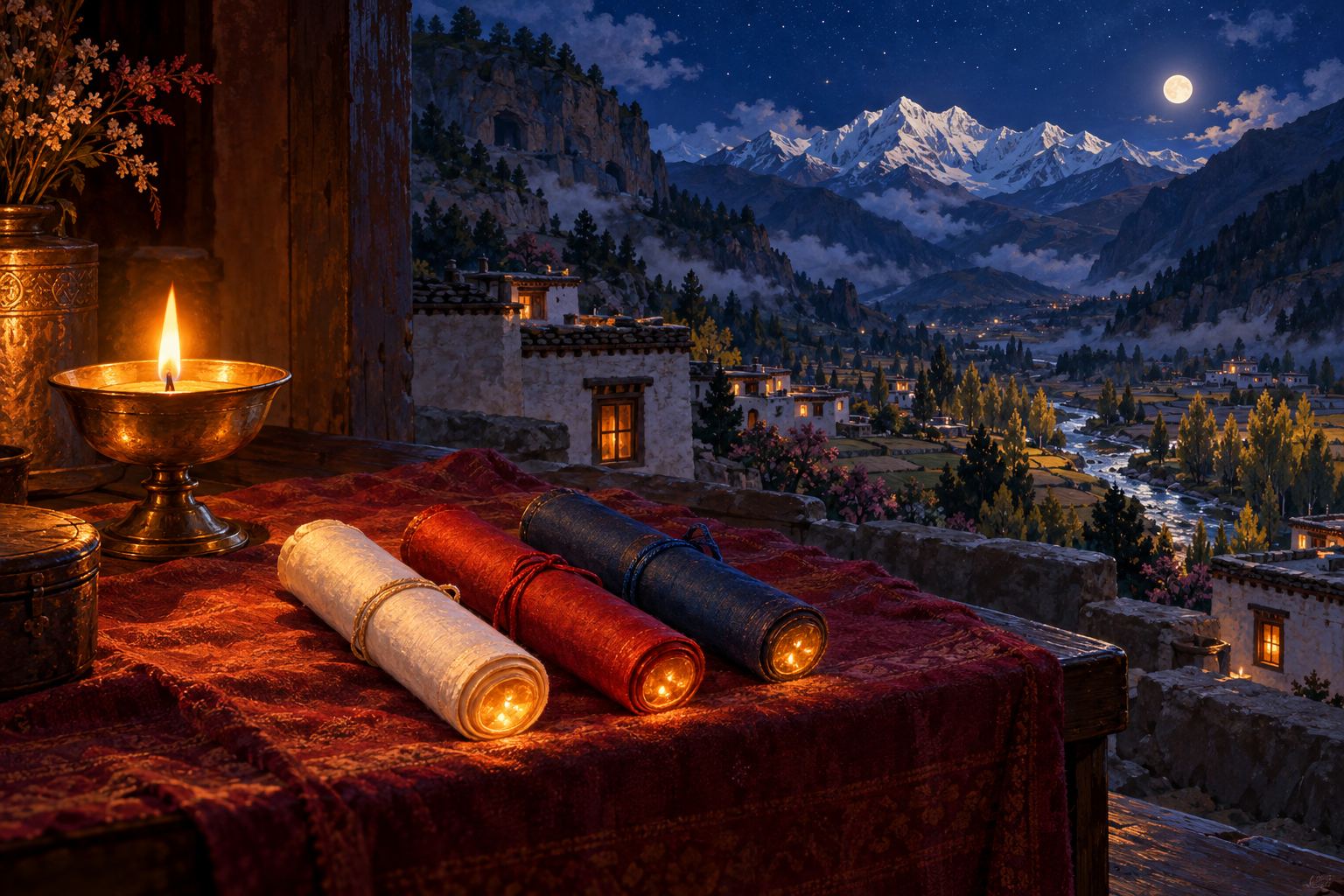
The stranger held out three scrolls, one white, one red and one blue, and asked him to choose one. Ratna Lingpa answered that he wanted all three.
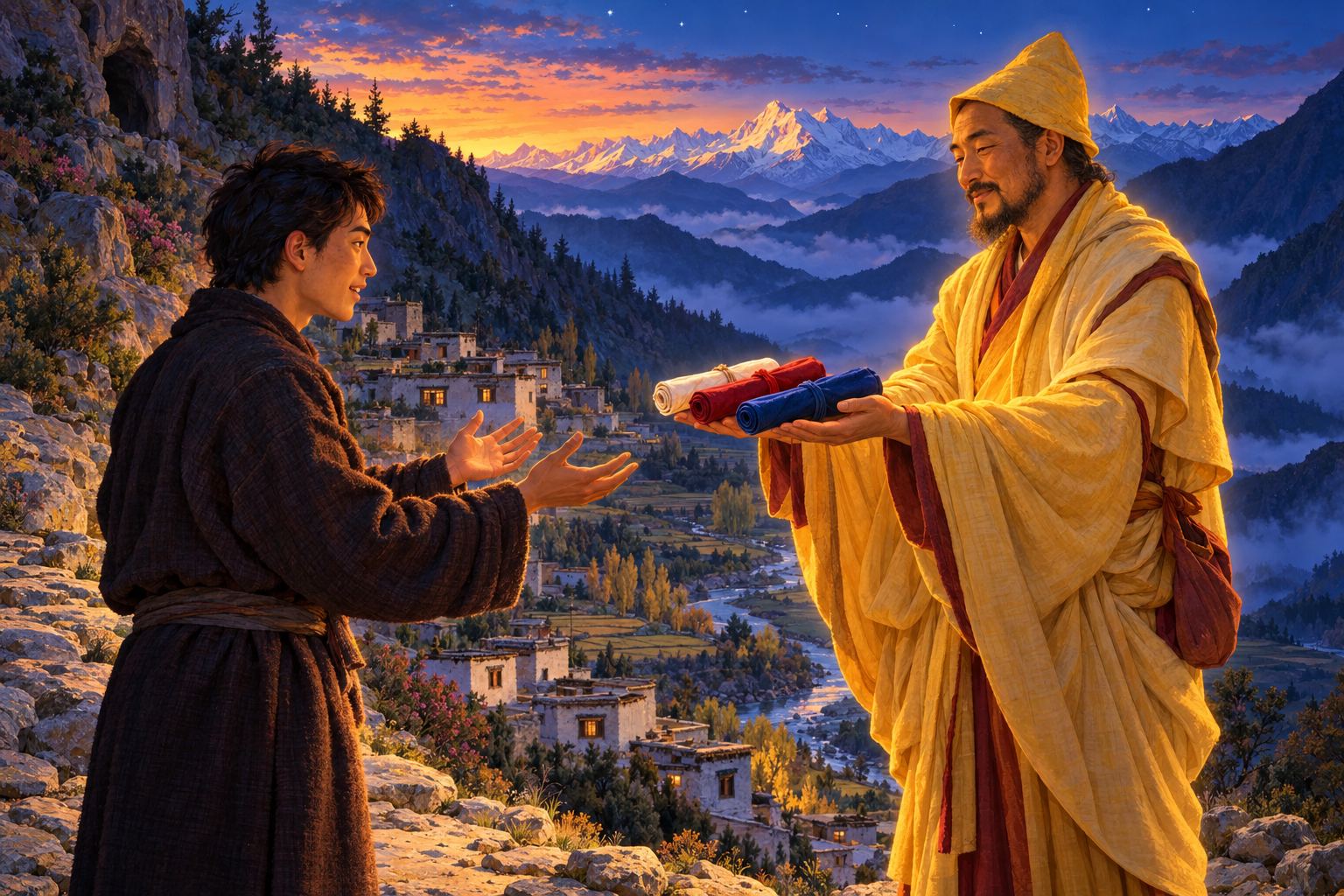
Because of that answer, the accounts say, he received the treasure lists of three lifetimes, and revealed in one life what would otherwise have taken three. That is why he is remembered by three names: Ratna Lingpa, Zhikpo Lingpa and Drodül Lingpa.
I like this story for its plainness. He did not bargain or hold back. Offered a gift, he simply said yes to all of it.
Twenty-five treasures
From the age of thirty he began to reveal treasures in the cliffs and caves of southern Tibet. The first came from a rock called Khyungchen Drak, and others followed at Dritang Koro Drak and at Kharchu Pelgyi Puk, the "glorious cave of Kharchu." The sources count twenty-five revelations in all.

Kongtrul writes that wondrous signs were seen when the treasure came out at Kharchu, and that over his life Ratna Lingpa met Guru Rinpoche twenty-five times. These are the tradition's words, and I pass them on as such.
His cycles range widely: practices of the guru in peaceful and wrathful forms, of the Great Perfection (Dzogchen), and of Mahamudra, the "great seal" teachings on the nature of mind. Two remain best known: the Tsedrub Sangdü, a practice for long life, and the Phurba Yangsang Lamé, a practice of the deity Vajrakilaya. Such practices are received from a teacher, so I only name them here.
A prayer from the Copper-Coloured Mountain
Ratna Lingpa also left short prayers that people still say. One is a prayer to Guru Rinpoche in four lines. A note with it, in his own voice, says that while he was bringing out a cycle called the Fourfold Secret, he found himself one night on the Copper-Coloured Mountain, Guru Rinpoche's pure land, and met him there. The heroes and dakinis, the male and female beings of awakened energy around him, were chanting the prayer together. When he woke, he wrote it down.
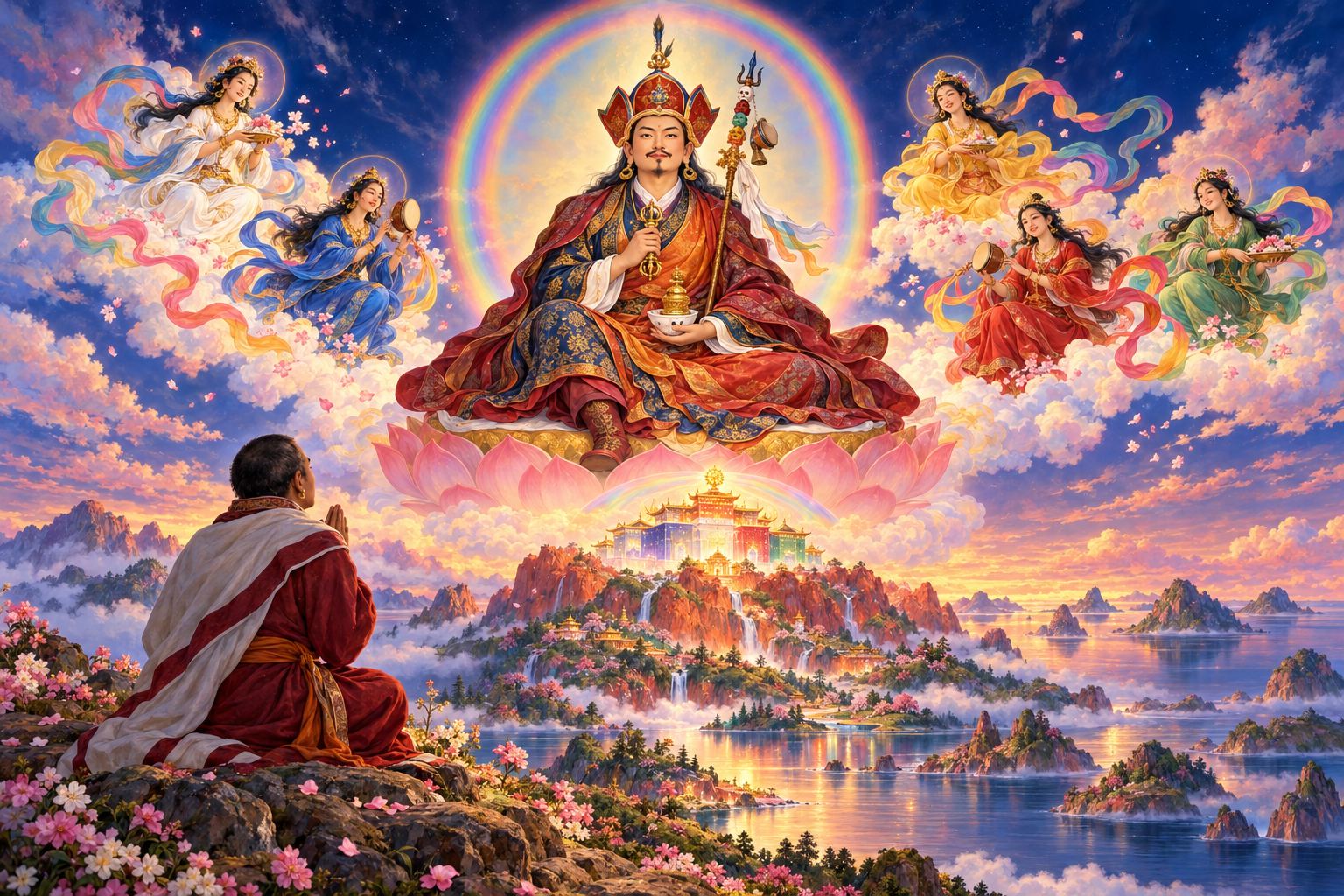
In paraphrase, the prayer calls on Guru Rinpoche as Pema Tötreng, the Lotus Skull-Garland, in whom all buddhas are gathered. It asks him to care for us in every life, to calm what stands in the way, and in the end to bring us to his realm of Lotus Light. Samye Translations published it in English in 2023 from an unpublished manuscript. I have not found it in other sources, so its history is best held lightly.
It is not the Seven-Line Prayer. The Seven-Line Prayer is older and far better known, and it begins in the land of Oddiyana. Ratna Lingpa's verse is a separate, shorter prayer with its own story.
Yet the two meet. One of his treasures is an invocation for the tenth day of the month, the day kept for Guru Rinpoche. Among its instructions, it tells his followers to chant the Seven-Line Prayer in a clear voice, to the sound of drum, conch and cymbal.
He also wrote Cloud Banks of Blessings, a long prayer recounting eleven deeds of Guru Rinpoche's life. Among its first verses is the one the Seven-Line Prayer also remembers: the child born in a lotus in Oddiyana.
The Hundred Thousand Tantras
Now to the old books. In the fourteenth century the great scholar Butön Rinchen Drub shaped the Kangyur, the collected words of the Buddha in Tibetan. The Treasury of Lives notes that he left out major Nyingma tantras, scriptures the Old School traced to the early translators of Guru Rinpoche's time. Their Indian originals were in question, and so was their standing.
Outside the great collection, these texts were at risk. They lived in handwritten copies scattered among temples and family houses, each one written out leaf by leaf.
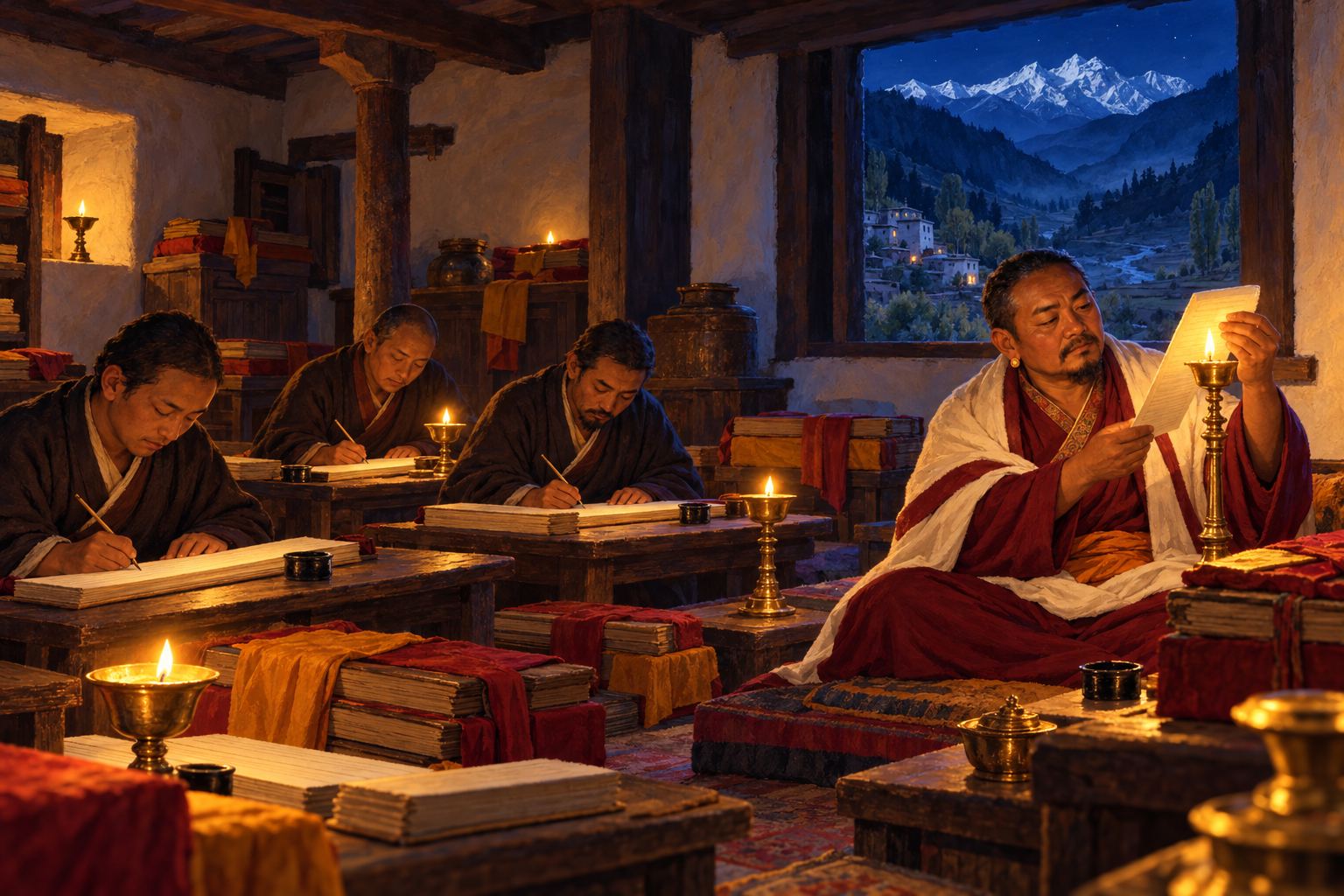
In response, the Treasury of Lives says, Ratna Lingpa gathered the tantric heritage of the Nyingma into one collection, said to have filled forty-two volumes. In valleys without printing, a work like that meant finding copies and having them written out again by hand.
Such a collection is called the Nyingma Gyübum, the "Hundred Thousand Tantras of the Old School." Ratna Lingpa's own set no longer survives. But it is said to have been the basis for the edition that Jigme Lingpa assembled three centuries later, in the 1770s, and through that work it lives on in the collections studied today.
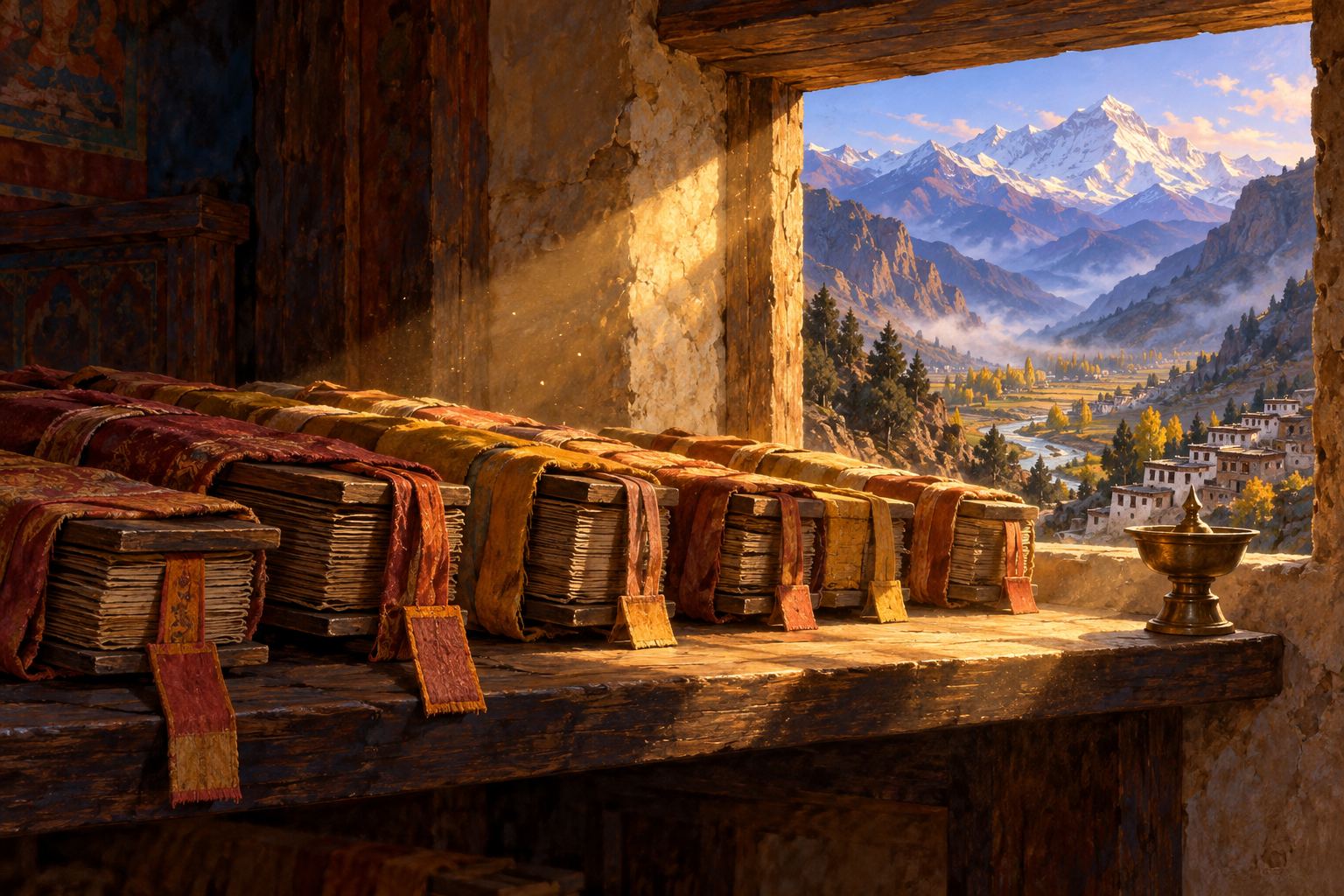
Treasure revealers are usually remembered for what they found. Ratna Lingpa is remembered too for what he kept.
Sons and students
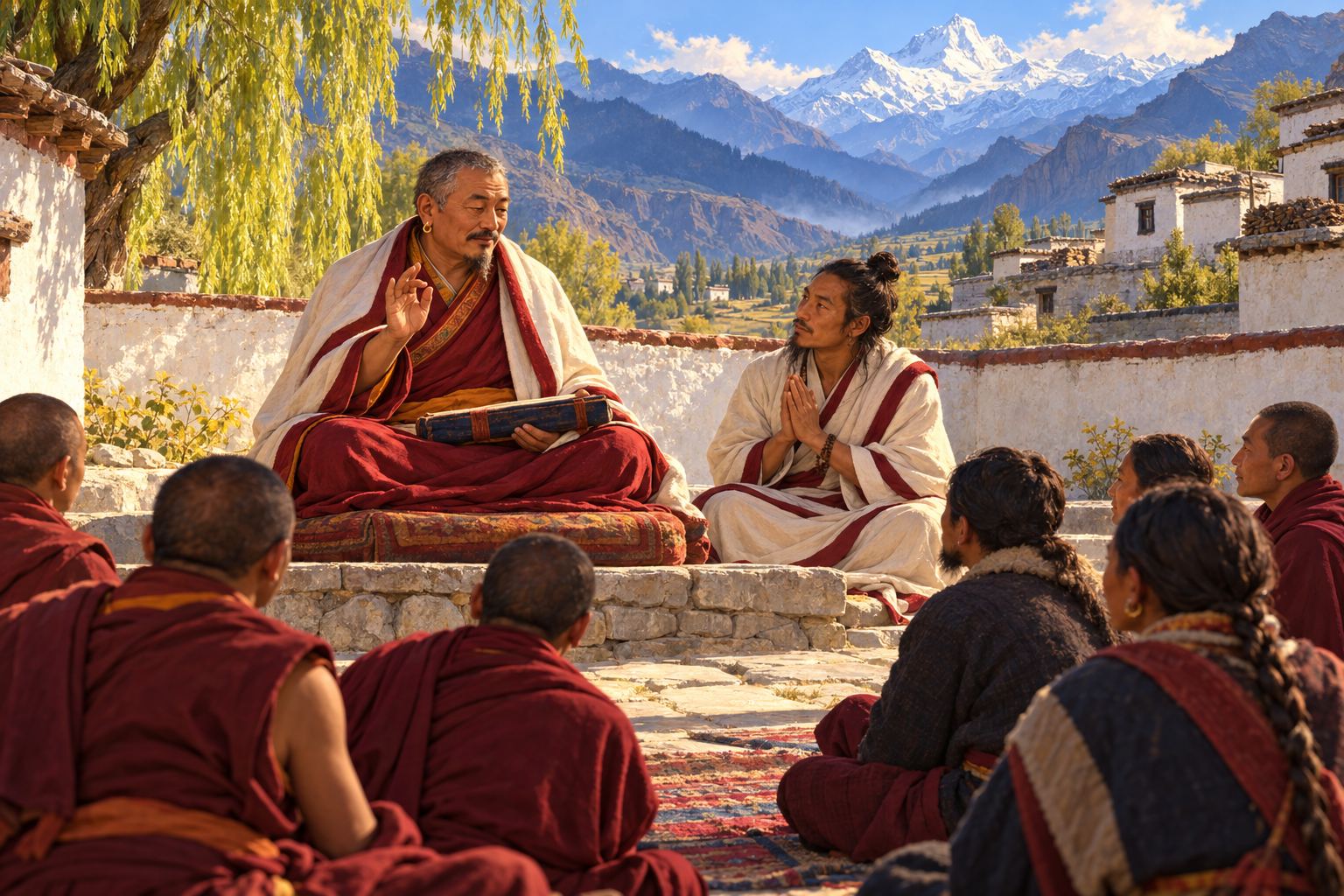
Ratna Lingpa was a lay master with a family, and his lineage passed first through his children, especially his son Rigdzin Tsewang Drakpa. Kongtrul speaks of four "heart sons" and of family and student lines that continued down to his own day.
His students included the Sixth Karmapa, Tongwa Dönden, and the Second Drukchen, Kunga Peljor, two of the great teachers of his century. Kongtrul says his teaching reached people from Mount Kailash in the far west to Gyalmorong in the east.
He died in 1478 or 1479. The sources differ by a year, as often happens when Tibetan ages are counted from birth as one. Kongtrul says that in his seventy-sixth year he passed into the palace of Lotus Light amid great wonders. Pema Lingpa's life story adds that the young tertön of Bhutan saw him in a dream that very day, saying goodbye.

The lineage today
Four centuries later, Jamgön Kongtrul received in eastern Tibet the parts of Ratna Lingpa's cycles that had come down there, and his great collection of treasures, the Rinchen Terdzö, includes Ratna Lingpa's texts. Kongtrul writes that he set up regular group practice of them at Palpung Monastery.
The Treasury of Lives notes that the long-life and Vajrakilaya cycles are still practised, and his prayers are now being translated and recited in English. I could not confirm the details of his family line in our own time, so I leave that to those who know it.
Whenever someone opens a volume of the Old School's tantras, or says one of his short prayers, a little of his patient work goes on. For anything beyond recitation, the practices he revealed are given by a qualified teacher; the Find a Teacher page on this site is a place to start.
About the art
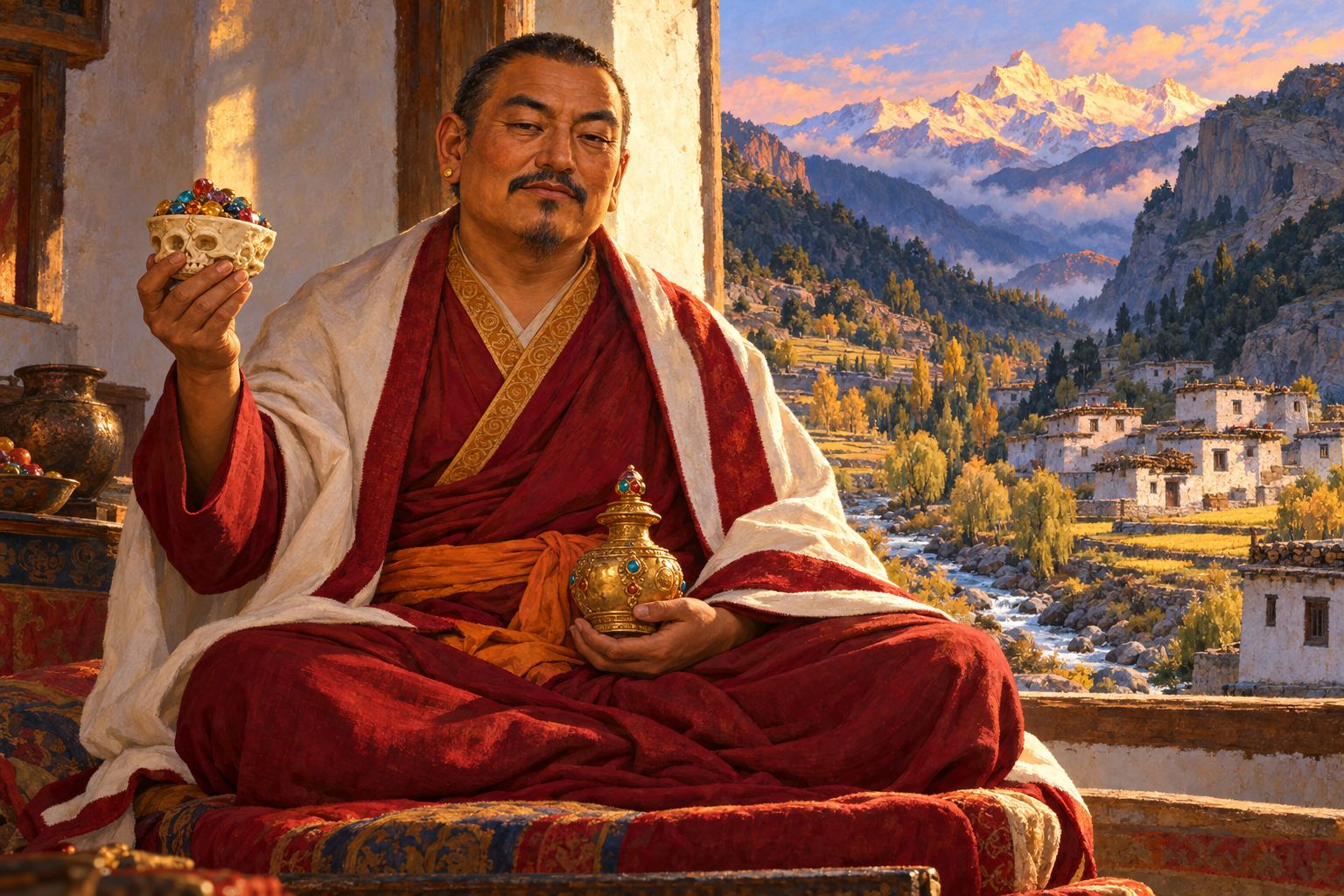
Ratna Lingpa is drawn from the one portrait I found, a line drawing from the book Nyingma Icons published by Himalayan Art Resources (item 66250), which is also the image on his Lotsawa House page. It shows a lay master, not a monk: bare-headed, with short cropped hair, a thin moustache and a small beard, an earring, and a plain wrap robe and shawl. In his raised right hand he holds a skull cup heaped with jewels, and in his left a long-life vase, the emblem of practices for long life, which suits the long-life cycle he is remembered for. Because the drawing has no colours, the maroon robe and white shawl with a red border are a choice. In the scenes of his youth he holds nothing and has no beard.
Guru Rinpoche appears twice. On the mountain path he comes in disguise, as the accounts describe, as a wandering yogi in yellow silk, so he wears none of his usual emblems. In the vision of the Copper-Coloured Mountain he appears in his main form: the lotus hat with a half-vajra and a single vulture feather, the vajra at his heart, the skull cup holding a long-life vase, and the slender staff called the khatvanga in the crook of his left arm, all within a sphere of rainbow light, with dakinis in five colours around him.
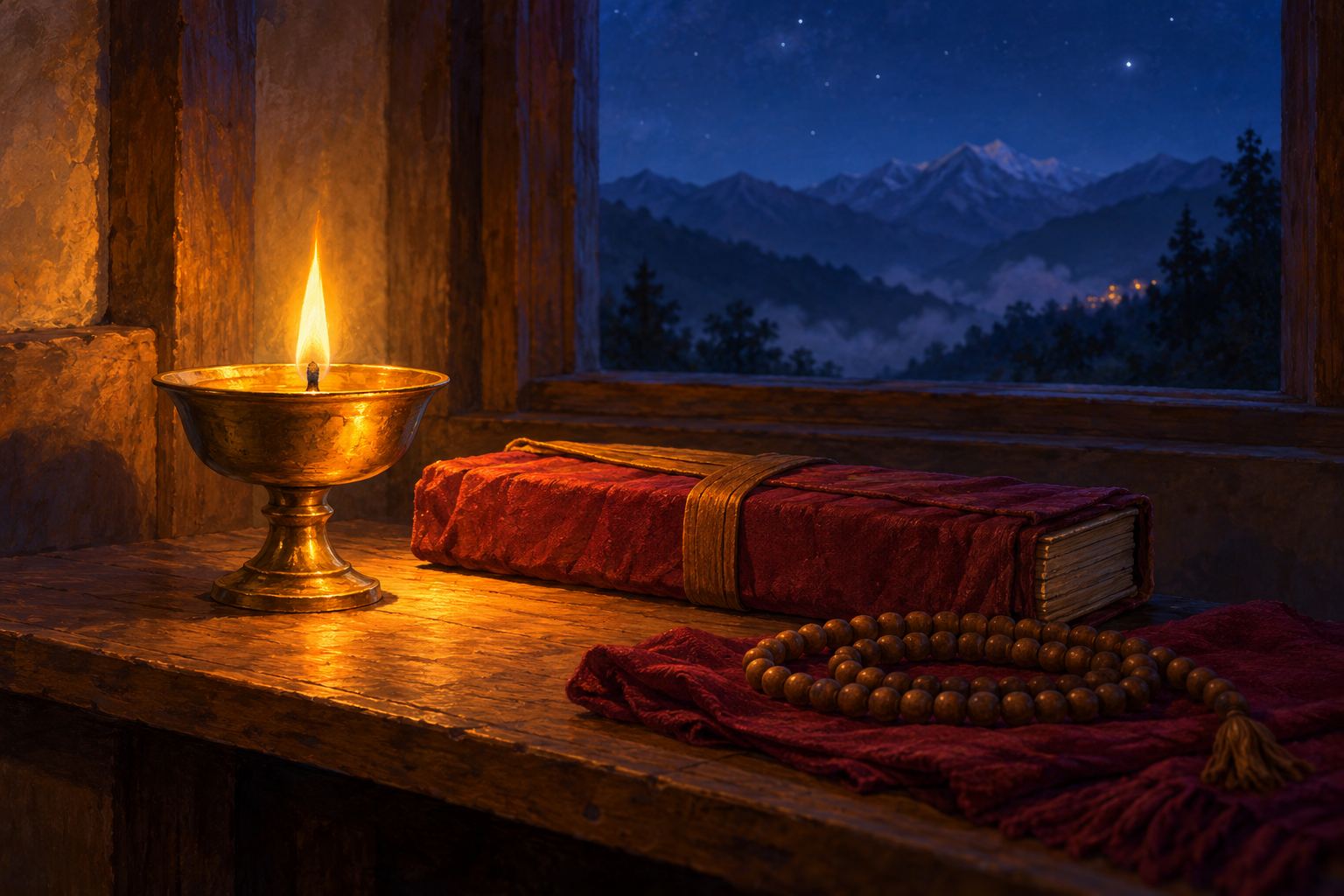
The books are shown as Tibetan books were made: long loose leaves of handmade paper stacked between wooden boards and wrapped in cloth. No page in the pictures carries real writing, because image tools cannot draw Tibetan script faithfully. Lhodrak is shown as a green, steep valley country of stone houses and terraced barley. No picture or description of the treasure cliffs was available, so they are kept general. The young lay yogi in the courtyard scene stands for his son and is not a portrait.
Why this matters for practice
Ratna Lingpa's own treasure for Guru Rinpoche's day tells his followers to chant the Seven-Line Prayer in a clear voice, and his Cloud Banks of Blessings sings, as the prayer does, of the child born in a lotus. His life also shows a quieter kind of devotion: copying and keeping what others might lose. Reciting the prayer once is a small way of keeping it alive too.

If something in this story stayed with you, perhaps a man who asked for all three scrolls, or one who carried old books through the valleys so they would not be lost, you might pause tonight and recite the Seven-Line Prayer once. Nothing more is needed.
Sources and further reading
- Ratna Lingpa, Treasury of Lives (Jakob Leschly, 2007), web.archive.org snapshot of 2015
- rat+na gling pa: Jamgön Kongtrul, Lives of the Hundred Tertöns (Rinchen Terdzö vol. 1, pp. 571–574), Tibetan and Wylie, Tsadra Foundation, Khyentse Lineage wiki (web.archive.org snapshot, 2025)
- Ratna Lingpa (author page and texts), Lotsawa House
- A Prayer to Padmasambhava (four-line prayer), trans. Stefan Mang and Oriane Lavolé, Lotsawa House (Samye Translations, 2023)
- The Invocation of Uḍḍiyāna on the Tenth Day, trans. Peter Woods and Stefan Mang, Lotsawa House (Samye Translations, 2019)
- Cloud Banks of Blessings: A Prayer Recounting the Eleven Deeds, trans. Stefan Mang, Lotsawa House (Samye Translations, 2016–2017)
- Ratna Lingpa, Rigpa Wiki (web.archive.org snapshot, 2024)
- Ratna Lingpa; Nyingma Gyubum, Rangjung Yeshe Wiki (web.archive.org snapshots, 2025)
- Teacher: Ratna Lingpa (set 5000) and item 66250, Himalayan Art Resources
- The Life and Revelations of Pema Lingpa (excerpts), trans. Sarah Harding, Shambhala / Snow Lion (web.archive.org snapshot, 2022)
- Ratna Lingpa, Encyclopedia of Buddhism
- The Nyingma School of Tibetan Buddhism (Dudjom Rinpoche, trans. Gyurme Dorje and Matthew Kapstein), vol. 1, pp. 793–795, Wisdom Publications, 1991
This retelling is waiting to be read by a knowledgeable practitioner. Where the traditional accounts differ, the story says so; if you notice a mistake, please tell us through Share Your Story.