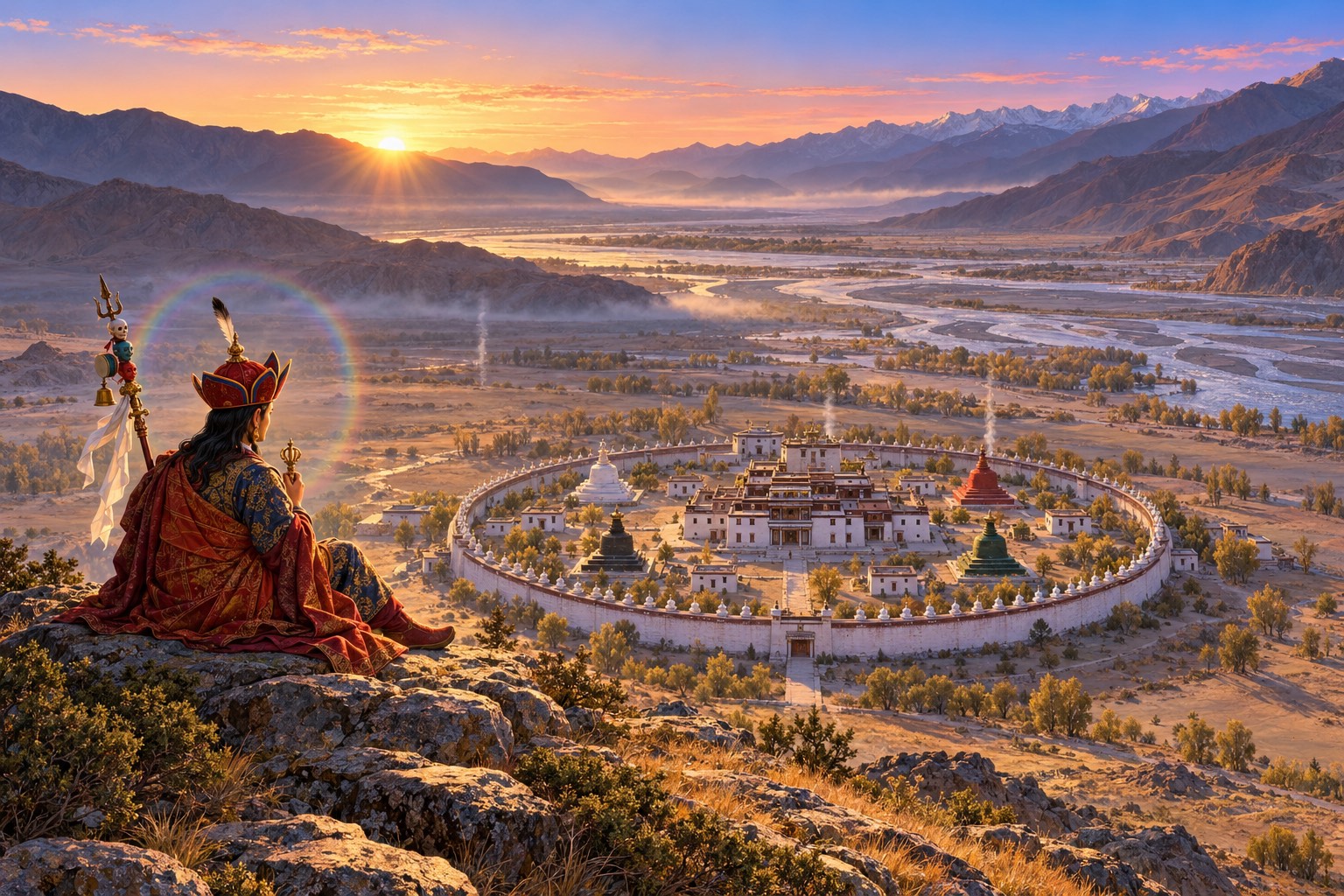
Some prayers are composed. Others, the Tibetan tradition says, are found. This is the story of the man remembered for finding the Seven-Line Prayer and setting it on its way: Guru Chökyi Wangchuk, known to most people simply as Guru Chöwang.
He lived some five hundred years after Guru Rinpoche, "Precious Teacher," is the name Tibetans most often use for Padmasambhava, the eighth-century master to whom the prayer's seven lines are addressed.
A name written at the moment of birth
Chökyi Wangchuk was born in 1212 in Lhodrak, a region of deep, wooded valleys in southern Tibet, near today's border with Bhutan. His father, Pangtön Drubpai Nyingpo, was a lay tantric scholar, and his mother was named Karza Gönkyi.
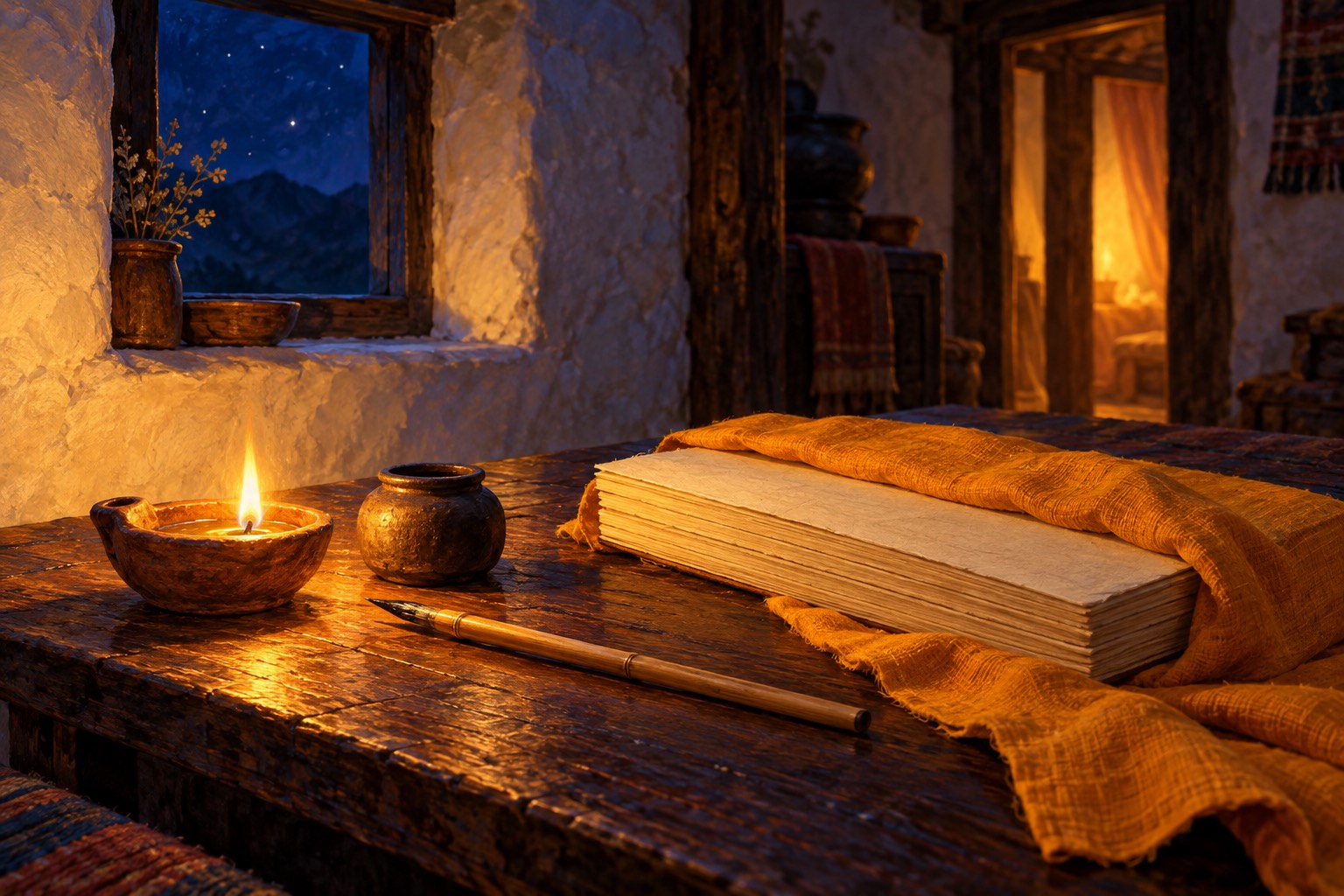
The family remembered how he got his name. When his mother went into labor, his father was copying out a scripture in praise of Manjushri, the buddha of wisdom. At the moment of the birth he had just written the words "lord of the Dharma," which in Tibetan is chökyi wangchuk. So that became the boy's name.
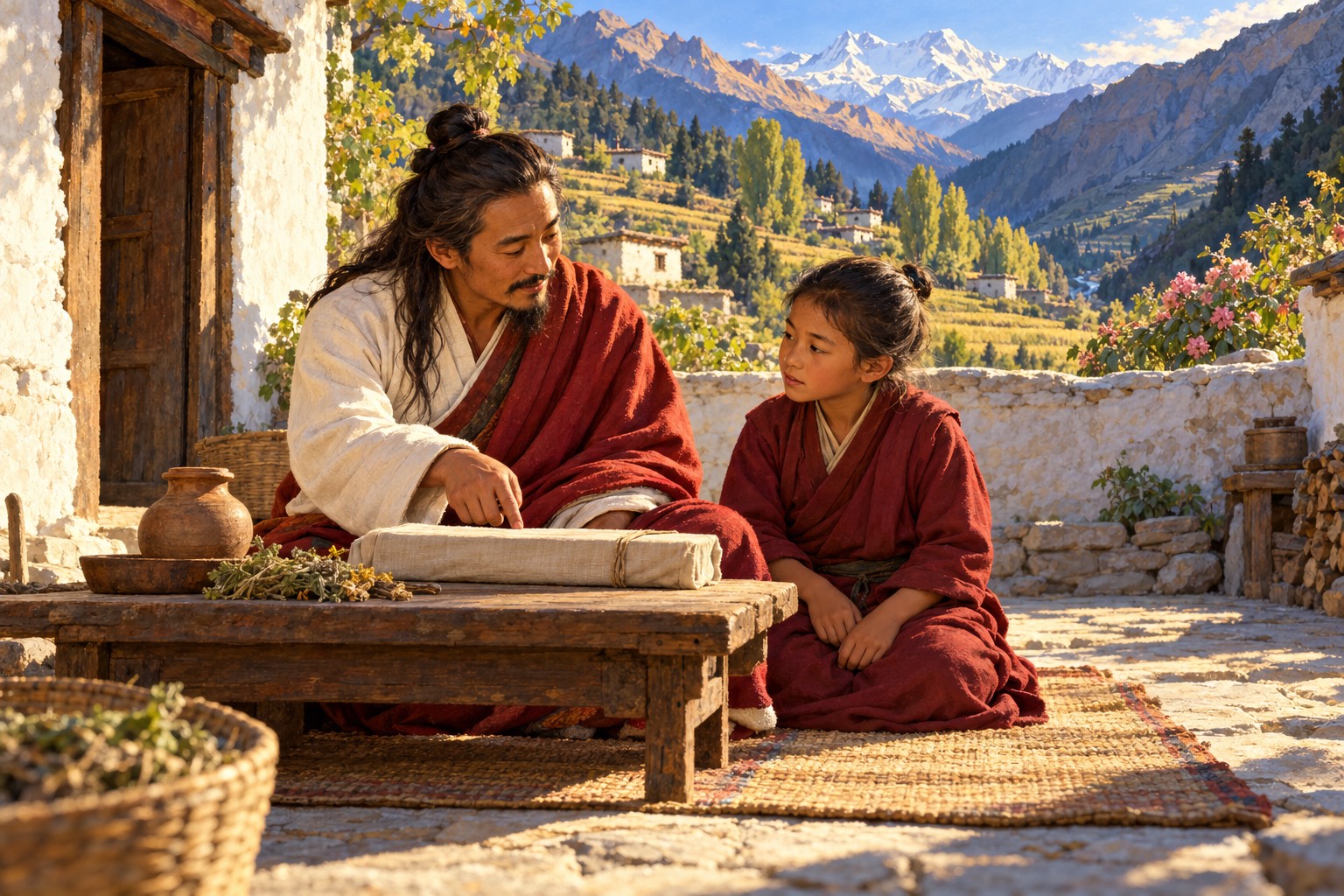
His father was also his first teacher. According to his Treasury of Lives biography, the boy was reading and writing at four. By ten he was studying medicine, astrology and tantric practice, and in his teens teachings of both the older and newer schools.
Heir to a treasure
To follow what happened next, it helps to know the word terma, "treasure." The Nyingma tradition holds that Guru Rinpoche and his disciple Yeshe Tsogyal hid teachings in rocks, lakes and even in the minds of disciples. They were to be found centuries later by destined people called tertöns, treasure revealers.
At seventeen, Chökyi Wangchuk met Ngadak Drogön, son of Nyangral Nyima Özer (1124–1192), the great earlier tertön of Lhodrak, and received from him the transmissions of Nyangral's treasures. The next year he took the bodhisattva vow, the promise to awaken for the sake of all beings, from the renowned scholar Sakya Pandita.
Later tradition counts Nyangral and Guru Chöwang as the first two of five "king" treasure revealers. It calls Chöwang an emanation of the speech of King Trisong Detsen, Guru Rinpoche's royal patron, and remembers him as Nyangral's rebirth.
The historian Daniel Hirshberg adds a human detail: the rebirth claim was Chöwang's own, made even though Nyangral had declared himself the last of his line. Devotion and history tell this link a little differently, and both are worth hearing.
The dangerous list
His biography says that at thirteen he came into possession of a treasure inventory, a kind of guide naming where teachings lay hidden. It was said to have been found at Samye by the earlier master Drapa Ngönshe. People said treasure seekers had nearly died following it, so his father hid it.
At twenty-two, with the help of a practitioner of Chöd, a meditation for cutting through self-clinging, he got it back.
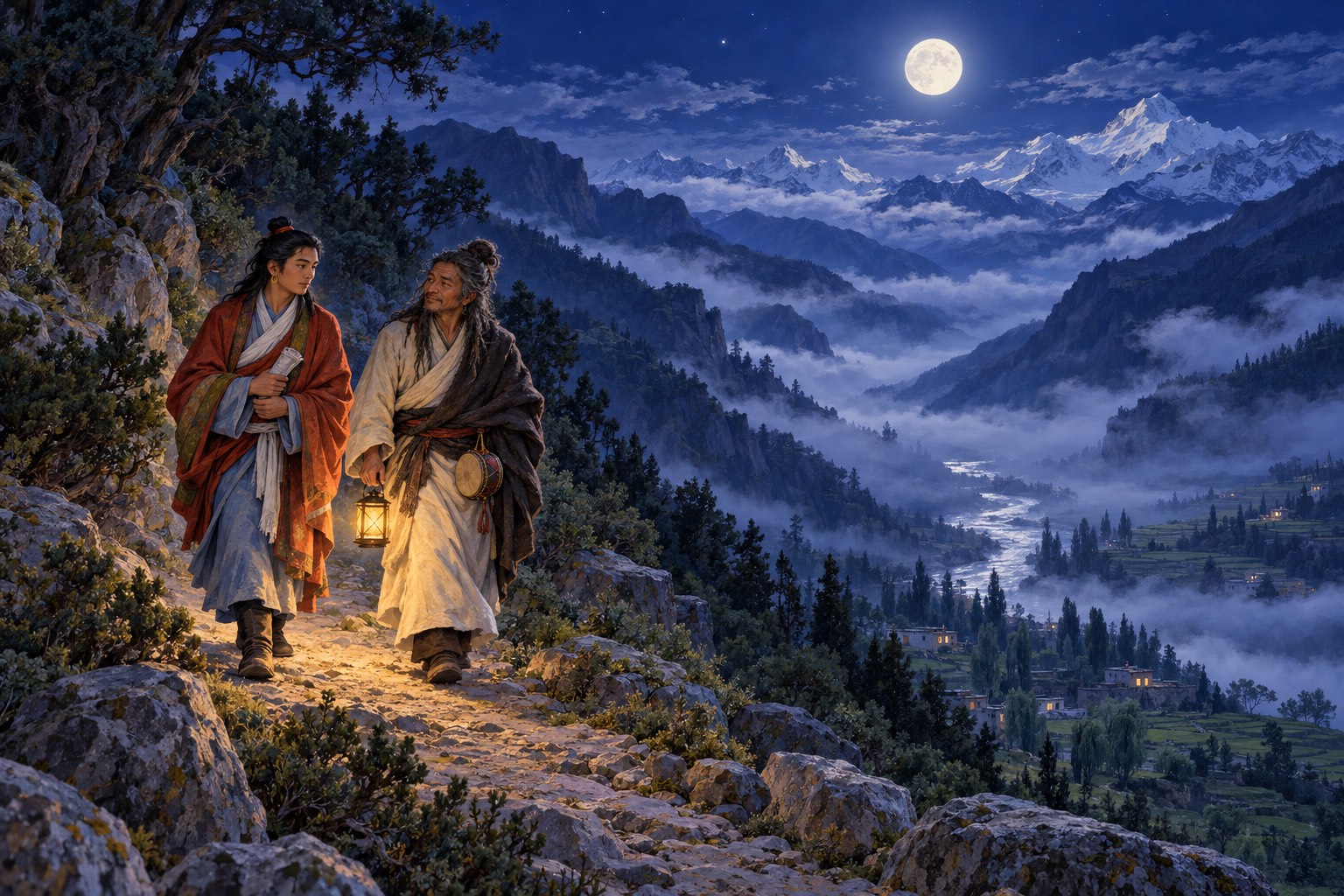
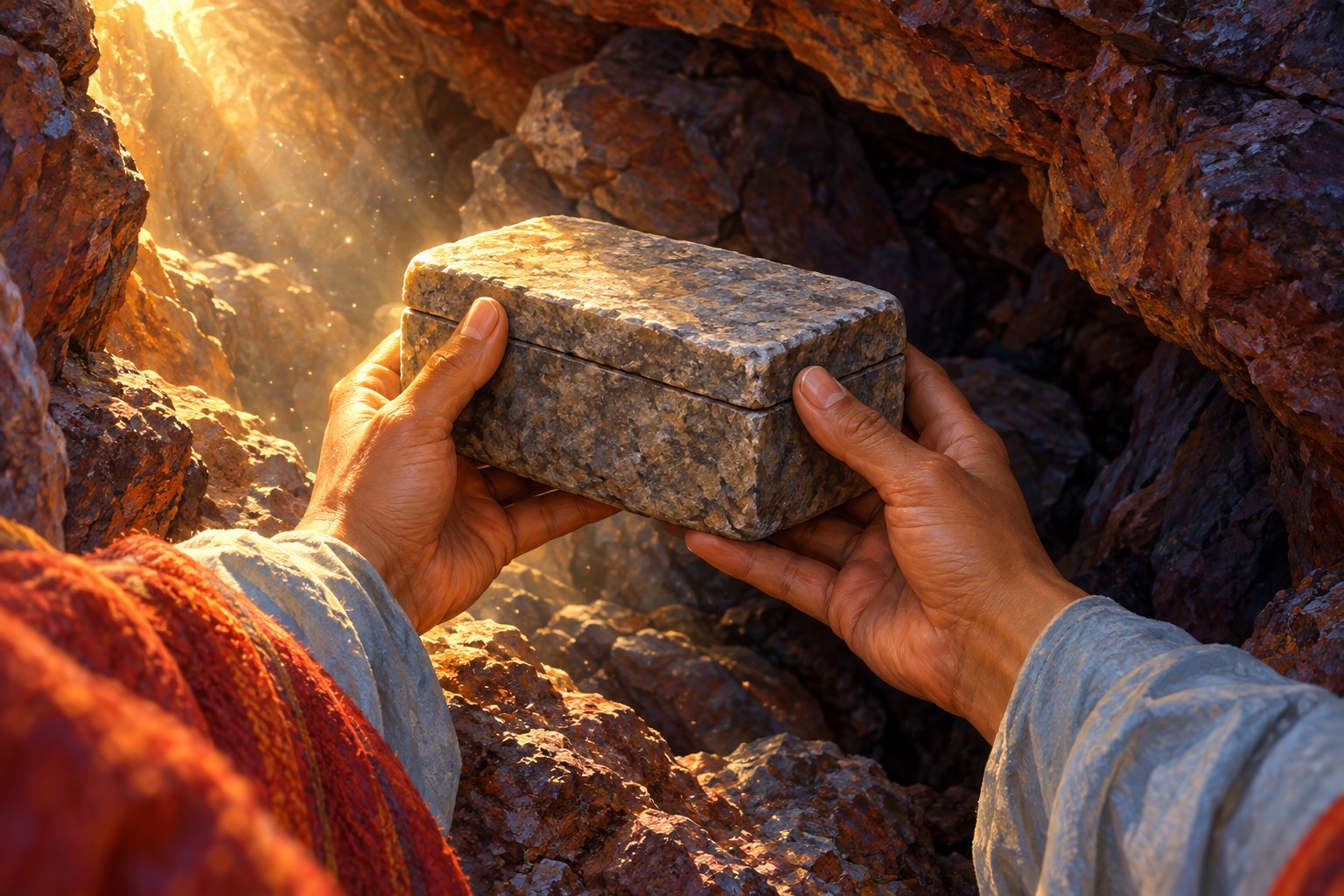
The inventory led him to a second, supplementary guide in a valley called Namkechen. There, the accounts say, he revealed a great trove of texts and sacred objects. A homage verse on Lotsawa House praises him for bringing three cycles of more than a hundred texts out of this place, which it calls Namkhé.

In all, tradition credits him with eighteen troves of earth treasure, meaning texts and objects drawn from the physical world. He is also credited with one mind treasure, a teaching said to surface from the depths of the revealer's own mind.
The prayer among the treasures
One of his revelations was a cycle called the Lama Sangdü, "the Secret Embodiment of the Guru," a body of practice centered on Guru Rinpoche. Treasury of Lives notes that the Seven-Line Prayer is part of it, and Lotsawa House presents his text as the prayer's original revelation.
That short text, in a translation by Rigpa Translations, speaks in Guru Rinpoche's voice to the fortunate men and women of the future. In paraphrase: go somewhere quiet, let your heart turn toward what truly matters, and rely on him completely. No elaborate offerings or praise are needed. Simply pray with these seven lines, with body, speech and mind. "Pray in this way, over and over again."
In its closing lines the text asks that this instruction be kept as a secret treasure until it meets a person of wisdom and great compassion named Chökyi Wangchuk. In the tradition's telling, the treasure was addressed, centuries ahead, to the very man who found it.
Where was the prayer before that? Here history and tradition part ways, gently. Historians can trace the written prayer back to Guru Chöwang's revelation and no further. The tradition says it is far older: that dakinis, the wisdom beings of the prayer's fifth line, sang these words to call Guru Rinpoche into the world. A treasure, as the tradition understands it, is not invented by its finder. It is recovered.
Setting down the rules
Guru Chöwang was not only a finder. He was also one of the first to write about the treasure tradition itself. His Great History of Treasures is among the earliest surveys of the subject, and the scholar Janet Gyatso has studied it closely.
He helped set standards that later generations followed loosely but widely. A complete treasure cycle, he held, should contain three things: a practice of the guru, a teaching of Dzogchen (the Great Perfection), and a practice of Avalokiteshvara, the buddha of compassion. He also said plainly that some treasures were false, even naming names.
Treasury of Lives records the counsel his father gave when he confirmed his son's first great find. Put the teachings on the guru, the Great Perfection and compassion first, he said, and keep away from magic, curses and talk of miracles. Treasure revealers who chased wealth, he warned, had done little good.
Jomo Menmo
Guru Chöwang's spiritual partner, or sangyum, was Jomo Menmo (1248–1283), one of the earliest women remembered as a treasure revealer. She was born Pema Tsokyi near Zarmolung, in a valley linked with Guru Rinpoche and Yeshe Tsogyal, and she is regarded as an emanation of Yeshe Tsogyal.
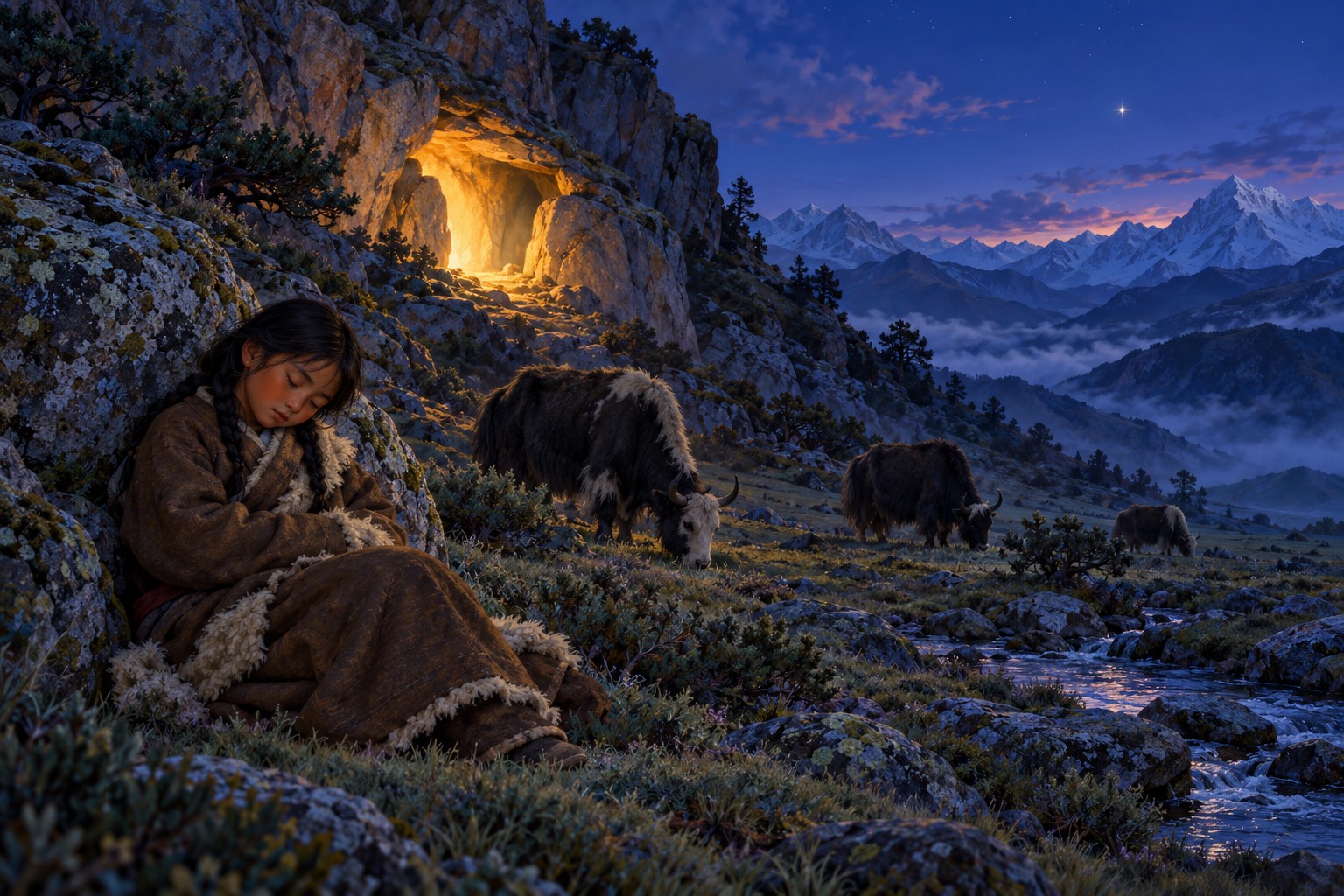
Her life story says that at about thirteen, while herding animals in the high pastures, she fell asleep near a cave. In a vision there, she received a teaching called the Gathering of All the Dakinis' Secrets. Later, when she sang and taught openly, neighbors decided she was mad or possessed by a menmo, a kind of spirit, and the nickname stayed with her.
She met Guru Chöwang at Layak in Lhodrak. The accounts say he recognized her at once, and that their partnership helped him come to a full understanding of one of his own revelations. He advised her to keep her treasure secret for the time being, because its moment had not yet come.

Later she wandered through central Tibet with two women companions. The traditional accounts say that in 1283 the three of them made a final offering on a mountaintop and departed into the sky, leaving nothing behind. Her treasure was revealed again in the nineteenth century by Jamyang Khyentse Wangpo.
A temple in Lhodrak
Guru Chöwang made his home at Layak Guru Lhakhang, also called Samdrub Dewachenpo, at Lhalung in Lhodrak. Treasury of Lives credits him with founding it. An older tradition, recorded by the traveler Hugh Richardson, says Guru Rinpoche founded it first and Chöwang rebuilt it. Its plan was said to follow Nalanda, the great monastic university of India.
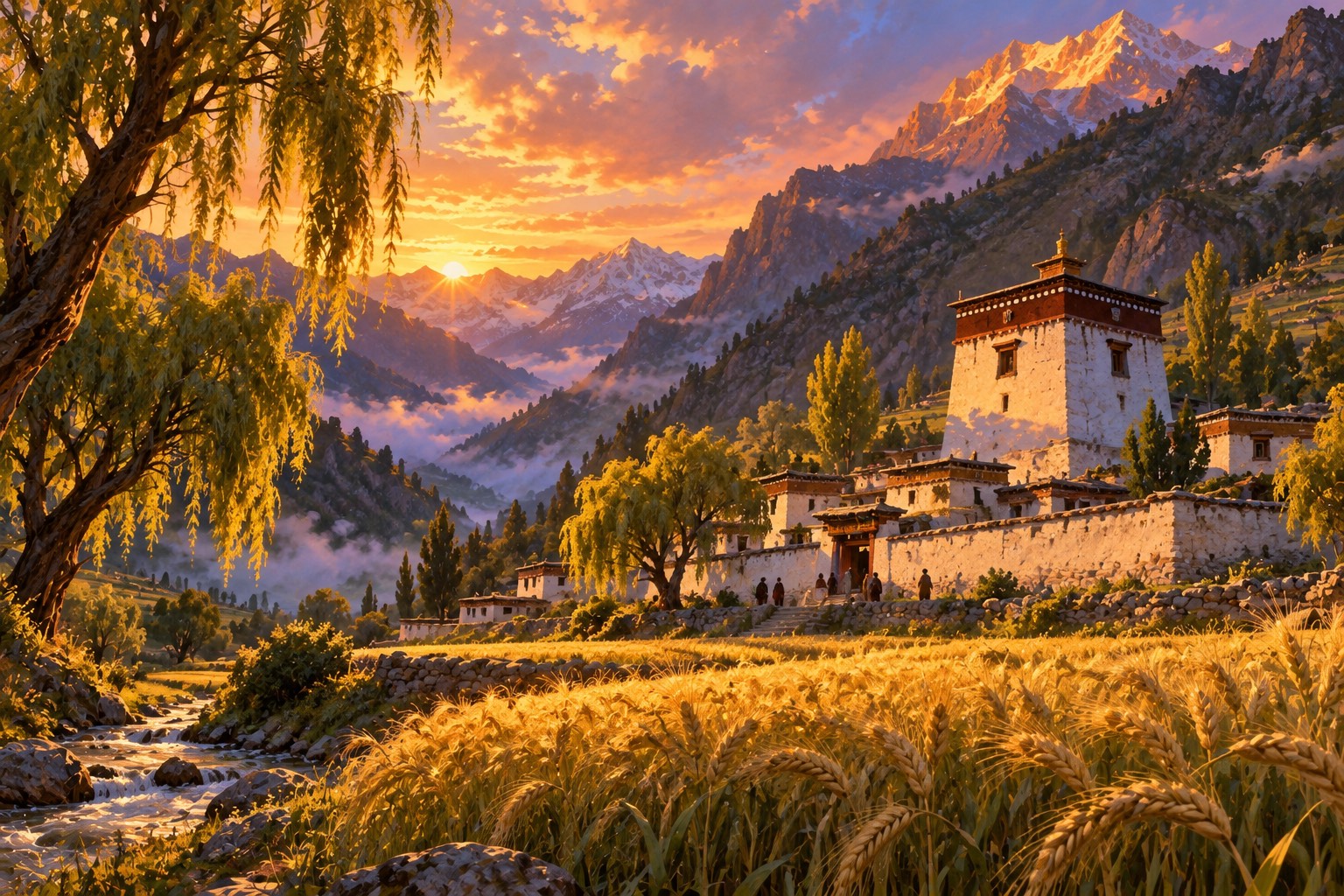
He taught widely. His students included Bharo Tsukdzin, a Newar master of the Kathmandu valley, and Mani Rinchen of Katok in eastern Tibet. His two sons, Pema Wangchen and Nyal Nyima Özer, carried his teachings on. He died in 1270, though one note of Richardson's gives 1273.
How the prayer spread
The Lama Sangdü did not stay in Lhodrak. According to Treasury of Lives, it became the core of a great yearly sacred dance, the Eight Manifestations of Guru Rinpoche, performed at most Nyingma monasteries. It is usually held on the tenth day of the fifth or sixth lunar month.
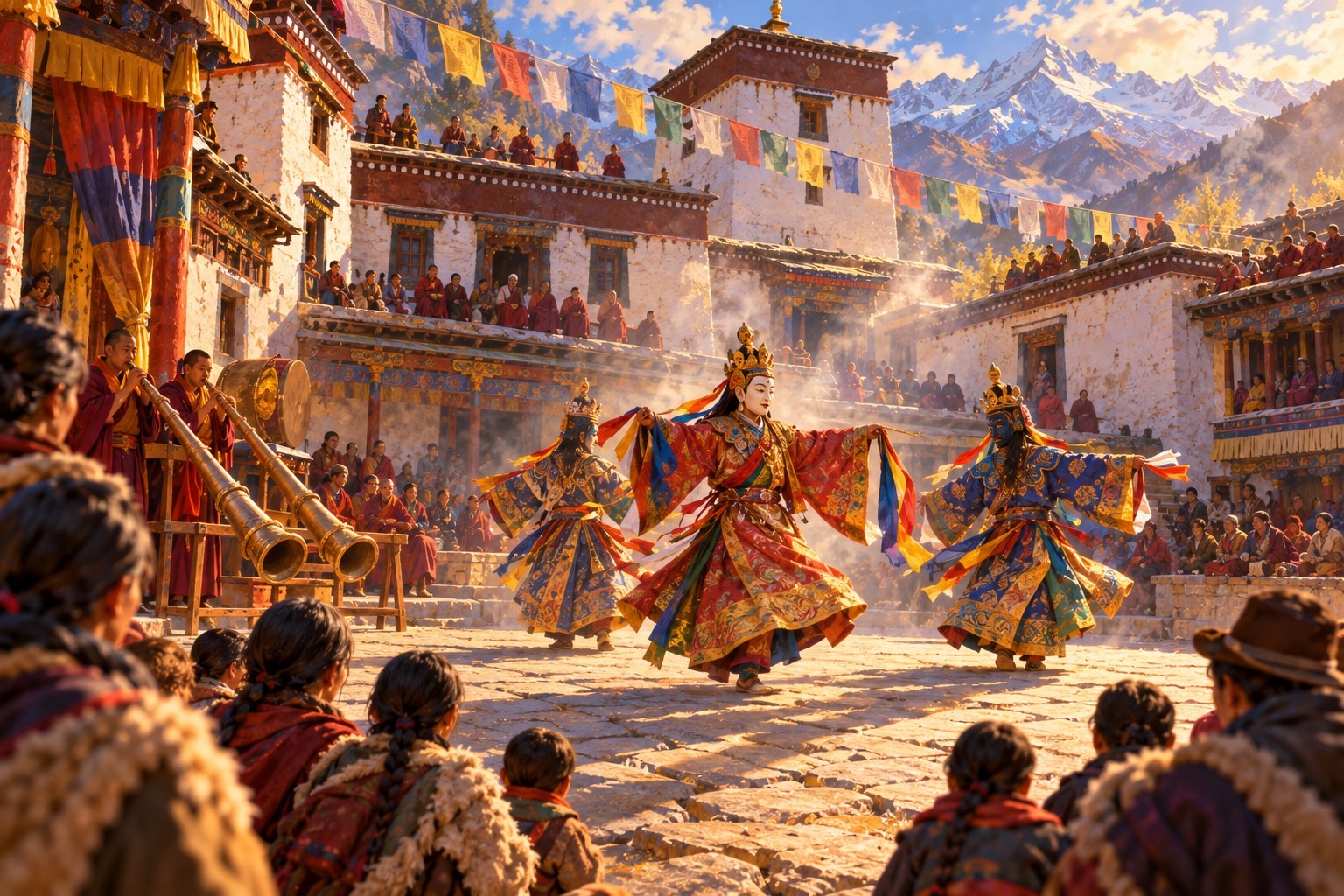
In the seventeenth century, Minling Terchen Gyurme Dorje compiled a ritual manual so that the Lama Sangdü could be offered at Mindrolling Monastery on the tenth day of every lunar month, the day associated with Guru Rinpoche. In the nineteenth century it became the main guru practice in the Rinchen Terdzö, Jamgön Kongtrul's vast collection of treasure teachings. Rigpa Wiki notes that it is practiced in all the schools of Tibetan Buddhism.
The seven lines also traveled on their own. Jamgön Mipham (1846–1912) built a beloved guru yoga around them, A Shower of Blessings, and wrote White Lotus, a long explanation of their layers of meaning. He called this prayer the most majestic of all prayers to Guru Rinpoche. Dodrupchen Jigme Tenpe Nyima, Dudjom Rinpoche, Thinley Norbu and many others taught on it.
Those deeper practices are for a qualified teacher to give; the Find a Teacher page can help. But the prayer itself is open to anyone, and today monks, nuns, lay families and newcomers say it in many languages.
A prayer that found its way
Nearly eight hundred years have passed since a lay master in a hidden valley of southern Tibet brought it to light. The instruction attached to it has not grown more complicated: no grand offerings, just the seven lines and a sincere heart, again and again.
About the art
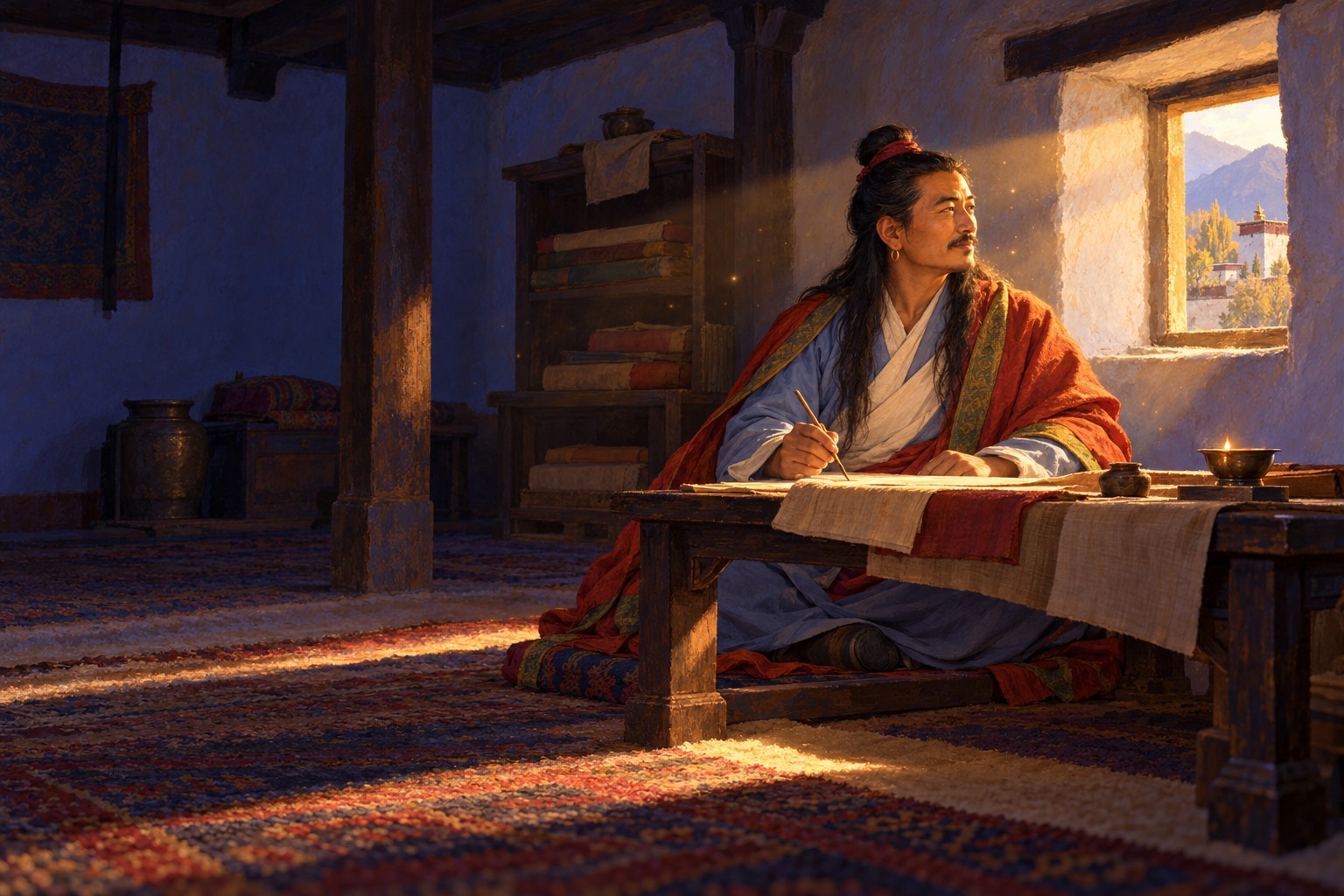
Guru Chöwang is shown as his traditional portraits show him: a lay tantric master, not a monk. He has his hair in a topknot with long locks over his shoulders, a thin moustache and earrings, and a red-orange shawl over pale blue and white layers. These details follow a Shechen Monastery mural, a painted clay portrait sculpture and a line drawing from the book Nyingma Icons, all reproduced by Lotsawa House and Himalayan Art Resources. He wears no hat in any of them, and he carries none of Guru Rinpoche's implements here, so the two are never confused.
No traditional portrait of Jomo Menmo was found, so her appearance is a careful choice, not a record. She wears the plain wool robe, white shawl and coral and turquoise beads of a Tibetan lay yogini, with no wings or rainbow scarves, because she was a historical woman and not a heavenly being.
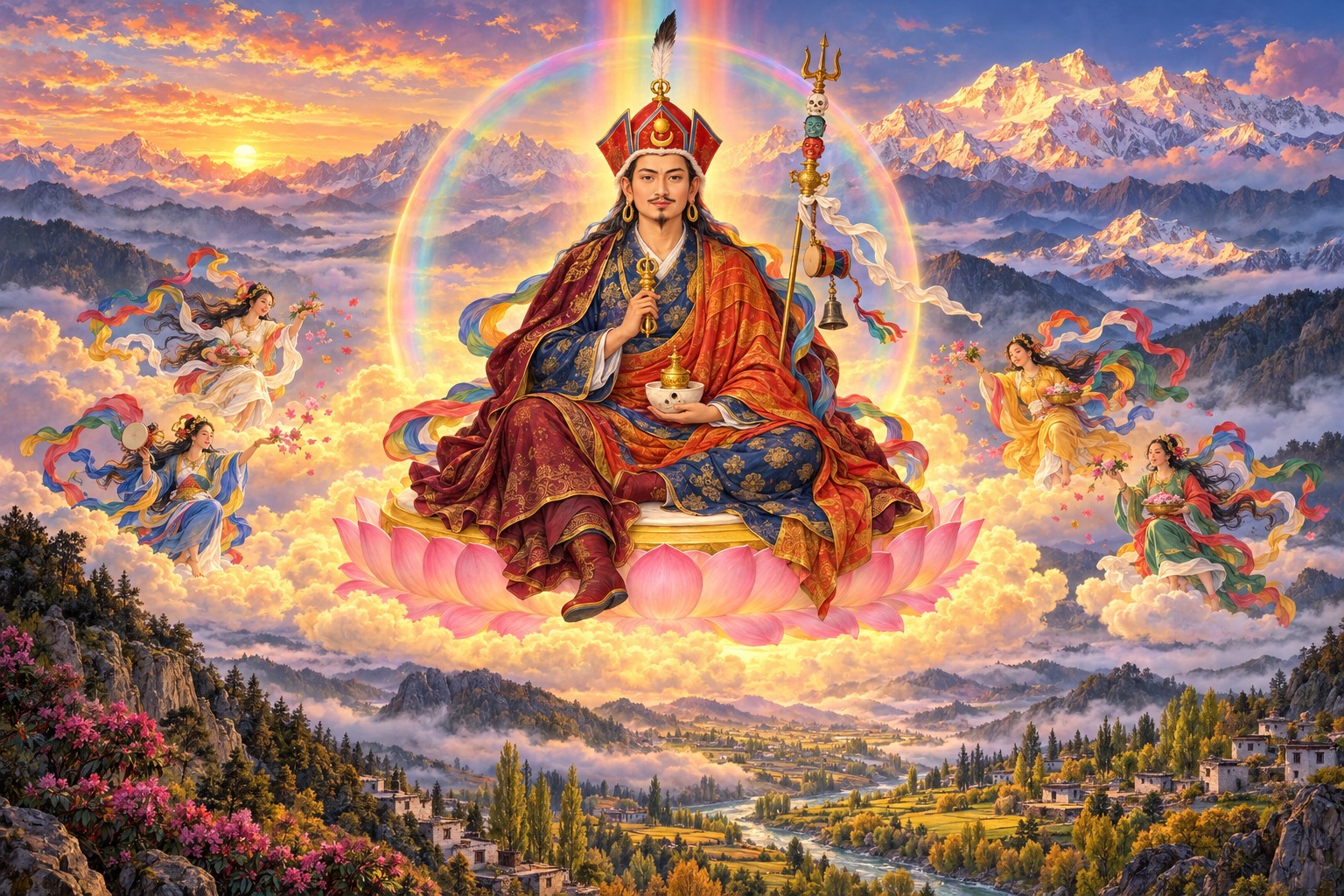
Guru Rinpoche appears once, in his best-known form. He wears the lotus hat with a half-vajra and one vulture feather, holds a five-pronged vajra at his heart and a skull cup with a small long-life vase in his lap, and a slender staff (the khatvanga) rests against his left shoulder. He sits within a sphere of five-colored light, with dakinis around him. The image pictures the voice of the revealed text, not a recorded event.
The treasure is drawn as a plain stone casket, not gold. In Tibetan accounts a treasure is usually a teaching: a scroll, a casket or an object that unlocks a text. The temple at Layak is shown with the "distinctive little square tower" that Hugh Richardson photographed in 1950. Its thirteenth-century form is not known in detail. No prayer flags appear before the later dance scene, because the site does not show them in early-period images.
Why this matters for practice
The fourth line of the Seven-Line Prayer says Guru Rinpoche is "renowned" as the Lotus-Born, and this is the story of how that renown traveled: from a treasure found by a lay master in southern Tibet to monasteries, households and newcomers around the world. The text Guru Chöwang revealed asks for nothing elaborate, only the seven lines said with a whole heart, again and again. Knowing that the prayer reached you through so many hands can make even one recitation feel like joining a long, living line of voices.

If something in this story moved you, you might pause tonight and recite the prayer once, as it has been passed from voice to voice since Guru Chöwang's time.
Sources and further reading
- Guru Chowang, by Jakob Leschly (2007), Treasury of Lives (Internet Archive snapshot, 2013)
- Layak Guru Lhakhang, Treasury of Lives (Internet Archive snapshot, 2024)
- Guru Chökyi Wangchuk Series (author page), Lotsawa House
- Accomplishing the Lama Through the Seven-Line Prayer: A Special Teaching from the Lama Sangdü (Rigpa Translations, 2004), Lotsawa House
- Seven-Line Prayer (topic page), Lotsawa House
- Lama Sangdü Series, Lotsawa House
- Guru Chökyi Wangchuk, Rigpa Wiki (Internet Archive snapshot)
- Lama Sangdü, Rigpa Wiki (Internet Archive snapshot)
- Seven Line Prayer, Rigpa Wiki (Internet Archive snapshot)
- Jomo Menmo, Rigpa Wiki (Internet Archive snapshot)
- Part VI: Khandro Sangdü and the female tertön Jomo Menmo, Dakini Translations (2020)
- Teacher: Guru Chowang (set), with items 66247 and 73029, Himalayan Art Resources
- Monastery of Guru Lhakhang (photograph by Hugh Richardson, 1950), The Tibet Album, Pitt Rivers Museum
- Lhodrak Kharchu, Nekhor
- Remembering the Lotus-Born: Padmasambhava in the History of Tibet's Golden Age, by Daniel A. Hirshberg (Wisdom, 2016), Book
- Janet Gyatso, 'The Logic of Legitimation in the Tibetan Treasure Tradition' (1993) and 'Guru Chos-dbang's gTer 'byung chen mo' (1994), Scholarship
This retelling is waiting to be read by a knowledgeable practitioner. Where the traditional accounts differ, the story says so; if you notice a mistake, please tell us through Share Your Story.