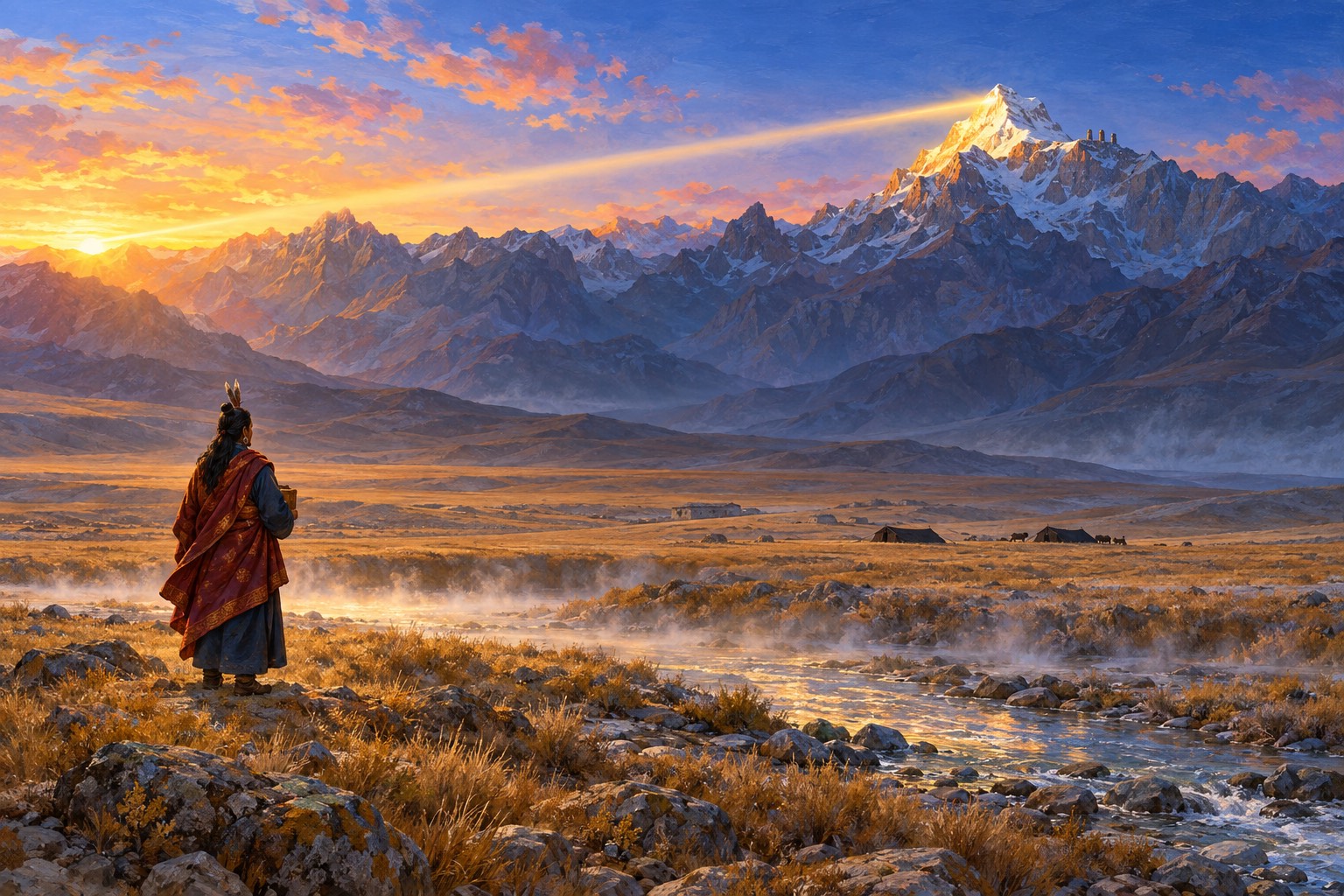
In the high, dry country of western Tibet, a long bare mountain range rises above the plain. One of its peaks is called Trazang, and the rock beneath it Zangzang Lhadrak. At dawn one spring morning in 1366, the old accounts say, a beam of white light came out of the east and touched its summit.
The man waiting for that sign is remembered as Rigdzin Gödem. What he drew out of that mountain became a living tradition that is still practiced today. Along with it came two prayers to Guru Rinpoche, “Precious Teacher,” the name Tibetans most often use for Padmasambhava, and people say those prayers every day.
The boy with vulture feathers
He was born in 1337 in a place called Nyenyul, east of Mount Trazang, in the region of Latö Jang in western Tsang. His parents named him Ngödrup Gyaltsen. His father, Lobpön Düdul, was a lay tantric practitioner, a householder yogi rather than a monk. He was skilled in the practice of Vajrakilaya, a fierce form of awakened activity pictured with a ritual dagger that cuts through obstacles.
The boy learned quickly from his father. When his father died while he was still young, his mother, Sönam Khyeudren, taught him to read and write, and two brothers of the Sé clan took over his religious training. The historian Jay Valentine has shown how much this circle of family and neighbors carried the tradition from the start.
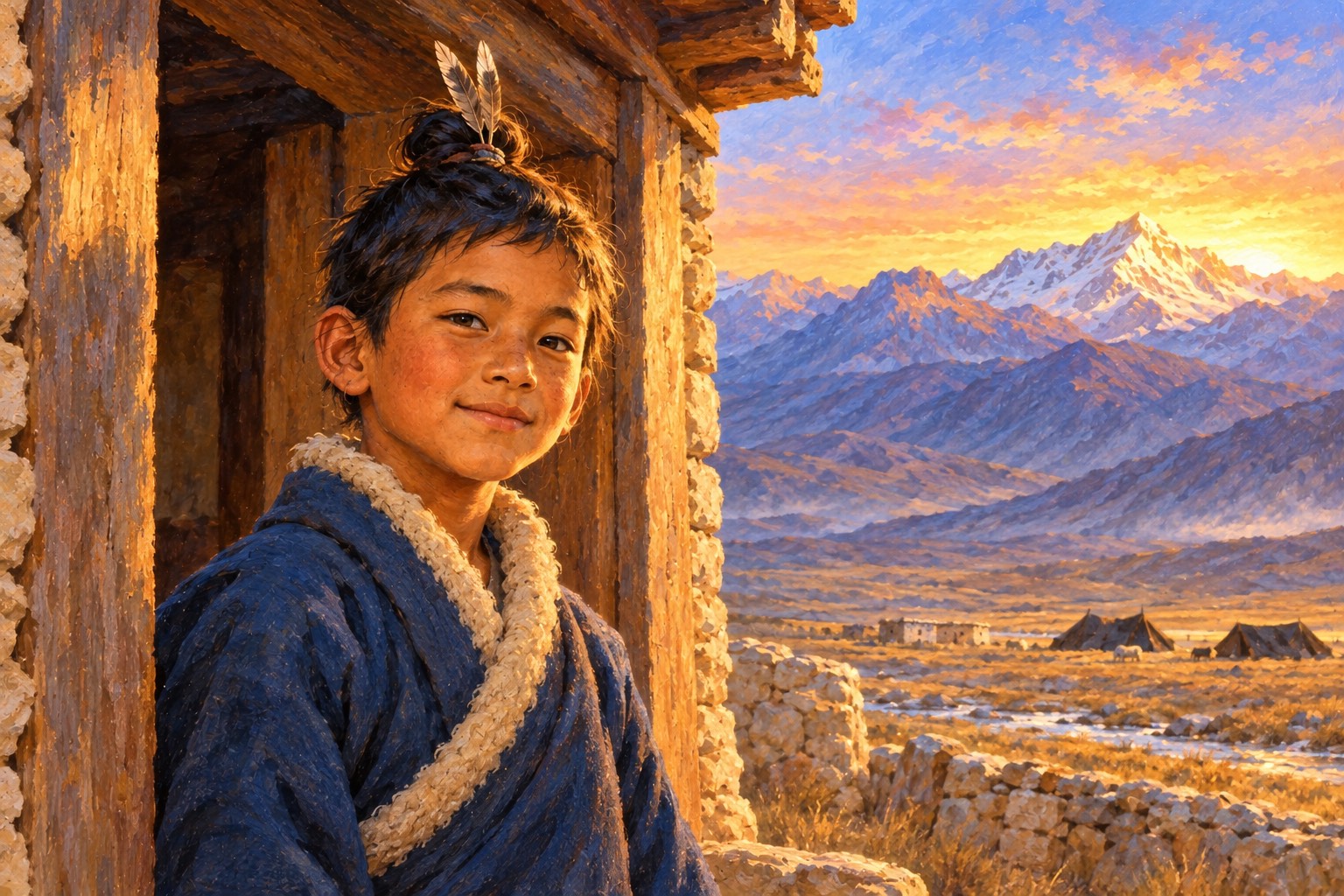
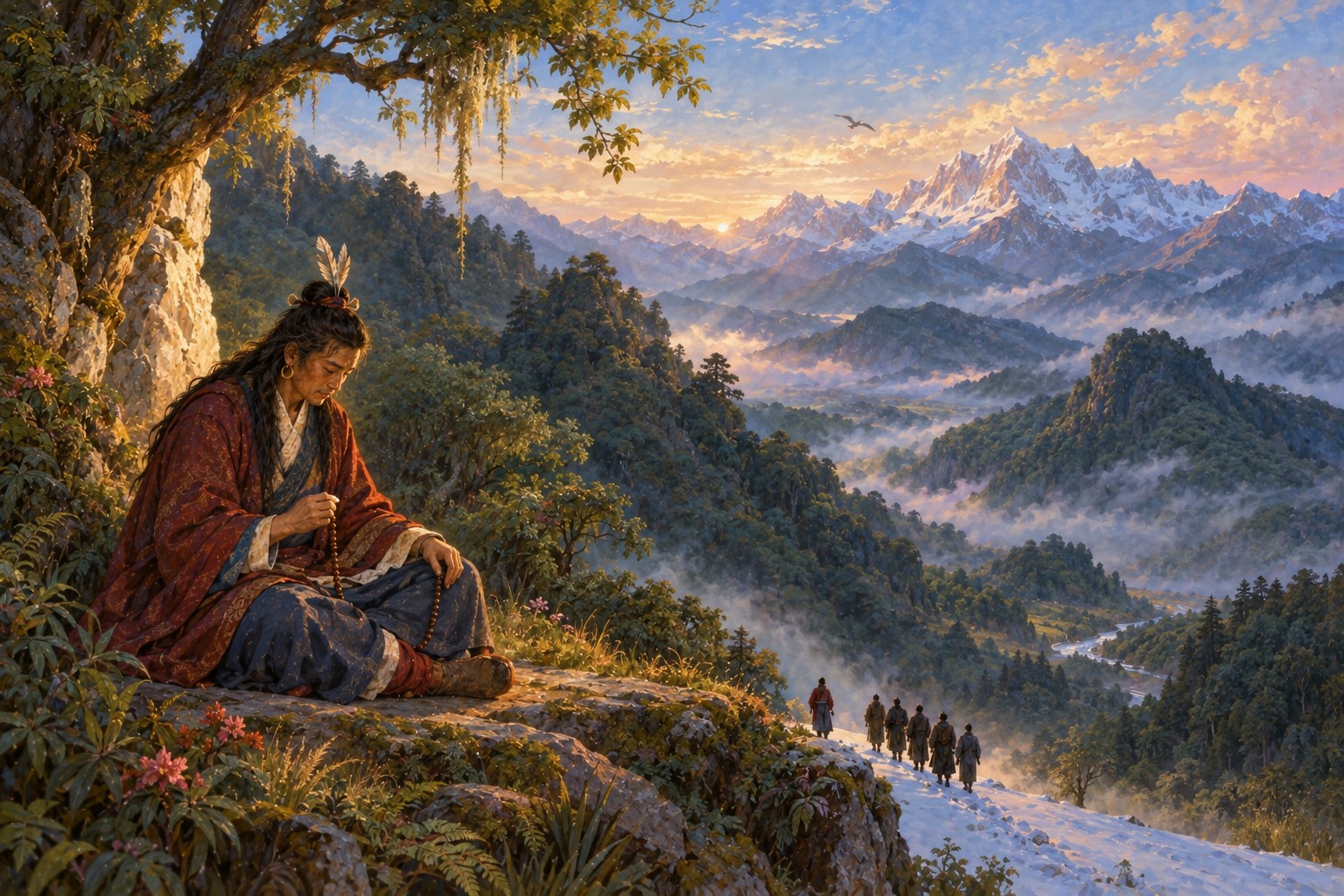
Then something unusual happened, according to the traditional accounts. When he was about eleven or twelve, three small growths that looked like vulture feathers appeared on the crown of his head. The sources count differently after that. One biography says there were five by the time he was twenty-three; Rigpa Wiki says five more grew when he was twenty-four.
People began to call him Gökyi Demtruchen, “the one with vulture feathers,” or Gödem for short. Later the title Rigdzin, “awareness-holder,” was added. In Nyingma art a vulture feather crowns Guru Rinpoche's own hat, and it is said to stand for the highest view, so the name carried a quiet meaning of its own.
A meeting by a stream
Two words will help with what comes next. A terma is a “treasure”: a teaching the tradition says Guru Rinpoche and his disciples hid long ago, to be found when the time was right. A tertön is the person destined to find it.
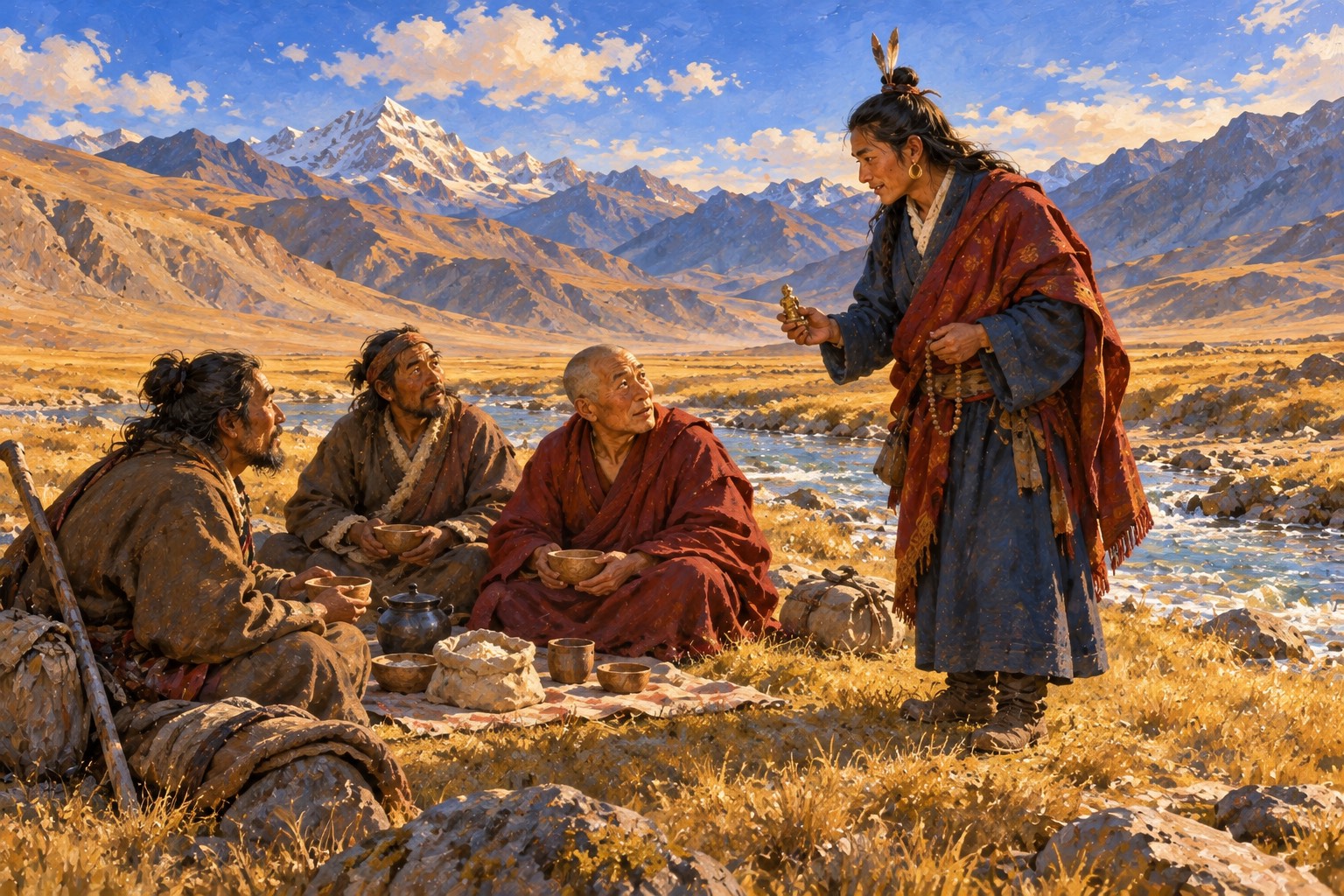
In 1364, the story goes, a lama named Zangpo Drakpa found texts foretelling that someone else would reveal great treasures. The next year he sent them off with three travelers and an odd instruction. East of Mount Zangzang they would meet a yogi with a sacred image or a rosary in his hand, who would start talking about the king of Gungtang. They were to give everything to him.
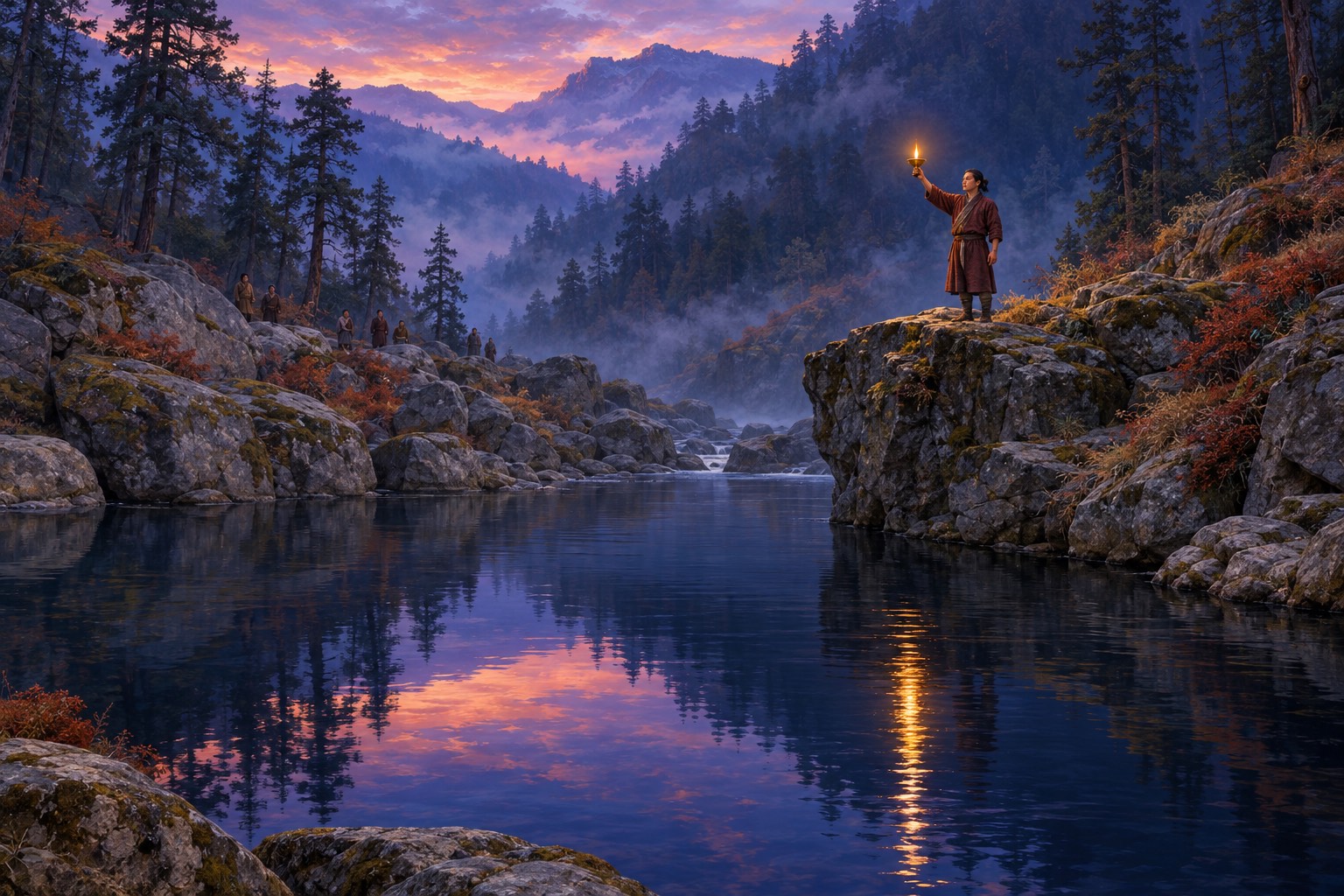
About a week later the travelers stopped to eat beside a stream. A young man walked up carrying a small brass image of Vajrakilaya and a rosary. He asked whether they had heard that the king of Gungtang had died that very day. The travelers recognized the sign and handed him the scrolls and a sealed letter.
The mountain opens
Back home, Gödem waited for a sign in the sky. He took the rising of the planet Jupiter in a certain lunar mansion as that sign, and on the eighth day of the snake month came the dawn of the white light. Below the summit, near three standing stones and under a light dusting of snow, he took seven paper scrolls from a hollow in the white rock. They were keys to something deeper.
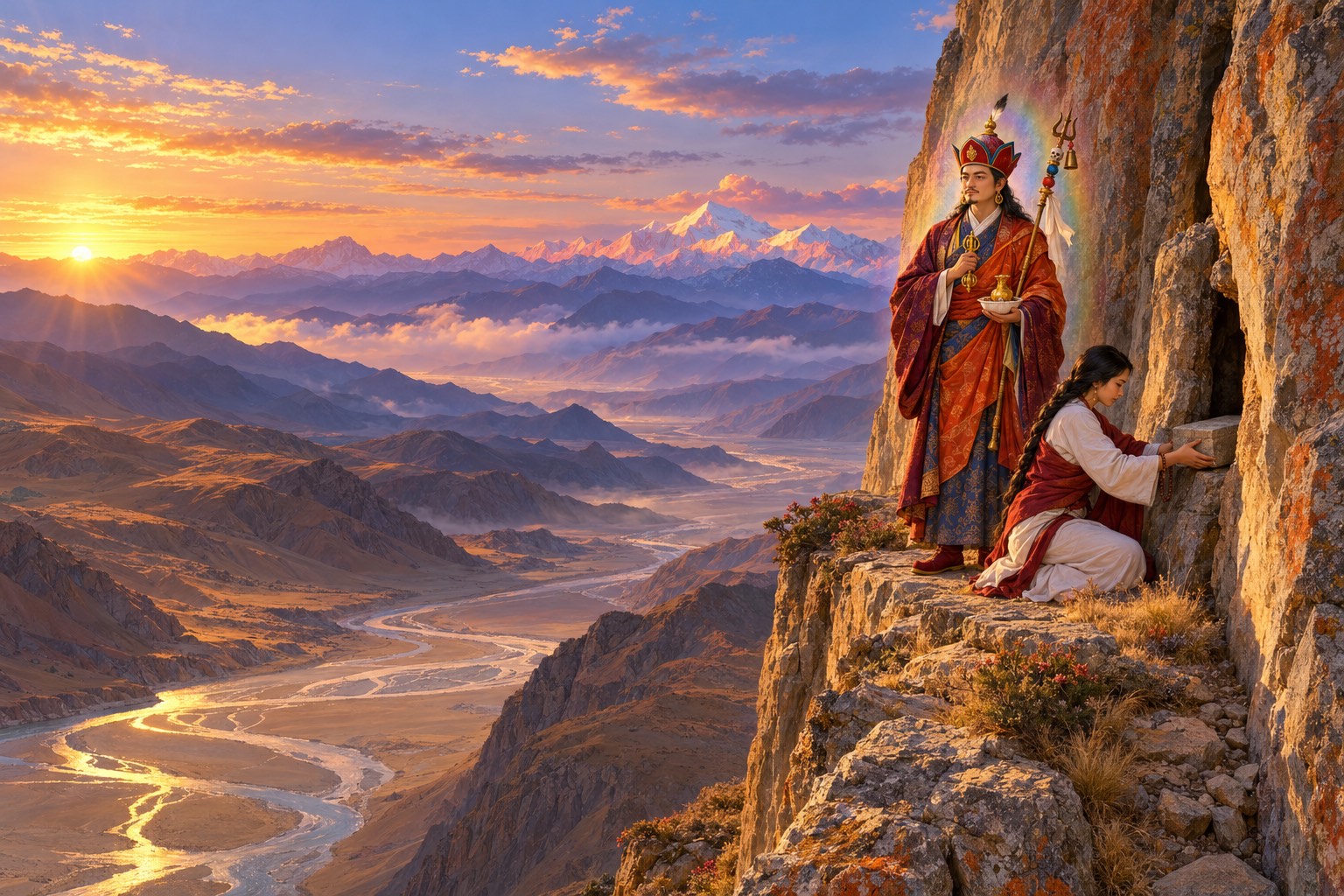
Some weeks later, the biography says, he was giving a Vajrakilaya empowerment, a ceremony that formally introduces students to a practice. Partway through, he stopped and led his disciples up the mountain. The air smelled sweet and was full of rainbows, it is said, and the cliffs glowed red in the setting sun.
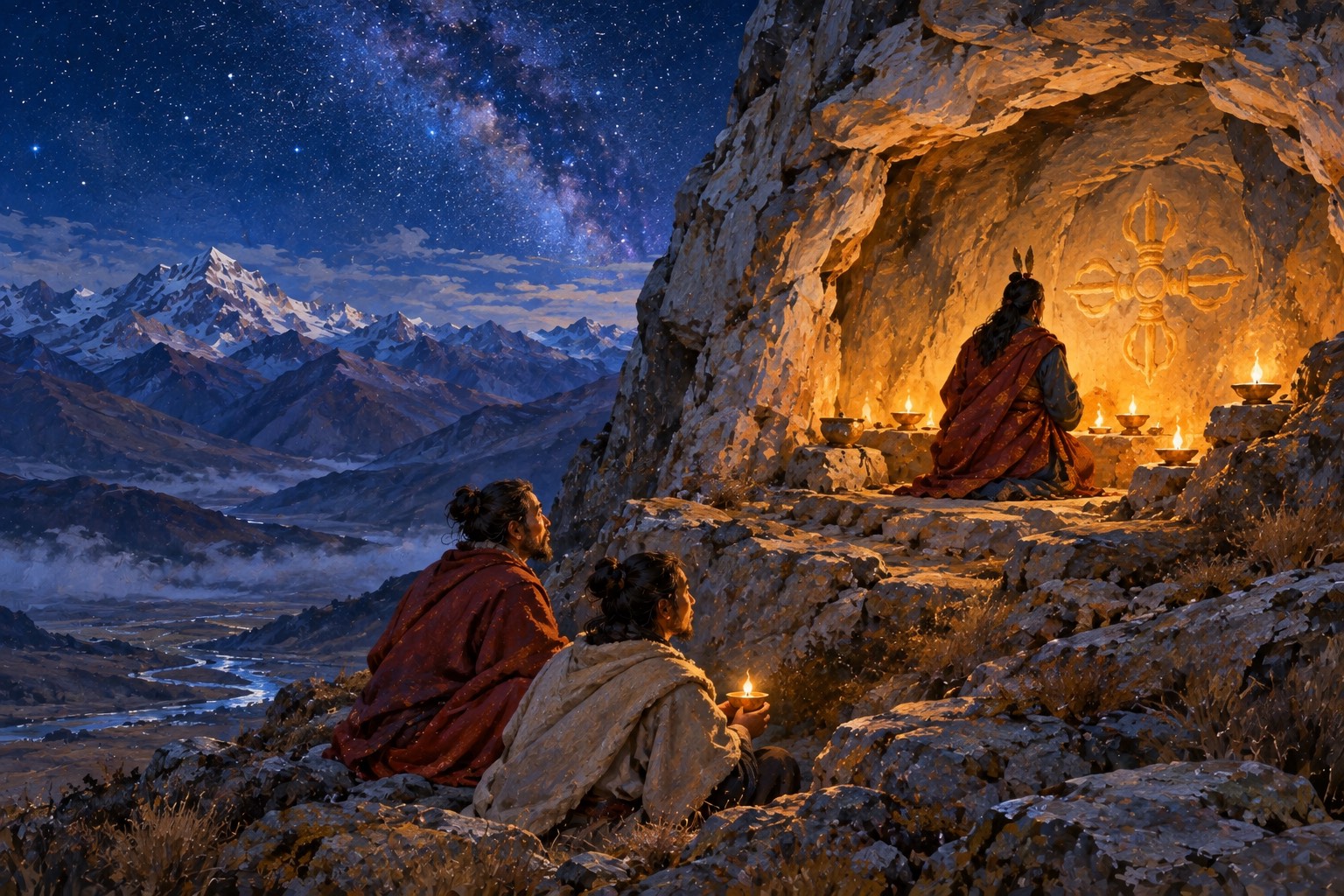
He went into a cave to pray while two disciples waited below the entrance. After dark the rock trembled. At midnight, by the light of butter lamps, they made out the shape of a crossed vajra, a double ritual scepter, on the stone. When he pressed beneath it with the key, the account says, the rock opened like a door.
Inside, coiled on a square blue stone, lay a large pale-blue snake. Within its coils rested a maroon leather casket with five compartments, one for each direction and one for the center.
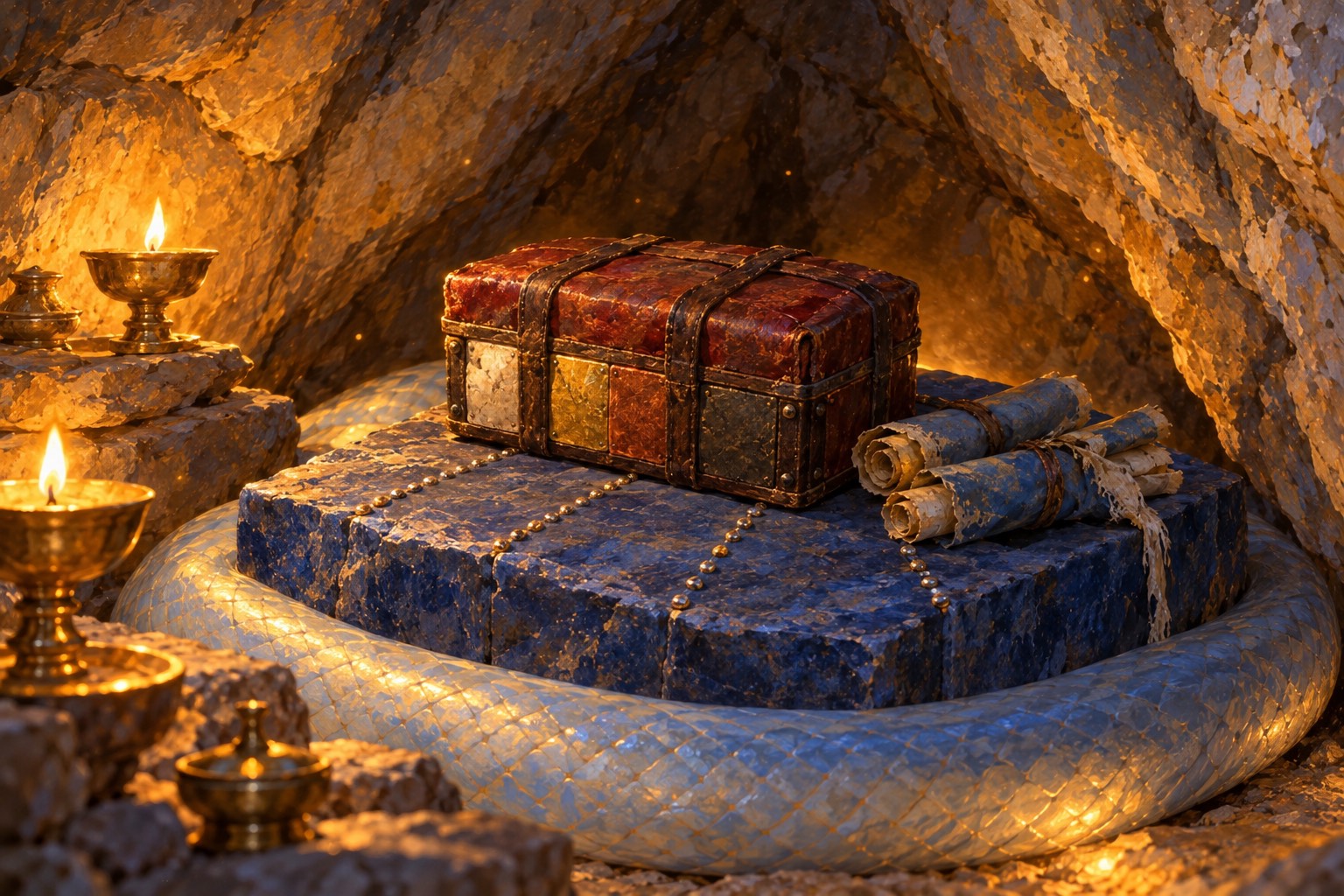
From the center came the four volumes of the Gongpa Zangtal, “the Unobstructed Wisdom Mind of Samantabhadra.” It belongs to Dzogchen, the Great Perfection, the Nyingma teaching on the mind's own nature. The other compartments held practices of Vajrakilaya, of Guru Rinpoche and much else. The jewels left as offerings in the corners of the cave, the sources add, he left where they lay.
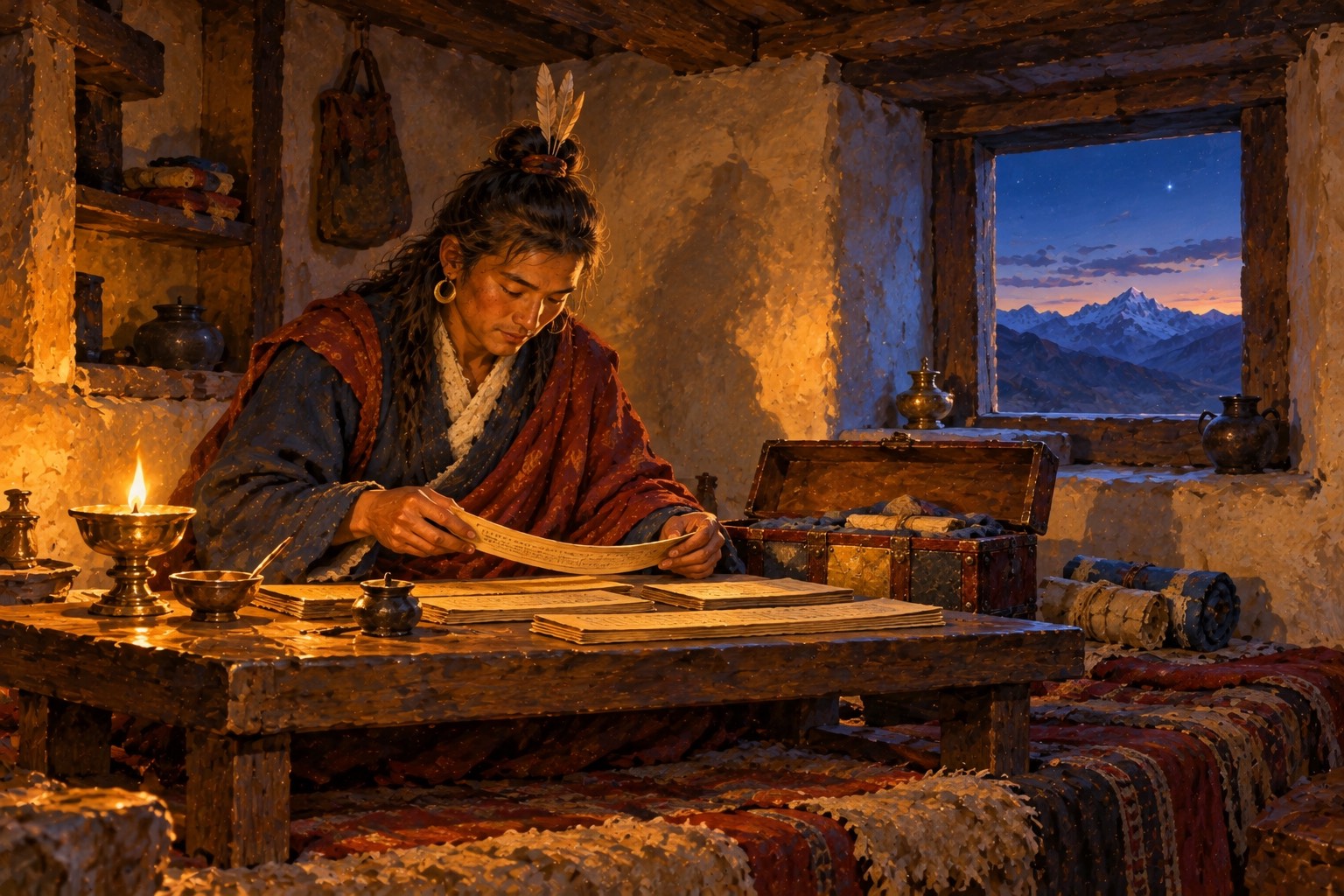
Then came the patient work of turning the yellow scrolls into readable books and teaching them to chosen students. Because Zangzang lies to the north, the collection came to be called the Changter, the Northern Treasures. One short prayer from the Gongpa Zangtal, the Aspiration of Samantabhadra, is still recited all across the Tibetan Buddhist world.
Two beloved prayers
Two of the best-loved prayers to Guru Rinpoche came down along the same road. They are not the Seven-Line Prayer, which Guru Chöwang had revealed a century earlier. They are the Le'u Dünma, the “Prayer in Seven Chapters,” and its last chapter, often said on its own: the Sampa Lhündrupma, the prayer that “spontaneously fulfills all wishes.”
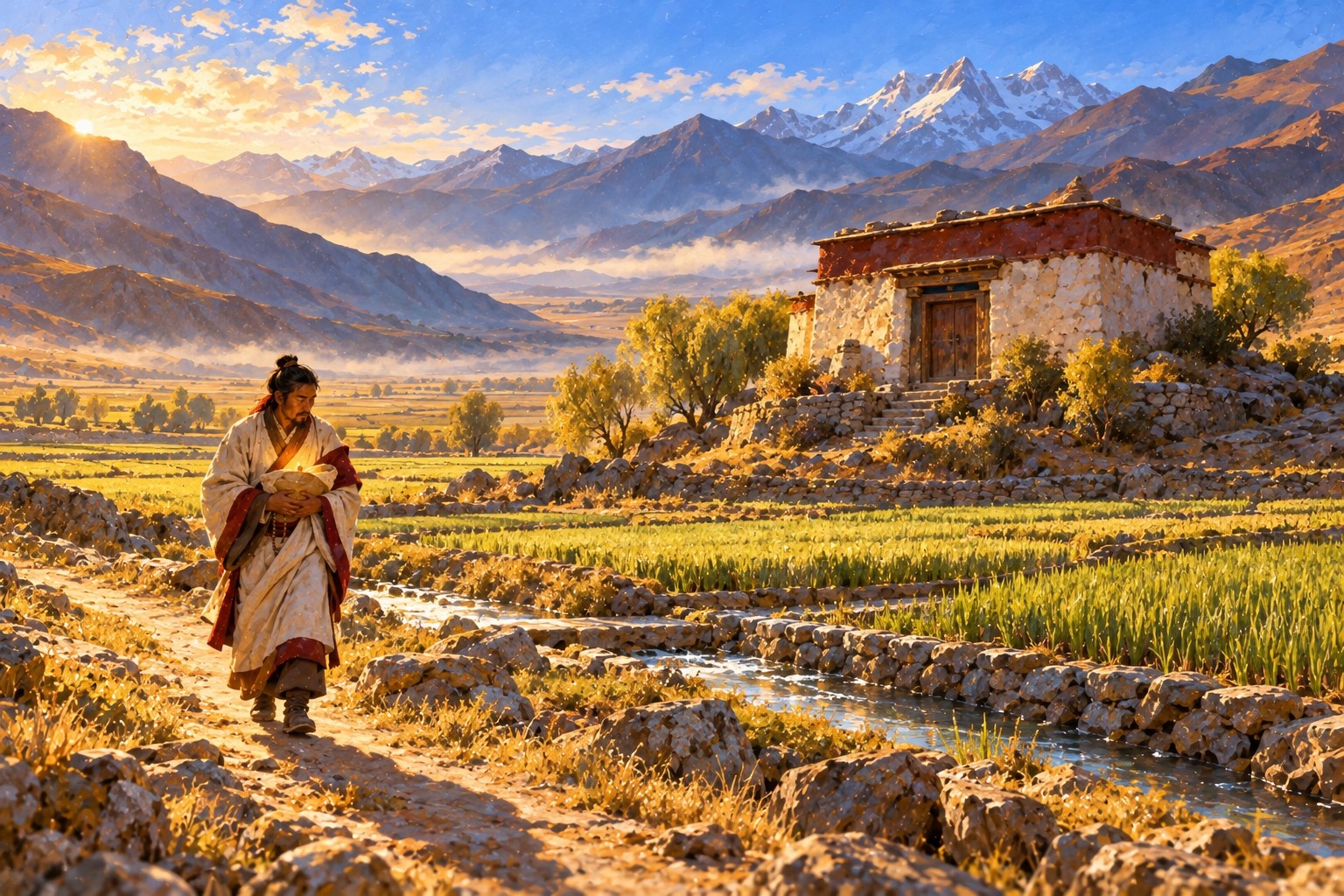
These were found by Zangpo Drakpa himself. The closing note of the seventh chapter, as translated on Lotsawa House, says he drew it from a temple at Rulak Gyang in a water-dragon year, 1352, and passed it to Rigdzin Gödem. Gödem then decoded it from the symbolic script of the dakinis, the female wisdom beings said to guard such treasures. Other accounts date his finds to around 1364. Either way, the prayers have always traveled with the Northern Treasures.
Each chapter is said to have been requested by a different close disciple of Guru Rinpoche: King Trisong Detsen, Yeshe Tsogyal, Namkhé Nyingpo, Nanam Dorje Düdjom and Prince Mutri Tsenpo. Each belongs to a particular time of day.
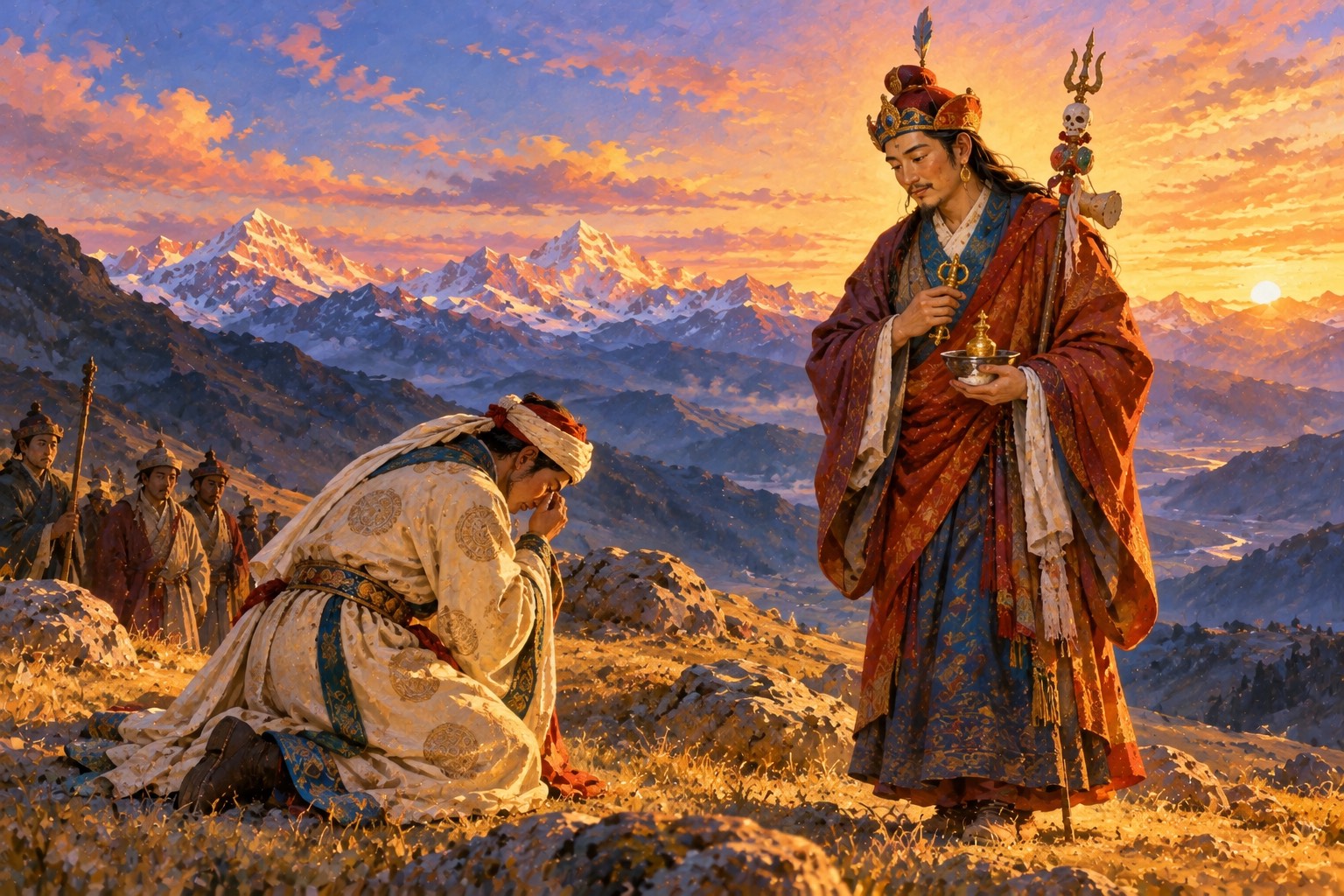
The Sampa Lhündrupma has the most tender setting. As Guru Rinpoche prepared to leave Tibet for the southwest, the text tells, the young prince Mutri Tsenpo bowed to him on the heights of Gungthang and wept. Guru Rinpoche comforted him and left him this prayer.
It is a long, plain list of the things people fear: war, sickness, famine, wild animals, dangerous journeys, the moment of death and what comes after. For each one it calls on Guru Rinpoche in a particular form, thirteen forms in all, as Rigpa Wiki lists them. Its spirit is simple: whatever frightens you, call on him.
The hidden valley of rice
Gödem's treasures also included guides to beyul, “hidden lands.” The tradition holds that Guru Rinpoche set these valleys apart as refuges for hard times, to be opened by the right person. Gödem is credited with opening seven. The best known is Sikkim, which Tibetans call Demojong, “the valley of rice,” sometimes rendered “valley of fruit.”
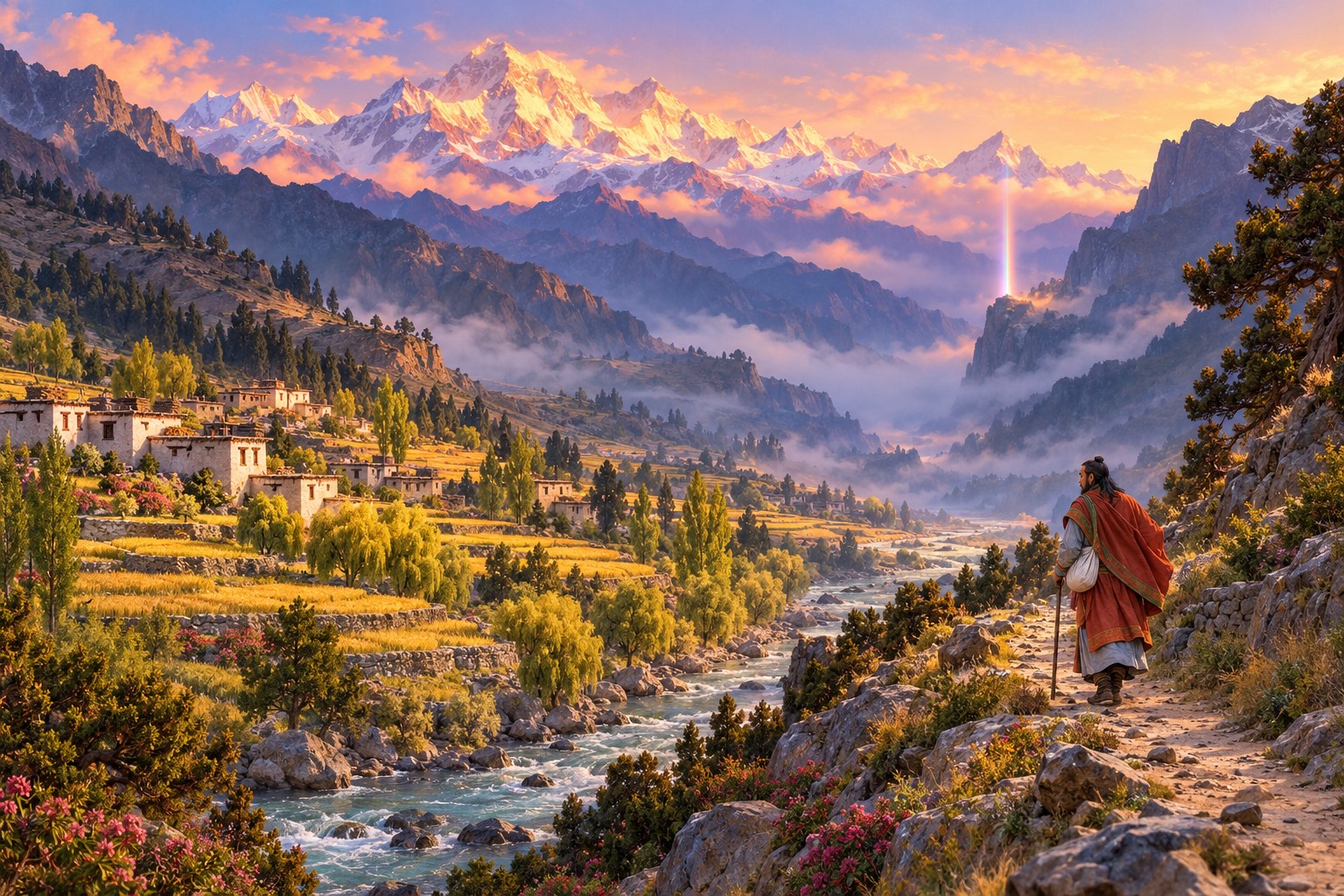
In 1373, according to the history kept in Sikkim, he came over the high, snowy pass of Chorten Nyima from the north with nine companions. (One modern guide places this opening in the thirteenth century, which does not fit his dates.)
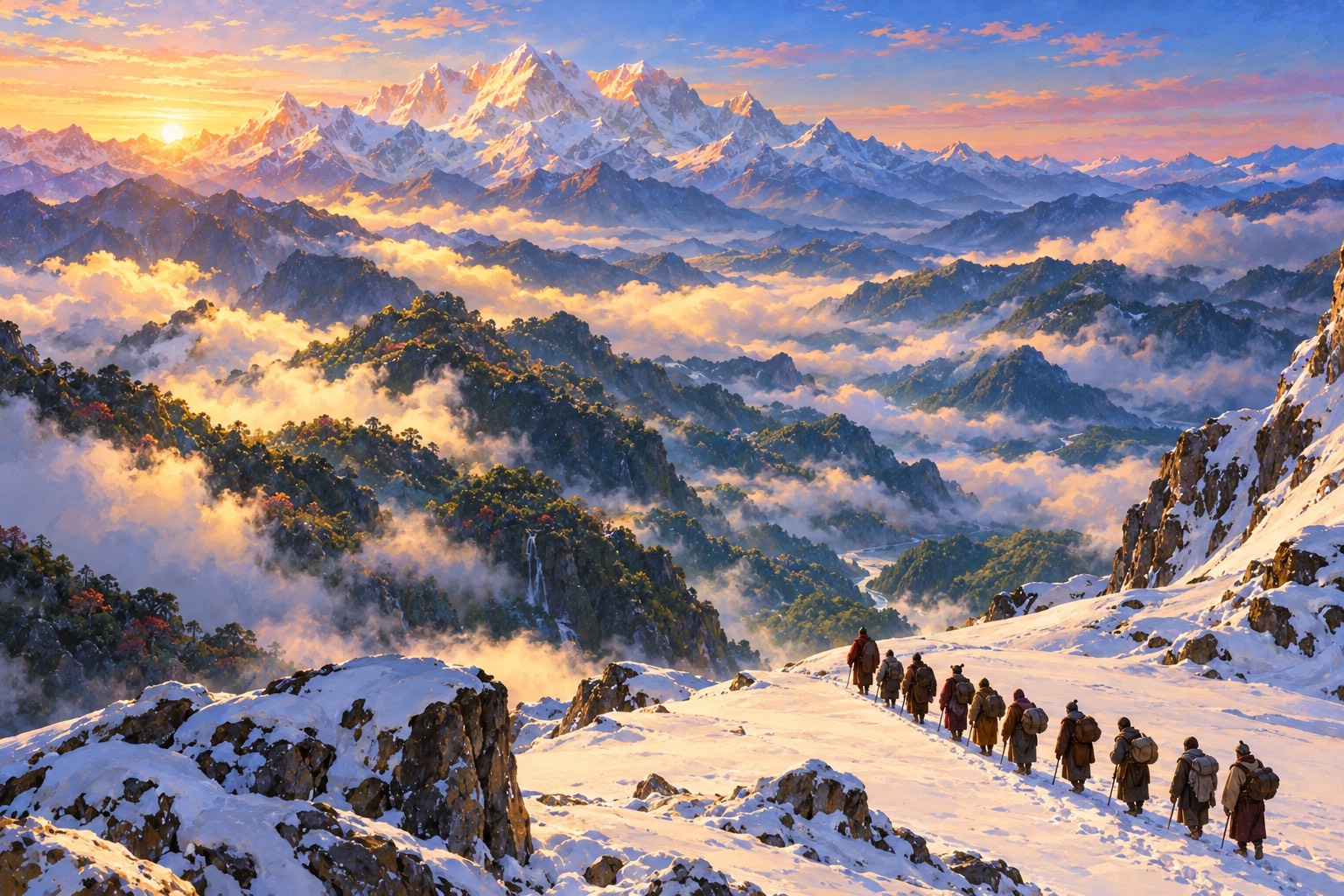
Below lay another world: steep forests of oak, magnolia and red rhododendron, mist, roaring rivers, and the snows of Kangchenjunga over everything. He is said to have blessed the White Rock Cave at Tashiding as a place for meditation, and to have revealed treasure linked to the great mountain itself.
One Sikkimese account adds a detail that is hard to forget: he sent a letter home to Tibet tied to the neck of a vulture. Literal or not, there is something lovely about the vulture-feathered master sending his news by vulture.
Last years
In 1389 the king of Gungtang, Trigyal Chokdrupde, made Gödem his personal preceptor and gave him land at Riwo Palbar. Gödem offered the king a ritual dagger said to have belonged to Guru Rinpoche, and founded the monastery of Se Trazang.
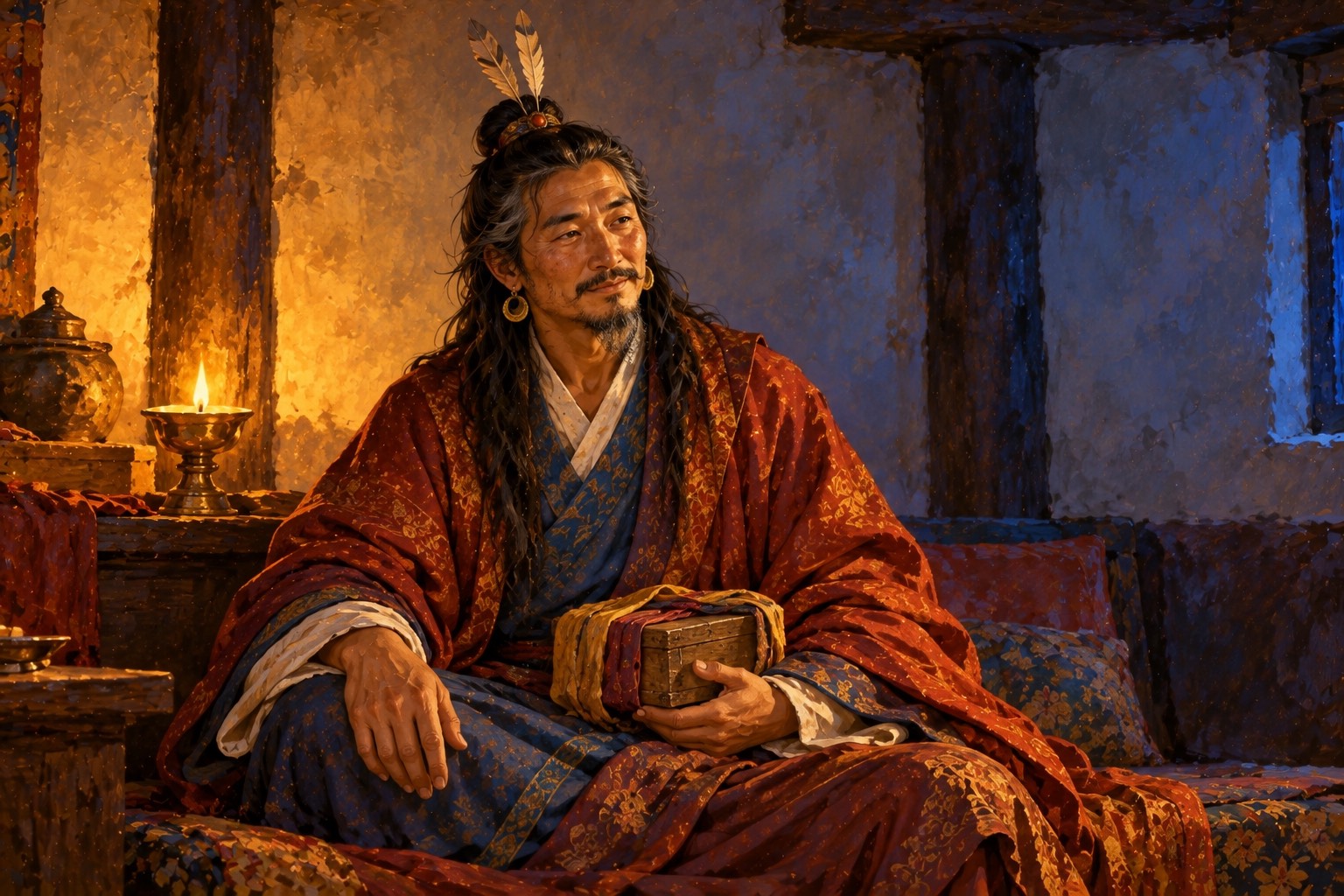
He died at seventy-one at Zilnon in Sikkim, according to the biography by Martin Boord, in 1408. Other references give 1409, and both dates are still in use. His teachings flowed on through three lines: his son Namgyel Gönpo, his wife Pema Zangpo, and his disciples. Valentine calls her “clearly the most revered matriarch of the tradition.”
Dorje Drak
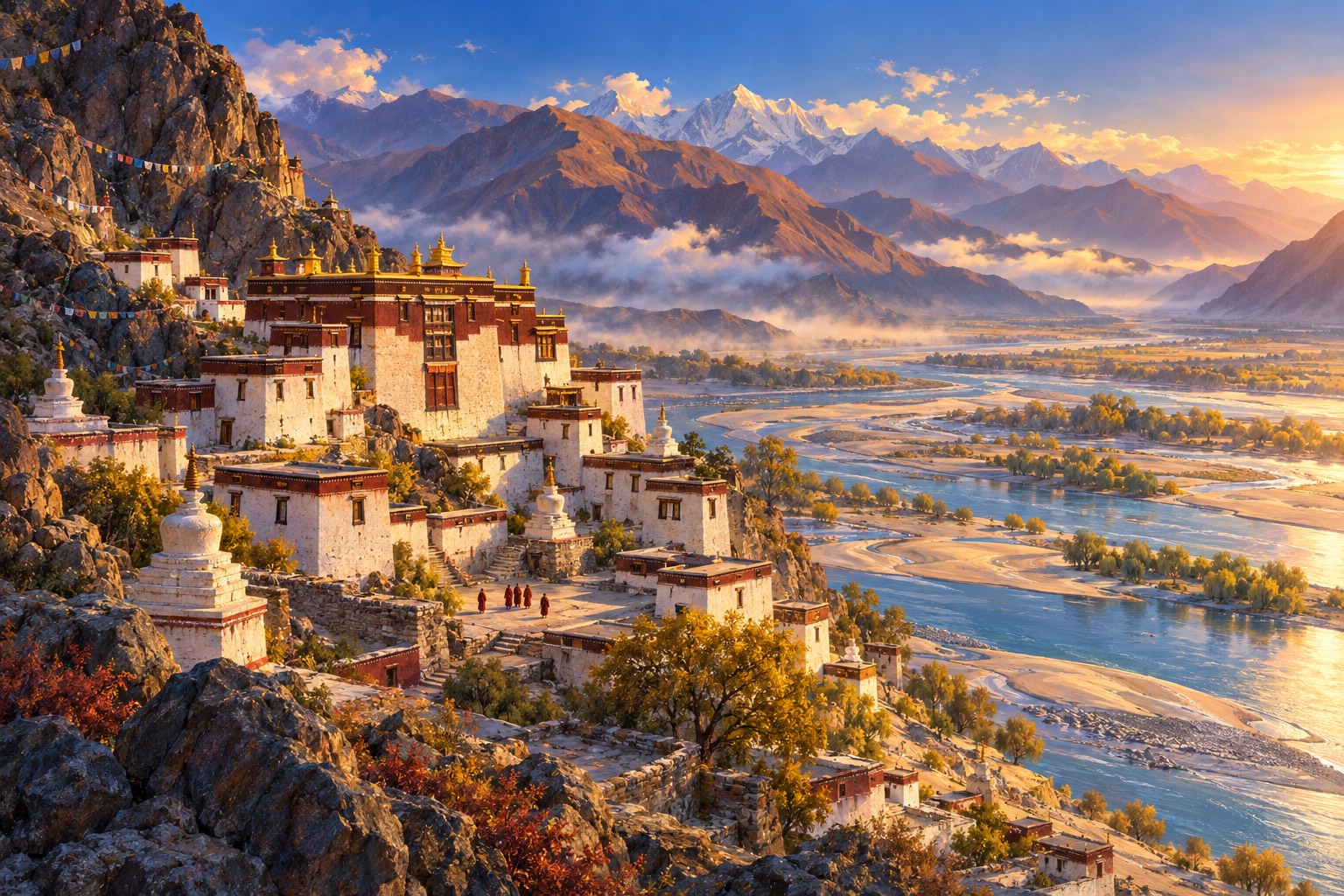
Much later, a lama named Lekden Dorje was recognized as Gödem's rebirth; sources disagree on his dates by about sixty years. His own rebirth, Ngakgi Wangpo, built Thubten Dorje Drak on the bank of the Tsangpo river in central Tibet in the early seventeenth century. Rigpa Wiki gives both 1610 and 1632 for its founding.
It became one of the six great Nyingma monasteries, and its heads, the Rigdzin Chenmos, are counted as Gödem's incarnations. After 1959 the community was re-established in exile at Shimla in India.
So one mountain's treasures became a whole landscape of practice: a great monastery, a hidden valley beneath Kangchenjunga, and two prayers said in homes far beyond either.
About the art
Rigdzin Gödem is drawn as his traditional portraits show him: a lay master, not a monk, with long hair over his shoulders and a high topknot, a dark blue robe and a red-maroon shawl, and a small treasure casket in his hand. In a Nyingma line drawing and in Himalayan Art Resources' notes on him, three slender vulture feathers rise from the crown of his head. They are the sign of his name, and here they are kept small and quiet, as in the paintings. He carries none of Guru Rinpoche's implements, so the two are never confused.
Guru Rinpoche appears once, at the farewell on the heights of Gungthang that the Sampa Lhündrupma describes. He wears the lotus hat with a half-vajra and a single vulture feather, the same feather that gave Gödem's name its meaning. He holds a five-pronged vajra at his heart, with the slender khatvanga staff against his left shoulder. He is shown standing because the scene is a parting on a mountain road; the prince wears the long patterned silk robe and turban of the eighth-century Tibetan court.
The cave scene shows a crossed vajra, two ritual scepters joined at right angles, which the account says appeared on the rock at midnight. The treasure casket follows the account's description: maroon leather with five compartments, one for each direction and the center. The snake is only suggested, as a calm pale-blue coil. Sikkim is painted as the account and the land describe it, with dense forest, mist and Kangchenjunga. It has no monasteries or prayer flags, because those came after Gödem's time. Prayer flags appear only in the later scene of Dorje Drak.
Why this matters for practice
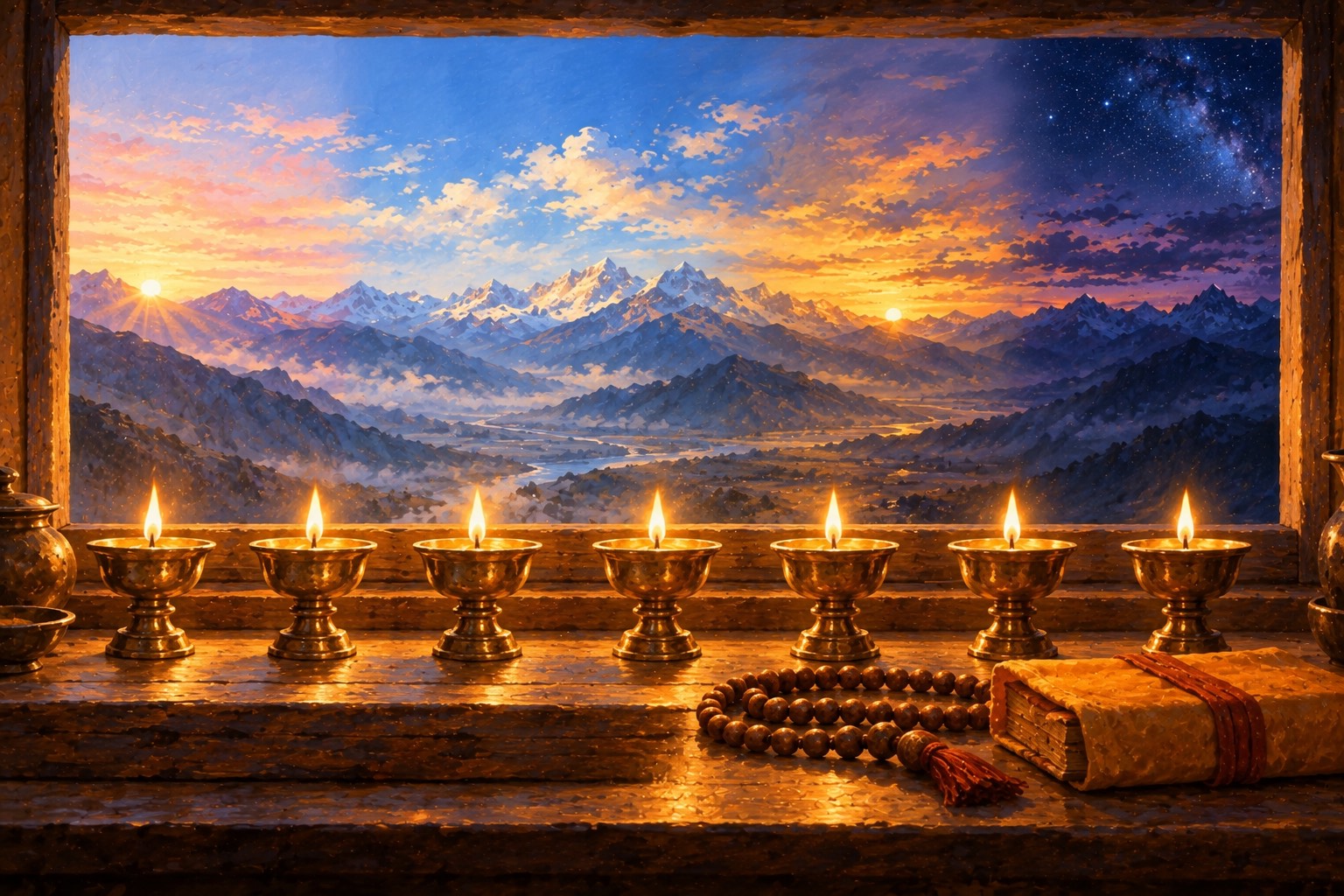
The Seven-Line Prayer ends by asking Guru Rinpoche to come and grant his blessing, and the prayers that came down through Rigdzin Gödem's lineage make that same request at length, naming one fear after another. Gödem's life shows a tradition that trusts the call will be heard: in a cave at midnight, on a snowy pass, in a hidden valley. Reciting the seven lines, even once, is the simplest form of that same call.

If something in this story moved you, you might pause tonight and recite the Seven-Line Prayer once, and let it join the long chorus of voices that have called on Guru Rinpoche in every kind of trouble.
Sources and further reading
- Teacher: Godemchen, Rigdzin (set), with the biography by Martin Boord (Treasury of Lives, 2013), Himalayan Art Resources
- The First Dorje Drak Rigdzin, Rigdzin Godemchen Ngodrub Gyeltsen, by Martin Boord, Treasury of Lives (Internet Archive snapshot, 2015)
- Godemchen Ngodrub Gyeltsen, item 1066 (Rubin Museum of Art), and item 66248 (Nyingma Icons), Himalayan Art Resources
- Subject: Vulture Feather Adorned Hats, by Jeff Watt, Himalayan Art Resources
- Rigdzin Gödem Series (author page), Lotsawa House
- Tulku Zangpo Drakpa Series, with the Le'u Dünma chapters 1 and 7 and the Sampa Lhundrupma (Rigpa Translations), Lotsawa House
- Northern Treasures Series, Lotsawa House
- Rigdzin Gödem; Northern Treasures; Le'u Dünma; Sampa Lhundrupma; Dorje Drak Monastery, Rigpa Wiki (Internet Archive snapshots, 2024)
- The Family and Legacy of the Early Northern Treasure Tradition, by Jay Valentine, Journal of Global Buddhism 16 (2015), Journal of Global Buddhism (Internet Archive copy of the PDF)
- The Lords of the Northern Treasures, by Jay Valentine (PhD dissertation, University of Virginia, 2013), Dissertation
- The Legacy of Guru Padmasambhava in the Dissemination of Buddhism in Sikkim, by Thupten Tenzing, Sahapedia
- The Guru in West Sikkim, Nekhor
This retelling is waiting to be read by a knowledgeable practitioner. Where the traditional accounts differ, the story says so; if you notice a mistake, please tell us through Share Your Story.