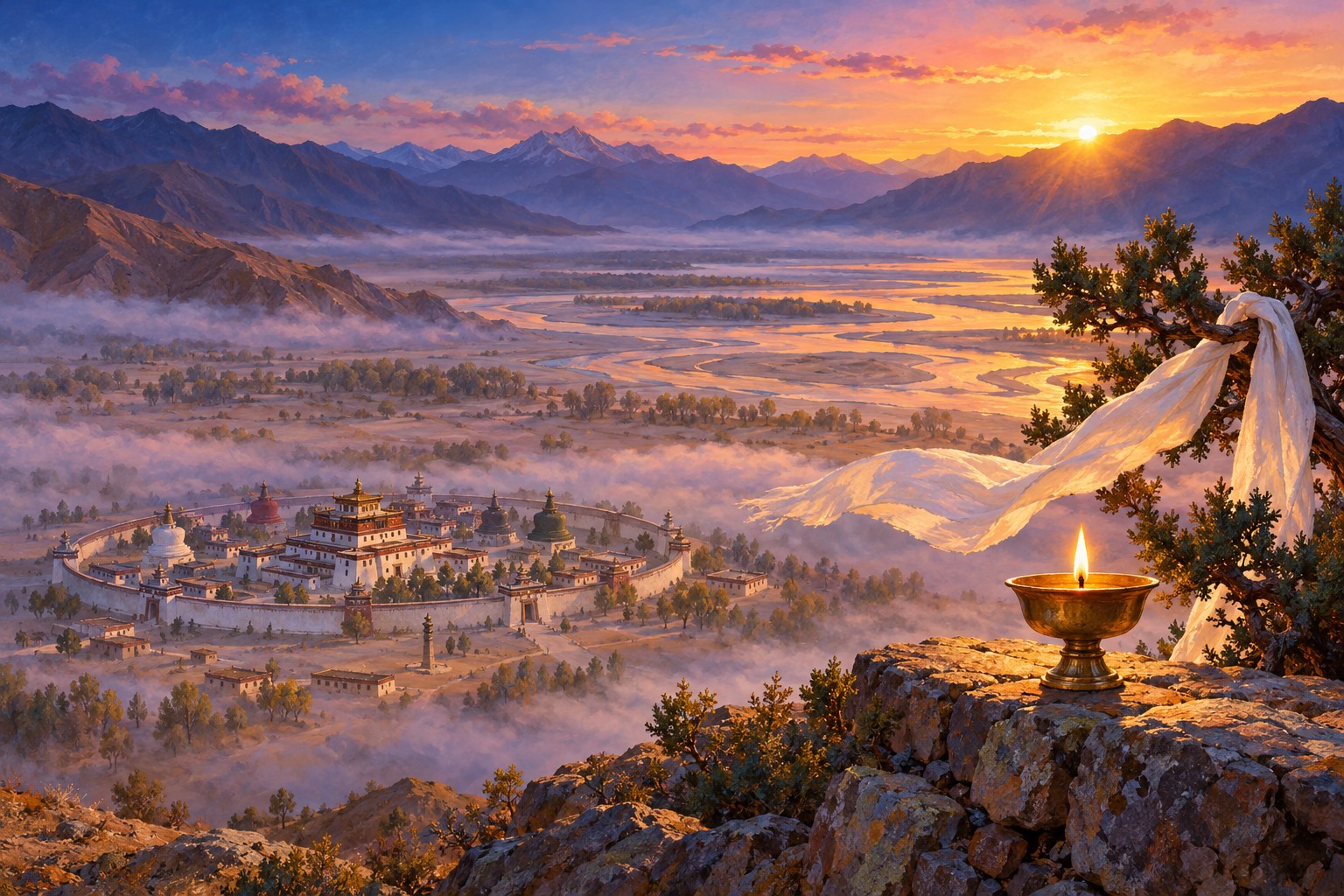
In the autumn of about 1906, a band of pilgrims was walking home from Lhasa to Golok, the high nomad country of eastern Tibet. Somewhere behind them, in clothes far too fine for the road, walked a girl of fourteen who had run away to follow them.
She became one of the most loved women teachers of the Nyingma, the "ancient" school of Tibetan Buddhism that traces its teachings to Guru Rinpoche. Golok remembers her as Sera Khandro, the dakini of Sera. A dakini, khandro in Tibetan, is the tradition's word for awakened feminine wisdom. People there also called her Üza Khandro, the dakini lady from Central Tibet, for she was never quite one of them.
Unusually for a woman of her time, she wrote the story of her own life. Most of what follows comes from it, as studied by the scholar Sarah Jacoby and translated in part by Christina Monson.
A girl in a Lhasa house
She was born in Lhasa in 1892 and named Kunzang Dekyong Wangmo. Her father, Jampa Gönpo, was of Mongolian royal descent, wore Chinese dress and, Jacoby thinks, served among the officials of the Qing empire. Her mother, Tsering Chödzom, came from the old Tibetan Nub clan.
Her own account keeps a small, human detail: the household argued over her birth year, because the Chinese and Tibetan calendars disagreed. The Tibetan side won. A later biography, cited in Monson's notes, says rainbow light filled the sky at her birth.
 Illustration in preparation
Her father wanted her to follow him into the Lhasa elite, and had her learn Chinese before Tibetan. But the girl, she writes, would rather recite the six-syllable mantra of compassion than play games, and she urged the other children to do the same.
At seven, her account says, she went to Drak Yerpa, a cliff of meditation caves near Lhasa blessed by Guru Rinpoche and Yeshe Tsogyal, and drew a small ritual dagger part-way out of the rock. It was her first sign of being a tertön, a treasure revealer.
Illustration in preparationTreasures, or terma, are teachings that the tradition says Guru Rinpoche and Yeshe Tsogyal hid long ago, to be found by destined people in later ages. When she spoke of such things at eight, her mother told her to be quiet: a girl, she said, could not reveal treasures.
A dream in a time of sorrow
As she grew, her father promised her in marriage to an official's son, and her heart sank. She writes honestly of falling into deep despair. Soon afterwards her mother died. They were dark years for a child.
Then, at twelve, Jacoby recounts, the female buddha Vajravarahi came to her in a dream and gave her the two cycles of treasure teaching that would become the heart of her life. Again and again in her story, the dakinis' voices answer her grief and tell her not to lose heart.
Illustration in preparationThrough it all she prayed to Guru Rinpoche and Yeshe Tsogyal. In time she came to see herself, as the tradition does, as an emanation of Yeshe Tsogyal, one in whom Tsogyal's wisdom appears again.
The pilgrims from Golok
Then a party of travellers from Golok asked for lodging at her family's house. Their lama was Drime Özer (1881–1924), a son of the treasure revealer Dudjom Lingpa, whose story is told in this library.
The moment she saw him, she writes, tears ran down her face, and she prayed never to be parted from him in any lifetime.
Illustration in preparationOne night she slipped out of the house and went after them. She never returned to Lhasa and never saw her family again.
Jacoby gives her age as fourteen; Sera Khandro, counting the Tibetan way, says fifteen. This page uses the international count throughout.
Illustration in preparationThe long road east
She carried a few snacks and wore her fine Lhasa clothes, and neither lasted. Her account of the road is frank and sometimes funny. Hungry, she mistook a nomad's tent for a wild yak. When nomads gave her barley flour she had no bag for it, so she put it in her shoe, and they laughed at her.
Illustration in preparationWinter came on. She was cold, hungry and often unwell, and more than once, she writes, she nearly did not survive. Slowly she learned the road's skills, like making tea over a smoky fire that stung her eyes.
Illustration in preparationWhen the pilgrims reached home in the Serta grasslands, they scattered to their own tents. She was alone in a land whose dialect she could not follow, unable to read Tibetan, with no work she knew how to do. Some in the encampment wanted no young outsider near their lama.
So the noble girl from Lhasa became a servant in a nomad family, herding their animals. Between chores she began the foundational practices, or ngöndro, under Drime Özer and his brothers. Monson's notes say she completed a hundred thousand prostrations in seventeen days.
A monk on the pasture
Her short autobiography tells of a day some years later when she was out with the herds. A monk dressed like an Indian scholar came up and asked her three times whether she knew him. He was, he said, Guru Rinpoche.
Illustration in preparationShe bowed and prayed to him. In her telling, he replied that even ordinary people who call on him with devotion "will see my face, hear my speech" and receive his blessing. Then he pointed her toward the companion destined to share her treasure work.
Whatever one makes of such a vision, its message echoes the Seven-Line Prayer, which calls on Guru Rinpoche to come.
Hard years
Her twenties were her hardest years. At a lama's direction she settled with Gara Gyalse, son of a treasure revealer of Bannak in Golok, the man she called her "life partner," as Jacoby renders it. They had a daughter, Yangchen Drönma, and later a son. Gyalse did not believe a woman could be a treasure revealer, so she began to write her treasures down in secret.
Not everyone doubted her. Around 1915 Gotrul Rinpoche, a respected lama of Palyul Dartang, rose in a public gathering and declared her an emanation of Yeshe Tsogyal.
Her short autobiography says that once Drime Özer accepted her as his disciple, she revealed the Secret Treasury of the Dakinis near Amnye Machen, the great snow mountain of Golok, home of the protector Machen Pomra. So the sources tell of this treasure in two ways: given in a girlhood dream, and later drawn from a sacred place.
Illustration in preparationMeanwhile an illness settled in her legs until she could barely walk. In 1921, at twenty-nine, she was so weak that her disciples carried her on horseback, with her children, to Drime Özer.
Illustration in preparationShe credited that reunion with her recovery. Over months of retreat, she writes, her strength came back, and she and Drime Özer worked side by side on their treasures and his father's. The happiness lasted three years. In 1924 an epidemic passed through the encampment, and within one week she lost both Drime Özer and her small son.
The dakini of Sera
Once more she had no home. Drime Özer's disciple Sotrul Natsok Rangdrol invited her to his monastery, Sera in Serta, which gave her the name she is remembered by.
At Sera she wrote: first a long life of Drime Özer, then her own story, over four hundred Tibetan folios. She dictated its first part, finished in 1927, to her monk scribe Tsultrim Dorje, and then, Jacoby notes, wrote the rest herself.
Illustration in preparationJacoby counts her among the most prolific women authors in Tibetan history: four volumes of treasures, a commentary on a Great Perfection text by Dudjom Lingpa, the two life stories, and the editing of Dudjom Lingpa's and Drime Özer's treasures, some forty volumes. Rigpa Wiki also lists among her revelations the Immaculate White Lotus, a life story of Guru Rinpoche himself.
She travelled through Golok and Kham, giving her lineage's teachings to lamas, nuns, nomads, and even the king and queen of Ling. Dudjom Rinpoche called Chatral Sangye Dorje (1913–2015) her supreme heart-son. Some accounts name Dudjom Rinpoche himself among her students; in his own words, he received her teachings through Chatral Rinpoche.
Illustration in preparationShe died in 1940 at Riwoche, at the home of a disciple, aged forty-eight. Chatral Rinpoche recorded that when her body was carried to the cremation ground it had dissolved into light until it was the size of a young child: eight years old in his account, seven in the Treasury of Lives. Several women have since been recognized as her rebirths, among them Tare Lhamo of Golok (1938–2002).
Her treasure practices are meant to be received from a qualified teacher, so this page only names them; the Find a Teacher page can help. The Seven-Line Prayer itself is open to anyone.
Toward the land of the dakinis
The first line of the Seven-Line Prayer names a place: the north-west of Oddiyana, Guru Rinpoche's homeland, the land of the dakinis. Sera Khandro lived out her life far from her own birthplace, always the lady from Central Tibet.
Yet when she finished her short life story in 1929, she closed it with a wish for everyone: that, singing the Vajra Guru mantra that closes the Seven-Line Prayer, all might be born in Oddiyana, the land of the dakinis, and awaken there together.
Illustration in preparationAbout the art
Sera Khandro is drawn from two devotional images: a painted portrait reproduced on Rigpa Wiki (courtesy of Jnanasukha.org), which shows her with long black hair loose down her back, a golden-yellow silk blouse, a wide maroon-brown shawl and coral-and-turquoise earrings, seated in a white tent beside wrapped books; and a painted statue photographed for the Treasury of Lives, with a pearl net over her shoulders and a small closed casket in her lap. The casket stands for a treasure, a teaching revealed in later times. She was never a nun, so she wears lay dress, not robes. In the paintings she holds a small ritual implement; on this page she holds only a mala, because the story stays at the level of story.
No pictures of her early life exist, so her childhood dress, a blue silk robe and braids with a few coral beads, is a choice for a Lhasa noble girl around 1900. In Golok she wears the patched sheepskin robe of the nomads among whom she worked as a servant. Her hardships are shown only in worn clothes, cold light and weariness.
Drime Özer appears small at the foot of a nineteenth-century painting of his father on Himalayan Art Resources, in robes and a pointed scholar's hat. Here he wears a maroon robe and a white shawl with a red border, the site's sign for a lay tantric master, because he chose not to live as a monk. The dakini of her dream is shown only as soft light and a graceful figure, not as the female buddha Vajravarahi, whose form belongs to practice. The monk on the pasture is painted as she describes him, an ordinary-seeming monk in a scholar's red hat, not in Guru Rinpoche's iconic form.
Guru Rinpoche appears once, in the last picture, in his main form: the lotus hat with a half-vajra and a vulture feather, a five-pronged vajra at his heart, a skull cup with a long-life vase in his lap, and the khatvanga staff resting against his left shoulder, seated on a lotus inside a rainbow sphere above Lake Dhanakosha in Oddiyana, the place named in the prayer's first line. The dagger at Yerpa, her pages and the books are shown blank or half hidden: the site never puts script, syllables or mantras into its pictures. Chatral Rinpoche, Dudjom Rinpoche and the women later recognized as her rebirths are recent or living people and are not pictured.
Why this matters for practice
The first line of the Seven-Line Prayer names a place, the north-west of Oddiyana, the land of the dakinis, and Sera Khandro's whole life was a journey away from her birthplace toward that other homeland. She ran from a noble house to live as a servant, and through poverty and illness she kept calling on Guru Rinpoche and Yeshe Tsogyal, ending her life story with a wish that everyone, singing the Vajra Guru mantra, might be born in Oddiyana. Reciting the prayer, even once, is a small way of turning toward that same place.
If something in this story touched you, a runaway girl with barley flour in her shoe, or a woman who kept writing when she was told to be silent, you might pause and recite the prayer once, calling on the one who, in her telling, answers those who call with devotion.
Sources and further reading
- Sera Khandro Kunzang Dekyong Wangmo, by Sarah Jacoby (August 2007), Treasury of Lives (Internet Archive snapshot, February 2014)
- “This inferior female body”: Reflections on life as a Tibetan visionary through the autobiographical eyes of Se ra mkha’ ’gro, by Sarah H. Jacoby, Journal of the International Association of Buddhist Studies 32/1–2 (2009/2010), Northwestern University PDF (Internet Archive snapshot, July 2022)
- The Excellent Path of Devotion: An Abridged Story of a Mendicant’s Experiences, by Sera Khandro (1929), trans. Christina Monson (2012), Lotsawa House
- Sera Khandro Series; A Brief Prayer to Sera Khandro; Dudjom Rinpoche, Prayer for the Spread of the Tradition of Sera Khandro (trans. Adam Pearcey, 2022); Chatral Rinpoche, Introduction to The Excellent Path of Devotion, Lotsawa House
- Sera Khandro; Immaculate White Lotus; Tulku Trimé Özer; Drak Yerpa, Rigpa Wiki (Internet Archive snapshots, February–March 2026)
- Love and Liberation: Autobiographical Writings of the Tibetan Buddhist Visionary Sera Khandro, by Sarah H. Jacoby (Columbia University Press, 2014), Columbia University Press (publisher's page)
- Treasury of Lives: Female Buddhist Masters, by Alexander Gardner, Tricycle (Internet Archive snapshot, June 2022)
- Kunzang Dekyong Wangmo, Wikipedia
- Tragtung Dorje Dudjom with consort, item 33544, notes by Jeff Watt, Himalayan Art Resources
This retelling is waiting to be read by a knowledgeable practitioner. Where the traditional accounts differ, the story says so; if you notice a mistake, please tell us through Share Your Story.