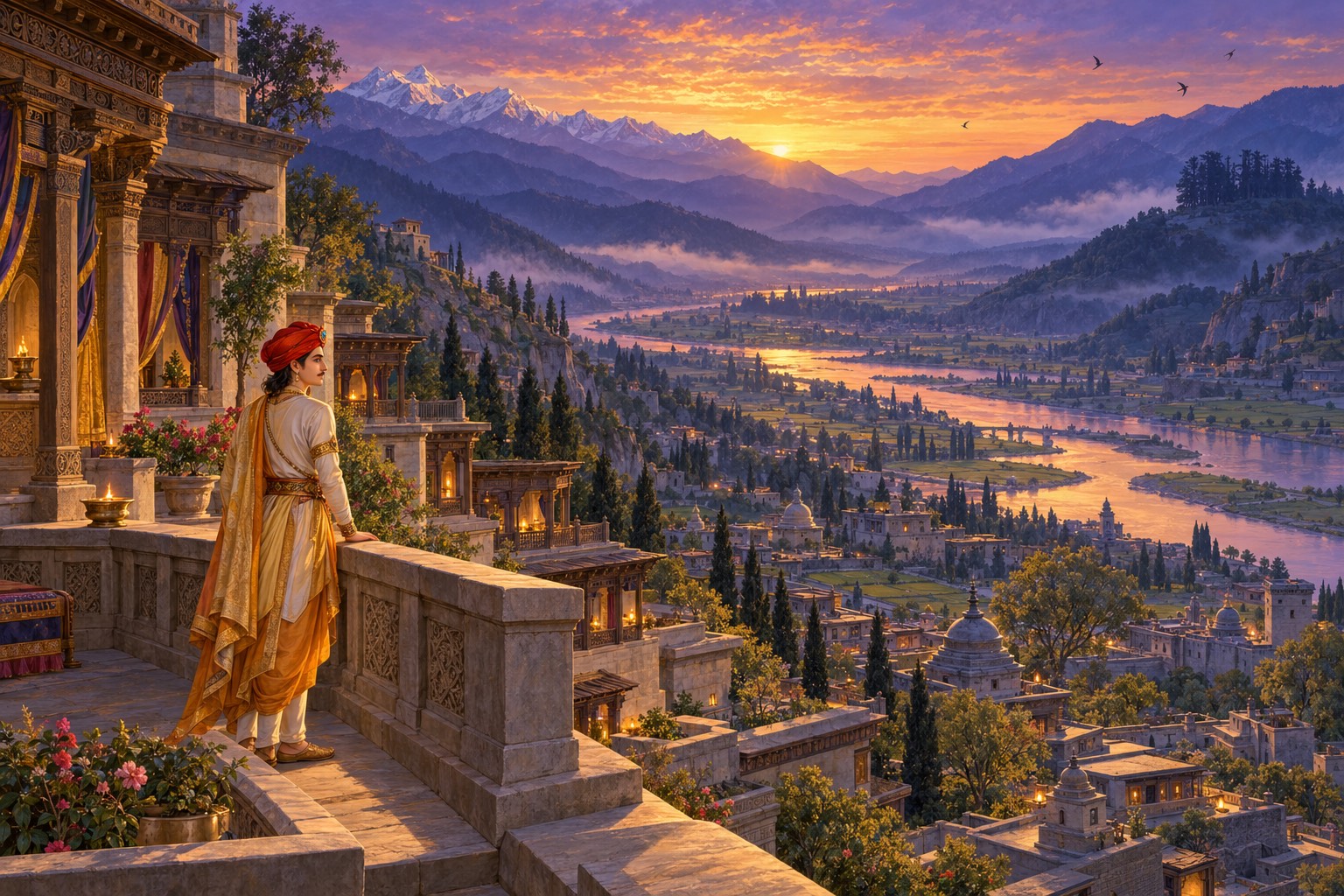
Long ago, in the eighth century, a king named Trisong Detsen ruled the high valleys of Tibet. The tradition remembers him as one of the three Dharma Kings: rulers who helped the Buddha's teaching, the Dharma, take root among their people.
This is the story of how he set out to build Tibet's first monastery, and how, the tradition says, Guru Rinpoche came over the mountains to help. It is told in two voices, and both are worth hearing.
One voice is the historical record: old chronicles, stone inscriptions and the patient work of modern scholars. The other is the voice of devotion: the life stories of Guru Rinpoche, told and retold for centuries. Where the two differ, this page will say so gently, rather than choosing for you.
A king's wish
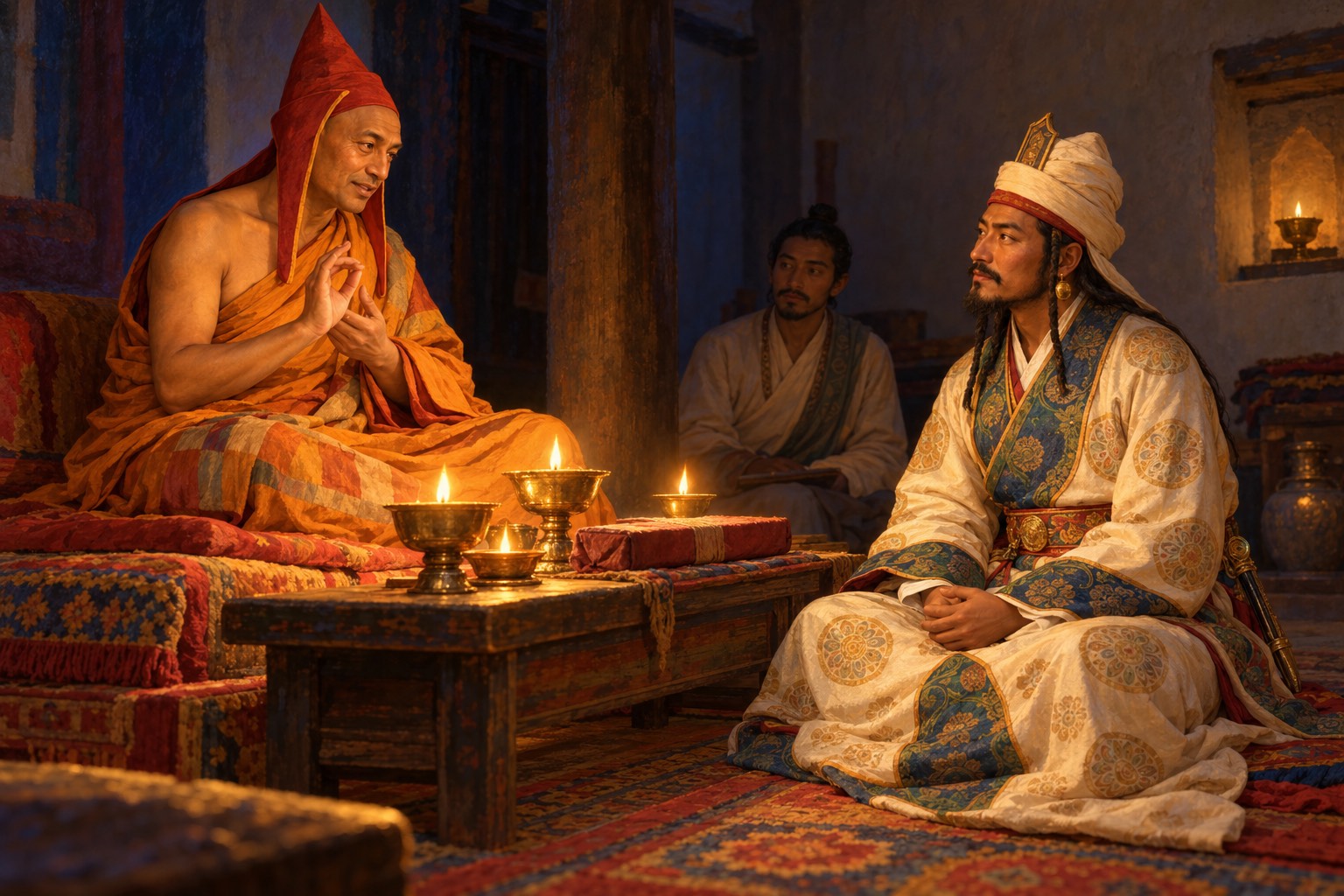
The king wanted a temple where the Dharma could be studied and lived. For that he needed a teacher. He invited Shantarakshita, a learned Indian monk remembered as an abbot of Nalanda, the great monastic university of northern India.
Tibetans came to call him Khenpo Bodhisattva, the Bodhisattva Abbot. A khenpo is an abbot, and a bodhisattva is one who lives for the awakening of others. The name tells you how he was loved.
His welcome was not entirely simple. The Testament of Ba, one of the earliest chronicles of these events, says in its oldest surviving version that the king first worried the foreign monk might bring harmful magic with him. The abbot was kept at a temple in Lhasa and questioned through an interpreter for three months before he was trusted.
Later historians softened that awkward moment. The scholar Sam van Schaik, who helped identify early fragments of the chronicle among manuscripts from the Dunhuang caves, finds the story interesting "whether you prefer your history wrinkled or smooth."
In time the abbot was welcomed, and he began to teach. A site was chosen in a wide, sandy valley beside the Tsangpo River, below a small hill called Hepori.
Walls that would not stand
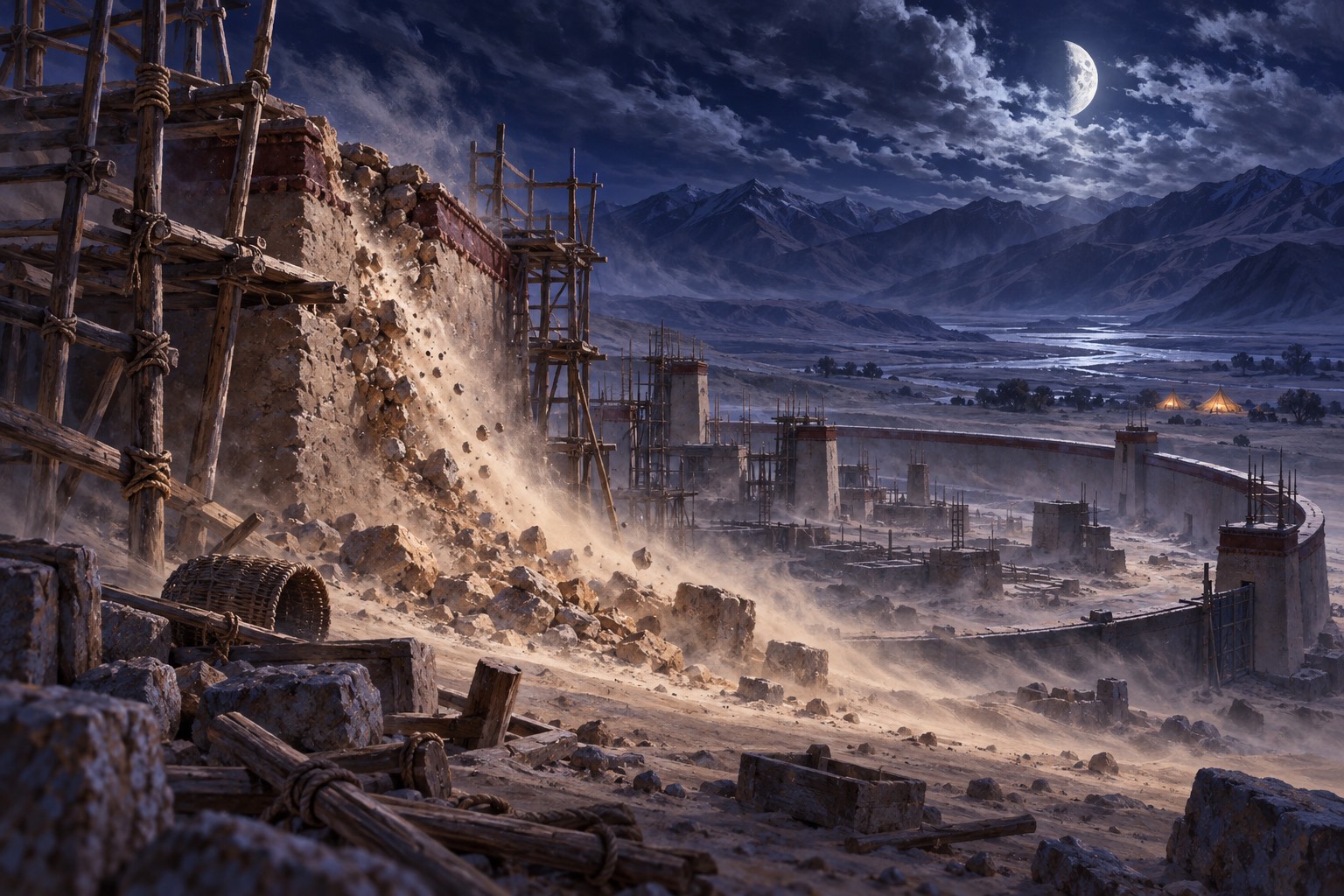
Then the trouble began. In the best-known telling, which Rigpa Wiki summarizes, the workers raised the walls by day, and the walls kept collapsing. Each morning the builders found their work undone, and they grew afraid.
The traditional accounts explain this as the work of local spirits: the unseen powers of Tibet's mountains, lakes and rivers, who were not ready to welcome a new teaching. Some workers blamed a spirit living in a nearby river.
The old chronicle tells it a little differently. As scholars summarize the Testament of Ba, the troubles were a destructive flood, lightning striking a royal palace, and sickness in the land. Some at court took these as signs that the old gods were angry, and the abbot was sent back to Nepal for a time.
Either way, the story turns on the same quiet moment. Shantarakshita did not claim he could do everything himself. He advised the king to invite another master: Padmasambhava of Oddiyana, the land in the northwest named in the first line of the prayer, an adept of the tantras, the Buddhist teachings of ritual and meditation that work with the deepest powers of mind.
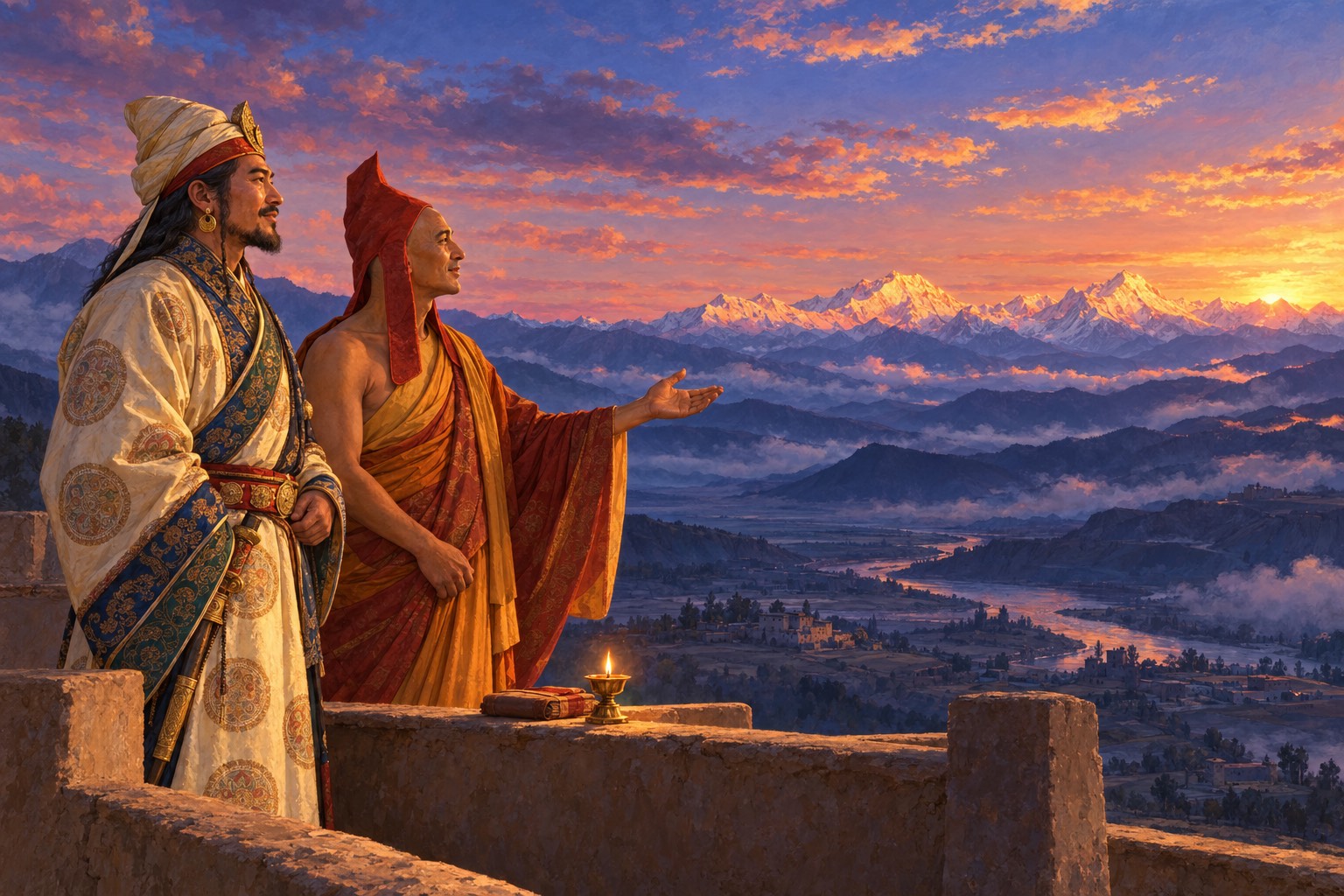
One later treasure text tells it with a twist. A treasure text is a teaching the tradition says Guru Rinpoche hid for later discovery. In The Wish-Fulfilling Tree, revealed by Chokgyur Lingpa in 1856, the abbot could have tamed the land himself, but pointed instead to an old prophecy of the Guru's coming. Each version, in its own way, honors both men.
Over the mountains
Envoys set out with gold to carry the invitation. The traditional accounts say Guru Rinpoche had already begun to travel toward Tibet, and that the king's messengers met him at Mangyul, near the border with Nepal.
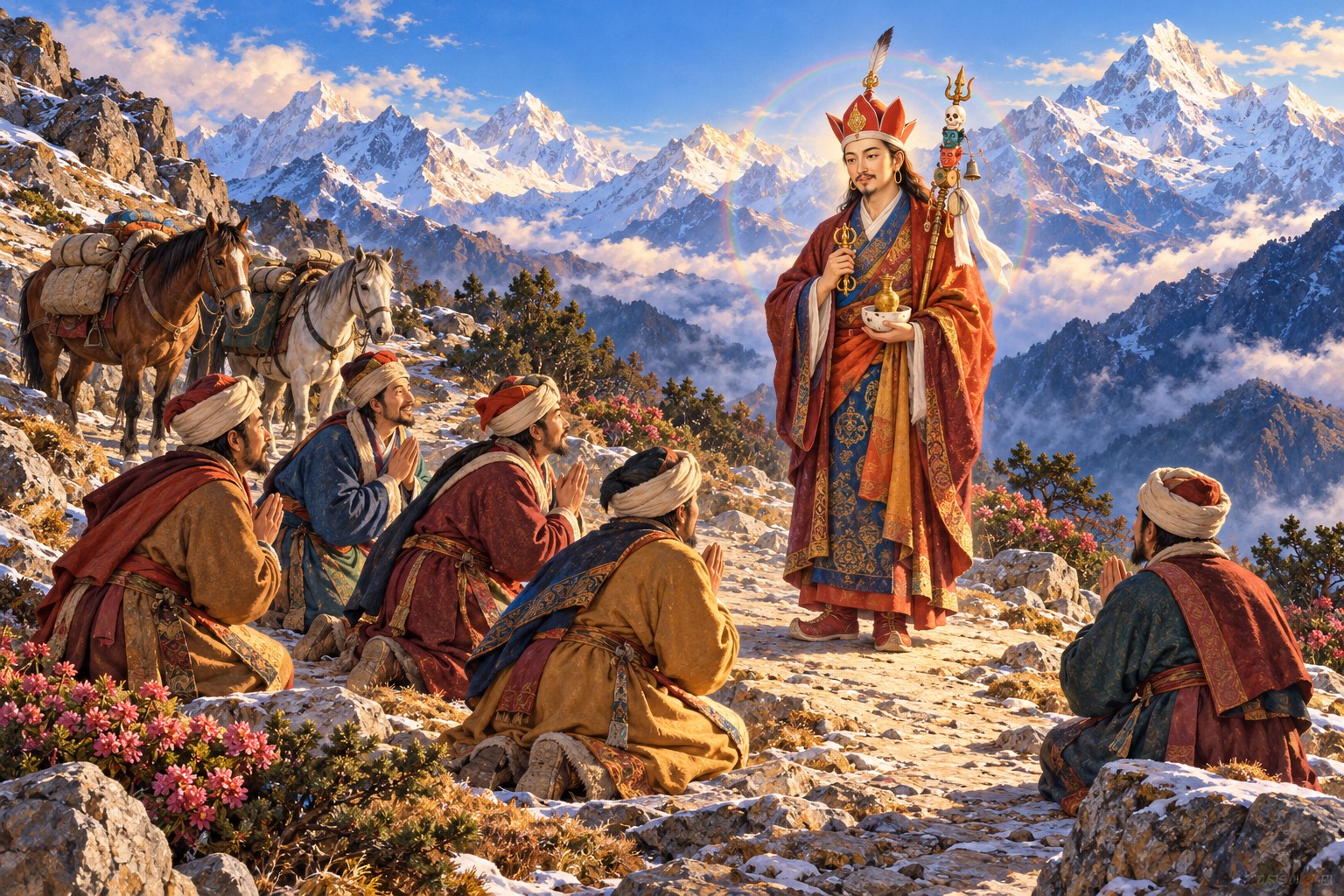
From there the life stories describe a long journey of taming. At lakes, passes and snow peaks, they say, he met the spirits of each place and bound them by oath to protect the Dharma instead of opposing it. Some are still honored as guardians at Samye today.
It may help to know how the tradition understands this. Taming a spirit does not mean destroying it. It is closer to turning a hostile neighbor into a sworn friend, so that wild power comes to serve what is good.
The life stories say the king came out to meet the Guru in a grove of tamarisk trees at Drakmar. The Wish-Fulfilling Tree adds that the king was proud at first and slow to bow, until his faith was kindled. Then the work at the building site began again.
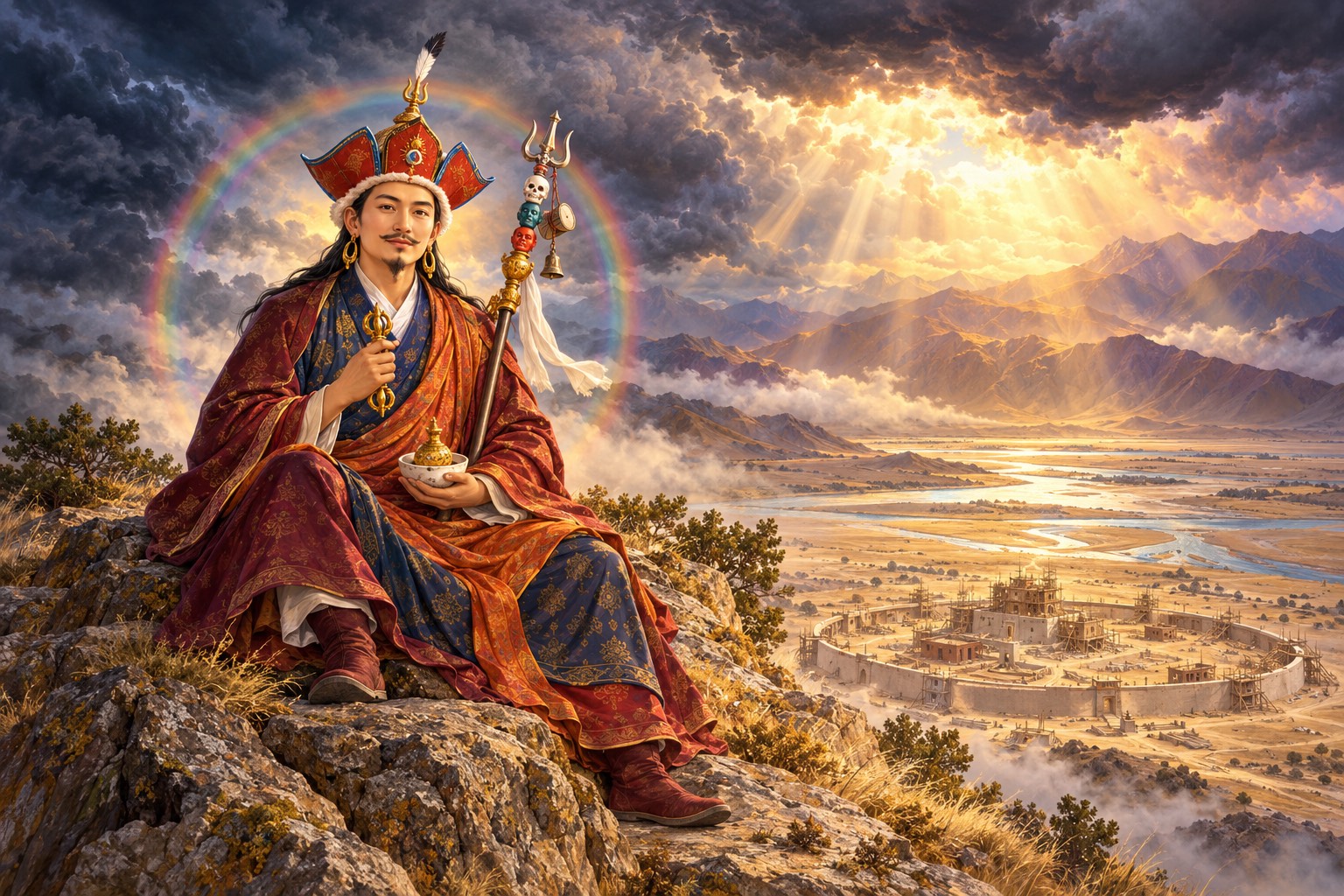
The tradition especially remembers Hepori, the hill beside the site. There, it is said, Guru Rinpoche subdued the forces that had troubled the work, and the storm over the valley grew still.
The Inconceivable
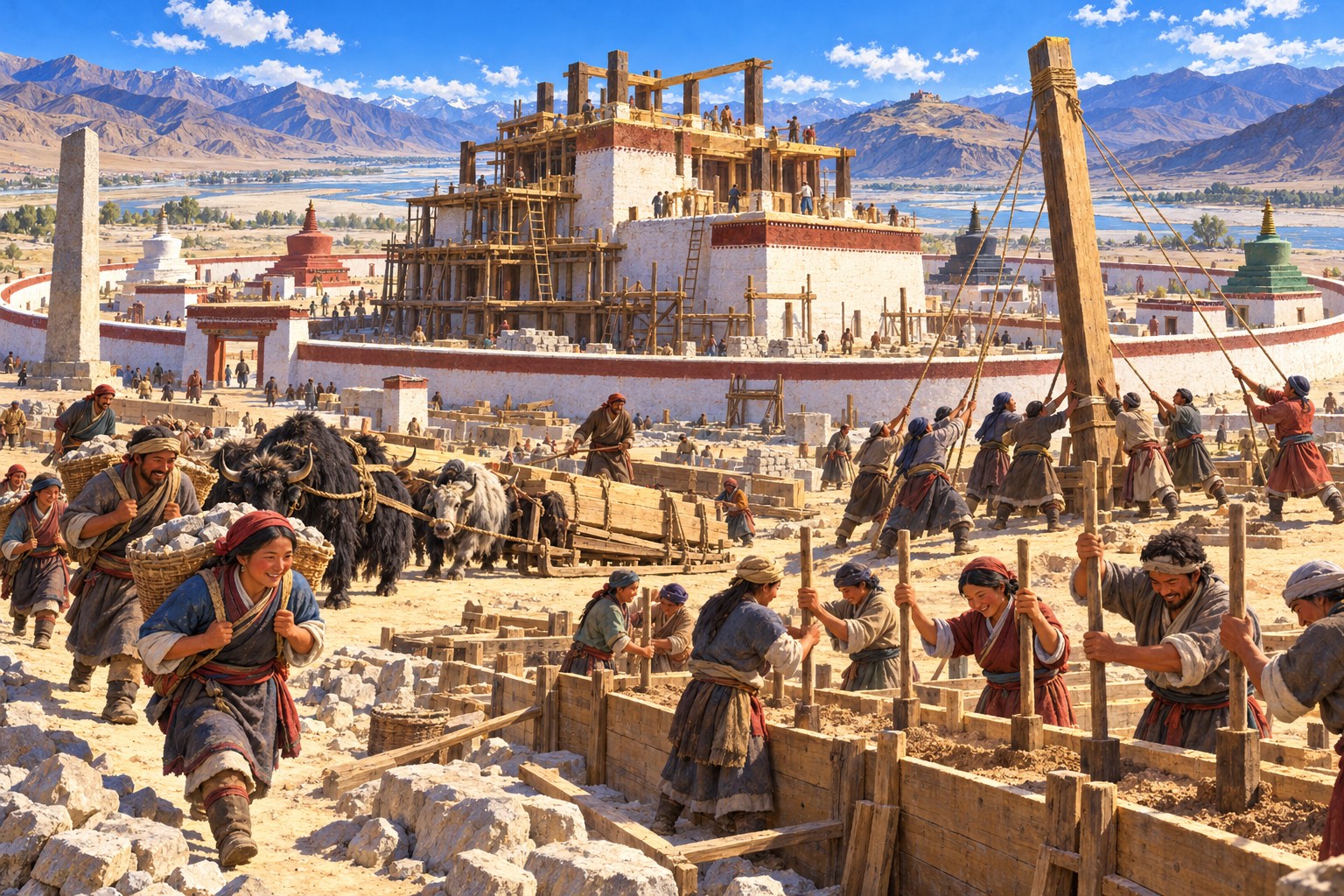
This time, the traditional accounts say, the walls stood. In The Wish-Fulfilling Tree the spirits, now under oath, even joined the work: people built by day, and the spirits built by night, raising the walls higher still.
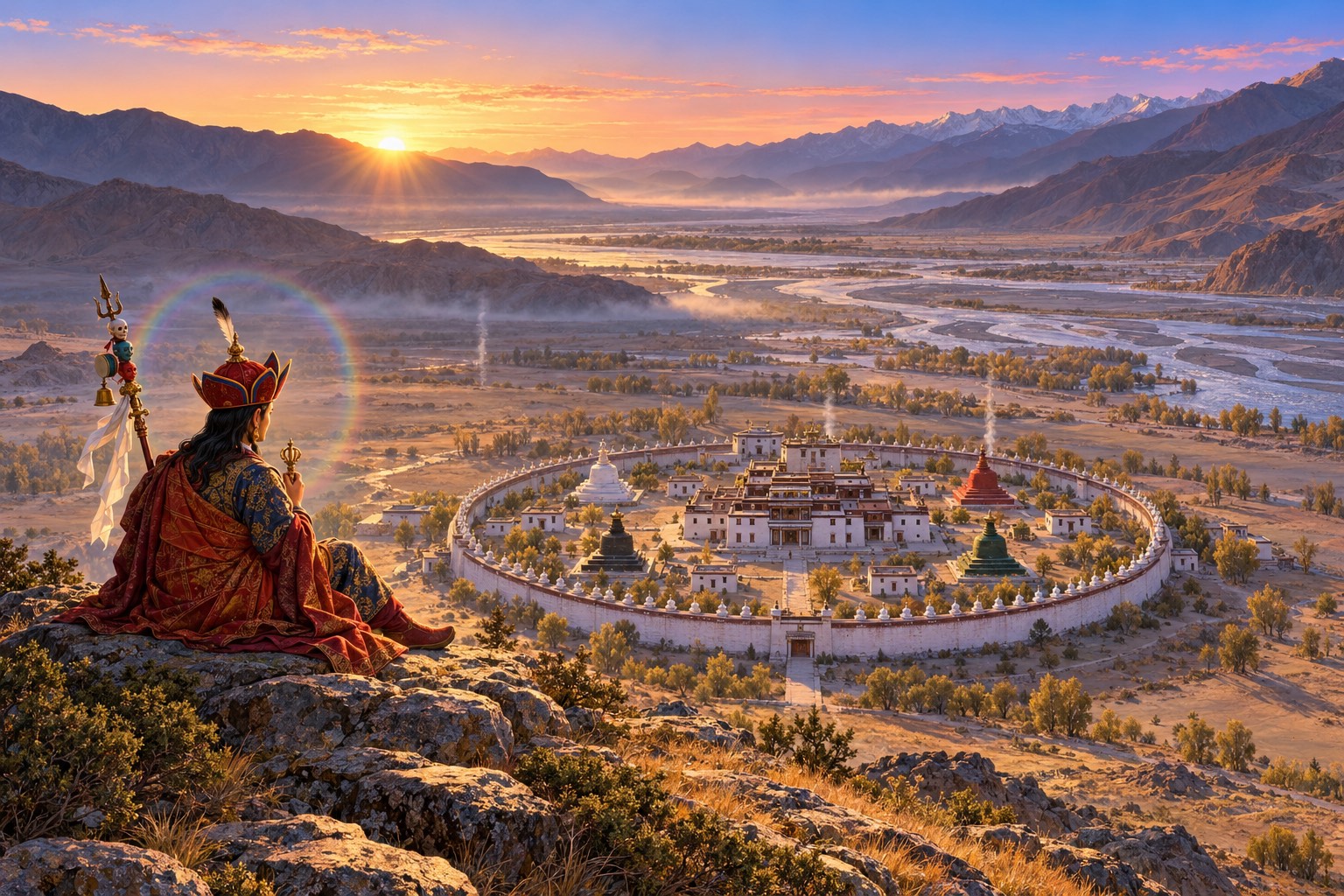
The temple was named Samye, often translated "Inconceivable." Its plan was a mandala, a sacred circle that maps the whole universe as Buddhist cosmology pictures it.
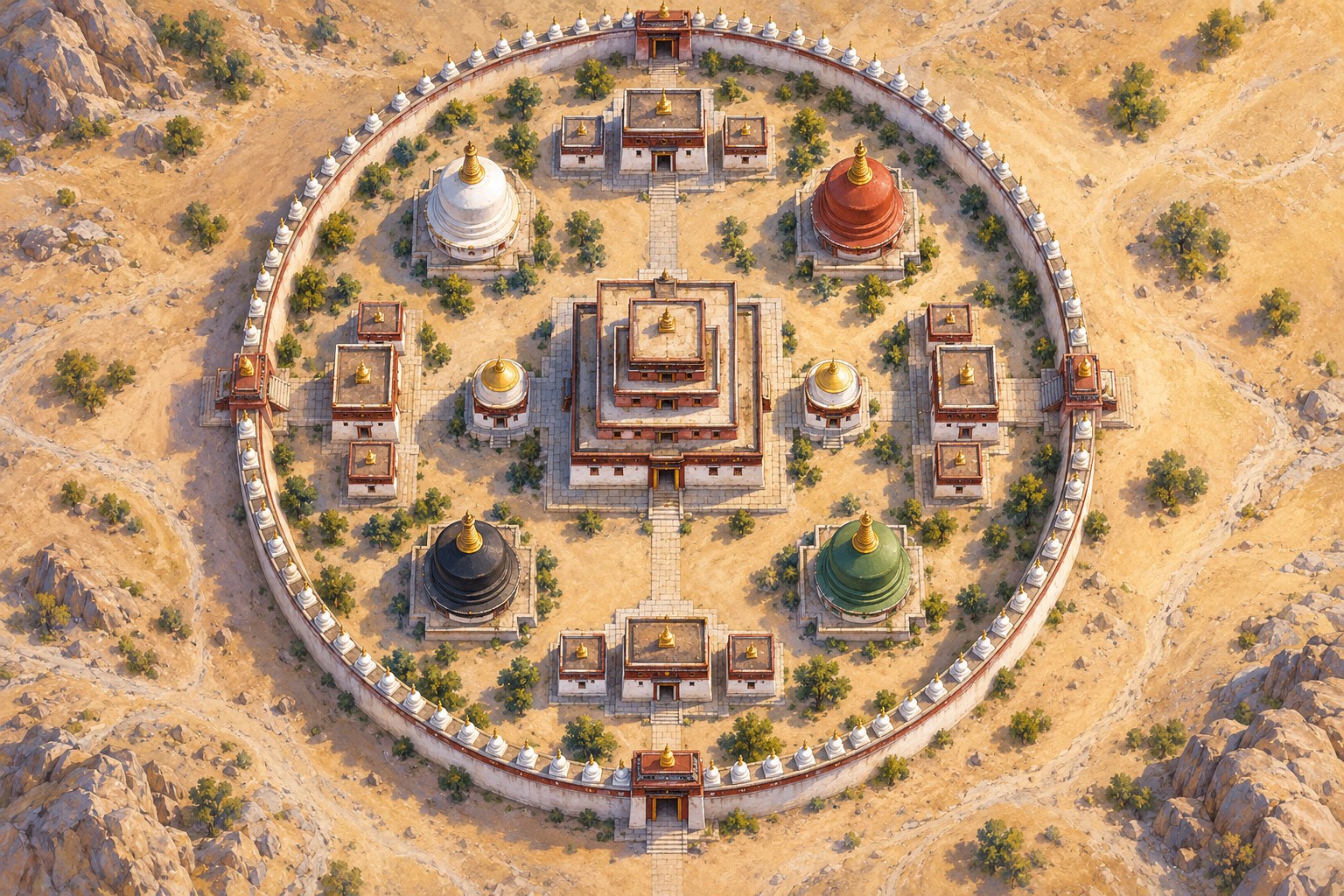
At the center rose the main temple, standing for Mount Meru, the great mountain at the heart of the world. Around it stood chapels for the four continents and their smaller islands, two for the sun and moon, and four great stupas, domed monuments for relics and offerings, each in its own color. A round outer wall enclosed it all, like the ring of mountains at the world's edge.
The tradition says the three storeys of the main temple were built in three styles. The Wish-Fulfilling Tree names them Indian, Chinese and Tibetan; some other accounts name the top storey Khotanese, after a Buddhist kingdom on the Silk Road.
When was it finished? Here the historical sources disagree among themselves. The Testament of Ba places the founding in a hare year and the consecration in a sheep year, which could mean 763 and 767, or 775 and 779.
Himalayan Art Resources, citing the Treasury of Lives, favors completion around 775 and consecration around 779. Rigpa Wiki gives 766, and the historian Butön gave later dates still.
Seven who were tested
A monastery needs monks. Shantarakshita ordained the first Tibetans to take monastic vows, a small group remembered as the "seven men who were tested." The tradition understands the name to mean that they would show whether Tibetans could keep a monk's discipline.
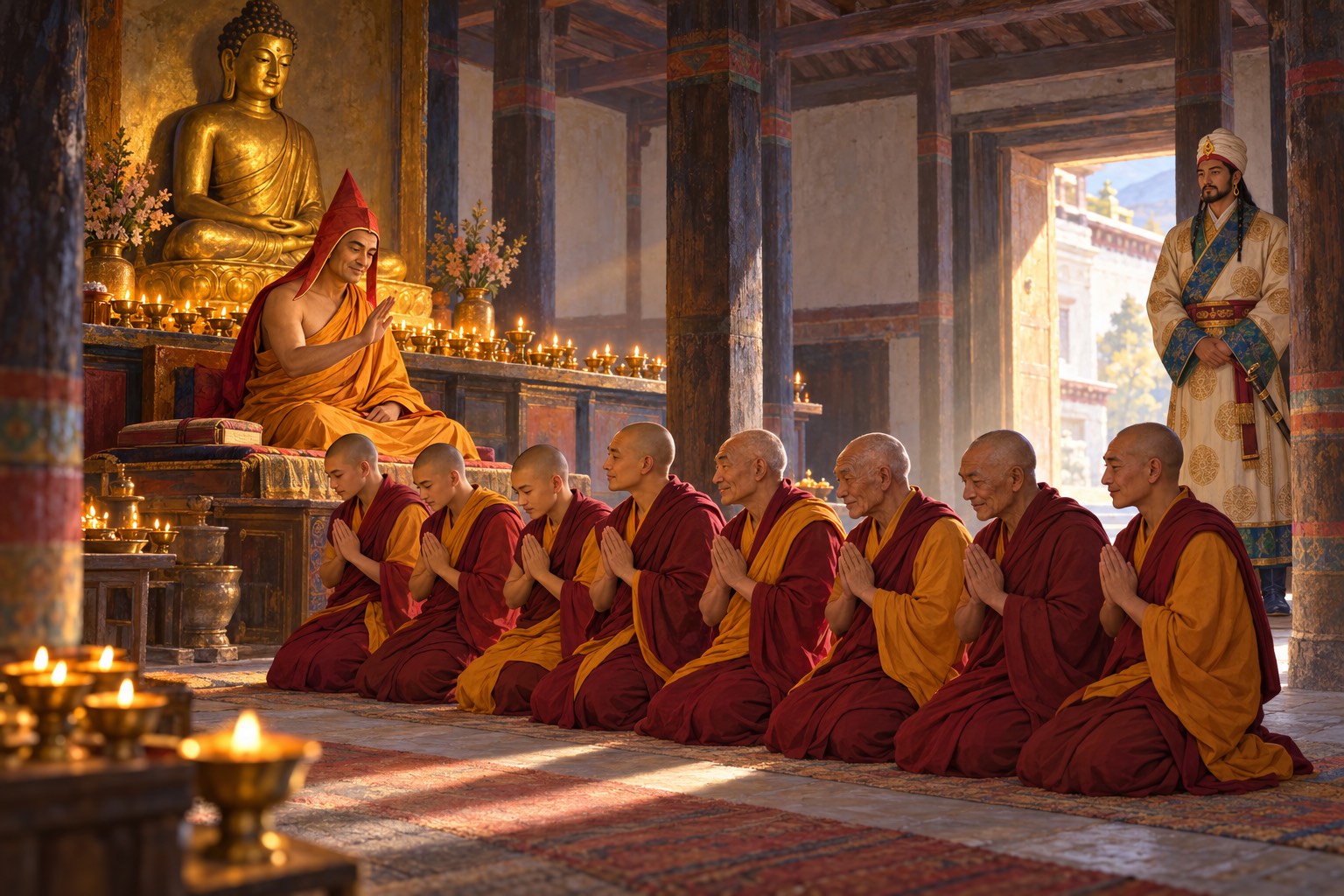
Their names differ from list to list. Rigpa Wiki gives one list, which includes the translator Vairotsana and Ba Salnang, the court figure later credited with the Testament of Ba, and it notes other lists with different names.
The two voices part once more over Guru Rinpoche himself. As Sam van Schaik writes on his blog Early Tibet, the earliest histories give him a modest role: taming the forces that hindered Samye, and perhaps bringing irrigation to the valleys. Summaries of the Testament of Ba add that he left when some at court grew suspicious of his power. The later life stories give him a long stay, many disciples, and treasures hidden for the future.
Two ways of remembering
So which story is true? Perhaps that is not quite the question for a night like this.
The historian asks what old documents can show. The devotee asks what the story opens in the heart. Both are honest ways of remembering.
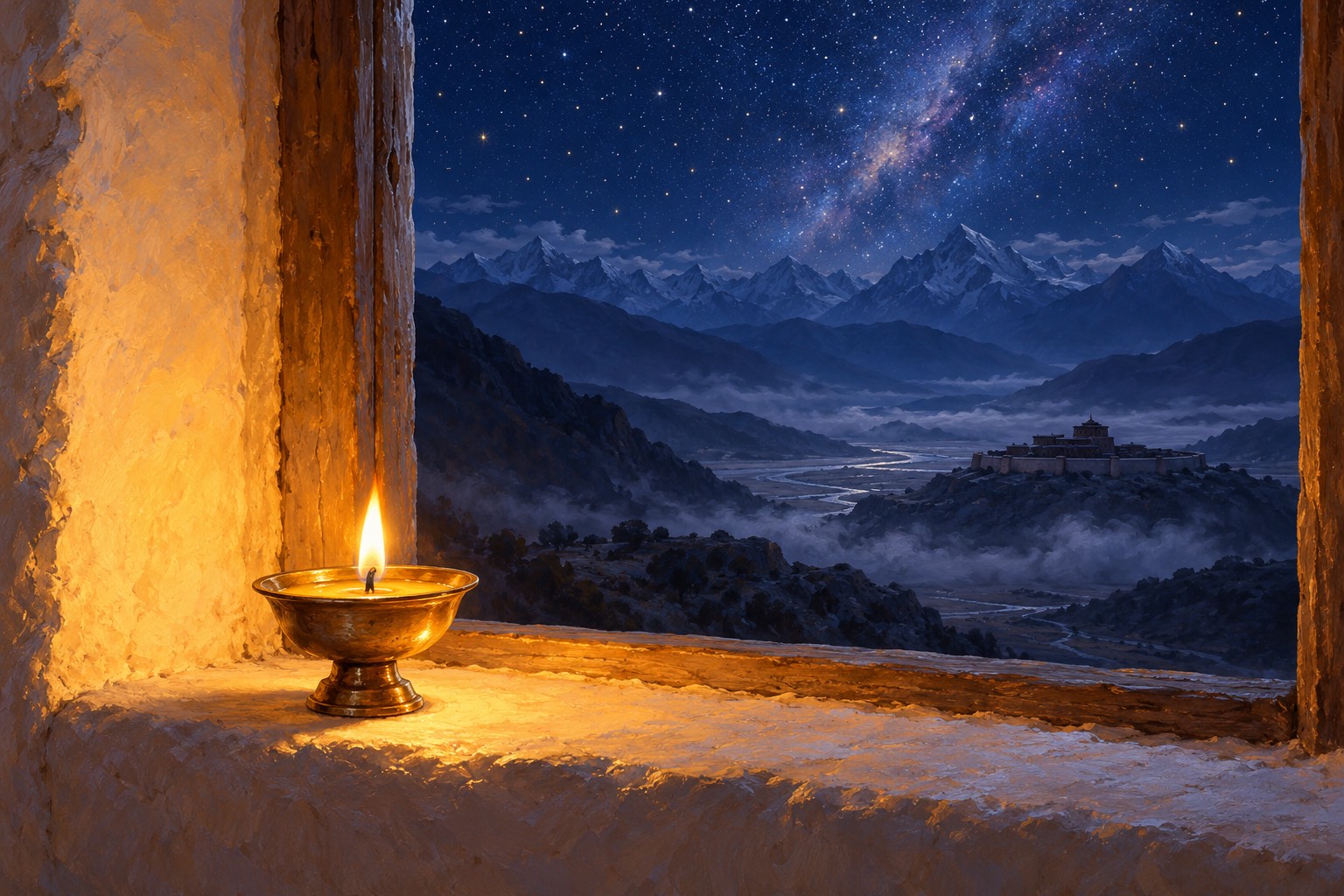
Samye still stands, damaged and rebuilt more than once, and pilgrims still walk around it. For many practitioners, the line of the prayer that speaks of Guru Rinpoche's wondrous accomplishment calls this place to mind: ground that seemed to resist became, with patience and the right help, a home for awakening.
About the art
Guru Rinpoche appears here in his main form, as Padmasambhava. He wears the lotus hat, crowned with a vajra, a sun and moon and a vulture feather. His right hand holds a five-pronged vajra, the 'diamond scepter' that stands for unshakable, awakened mind. His left hand holds a skull cup containing a small vase of long-life nectar, and a trident staff called a khatvanga rests in the crook of his left arm. The staff is one of his constant emblems; teachers explain its deeper meaning. On this page he is shown standing or seated on rock rather than on his usual lotus throne with sun and moon discs, because the story finds him travelling and at work in the landscape.
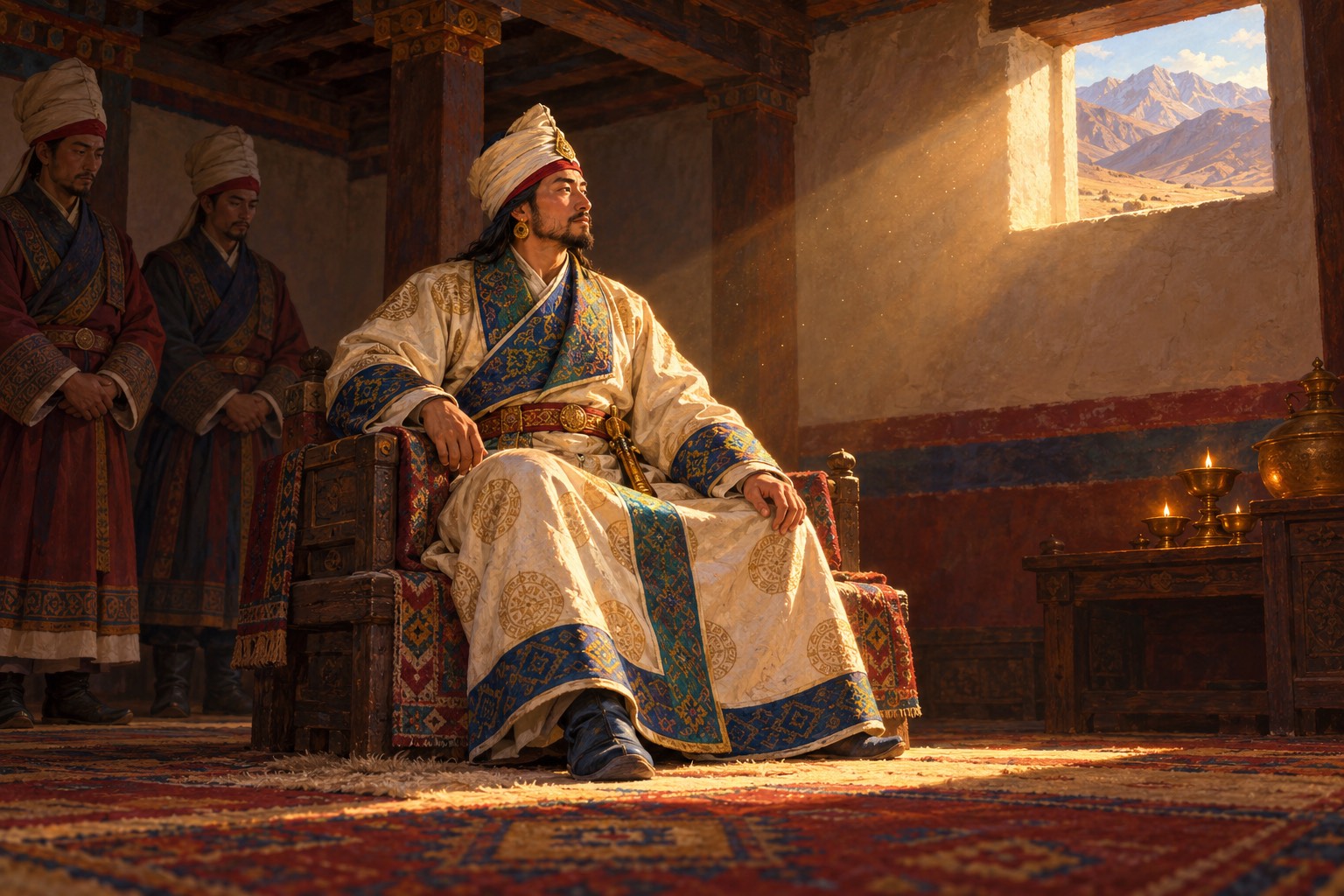
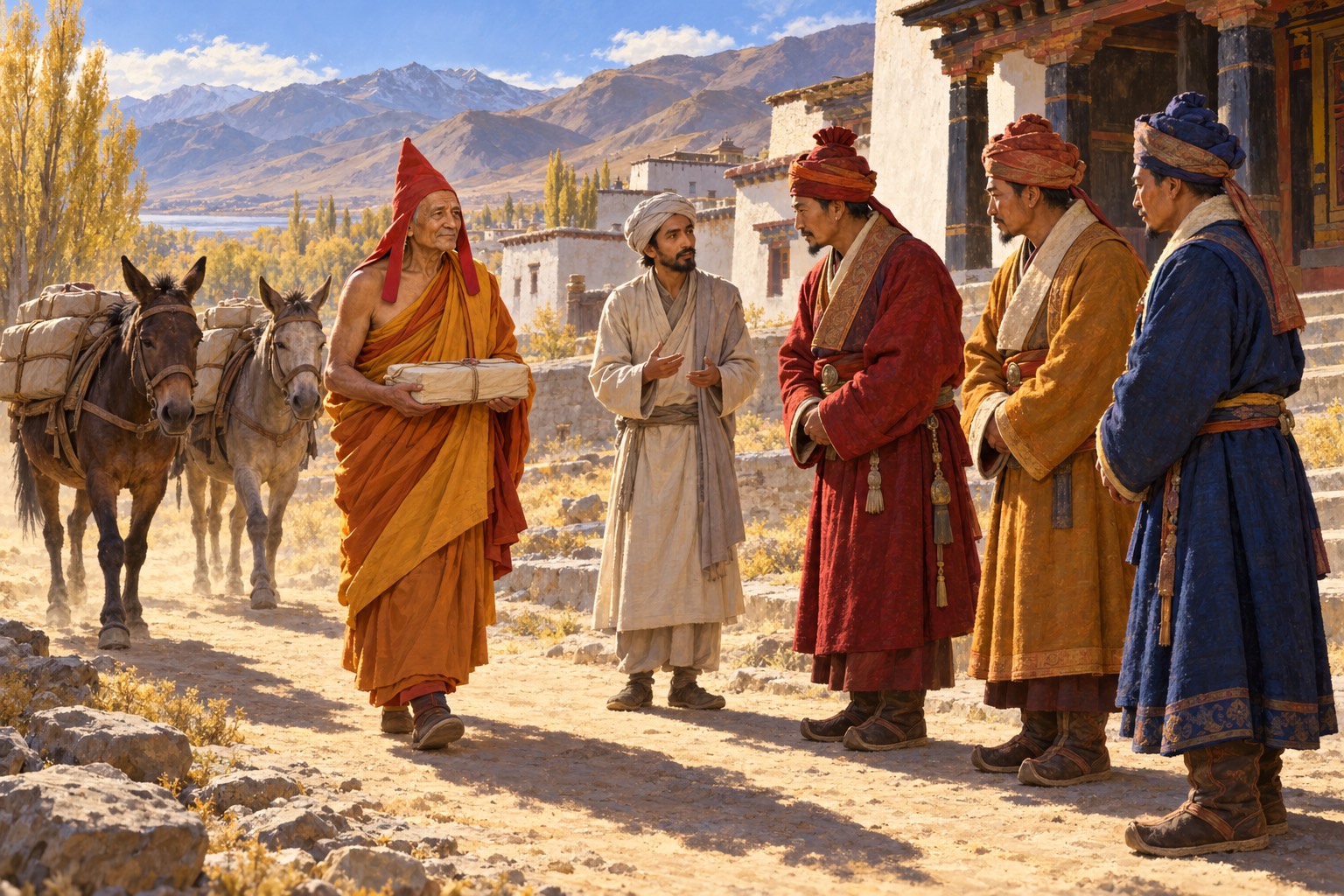
Shantarakshita is shown as an elderly Indian monk wearing the red pointed pandita hat, a hat that in Himalayan art marks a highly learned monk such as an abbot, over patched monastic robes. His hands are at his heart in the teaching gesture. King Trisong Detsen wears layered royal robes. In devotional paintings he is often shown with a wisdom sword and a book resting on lotus flowers at his shoulders, signs that the tradition regards him as an emanation of Manjushri, the bodhisattva of wisdom. Courtiers and envoys wear dress based on surviving images of the Tibetan empire: long belted robes with wide lapels and tall wrapped turbans.
Samye is drawn as a mandala: a central temple standing for Mount Meru, chapels for the continents, the sun and the moon, four stupas in white, red, black and green, and a round outer wall. The local spirits are never shown as creatures. They appear only as wind, dust, shadow and storm, because the tradition speaks of unseen powers, and we would rather let the weather carry the meaning than invent faces for them.
Why this matters for practice
The third line of the Seven-Line Prayer remembers Guru Rinpoche's wondrous accomplishment, and Samye is one of the places where the tradition sees that accomplishment take shape in the world. The story also shows a humble pattern: a king who asks, an abbot who knows when to call for help, and a master who turns resistance into protection. Reciting the prayer is, for many practitioners, a way of asking for that same help with whatever in their own life will not yet stand.

If something in this story moved you, you might pause tonight and recite the Seven-Line Prayer once, slowly, the way a builder sets a single stone.
Sources and further reading
- Samyé, Rigpa Wiki (archived snapshot)
- King Trisong Detsen, Rigpa Wiki (archived snapshot)
- Shantarakshita, Rigpa Wiki (archived snapshot)
- Seven men to be tested, Rigpa Wiki (archived snapshot)
- The Wish-Fulfilling Tree: The Life Story of the Master of Uḍḍiyāna (Chokgyur Lingpa, trans. Samye Translations), Lotsawa House
- Guru Padmasambhava: an introduction, Lotsawa House
- A Prayer Recalling the Life and Liberation of Padmasambhava (Nyangral Nyima Özer, trans. Samye Translations), Lotsawa House
- Śāntarakṣita series, Lotsawa House
- The Abbot, or Ironing out History's Wrinkles (Sam van Schaik), early Tibet
- Padmasambhava I: the early sources (Sam van Schaik), early Tibet
- Buddhism and Empire IV: Converting Tibet (Sam van Schaik), early Tibet
- Testament of Ba, Encyclopedia of Buddhism
- King: Trisong Detsen (Tibet), Himalayan Art Resources
- Hats of the Himalayas: Pandita Hat, Himalayan Art Resources
- Kings: Main Page & King Appearance, Himalayan Art Resources
- Samye Monastery Main Page, Himalayan Art Resources
- Indian Master Shantarakshita and Scenes from his Life, Rubin Museum of Himalayan Art
- Samye, Wikipedia
- Padmasambhava, Wikipedia
This retelling is waiting to be read by a knowledgeable practitioner. Where the traditional accounts differ, the story says so; if you notice a mistake, please tell us through Share Your Story.