Every story has to begin somewhere. This one begins with a lake at dawn, a flower on the water, and a child sitting very still at its heart.
It is the story of how Guru Rinpoche came into the world. Guru Rinpoche, "Precious Teacher," is the name Tibetans most often use for Padmasambhava, the eighth-century master remembered for helping the Buddha's teachings take root in Tibet.
The Seven-Line Prayer, the short prayer this site is named for, opens with this very moment. Before it asks for anything at all, it simply remembers a place, the northwest of the land of Oddiyana, and a birth in the heart of a lotus. So it seems right to begin here too.
The land of Oddiyana
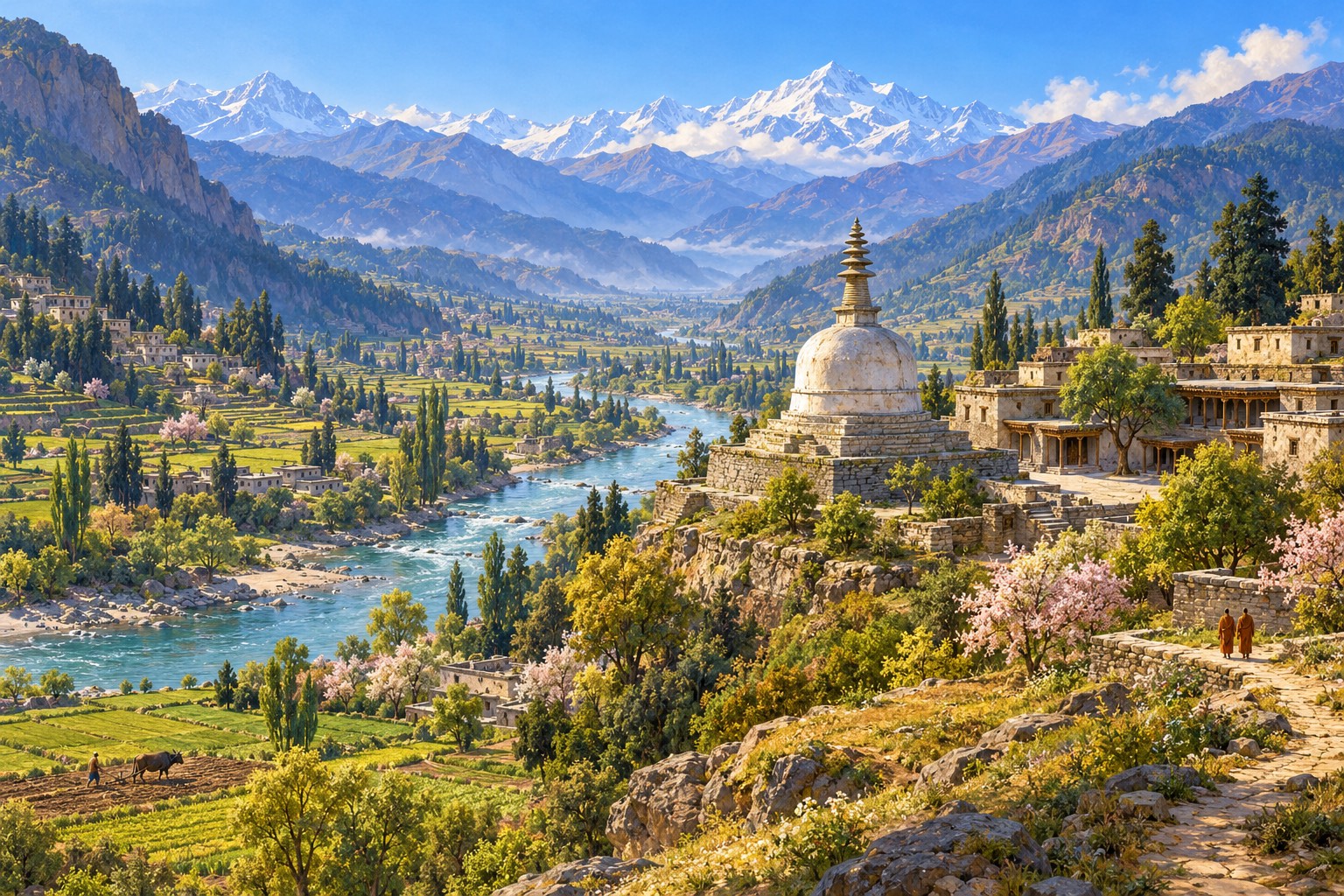
Oddiyana (Tibetans say Orgyen) was a real region at the far northwestern edge of the old Indian world. Most scholars place it in the Swat Valley of present-day Pakistan: green river valleys, orchards and forests, snowy peaks, and in those centuries many Buddhist monasteries and stupas, dome-shaped shrines that hold sacred relics.
Over time Oddiyana became more than a place on a map. Tibetan tradition calls it the land of the dakinis, a word often translated "sky-goers," meaning female wisdom beings, messengers of awakening. In its stories, history and wonder run together like two rivers meeting.
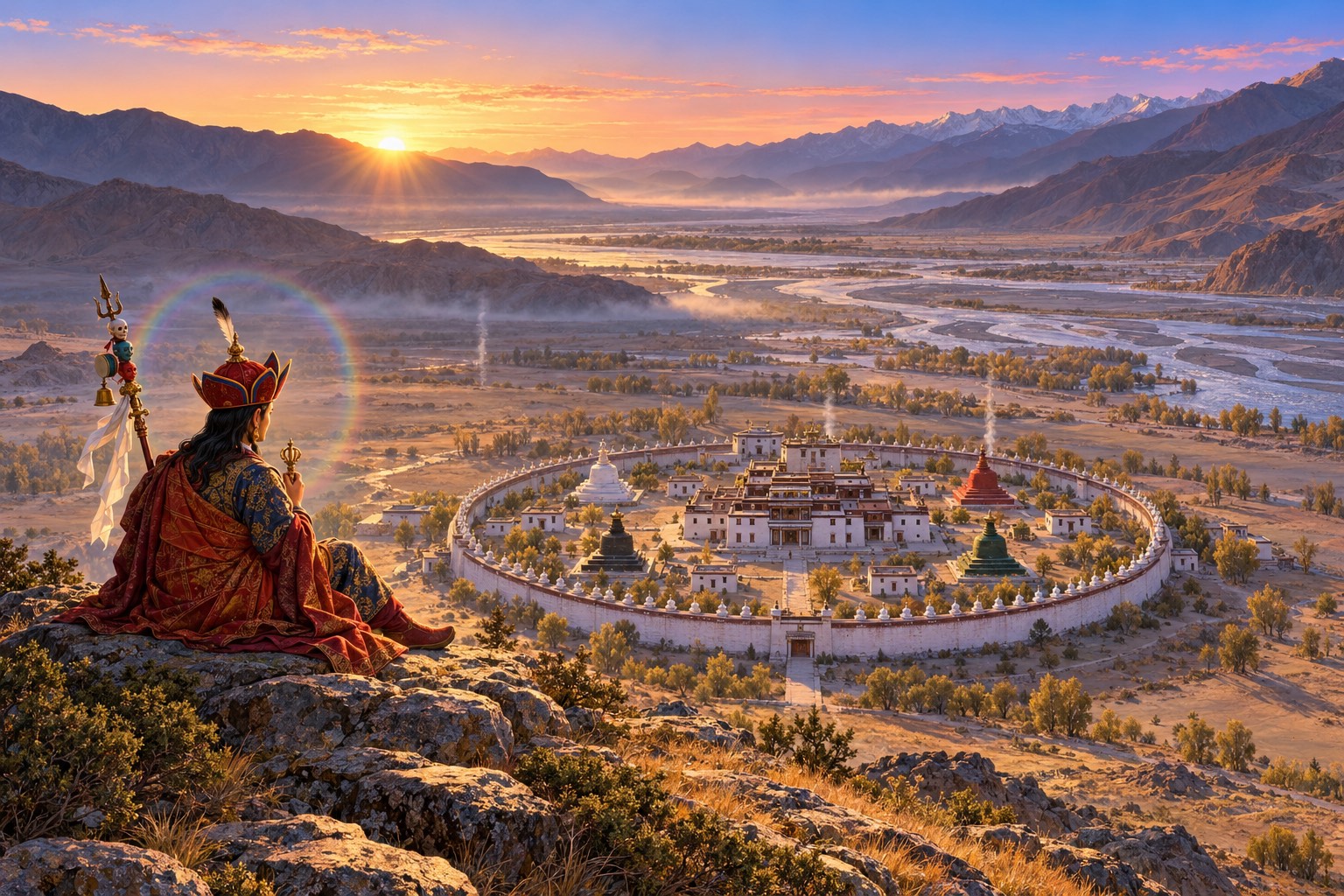
Centuries later, Tibetan pilgrims still made the long, hard journey there. One of the best known, Orgyenpa Rinchen Pal, reached the Swat Valley in the thirteenth century and wrote a guide to the route, full of meetings with dakinis.
A king with empty hands
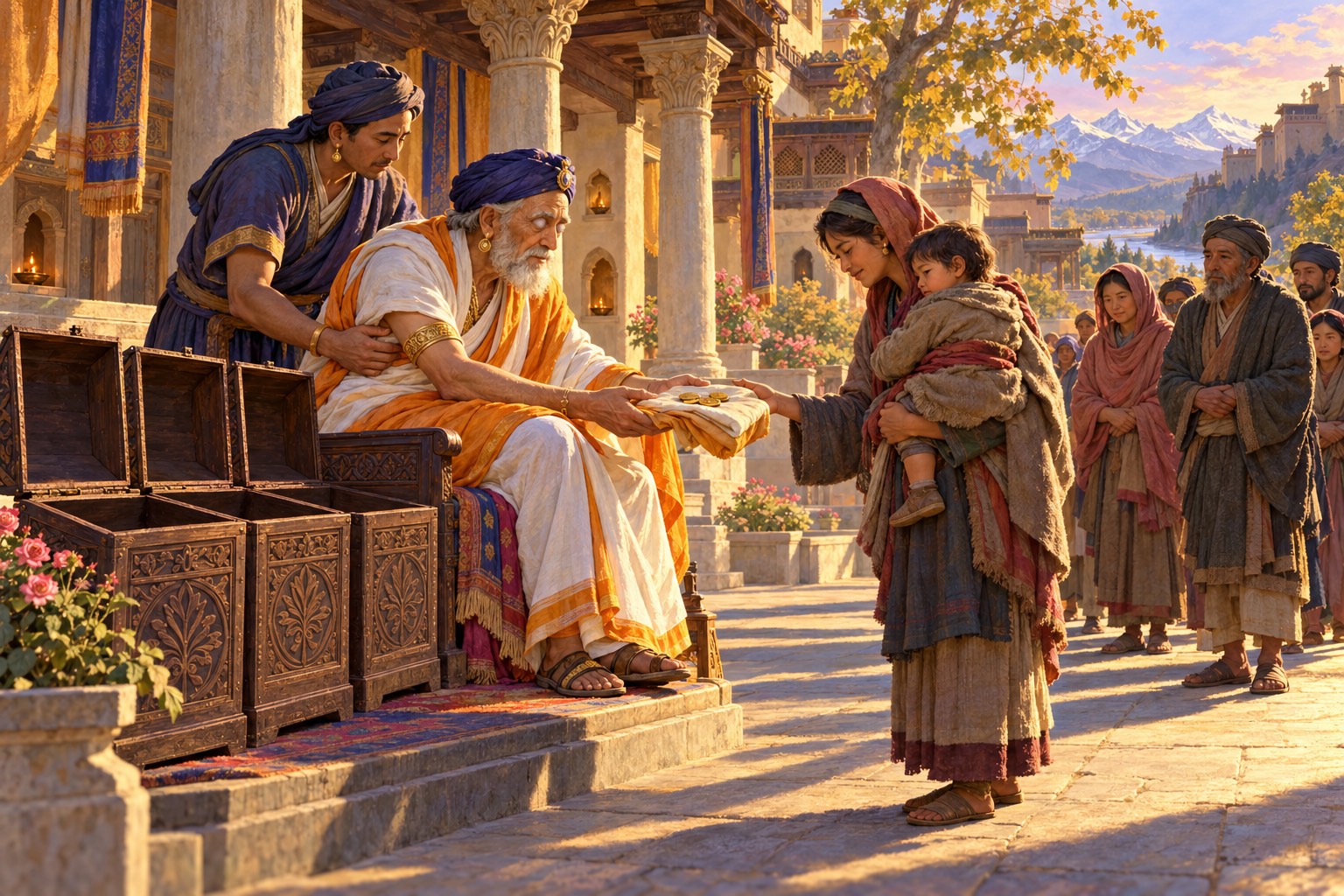
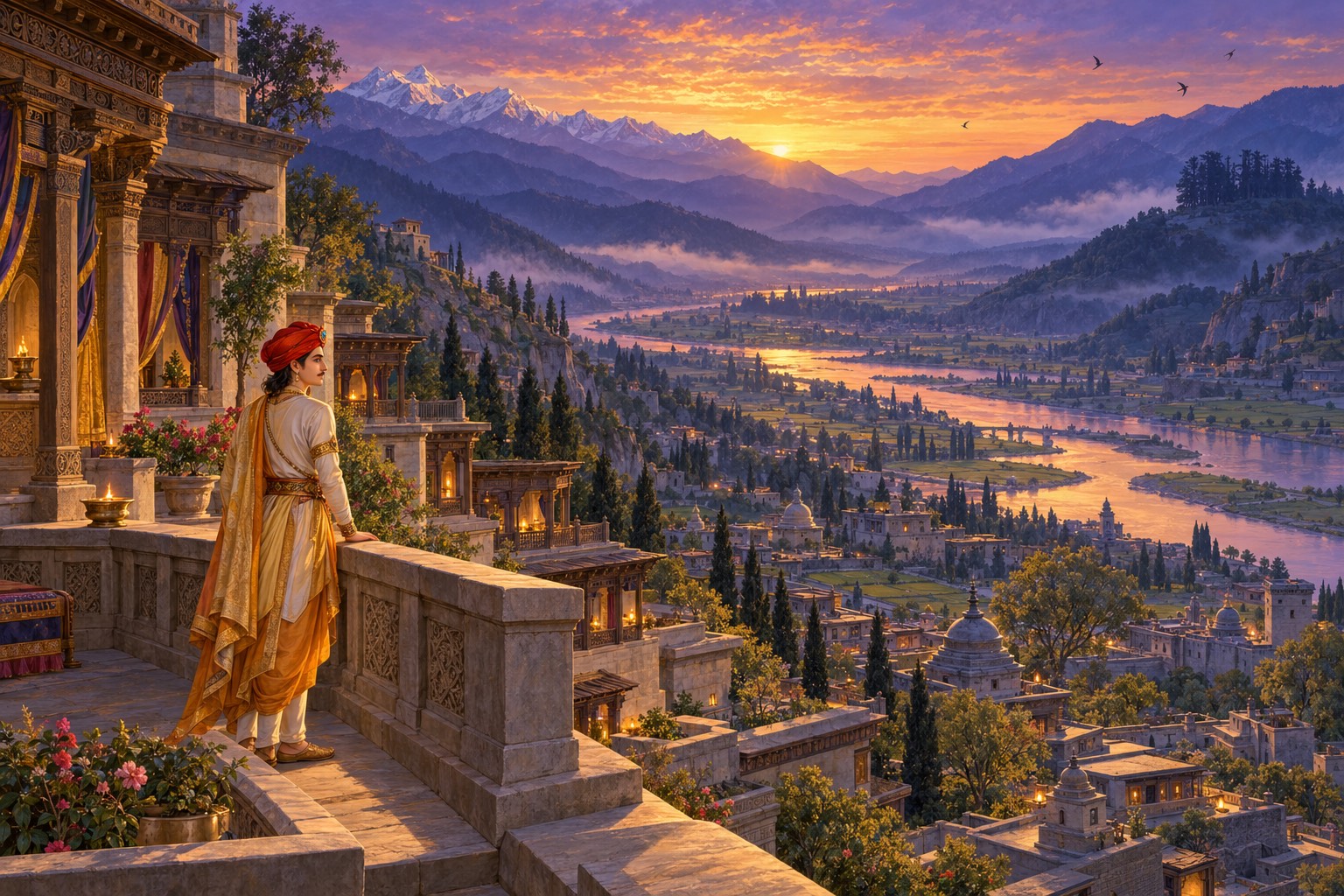
The traditional accounts say that Oddiyana was ruled by a king named Indrabhuti. He was known for his generosity. He gave so freely to the poor and in offerings to the Buddha's teachings that in the end his treasury stood empty.
He carried other sorrows too. He had no son to follow him on the throne, and in several tellings his eyesight had failed. One classical summary remembers him simply as the blind king.
So Indrabhuti did what kings in old stories do. He set out by boat across the great lake to seek a wish-fulfilling jewel, a gem said to grant whatever is asked of it, so that he could go on giving.

The lake was called Dhanakosha. In Sanskrit the name can be read as "treasury of wealth," which suits a story about a king whose treasury had run dry.
The accounts say the king found his jewel. But it was on the way home that something far more precious was waiting for him.
The lotus on the lake

Here the tellings move from the human world into the language of vision. According to the life stories, the Buddha Amitabha, the Buddha of Boundless Light, looked with compassion on the suffering of beings. From his heart he sent a golden vajra, a small scepter that stands for what cannot be broken, down toward the waters of Dhanakosha.
Amitabha's buddha family is the lotus family. That is one reason tradition understands Guru Rinpoche as Amitabha's emanation: a form that a buddha sends into the world to help beings.
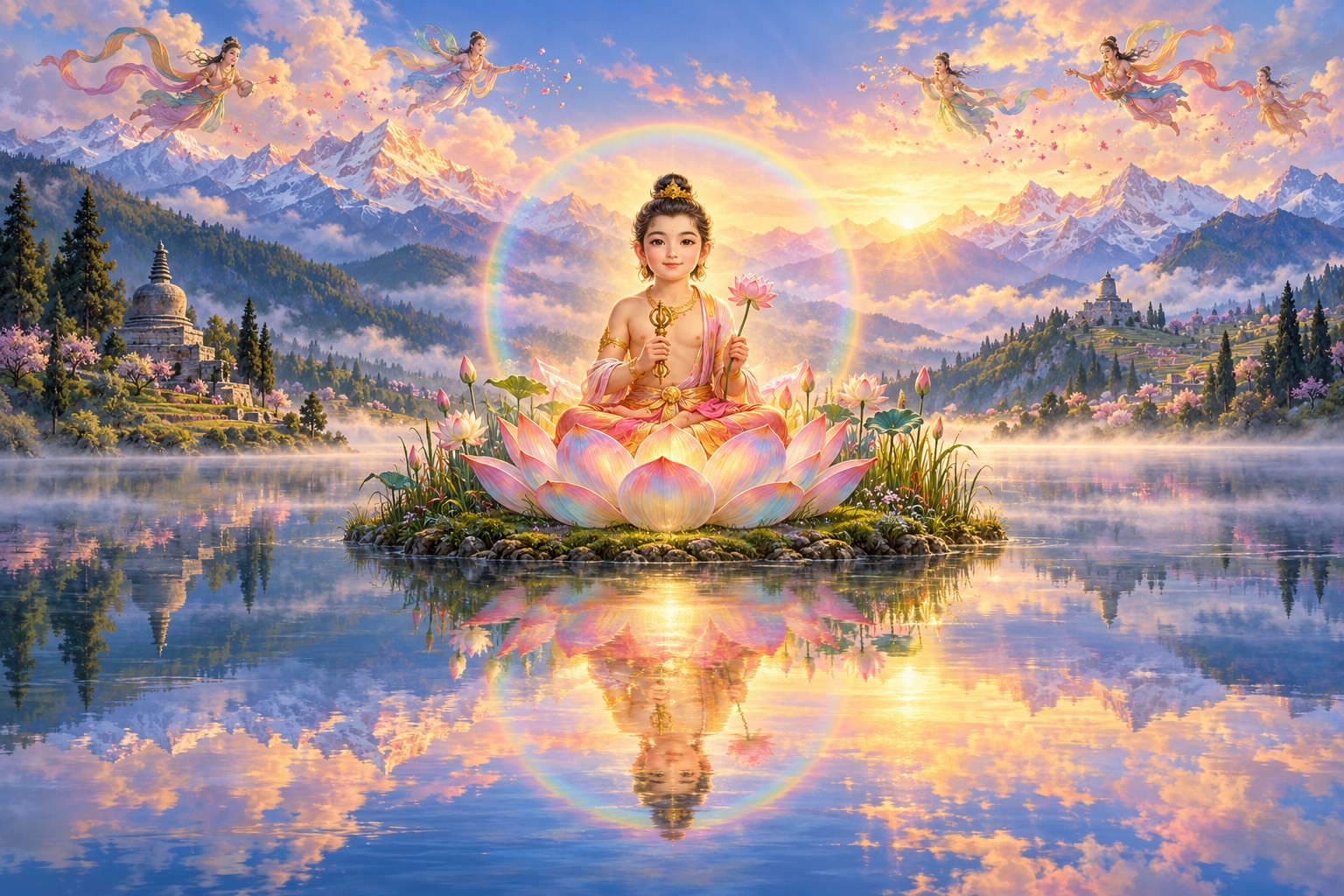
On an island in the lake, a great lotus of many colors had grown. The vajra came to rest in its bud. And there, the accounts say, it became a child of about eight years old, beautiful and bright, holding a vajra in one hand and a lotus in the other.
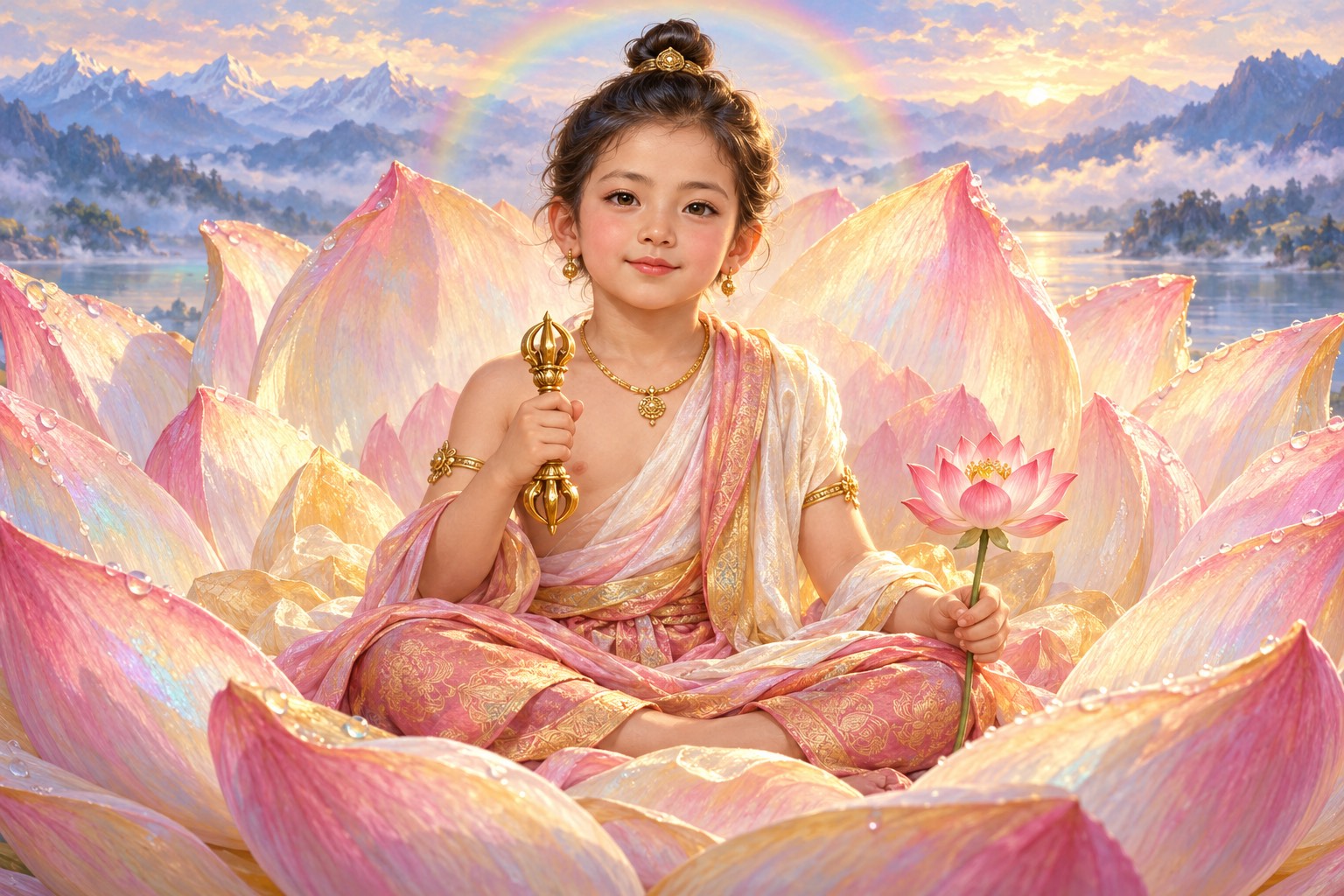
Notice that the stories do not describe a newborn baby. From the first moment he is a boy of eight, already awake and already at ease. It is one way of saying that he did not come into the world in order to become something. He came ready to help.
Some accounts even give the day: the tenth day of the waxing moon, in the monkey month. The tenth day of each lunar month is still kept by many practitioners as a day to remember Guru Rinpoche.
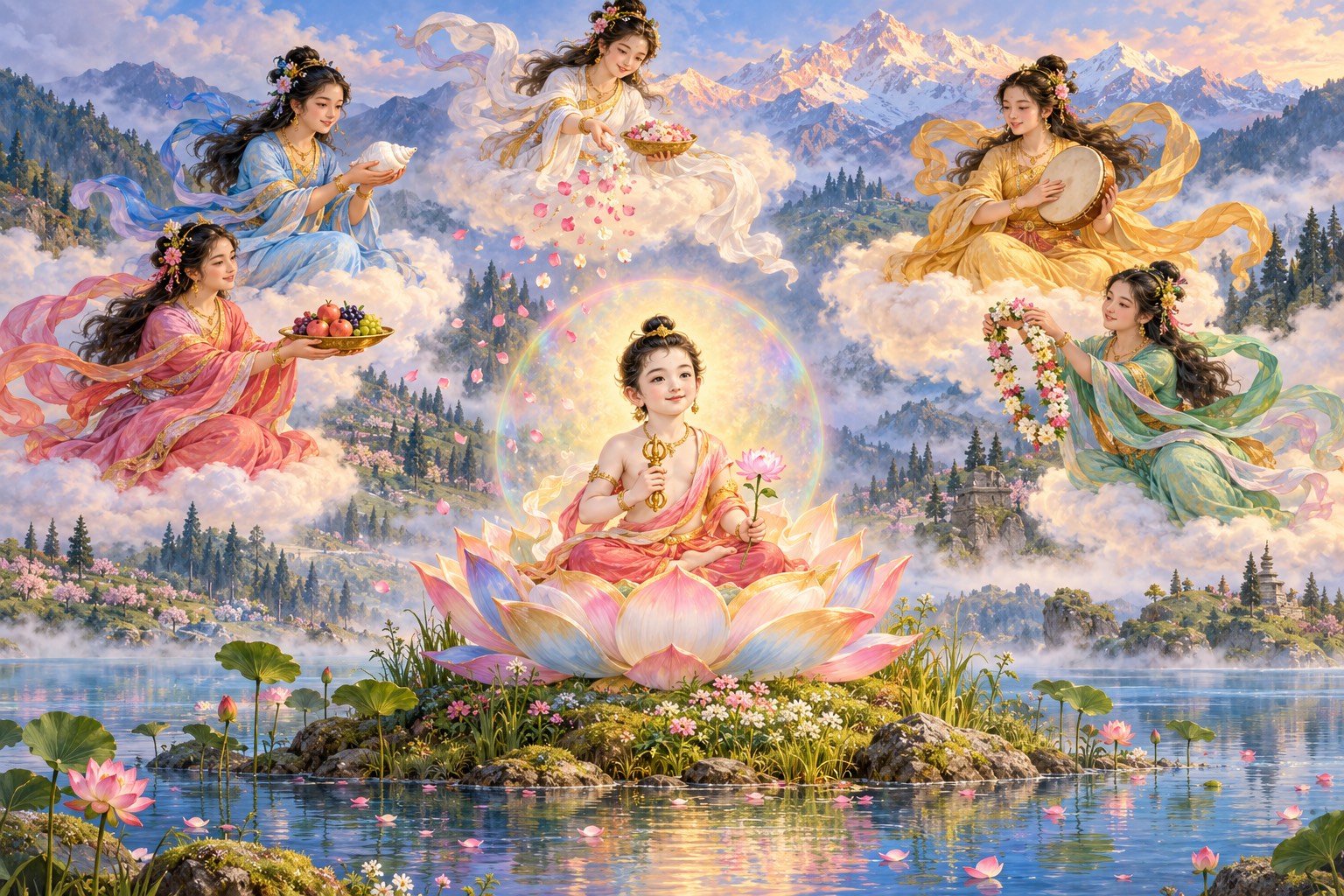
He was not alone. The life stories say that dakinis gathered around the lotus to honor him with offerings and song, and one account says that while he sat on the island he taught the Dharma, the Buddha's teaching, to the gods and dakinis who lived there.
Some accounts go further and say that the invocation sung at that moment was the Seven-Line Prayer itself. That is a story of its own, and it will have its own page here.
Who are you?
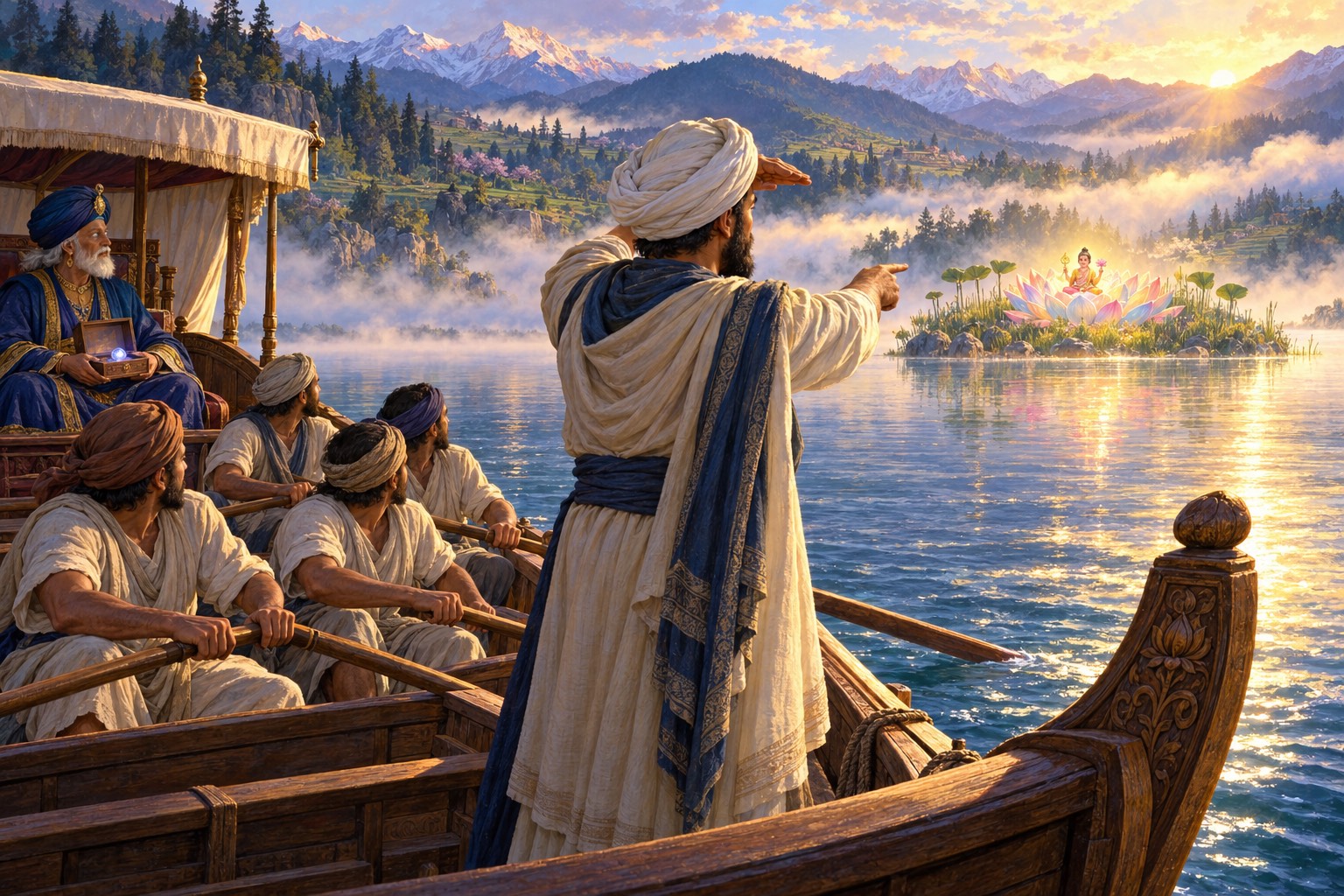
Now the two threads of the story meet. As the king's boat came home across the lake, the accounts say, the first to see the child was one of his ministers, a man named Trigunadhara. He hurried to tell the king.
Then Indrabhuti saw for himself: a child sitting on a lotus in the middle of the water, alone, unafraid and radiant.
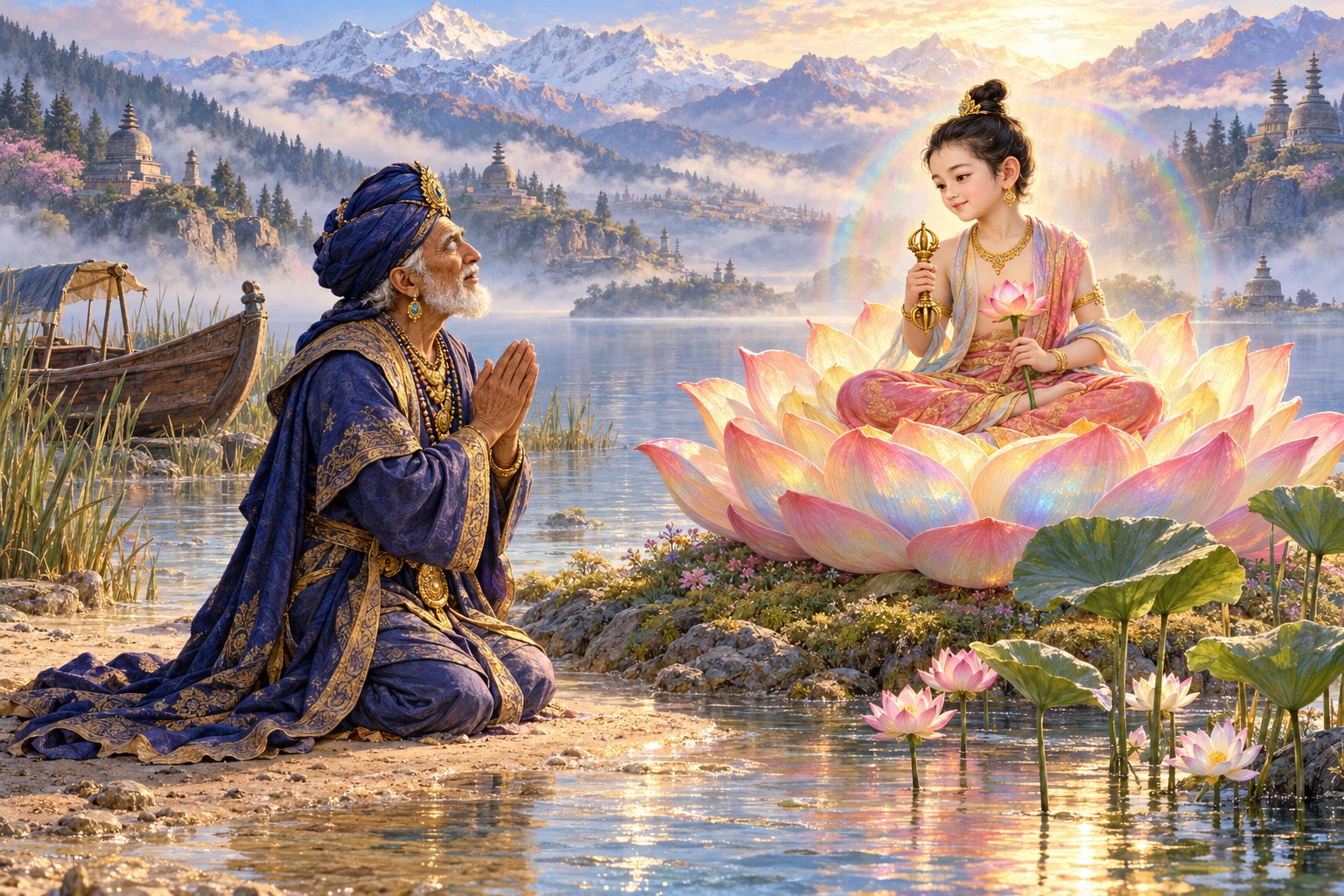
The king asked the questions anyone might ask a child found alone. Who were his father and mother? What was his family, his country, his name? What did he live on, and why was he here?
The old books record the child's answer as a song. In plain words, he said that his father was awareness itself and his mother the open space in which everything appears. His name was the Lotus-Born.
His homeland, he sang, was beyond birth. His food was the habit of splitting the world into "me" and "other." And his purpose was to carry on the work of all the buddhas.
The versions word the song a little differently, but they share its shape: each ordinary question receives an answer about the nature of mind.
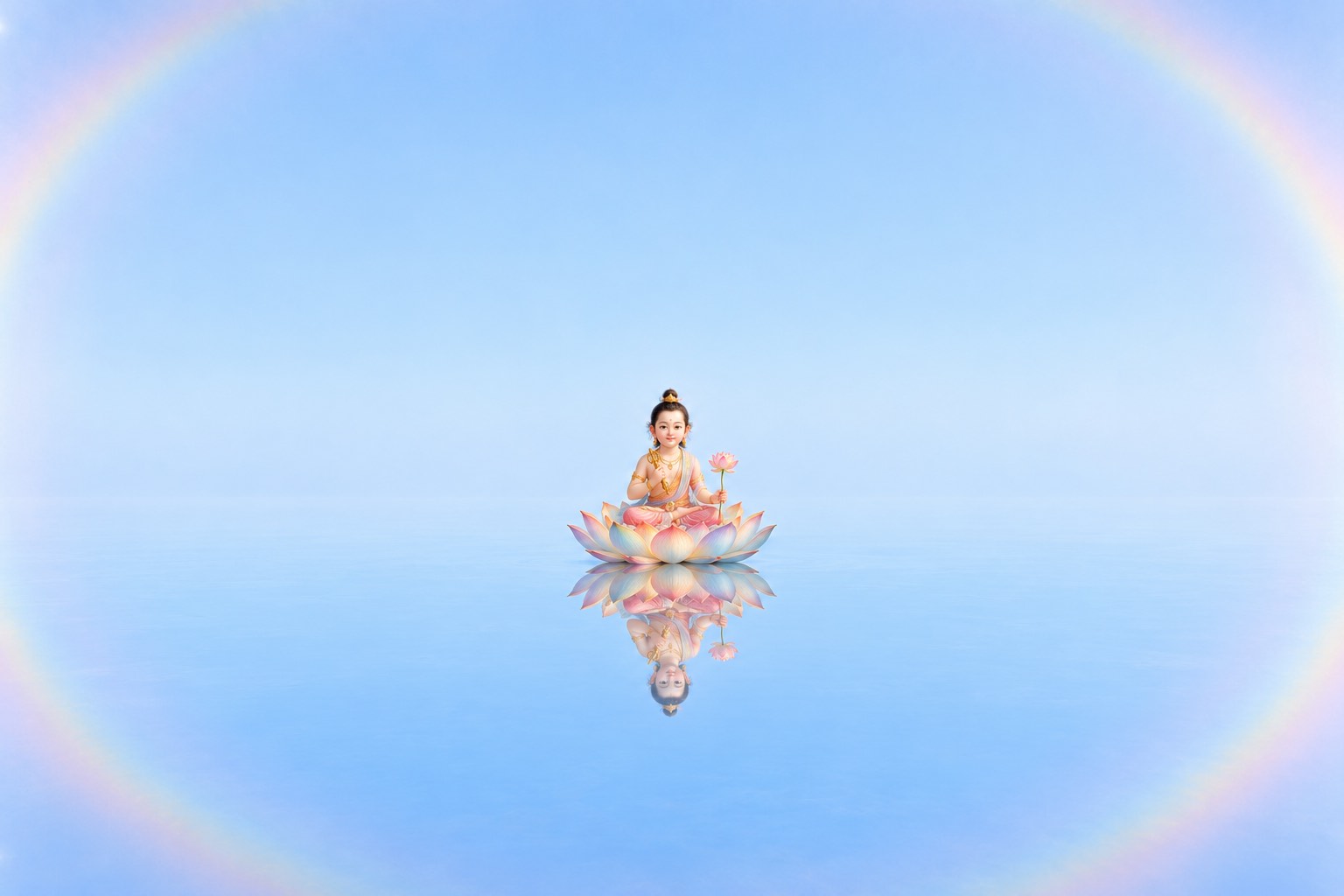
It is an unusual answer to give a king in a boat. One way to hear it is that the child was pointing past the lake and past the lotus. His true origin, he seems to say, is not a place at all, and not something that was ever born.
Indrabhuti, the accounts say, saw in him the answer to his prayers.
Home to the palace
The king brought the boy home. In the tellings, the whole kingdom shares in the joy. The wish-fulfilling jewel is said to have showered the people with food, clothing and precious things, and the dakinis sang praises as the child was enthroned.
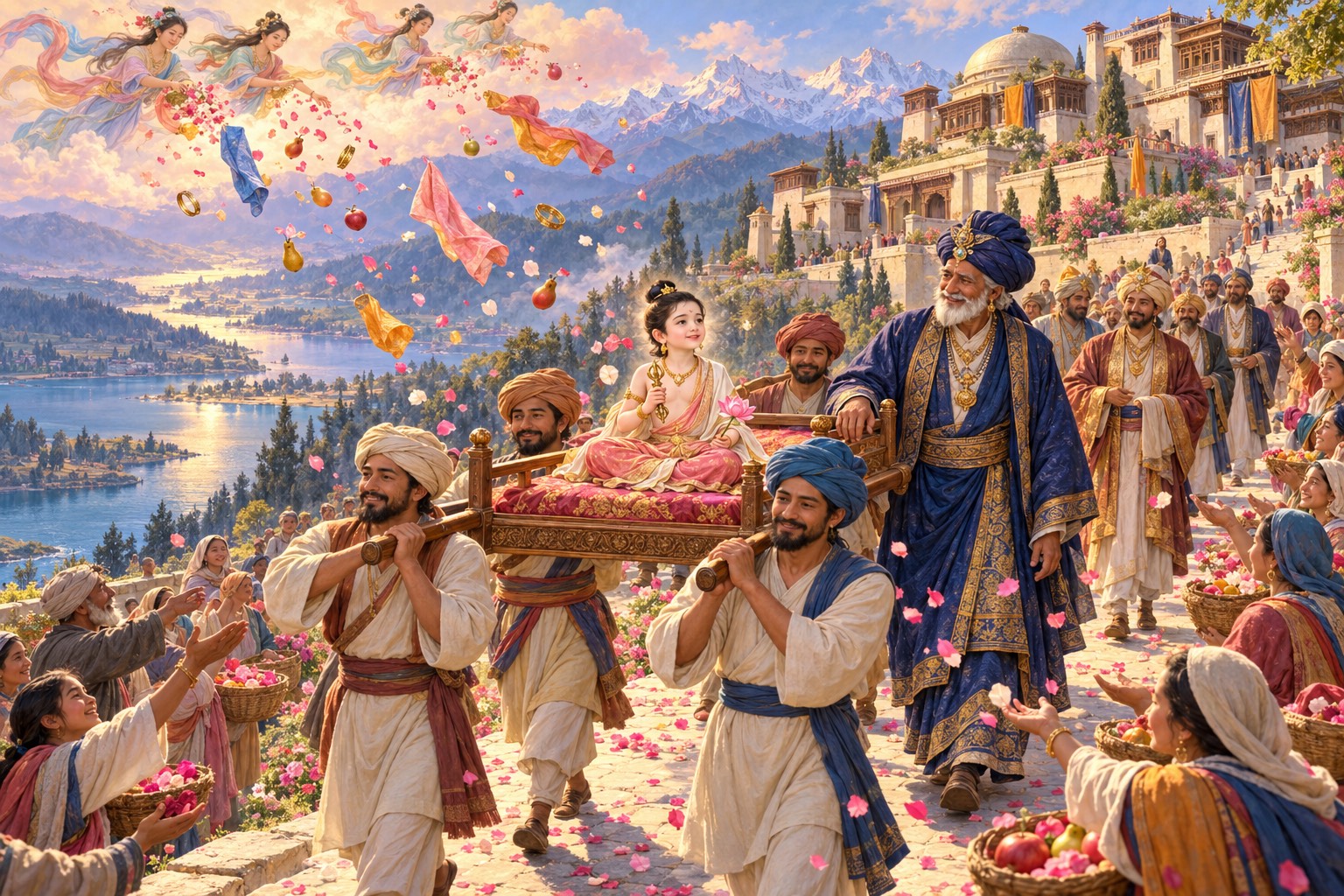
For a king who had given away his last treasure and longed for an heir, the story gives back both at once: a jewel that can go on giving, and a son.
Indrabhuti took him as his son and made him crown prince, seated on a throne of jewels. One classical version remembers it as a golden throne.
And he was given names that remember how he came. Padmakara and Padmasambhava both mean "Lotus-Born" in Sanskrit; in Tibetan he is Pema Jungné. He was also called Tsokyé Dorjé, "Lake-Born Vajra." One summary of the classical life adds Padmaraja, "Lotus King."
Each name holds a piece of the story. Padma and pema mean lotus; sambhava and jungné mean arising or born. In Tibetan, tso is lake, kyé is born, and dorjé is vajra.
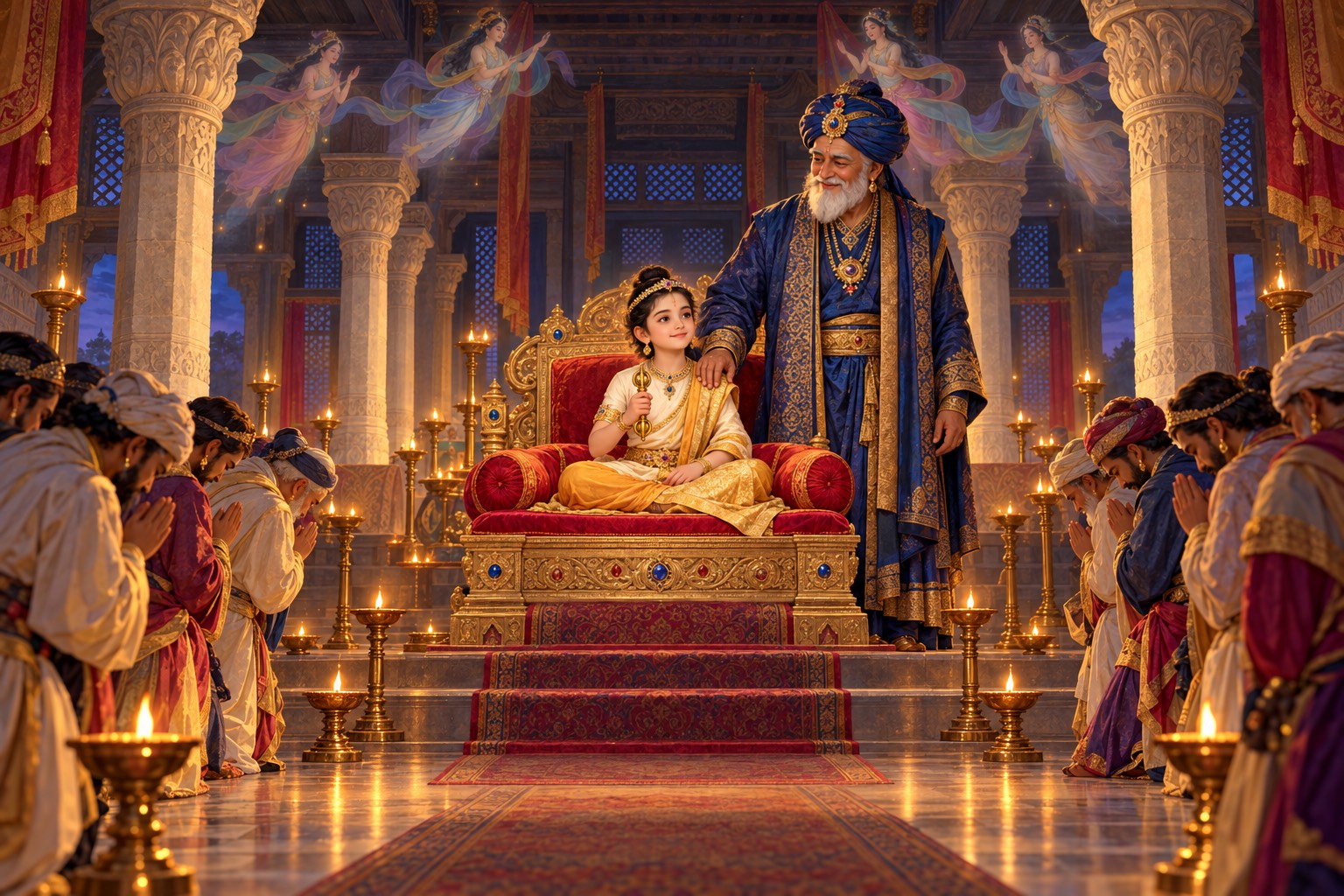
Here, for now, we leave him: a young prince in a palace beside a lake, much loved, with his whole life ahead of him. What he did next, and why he left, is the next story.
Many tellings
It is worth saying gently that not every account tells the birth this way. The lotus birth comes mainly from the terma or treasure texts, teachings that tradition says were hidden to be found by later masters. The best known, the Zangling Ma, was revealed by Nyangral Nyima Özer in the twelfth century and is available in English as The Lotus-Born.
There are many such life stories. Rigpa Wiki lists about a dozen major ones, written or revealed between the twelfth and twentieth centuries, and the details of the birth shift a little from one to the next: whether the king was blind, who saw the child first, what kind of throne he was given.

Other lines of tradition remember an ordinary birth, as the son of a king or a minister. One later treasure text even has Guru Rinpoche say that some saw him born on the lotus, some saw him as the son of Oddiyana's king, and some saw him fall like a thunderbolt onto a mountain peak.
Historians add one more layer. Writing for the Treasury of Lives, a peer-reviewed biographical encyclopedia, its editor Alexander Gardner notes that a master named Padmasambhava almost certainly lived and visited Tibet in the eighth century, but that very little about his life can be known for sure, and almost all of it comes to us through legend.
The Nyingma teacher Khenchen Palden Sherab Rinpoche did not treat these versions as rivals. Realized beings, he taught, can appear in whatever way is needed: "Everything is flexible, anything is possible."
So there is no need to settle the question tonight. You can hold the lotus the way the prayer holds it: as a picture of something pure rising, unstained, out of the muddy water of this world, and opening.
Each time you say the prayer's opening lines, you are, in a way, standing at the edge of that lake.
About the art
The child on the lotus is shown as the life stories describe him: a boy of about eight, not an infant, holding a vajra in his right hand and a lotus in his left. The vajra (Tibetan dorje) is a small scepter whose prongs curve together at each end; it stands for what is indestructible. The one shown here has five prongs, matching the vajra Guru Rinpoche holds in his best-known form. Paintings of this scene often show the child white with a reddish glow, seated on a pink or many-colored lotus.
He wears no hat here. The tall lotus hat with a vulture feather that you will see in later stories is, according to Himalayan Art Resources, a gift from the King of Zahor, so it belongs to a later chapter of his life.
The lotus itself is the key symbol of the page. It roots in mud and rises through water, yet its flower opens clean and dry. That is why Guru Rinpoche's names, Padmasambhava and Pema Jungné, mean "Lotus-Born," and why a lotus seat appears beneath buddhas and teachers throughout Tibetan art.
The dakinis, female wisdom beings, appear here in their gentle, peaceful aspect, bringing flowers, fruit and music. The landscape and buildings follow what scholars know of the Swat Valley in the eighth century, with Gandharan-style stupas and stone-and-timber houses, rather than the Tibetan architecture of later stories. The beam of light from Amitabha is drawn without any written syllable, because this site never places script or mantras inside illustrations.
Why this matters for practice
The Seven-Line Prayer begins by remembering exactly this: a land in the northwest of Oddiyana and a birth in the heart of a lotus. Knowing the story behind those words can turn them from a formula into a picture you can rest in as you recite. And the lotus offers its own quiet encouragement: whatever mud we are standing in, something clear and good can still open.

If something in this story moved you, you might pause and recite the prayer once.
Sources and further reading
- Padmasambhava, Rigpa Wiki (Internet Archive snapshot)
- The Life and Liberation of Padmākara, by Jamgön Kongtrul, Lotsawa House
- A Beautiful and Wondrous Uḍumbara Garland (verse summary of the Pema Kathang), by Jamyang Khyentsé Wangpo, Lotsawa House
- A Concise History of Orgyen Padma's Enlightened Deeds, by Orgyen Lingpa, Lotsawa House
- Guru Padmasambhava: introduction, Lotsawa House
- The Lotus-Born: The Life Story of Padmasambhava (review of Erik Pema Kunsang's translation), Tricycle
- Padmasambhava, by Jacob Dalton (Internet Archive snapshot), The Treasury of Lives
- Treasury of Lives: Nyingma Founders Part 1, Padmasambhava, Tricycle
- Padmasambhava Main Page, Himalayan Art Resources
- Padmasambhava (item 65278), Himalayan Art Resources
- Padmasambhava life story painting, birth detail (item 36501), Himalayan Art Resources
- Padmasambhava: Eight Forms, Himalayan Art Resources
- Oddiyana, Rigpa Wiki (Internet Archive snapshot)
- Padmasambhava, Wikipedia
- Finding the footprints of the Lotus-Born, Jamyang Buddhist Centre
This retelling is waiting to be read by a knowledgeable practitioner. Where the traditional accounts differ, the story says so; if you notice a mistake, please tell us through Share Your Story.