On the southern rim of the Kathmandu valley, where the hills begin to climb toward the forest, there is a small town called Pharping. Tibetans know the place by an older name, Yangleshö. For many who love Guru Rinpoche, it is one of the holiest places on earth.
The reason is simple to say and hard to measure. The traditional accounts remember this as the place where Guru Rinpoche reached one of the highest stages of his awakening. This is the story of what they say happened here.
A cave above the valley
By the time he came to Nepal, the life stories say, Guru Rinpoche had already been a prince, a wandering yogi in the cremation grounds and a student of many masters. At the cave of Maratika, with the princess Mandarava, he had accomplished the practice of long life. Now he turned toward the green hills south of the Kathmandu valley.
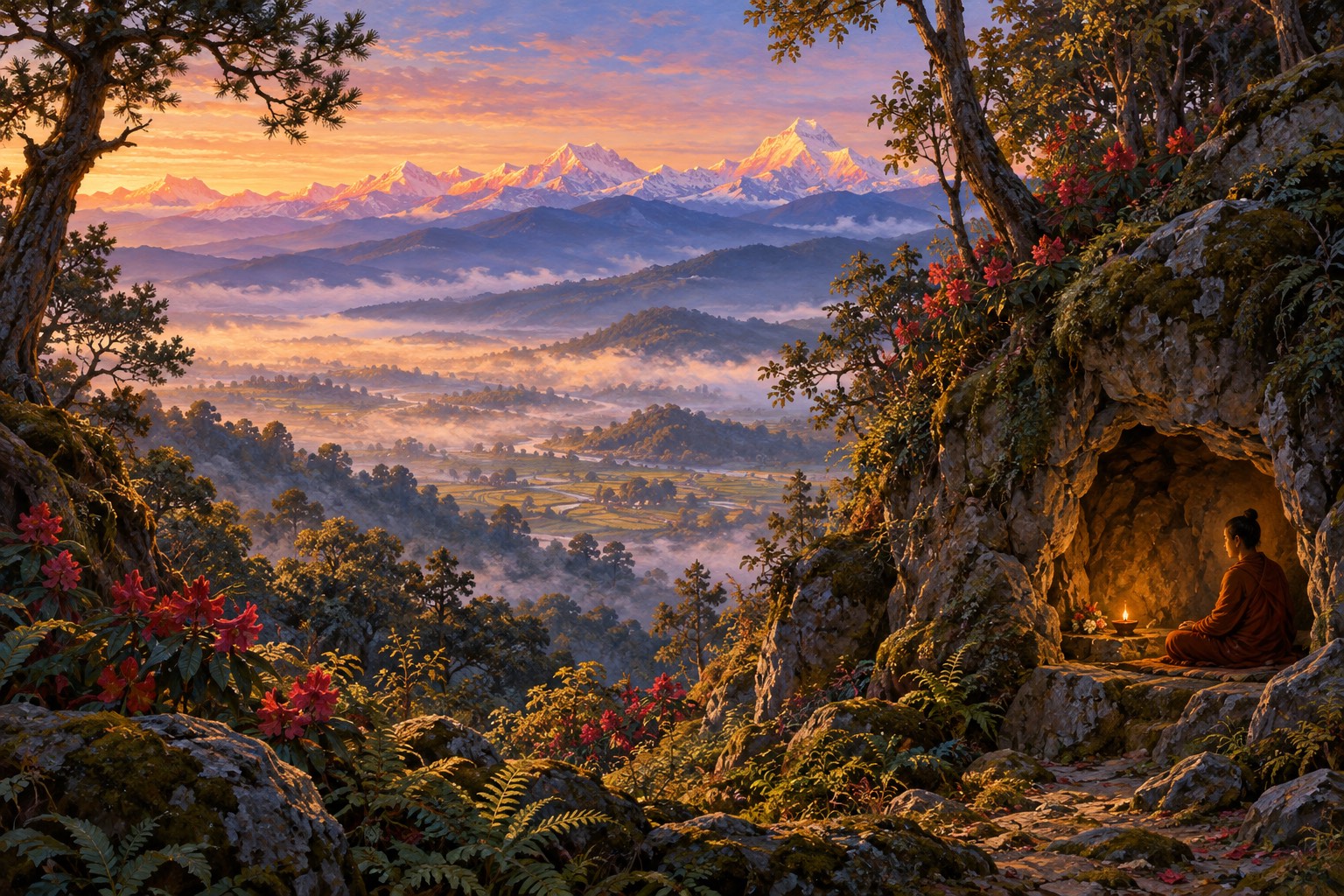
There are two caves at Pharping that tradition links with him. The lower one, just below the town, is Yangleshö proper. The upper one, in the forest on the hill behind it, is called the Asura cave, or the upper cave of Yangleshö. Asuras are powerful, jealous spirits in Buddhist cosmology; the name is old, and its story is not told the same way by everyone.
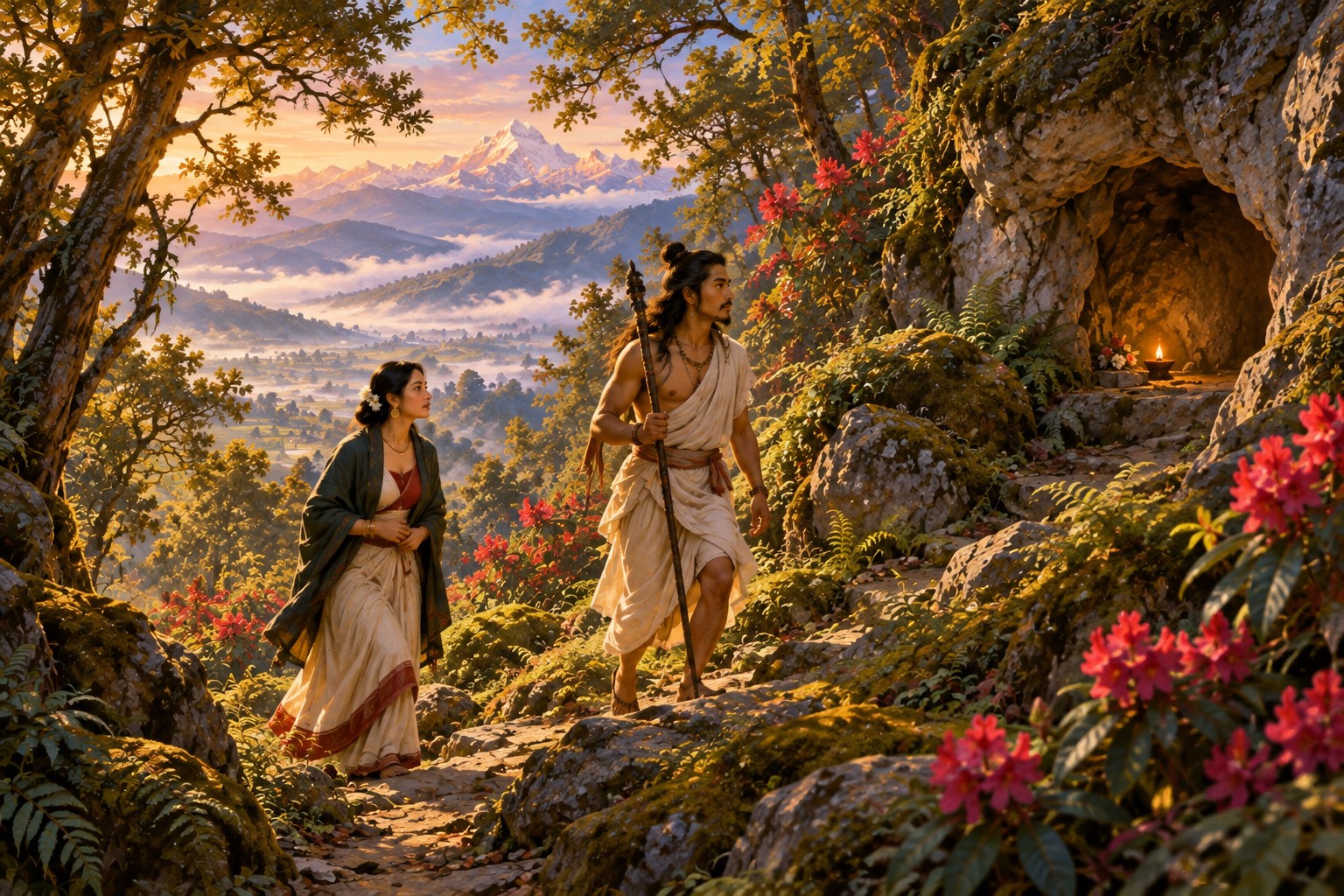
He did not stay there alone. With him, the accounts say, was Shakyadevi, a princess of Nepal.
Shakyadevi, the Nepali princess
Rigpa Wiki, drawing on the Rangjung Yeshe glossary, gives her story in a few lines. She was the daughter of a Nepalese king named Punyedhara. Her mother died as she was born, and the infant was left in a cremation ground, where, it is said, monkeys cared for her and raised her.
She grew up to become one of Guru Rinpoche's five principal consorts. In this tradition a consort is a spiritual companion in practice, a partner on the path whose own realization is honored in its own right. The deeper meaning of that partnership belongs with a teacher, and this page leaves it there.
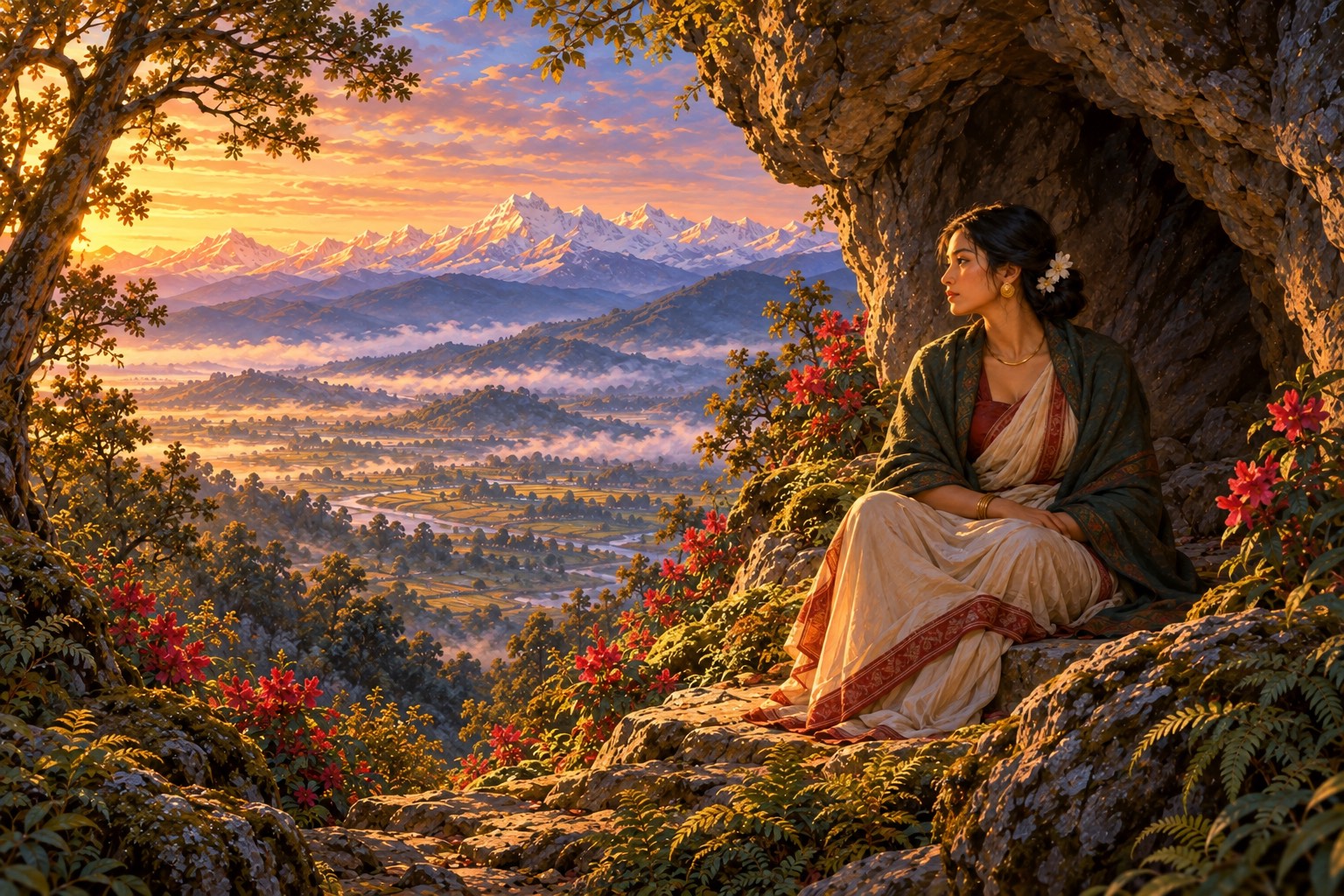
What the accounts stress is that Shakyadevi was not a bystander. They say she practiced alongside him at Yangleshö and reached the same attainment he did. Later tradition adds that she went on to realize the awakened nature of the female buddha Mamaki and, at the end of her life, the rainbow body, a sign of complete realization in which the body is said to dissolve into light.
The practice in the cave
In the low cave, the life stories say, the two of them took up the practice of Yangdak Heruka, known in Sanskrit as Vishuddha. Yangdak is a meditational deity, a form in which enlightened mind is recognized and practiced. Its practice is received from a qualified teacher, so this page only names it; the Find a Teacher page can help.
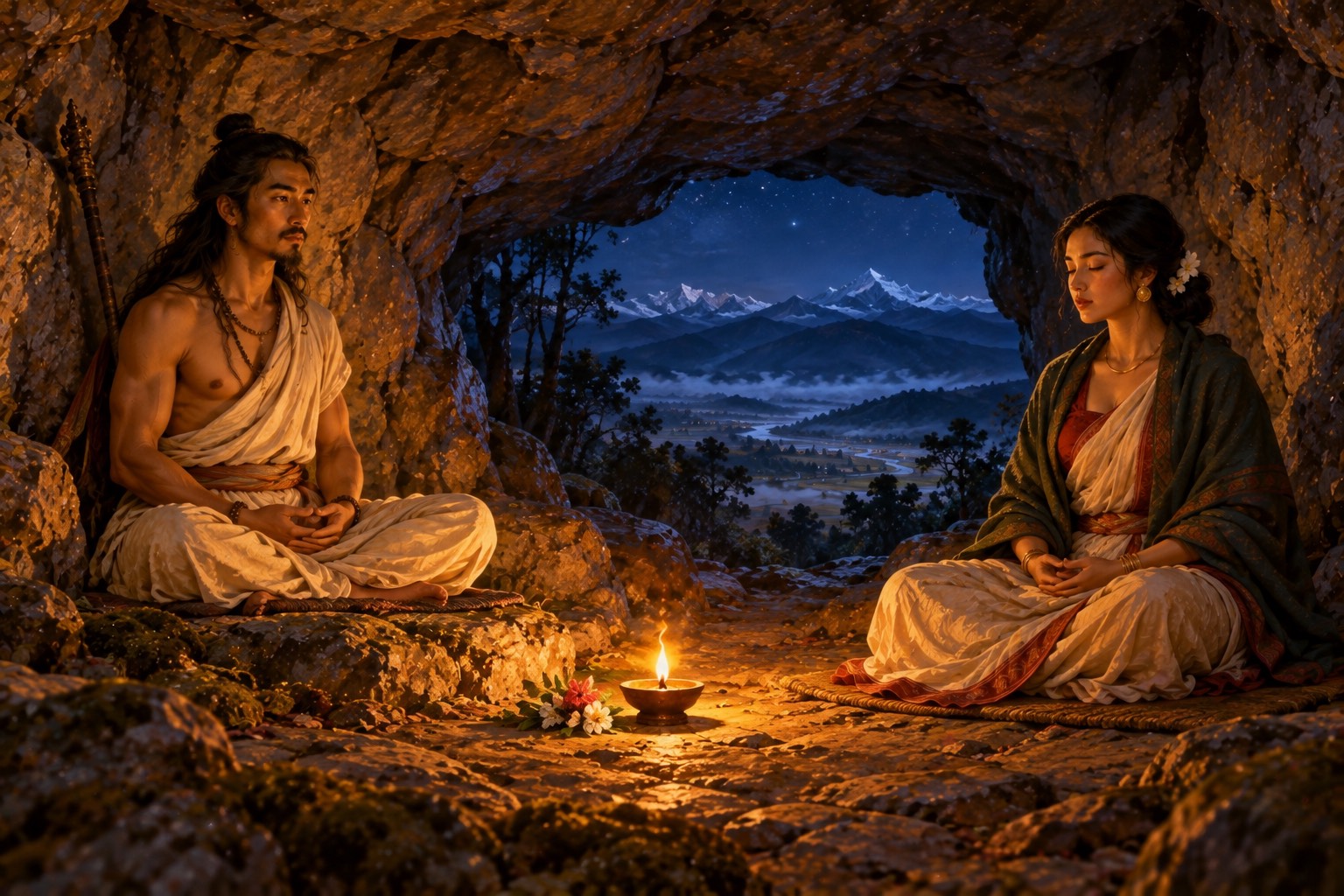
For a while, the accounts suggest, all went well. Then trouble came, not to the cave, but to the whole country around it.
Three years without rain
According to the version gathered in the collection known as A Great Treasure of Blessings, powerful spirits stirred up obstacles. For three years no rain fell. The fields dried and cracked, and famine and sickness spread among the people.
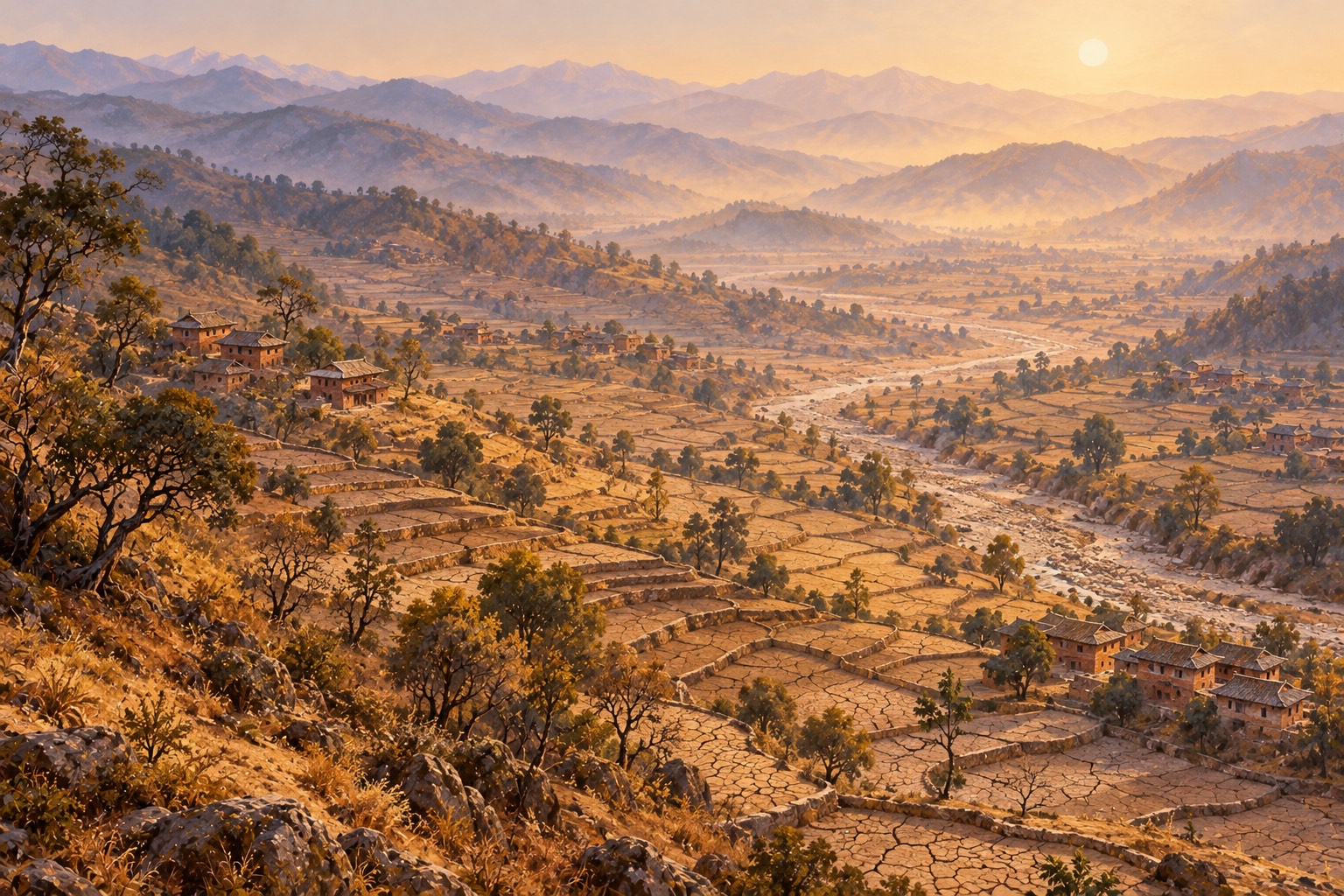
The traditional accounts read this hardship as an obstacle to Guru Rinpoche's practice, one that spilled out over the land. They describe it as the work of spirits, the way Himalayan peoples have long understood forces they could not see.
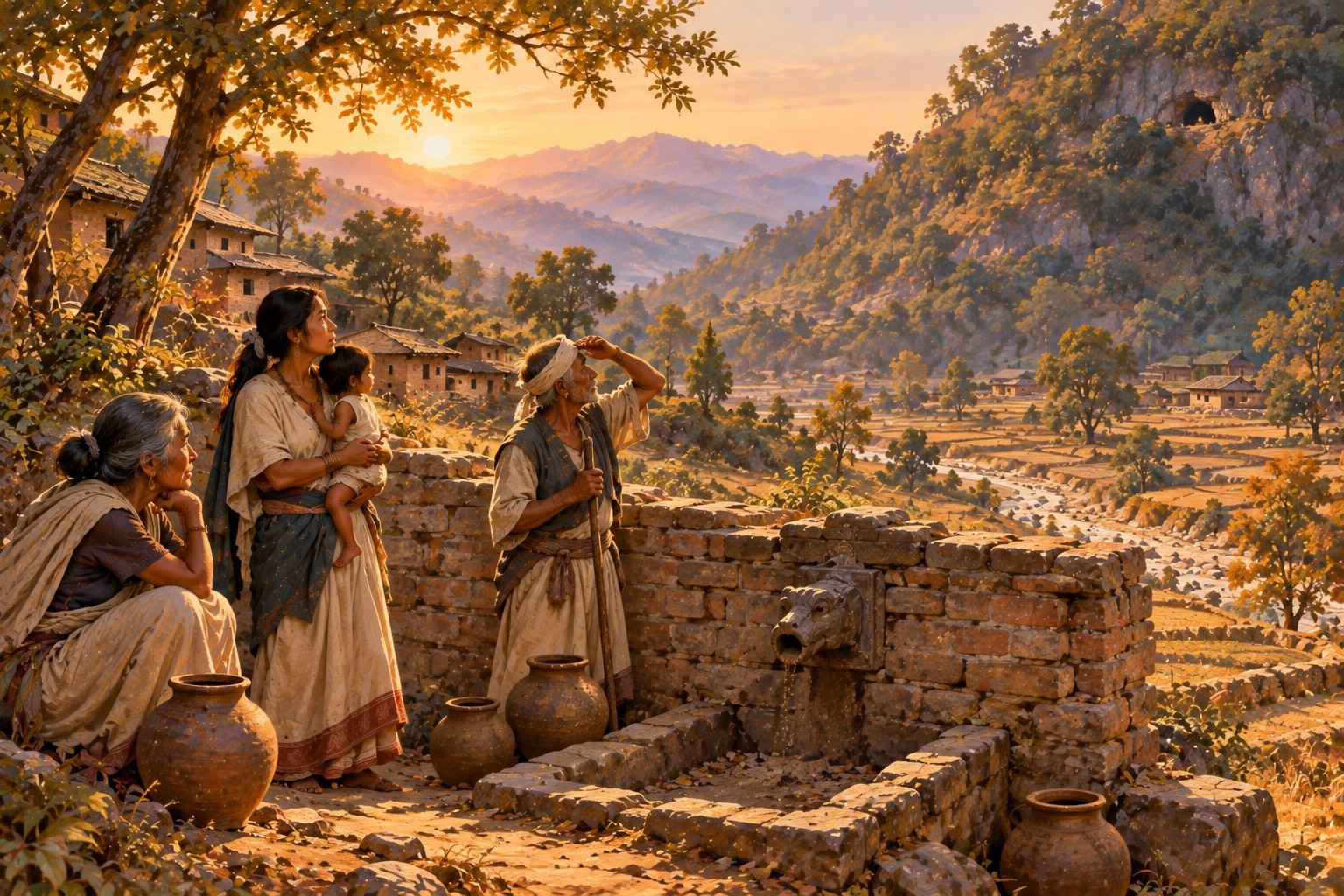
So Guru Rinpoche did something humble. Rather than relying on himself alone, he sent word south to his teachers in India and asked for a teaching that could meet these obstacles.
Two men came back over the hills, the accounts say, heavily laden. They brought the tantras and commentaries of Vajrakilaya, a meditational deity of enlightened activity, renowned in the tradition for removing obstacles to awakening. As with Yangdak, this page names Vajrakilaya and goes no further.
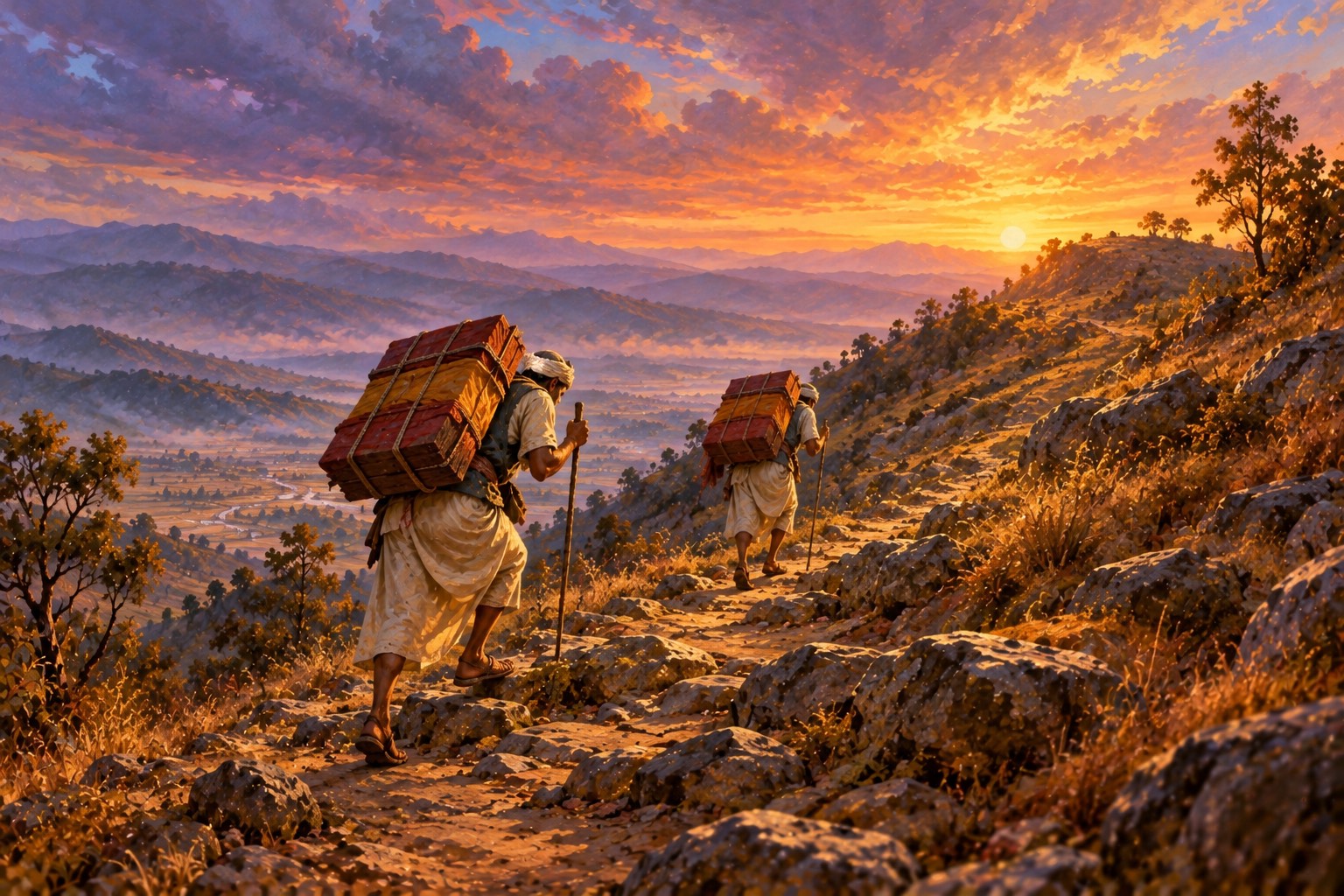
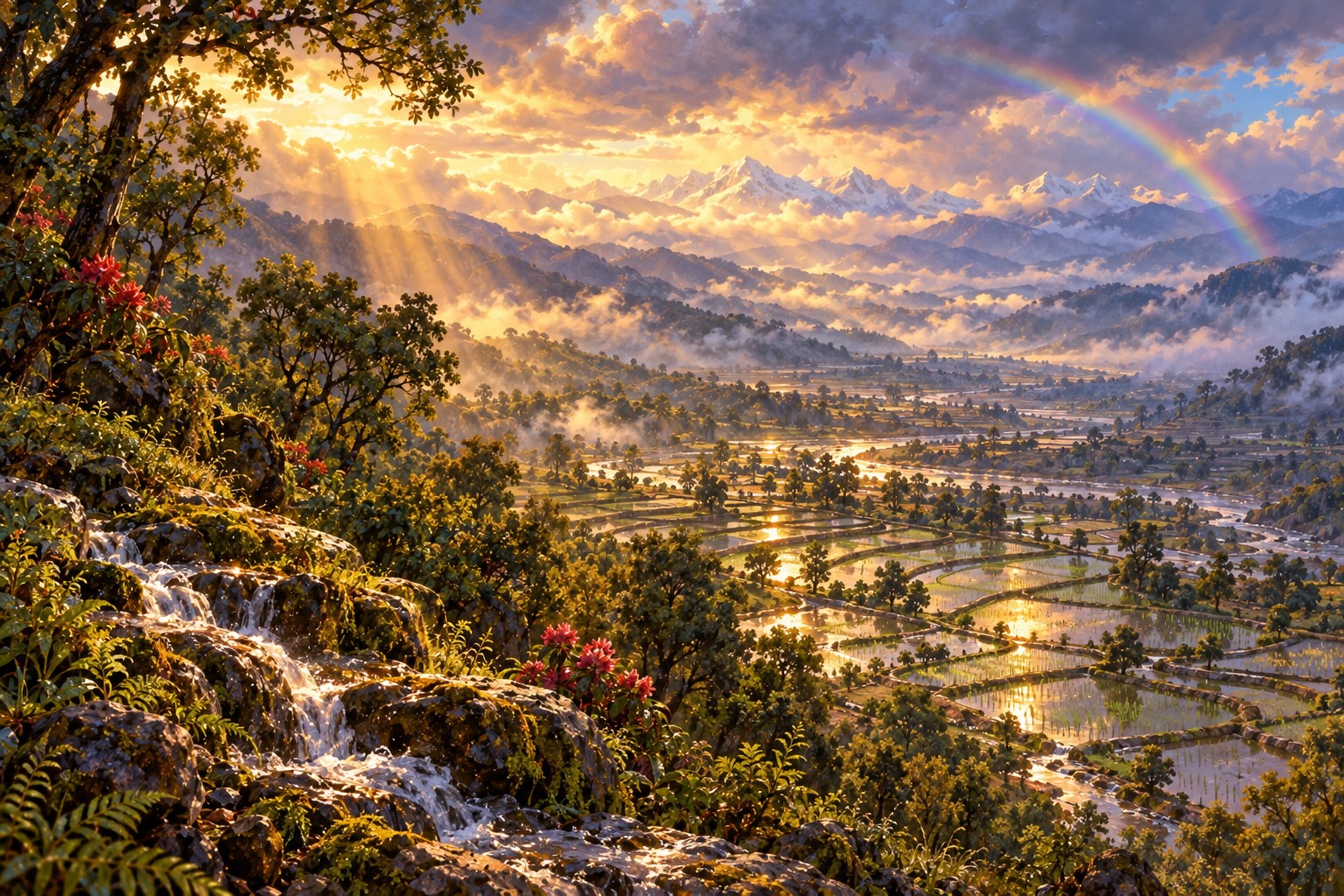
The moment the messengers arrived, the story goes, the obstacles were calmed. The drought broke, and the land could begin to recover.
The same account adds a homely image. Practicing Yangdak, Guru Rinpoche is said to have reflected, is like a merchant setting out to trade: the gain can be great, and so can the dangers on the road. Vajrakilaya is like an armed escort who travels with the merchant and keeps him safe.
So, the accounts say, he joined the two practices, and he bound the guardians of the Vajrakilaya teachings to protect them. One tradition, recalled in a translator's note on Lotsawa House, says that at Yangleshö he also worked through the Vajrakilaya teachings with the masters Vimalamitra and Shilamanju, and took the name Loden Choksé. A well-known prayer calls him the Pandita, the great scholar, of Yangleshö.
The great seal
Then came the attainment that makes Pharping so loved. Guru Rinpoche and Shakyadevi, the accounts say, both reached the level called the vidyadhara of mahamudra.
Vidyadhara means "awareness-holder": one who holds, and does not lose, the wakefulness of enlightened mind. The tradition describes four such levels, and this is the third. Mahamudra means "great seal": the recognition that everything bears the stamp of that same awakened nature. One commentary places this stage on the path of meditation, close to the end of the journey.
Jamyang Khyentse Chökyi Lodrö, in his short praise of Yangleshö, compresses it into a single night. After a night of practice and of clearing away obstacles, he writes, at dawn the Guru "attained complete awakening" (translated on Lotsawa House).
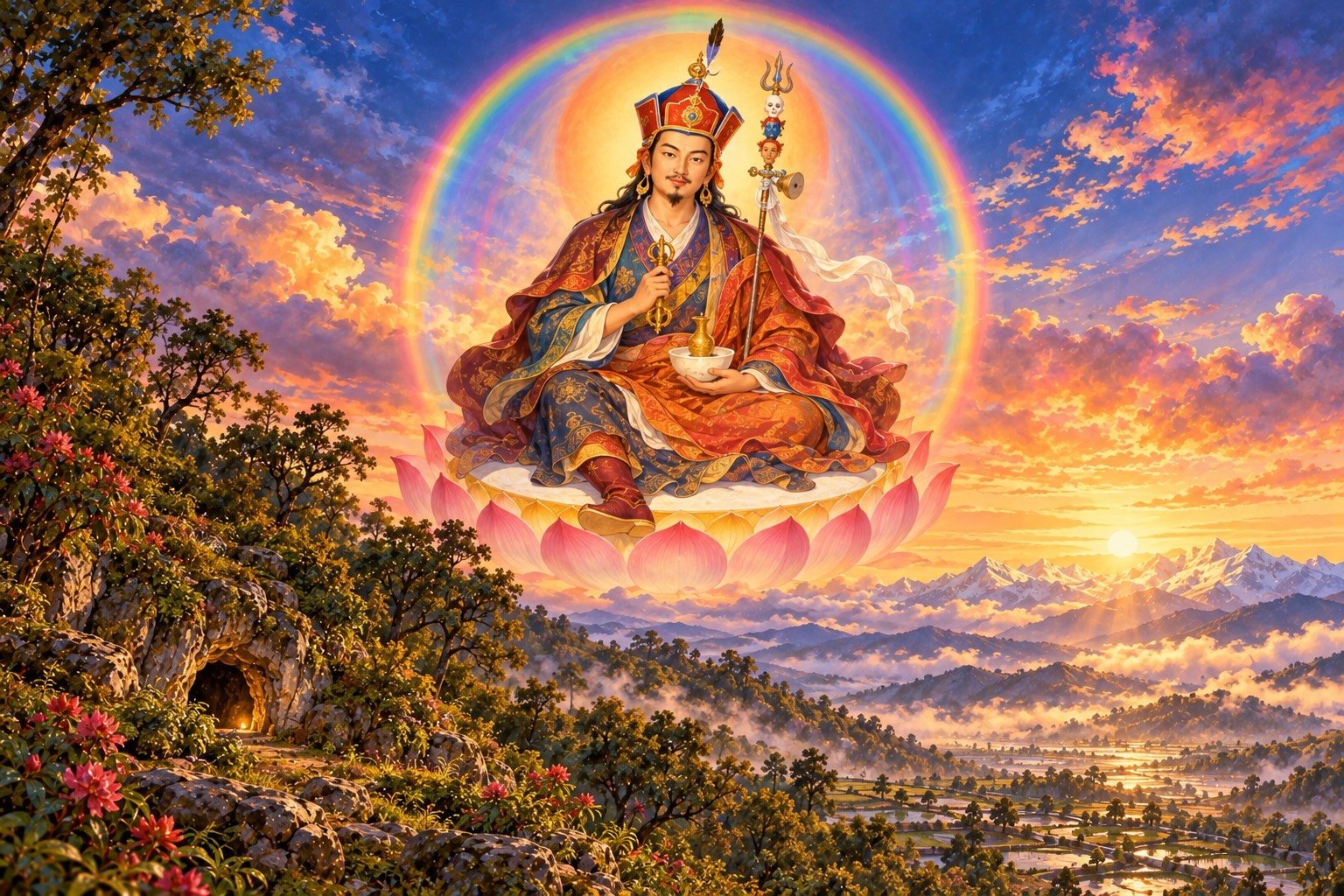
This is one of the moments the third line of the Seven-Line Prayer remembers, when it speaks of the wondrous supreme accomplishment Guru Rinpoche attained. The eighteenth-century master Katok Rigdzin Tsewang Norbu said that for followers of the Vajrayana, Yangleshö is as important as Bodhgaya, where the Buddha awakened.
Where the accounts differ
The tellings do not all agree, and it is honest to say so. Rigpa Wiki, the Lotsawa House notes and the prayer known as the Le'u Dünma speak of the attainment at the cave of Yangleshö. The pilgrimage guide Nekhor places the final fruition at the upper Asura cave instead.
Nekhor also gives a different order. In its telling he began with Yangdak at the lower cave and later joined it with Vajrakilaya at the Asura cave, staying in the sunny upper cave in winter and the cooler lower cave in summer. Tulku Urgyen Rinpoche spoke of a narrow passage in the rock that joins the two caves, which the Guru is said to have used to move between them.
Even the Rigpa Wiki notes that Orgyen Tobgyal Rinpoche once discussed the exact spot. For a pilgrim, perhaps it is enough that the hillside itself holds both caves, and the story moves between them.
Pharping today
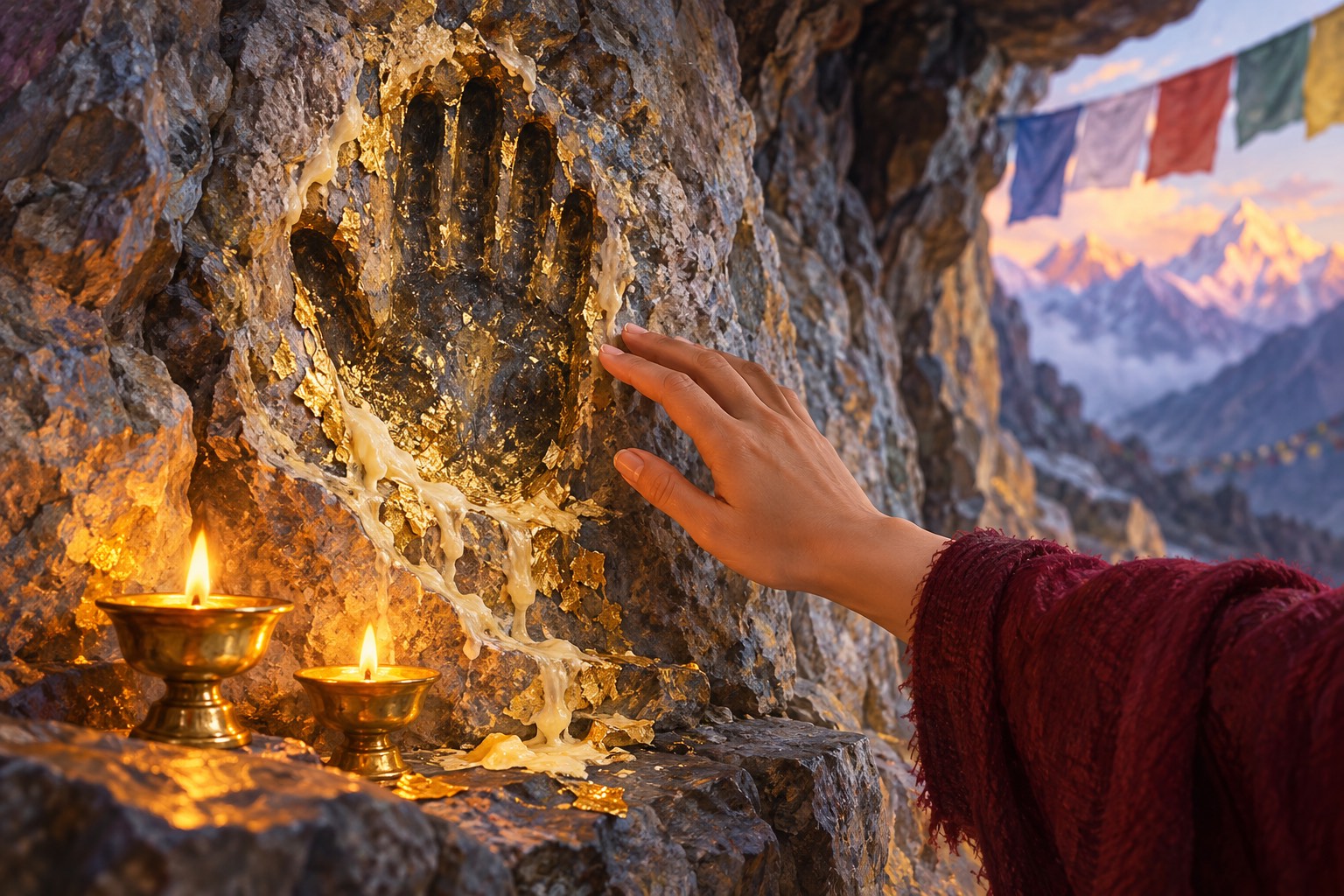
Beside the entrance of the Asura cave, on the upper left, is the shape of a hand pressed into the rock. Many pilgrims touch it as Guru Rinpoche's handprint. Nekhor records a humbler story too: that the print was made by a later practitioner, a student of the yogi Chime Dorje, who regretted it at once, saying everyone would one day take it for the Guru's. Both stories are told on the hillside.
At the foot of one flight of stairs up to the Asura cave stands an old Newar temple of Vajrayogini, a female buddha. Tradition links it with the Pamtingpa brothers, Newar disciples of the great Indian master Naropa, and the Tibetan translator Marpa is said to have visited. The building that stands there now probably dates from the seventeenth century.
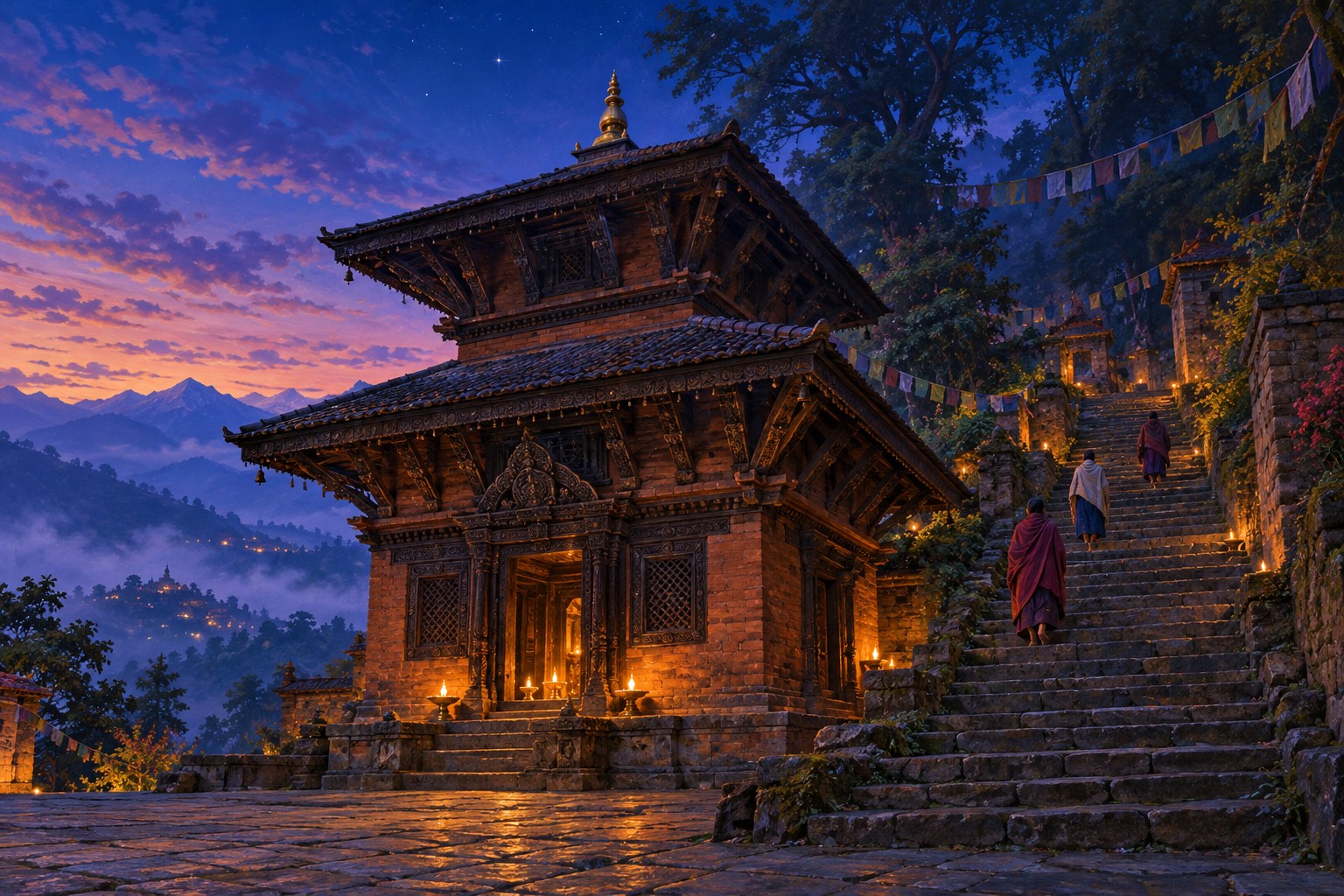
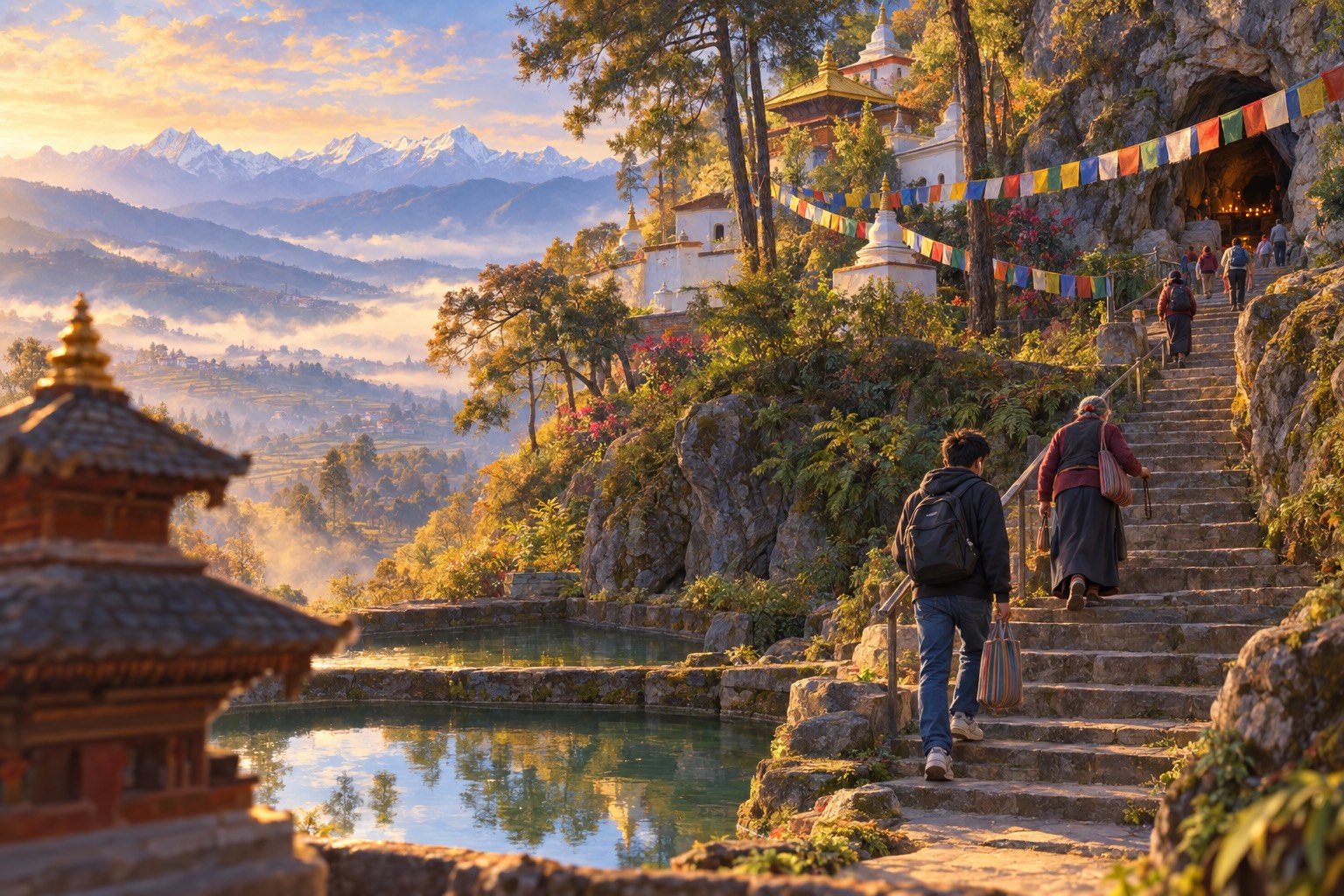
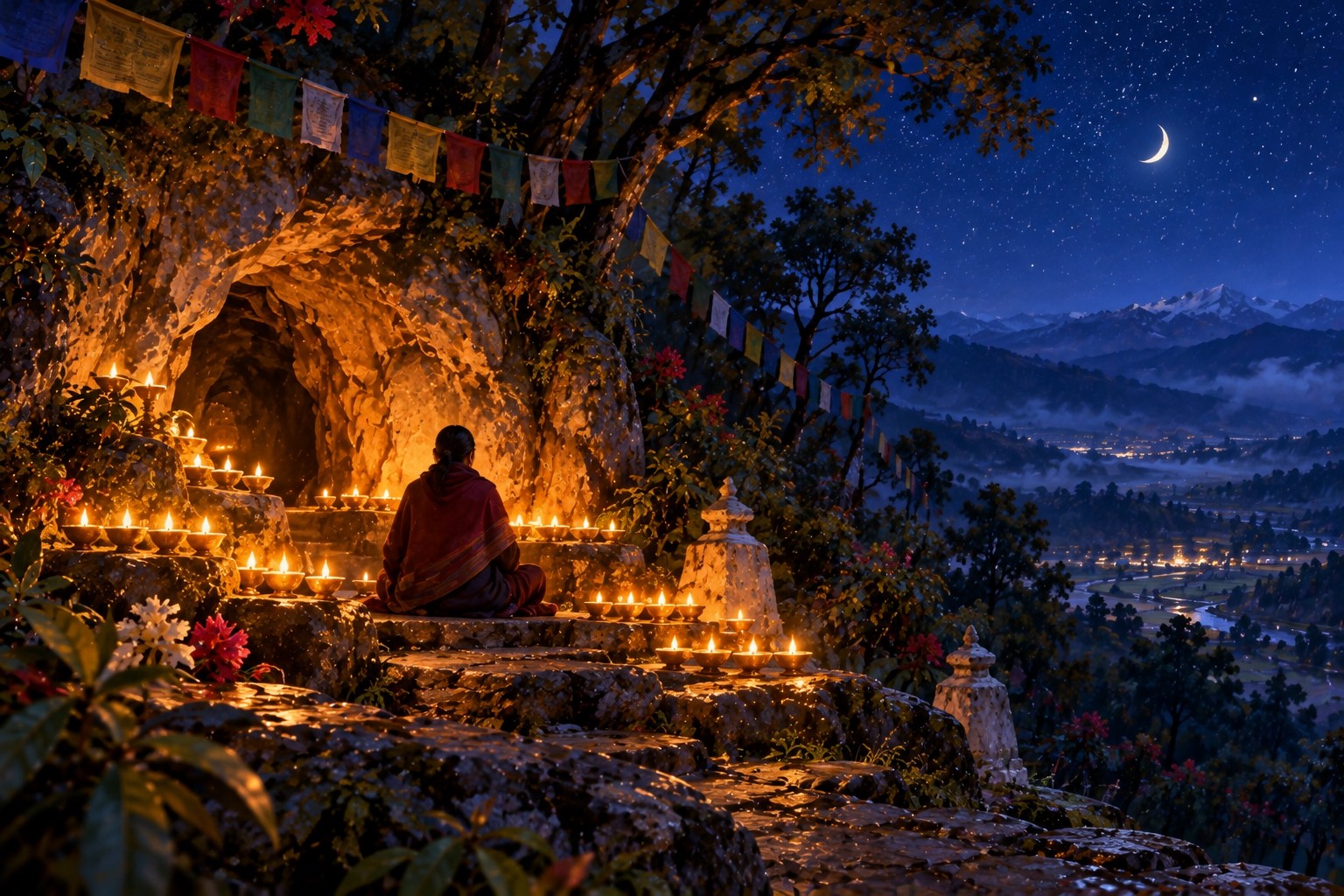
Today the hillside is full of monasteries and retreat centers, and the steps are busy with pilgrims, especially on the tenth day of the lunar month, Guru Rinpoche's day. Lamps burn at the cave mouths, and people bow their heads to enter. Our story "The Tenth Day" is a piece of original fiction about one such visit to the lower cave.
About the art
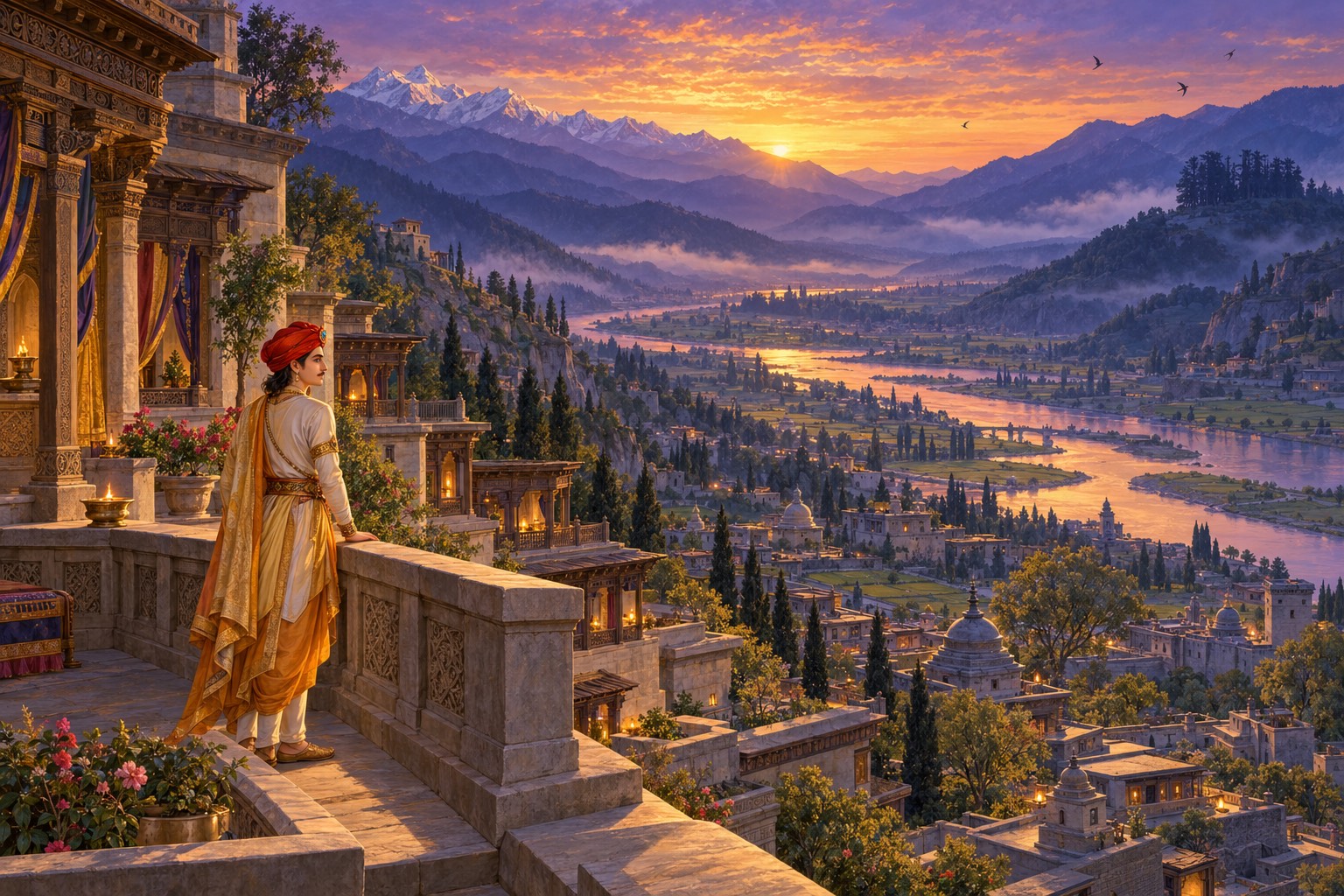
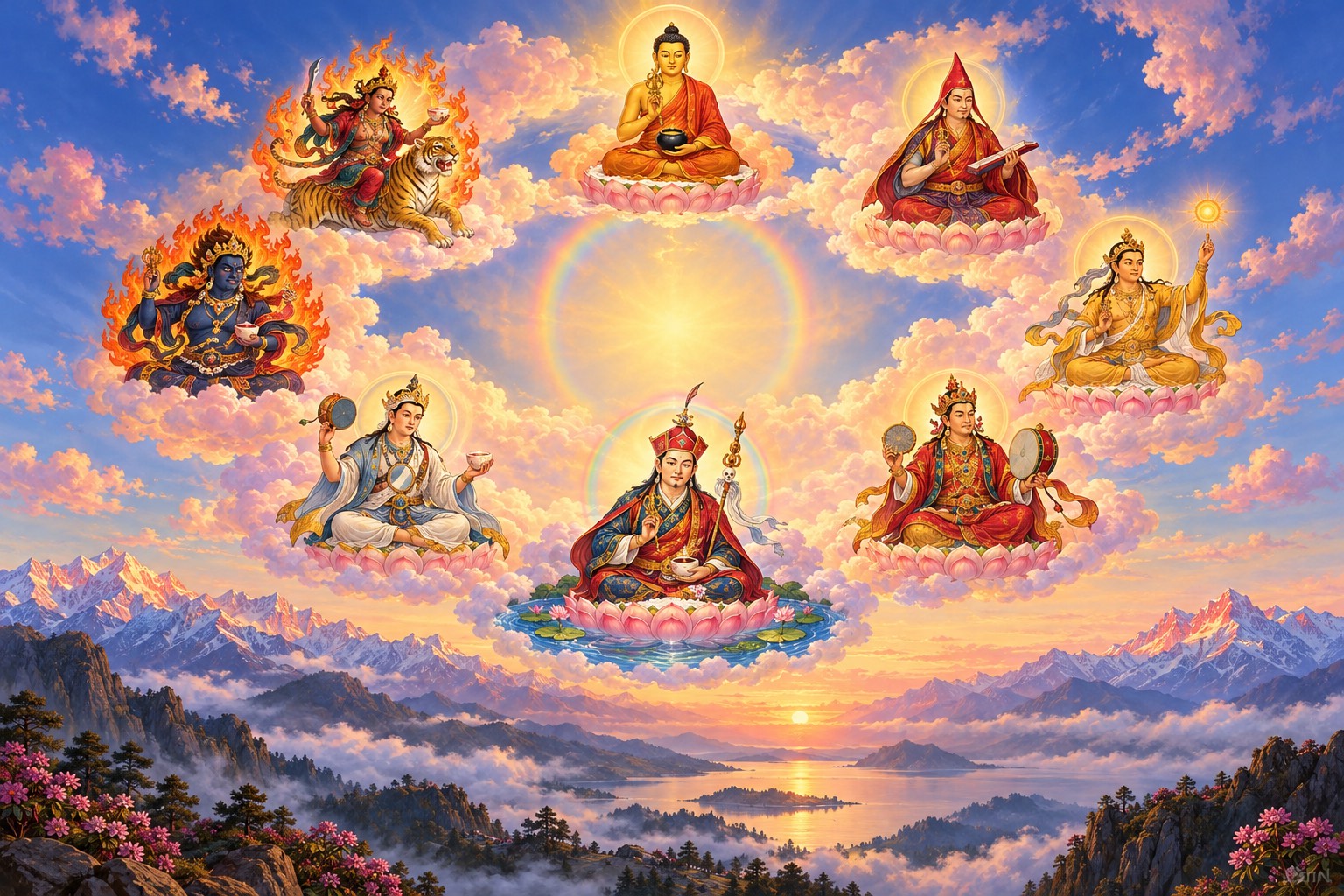
Guru Rinpoche appears on this page in two ways. In the retreat scenes he is shown as a lean, bareheaded yogi with a slender staff, the form this site uses for his years of wandering practice; the paintings of this episode vary, and some show him in his main form instead. In the dawn image he appears in his best-known form: the lotus hat with its single vulture feather, a five-pronged vajra held at his heart, a skull cup holding a small vase of long life in his lap, and a slender staff called a khatvanga resting against his left shoulder, all inside a sphere of rainbow light.
No traditional portrait of Shakyadevi was found for this page, so she is imagined as a young Nepali woman of the eighth century, when the Licchavi kings ruled the valley: a long draped cotton wrap with a red border, a dark green shawl, simple gold earrings and a few flowers in her hair. Her colors are kept distinct from Mandarava's rose and saffron and Yeshe Tsogyal's blue.
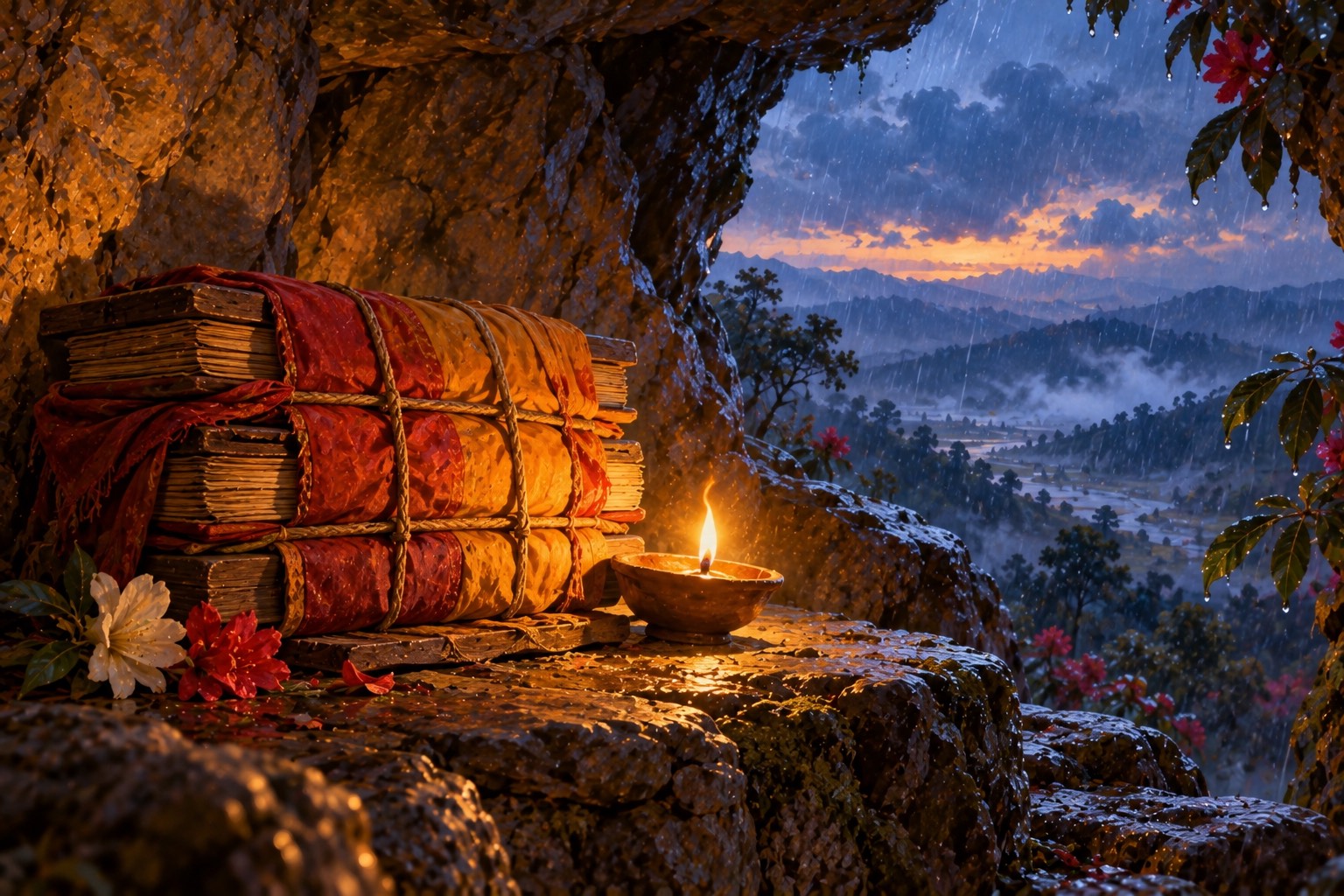
Himalayan Art Resources describes a life-story painting in which the Yangleshö episode shows Guru Rinpoche seated beside a ritual arrangement with a ritual dagger in his hand. This page does not show the practices themselves, their deities or their ritual objects; those belong with a teacher. The bundles of palm-leaf manuscripts wrapped in cloth stand for the teachings that arrived from India, and nothing is written on them, because this site never places script or mantras inside illustrations.
The ancient scenes leave out prayer flags, stairs and buildings, which belong to later centuries. The last three images show Pharping as it is today: the handprint by the Asura cave, the Newar Vajrayogini temple with its tiered roofs and carved wooden windows, and lamps at the cave mouth.
Why this matters for practice
The third line of the Seven-Line Prayer remembers that Guru Rinpoche attained a wondrous supreme accomplishment, and Yangleshö is one of the places tradition says it happened. The story also shows the path as something lived: a long practice, a hard season, a request for help, and a dawn. Reciting the prayer, even once, is a way of remembering that dawn.

If something in this story stayed with you, perhaps a dry land waiting for rain, a teacher humble enough to ask for help, or a dawn after a long night, you might pause and recite the prayer once. The third line is there for exactly this place.
Sources and further reading
- Yangleshö cave, Rigpa Wiki (Internet Archive snapshot)
- Pharping (Yangleshö), Rigpa Wiki (Internet Archive snapshot)
- Asura cave, Rigpa Wiki (Internet Archive snapshot)
- Shakyadevi, Rigpa Wiki (Internet Archive snapshot)
- Asura Cave & Yangleshö, Nekhor
- In Praise of Yangleshö, by Jamyang Khyentse Chökyi Lodrö, Lotsawa House
- Short Guide to Yangleshö, by Jamyang Khyentse Chökyi Lodrö, Lotsawa House (Samye Translations, 2017)
- Upon Arriving at Yangleshö, by Khenpo Jigme Phuntsok, with translator's notes, Lotsawa House (trans. Peter Woods, Samye Translations, 2017)
- Padmasambhava life story in chronological order (item 90161), Himalayan Art Resources
- Pharping, Wikipedia
- The Lotus-Born: The Life Story of Padmasambhava, by Yeshe Tsogyal (Rangjung Yeshe, 2004), chapter 5, Book
This retelling is waiting to be read by a knowledgeable practitioner. Where the traditional accounts differ, the story says so; if you notice a mistake, please tell us through Share Your Story.