The fourth line of the Seven-Line Prayer is the simplest. It calls him by his name: Padmasambhava, the Lotus-Born.
Yet the tradition remembers him by many names. The best loved are eight, known in Tibetan as Guru Tsen Gyé, which means "the eight names of the Guru." In English they are usually called the Eight Manifestations: eight forms in which, the accounts say, he appeared at different moments of his life.
Rigpa Wiki puts it gently. These are not eight different Padmasambhavas. They show one teacher's ability to appear as each need required. So this is not a catalogue. It is one life, told eight times, each time in a different robe.
1. Tsokyé Dorjé, the Lake-Born Vajra
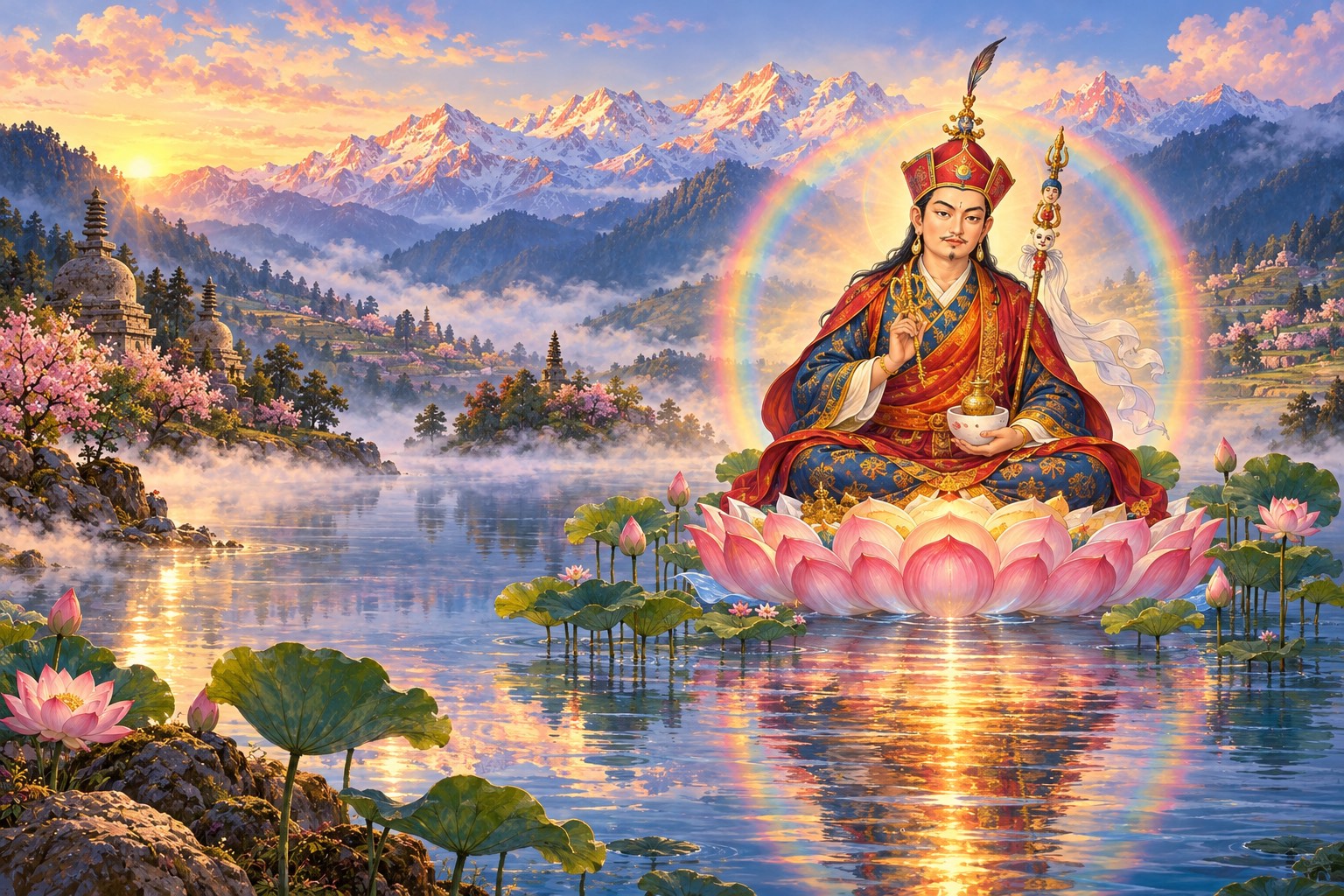
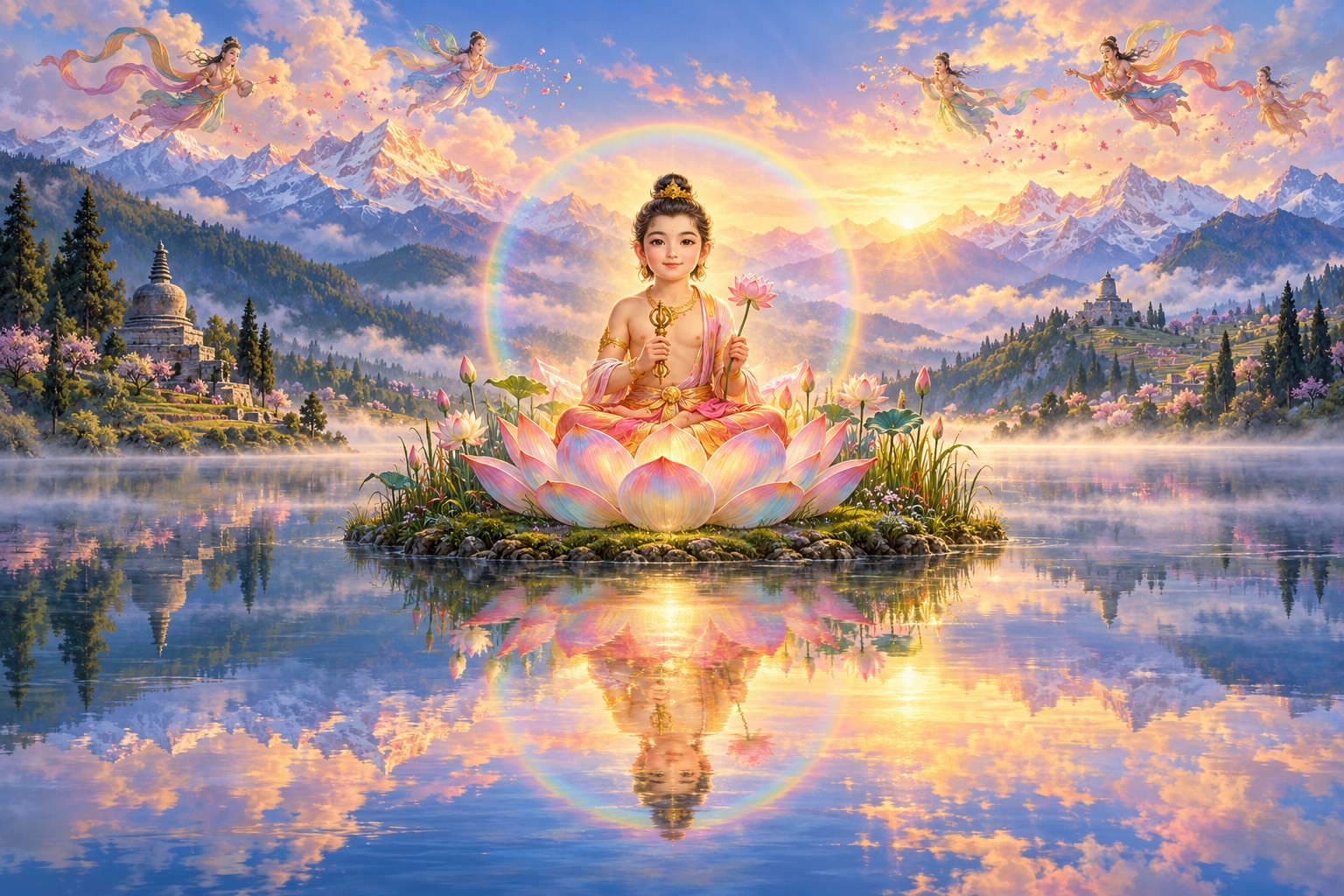
The first name belongs to his birth. The traditional accounts say that he appeared on a lotus on Lake Dhanakosha, in Oddiyana, as a child of about eight, holding a vajra, a small scepter that stands for what cannot be broken.
Tso means lake (one translation says ocean), kyé means born, and dorjé means vajra. The whole story, with the king who found him, is told in "The Lotus-Born" on this site. In paintings of the eight forms, Tsokyé Dorjé often looks just like the Guru's familiar main form, rising on a lotus from blue water.
2. Shakya Sengé, Lion of the Shakyas
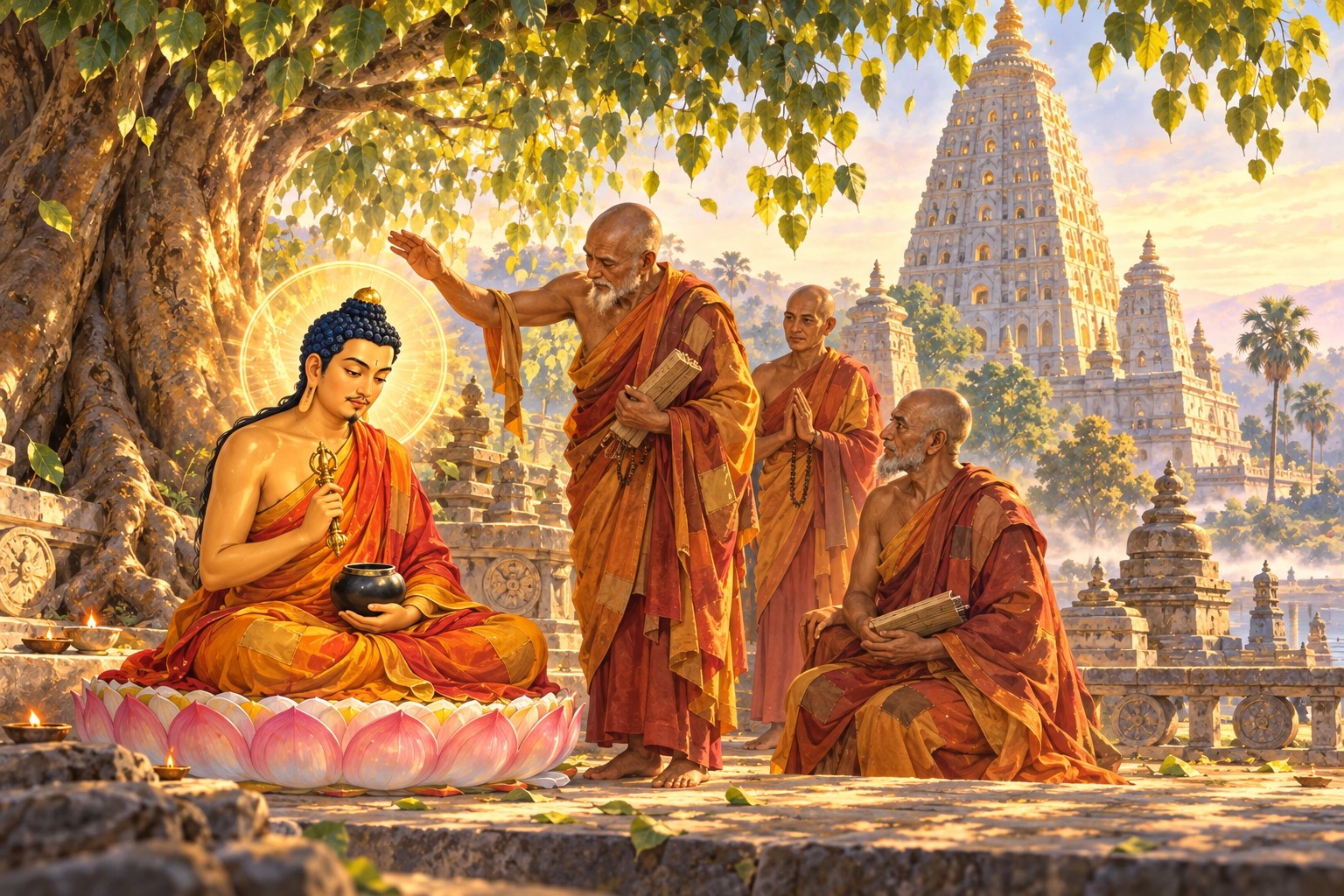
The accounts say that, though he was already awake, he chose to walk the path the way others must, so that they could follow. And so he asked to be ordained, to take the formal vows of a Buddhist monk.
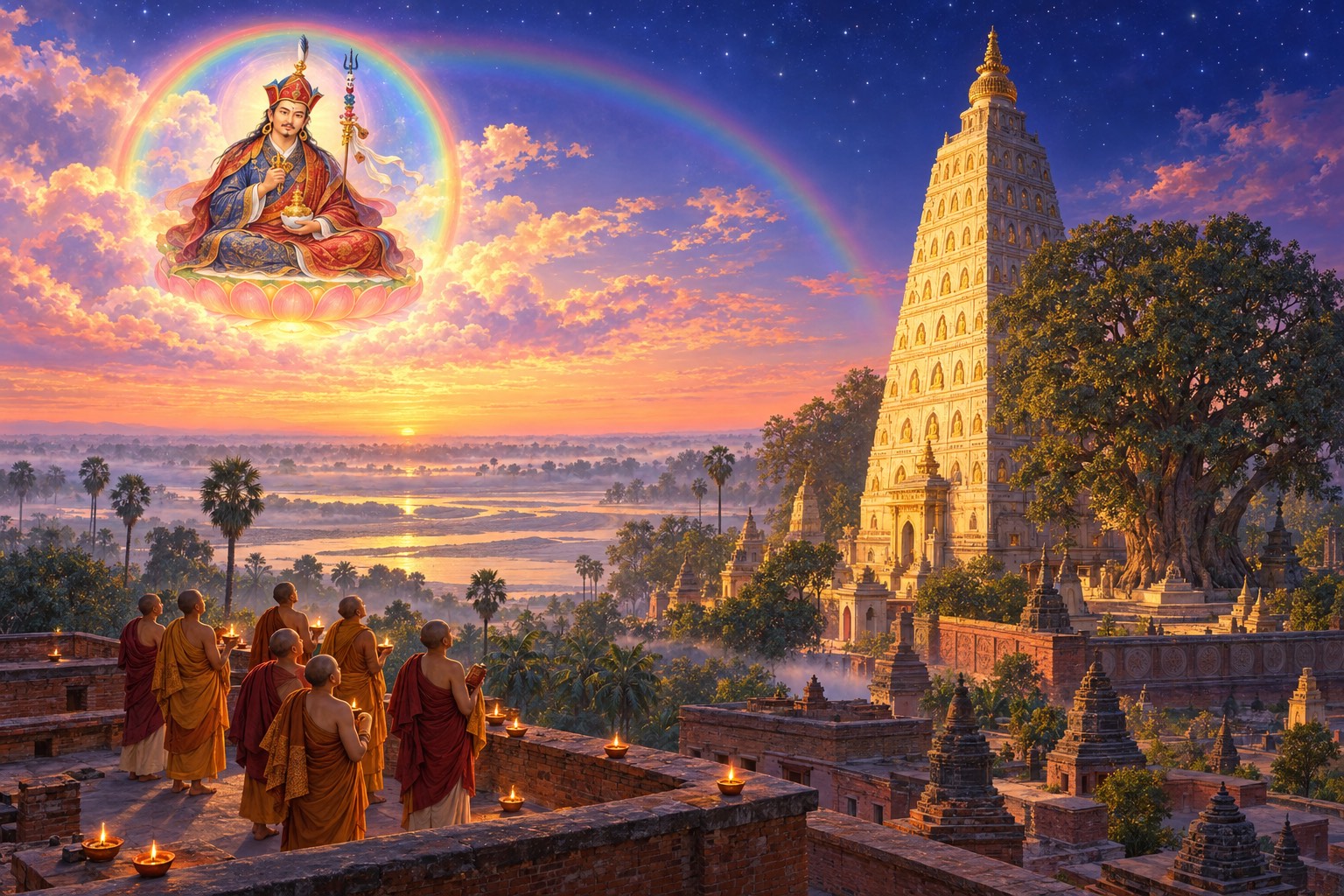
The tellings differ on where. Some say he was ordained at the Diamond Throne in Bodhgaya by Ananda, the Buddha's closest disciple. Others say it was in Zahor, by a master named Prabhahasti. Either way he received a new name, Shakya Sengé, "Lion of the Shakyas," the Buddha's own clan.
In paintings he looks almost like the Buddha himself: monk's robes, a crown of short curls, a vajra in his right hand and a plain alms bowl in his left.
3. Loden Choksé, Wise Seeker of the Sublime
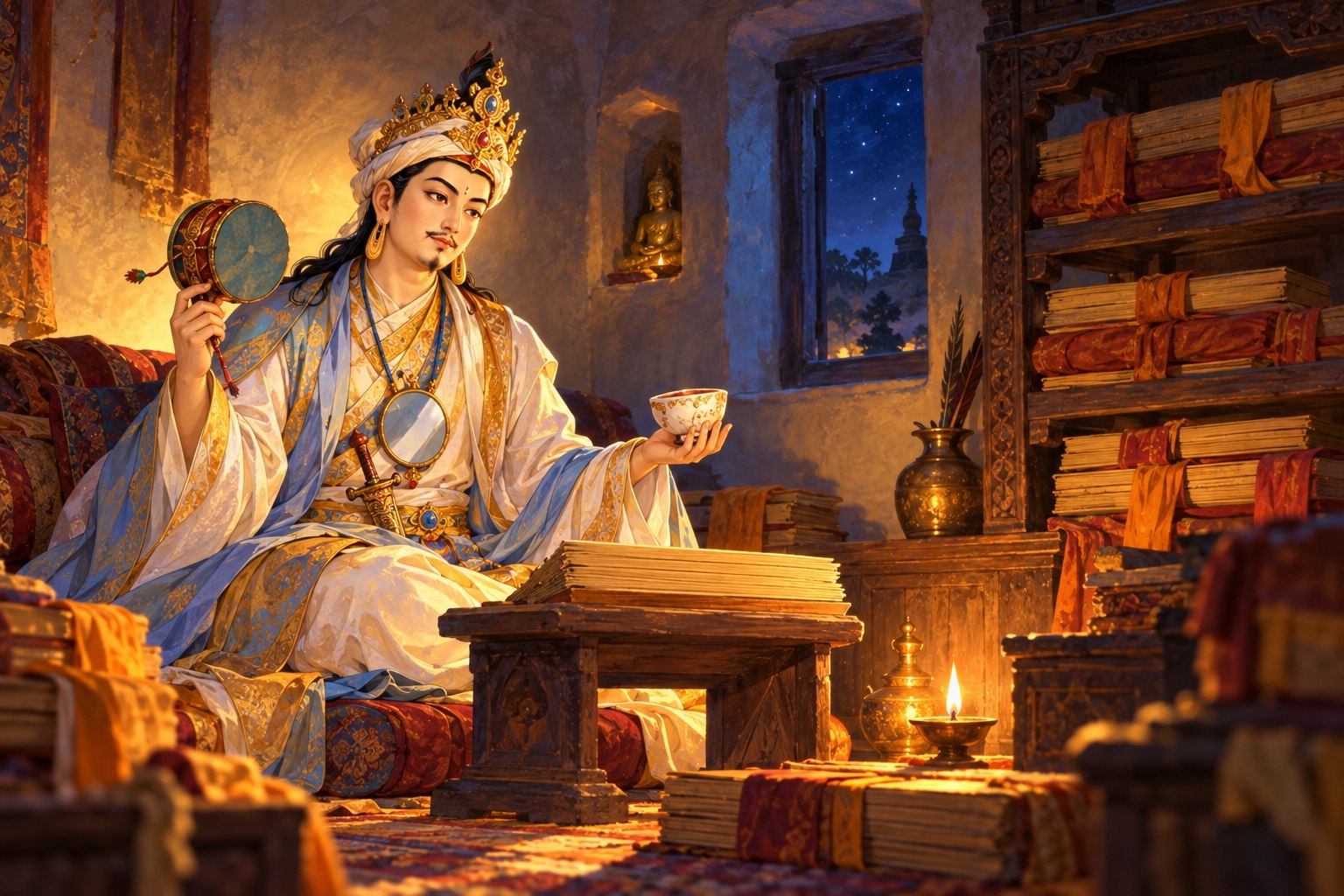
Next comes a season of learning. The life stories describe him travelling from teacher to teacher, studying the sciences of his day and the many kinds of Buddhist teaching. Rigpa Wiki says he mastered each teaching the first time he heard it.
For this, they say, he was called Loden Choksé, "Wise Seeker of the Sublime." Painters show him as a bright young prince-scholar holding a little hand drum and a skull cup. The skull cup, a bowl made from the crown of a skull, reminds the viewer of impermanence.
4. Pema Gyalpo, the Lotus King
The fourth name brings fire and water. In Zahor, the accounts say, an angry king tried to burn him on a pyre, and the fire became a lake. That story belongs to Princess Mandarava, and it is told in "Mandarava and the Lotus Lake."
In Rigpa Wiki's telling, something like it happened again. He returned with Mandarava to his old kingdom of Oddiyana, was recognised, and was set on a pyre once more. Again he was found sitting on a lotus in a lake. Afterwards the two of them taught there for thirteen years, and he became known as Pema Gyalpo, the Lotus King.
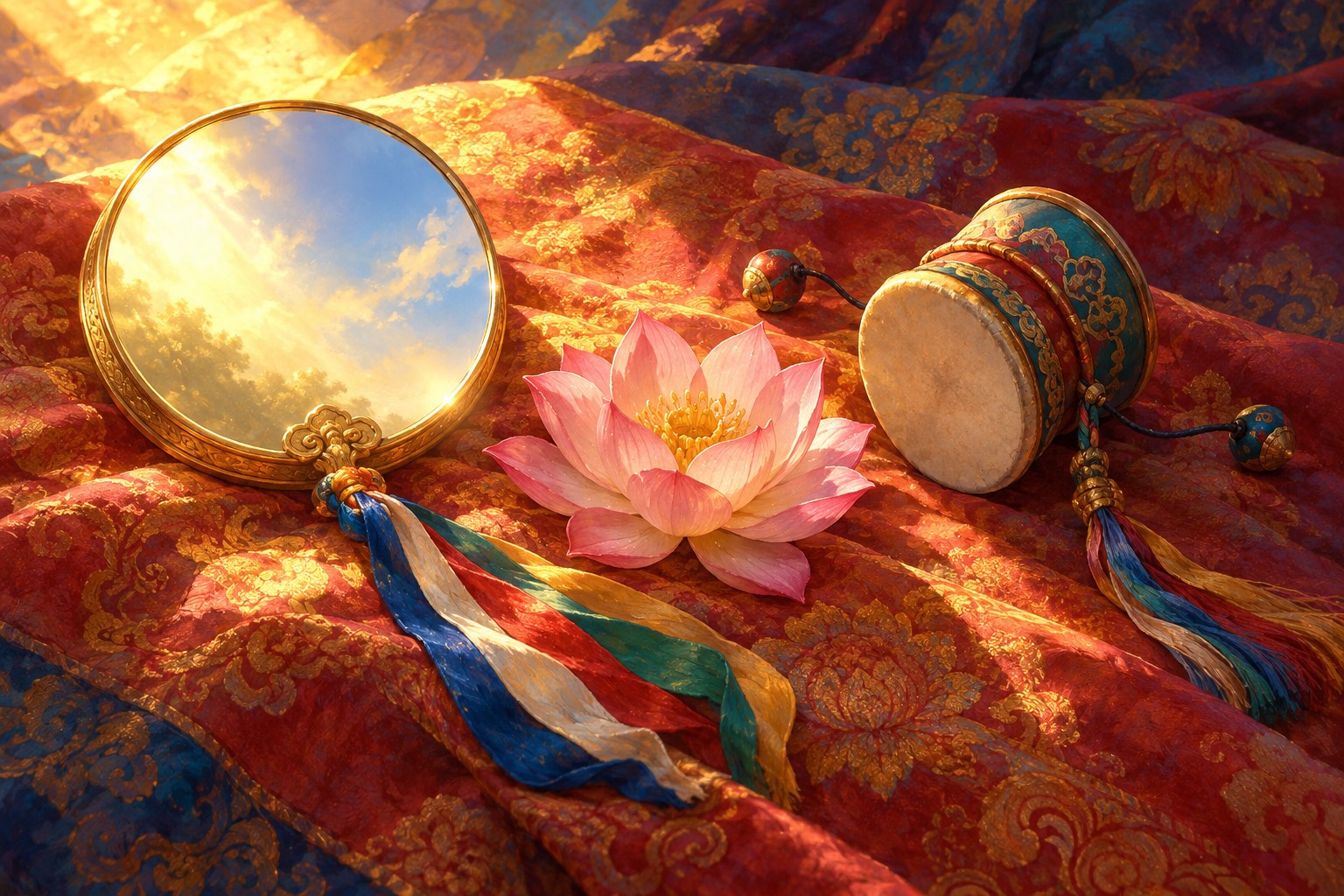
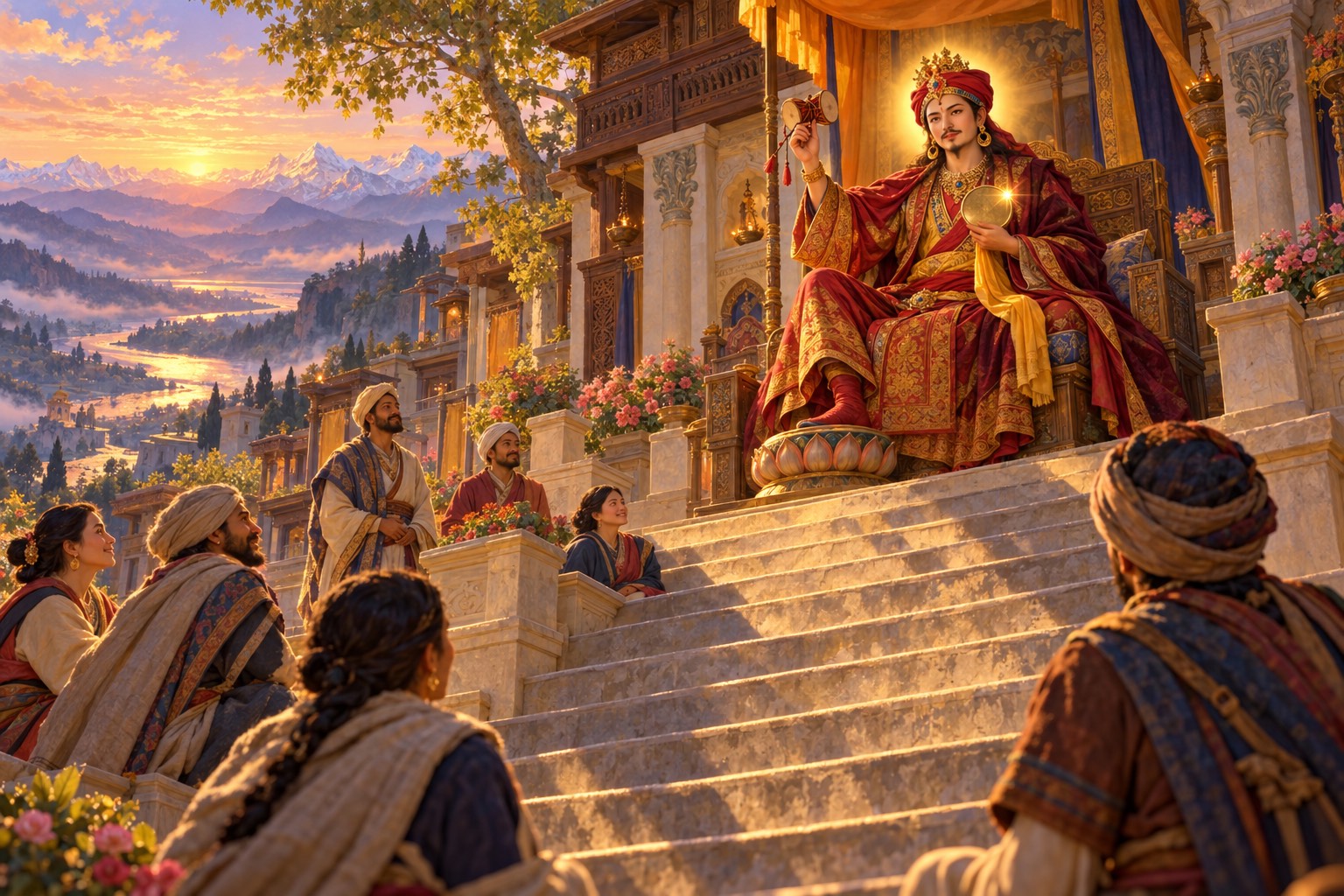
Other sources link the name to his earlier years as the young prince of Oddiyana, ruling, as Lotsawa House puts it, with wisdom and compassion. In paintings he wears a king's crown and holds a hand drum and a round golden mirror. The mirror is the easiest way to tell him apart from Loden Choksé.
5. Nyima Özer, Rays of the Sun
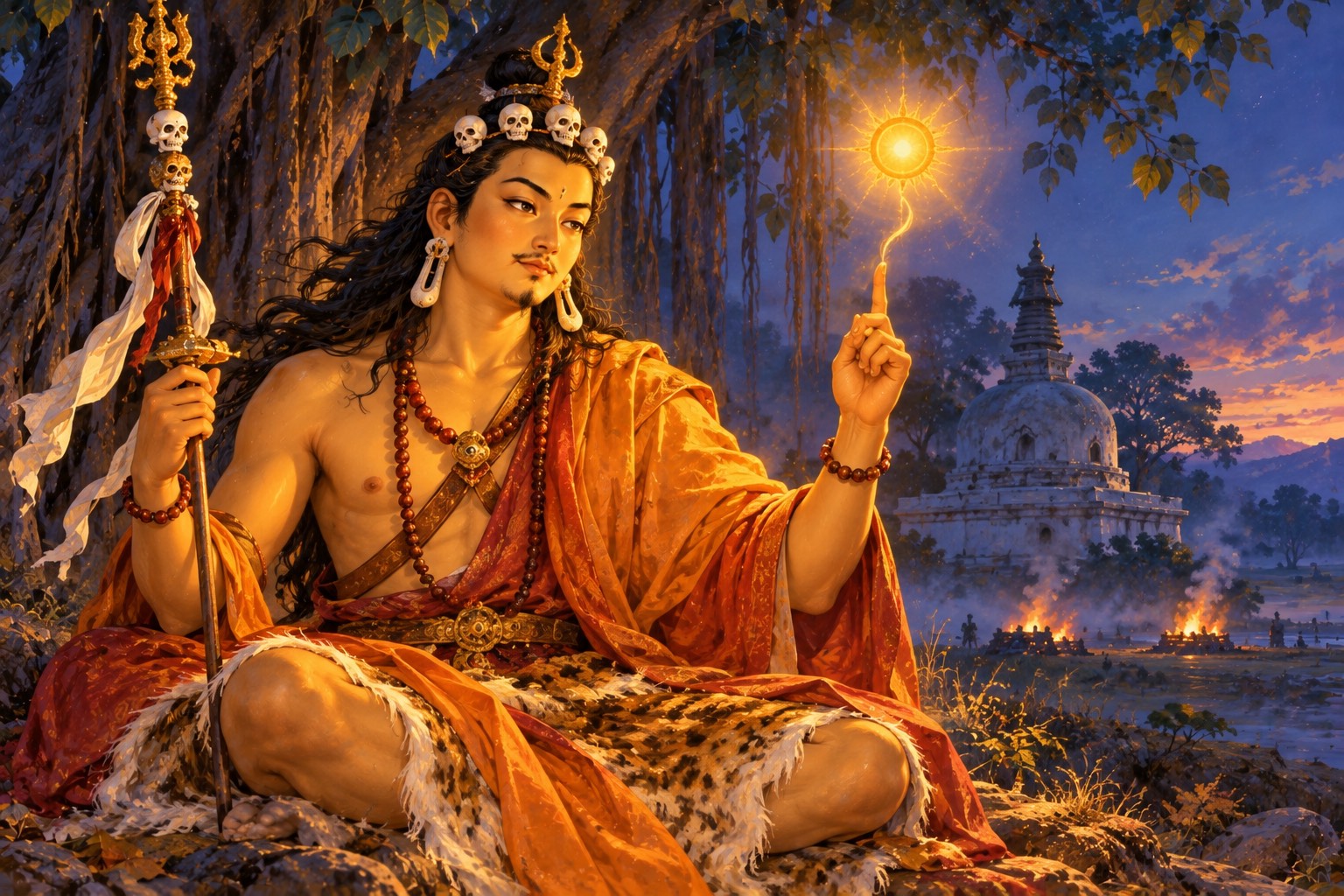
Then he went to the cremation grounds, the wild places where the dead were burned, which yogis sought out to face impermanence without flinching. ("From Prince to Yogi" tells how his path first led there.)
The accounts say he taught the dakinis there, the female wisdom beings of Tibetan tradition, and turned the spirits of those places into protectors of the Dharma, the Buddha's teaching. He became Nyima Özer, "Rays of the Sun."
Painters give him a beautiful sign. He sits as a lean yogi, a staff in his right hand, while his left forefinger points upward and a ray of light holds the sun in the sky. One Himalayan Art Resources note reads those rays as light that removes ignorance.
6. Sengé Dradok, the Lion's Roar
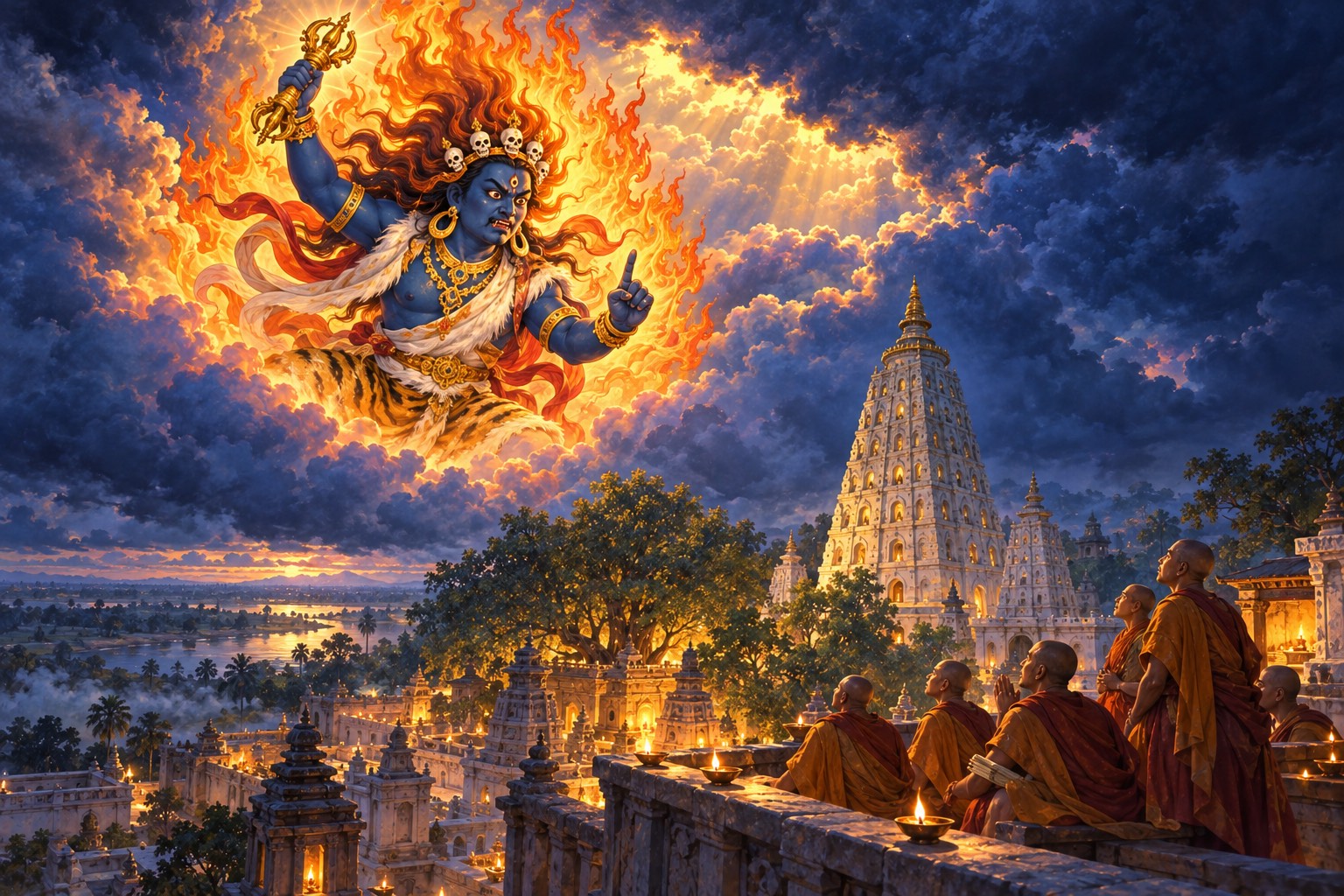
At Bodhgaya, the accounts say, five hundred skilled opponents came to debate the Buddhist scholars, and the scholars were losing. Guru Rinpoche came to their aid, won the debate, and turned back the magic that followed. "The Dakini and the Prayer" tells how the scholars called him.
From this he was named Sengé Dradok, "Lion's Roar," an old Buddhist phrase for truth spoken without fear. He is shown dark blue and wreathed in flames, a vajra held high. The tradition reads such fierce forms not as anger but as compassion at full strength.
7. Padmasambhava, the Lotus-Born
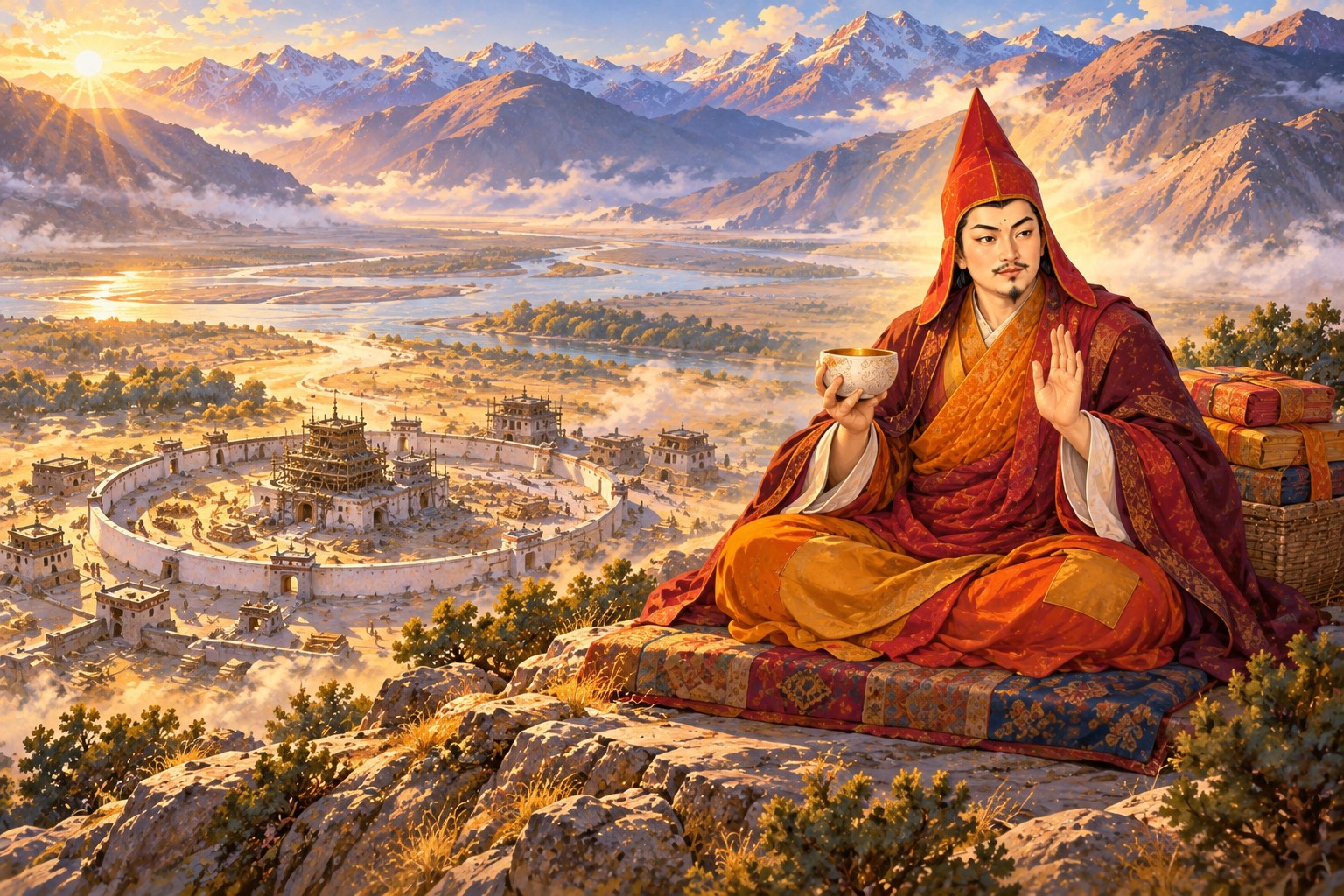
The seventh name is the one the prayer uses. Rigpa Wiki notes that Padmasambhava was first the name of this one manifestation, and only later came to stand for all of them.
It belongs to Tibet. King Trisong Detsen invited him to help found Samye, the first monastery there, but the accounts say the local spirits tore down by night what was built by day. Guru Rinpoche climbed the hill of Hepori and brought those forces under oath, and the building could go on ("The Building of Samye").
In this form he is a great scholar-monk, in a tall red pointed hat, seated before a basket of books, one hand raised in the gesture of protection.
8. Dorjé Drolö, the Wild Wrathful Vajra
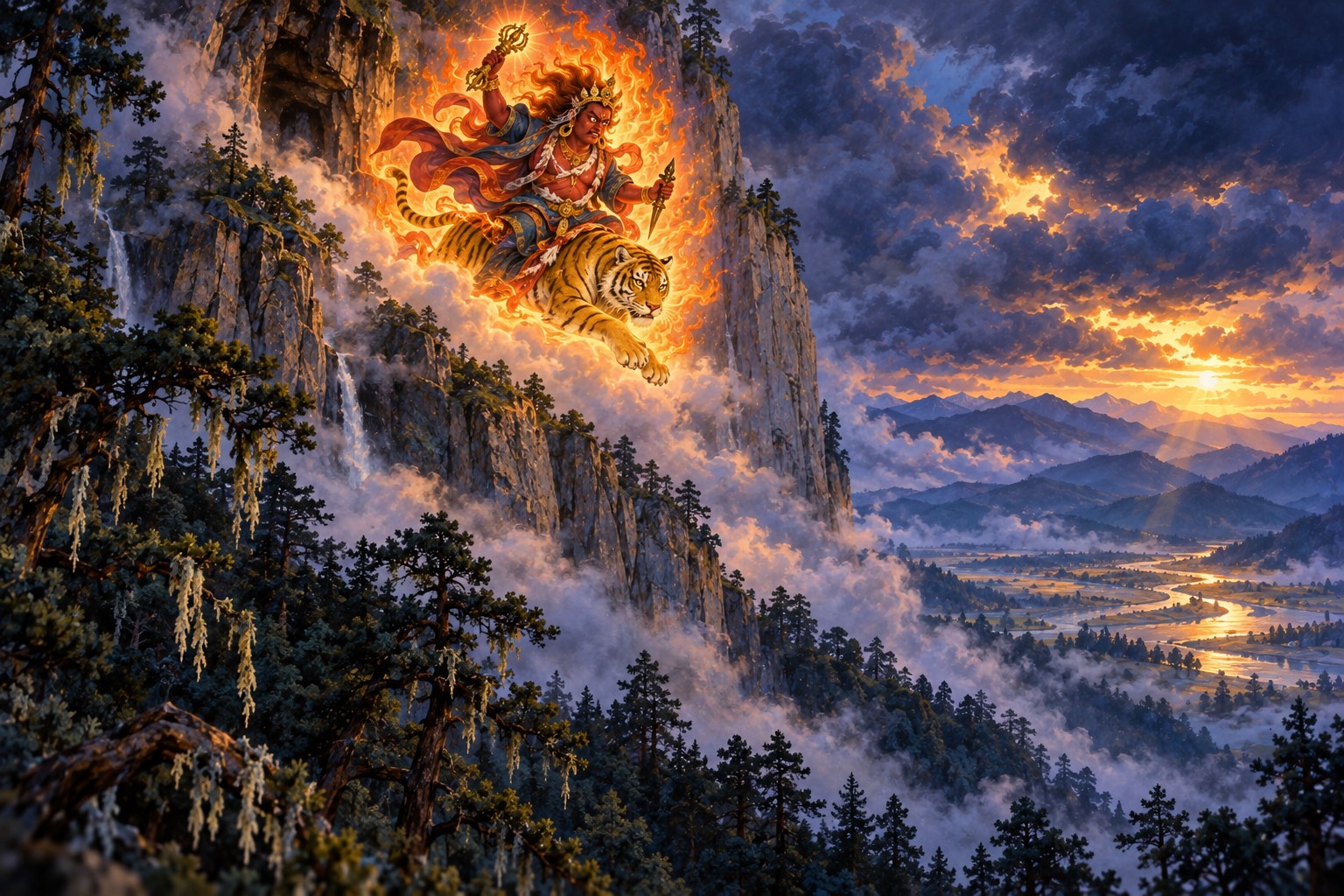
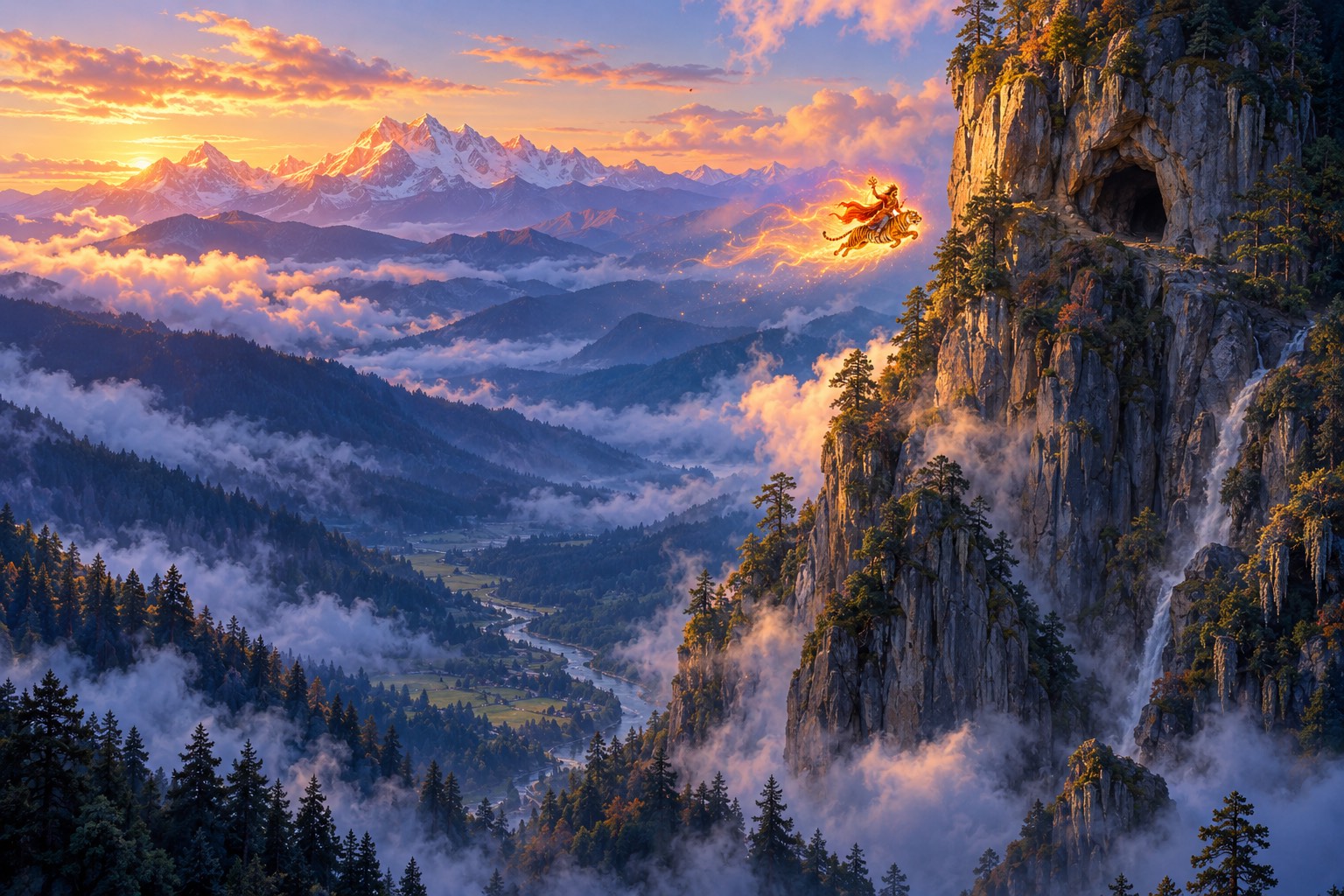
The last name is the wildest. Rigpa Wiki says that at thirteen places called Taktsang, "Tiger's Lair," he appeared in a terrifying wrathful form, binding worldly spirits under oath to protect the terma, treasure teachings hidden for later generations.
As Dorjé Drolö he is deep maroon, riding a tigress through flame, a vajra in one hand and a ritual dagger pointed down in the other. His best-known lair is the cliff above Paro, told in "The Tiger's Nest."
Why so many forms?
Why would one teacher need eight faces? The tradition's answer is simple: because beings are different. A scholar may listen to a scholar, a court to a king, a yogi in a cremation ground to another yogi, and a proud, frightening force only to someone more powerful still.
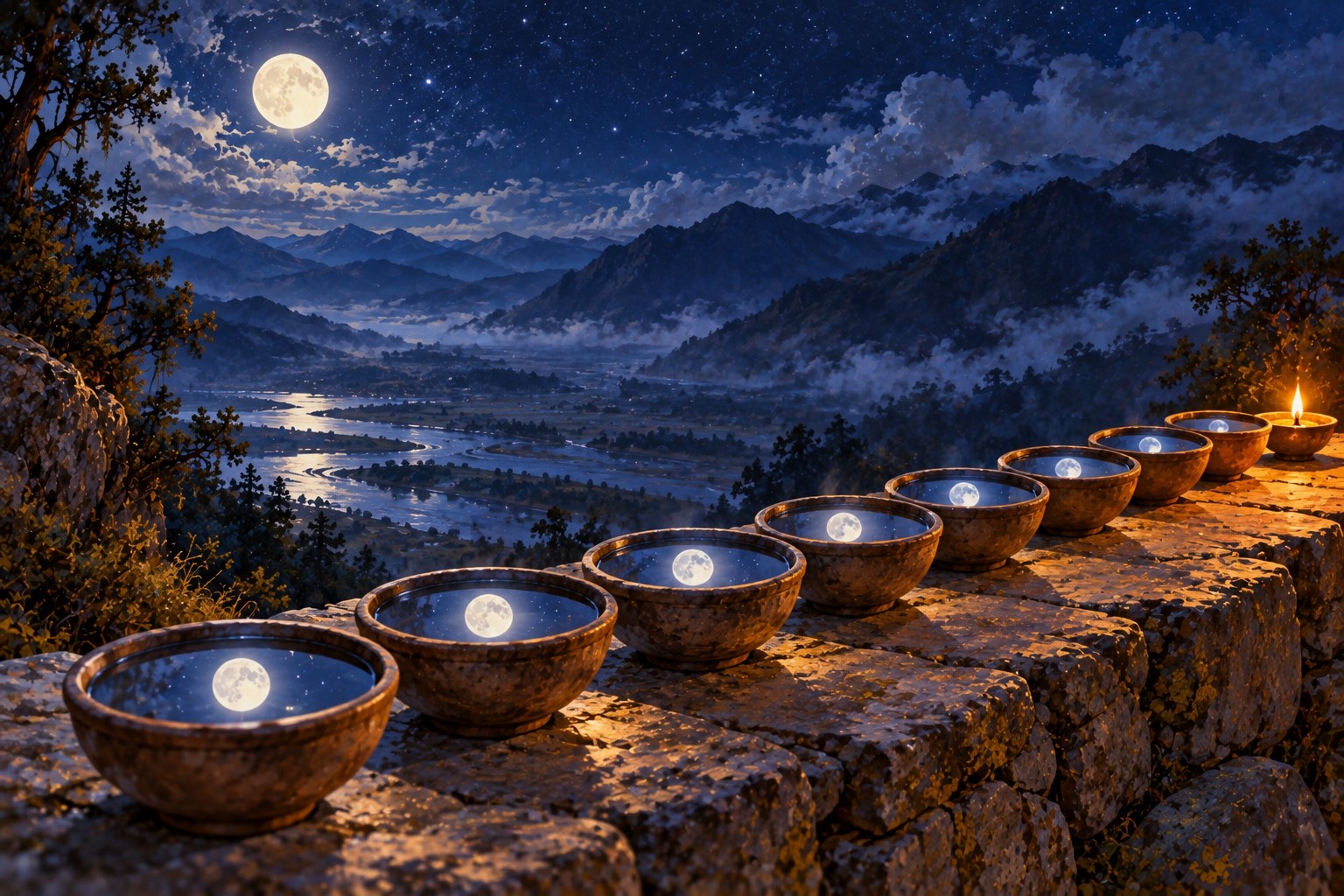
One picture may help, offered here only as an image. On a still night a single moon shines in every bowl of water set out to catch it. There are many moons in the bowls, and only one in the sky.
Rigpa Wiki adds that each manifestation shows a different side of the nature of mind, and quotes Guru Rinpoche himself: "Mind itself is Padmasambhava."
Many lists, one teacher
The lists do not all agree, and it is worth saying so gently. This page follows the order of the life story in Rigpa Wiki's biography.
Rigpa Wiki's own list of the eight runs differently, with Nyima Özer third and Pema Gyalpo sixth. Lotsawa House puts Pema Gyalpo second, right after the birth. The Pema Kathang, a fourteenth-century treasure biography, sets the eight around the directions of a mandala, the circular pattern of a sacred world. Some lists replace Tsokyé Dorjé with Orgyen Dorjé Chang or add the name Padmakara.
Himalayan Art Resources notes that when painters set the eight together, they usually arrange them by rank rather than by the order of his life. The forms stay the same. Only the order changes.
The eight, danced
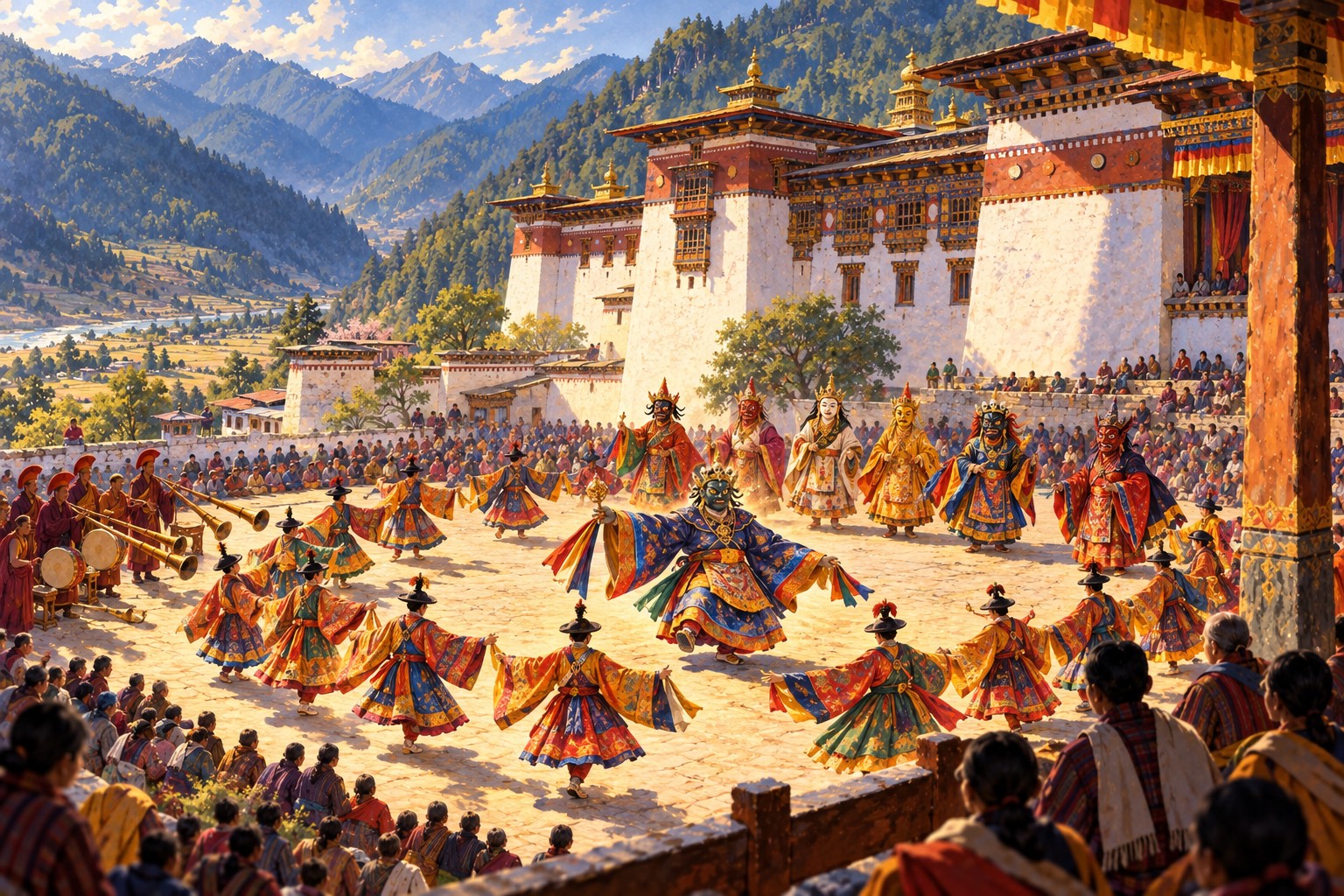
In Bhutan the eight are not only painted. They are danced. Each year at the Tshechu, a festival whose name means "tenth day," the day of the month kept for Guru Rinpoche, monks perform the Guru Tshengye, the dance of the eight manifestations.
Writing in Tricycle, Karen Greenspan describes a two-hour dance drawn from treasure texts of Guru Chöwang, the thirteenth-century master who also revealed the Seven-Line Prayer. Dorjé Drolö enters first and clears the ground. Then each form dances alone at the centre of a circle, in its own mask and robe, the peaceful ones slowly and the wrathful ones faster and faster.
The Treasury of Lives says the same cycle lies at the heart of a yearly dance of the eight aspects held at most Nyingma monasteries. One Bhutanese story, told in "The Tiger's Nest," even remembers Guru Rinpoche dancing in eight forms in a meadow in Bumthang.
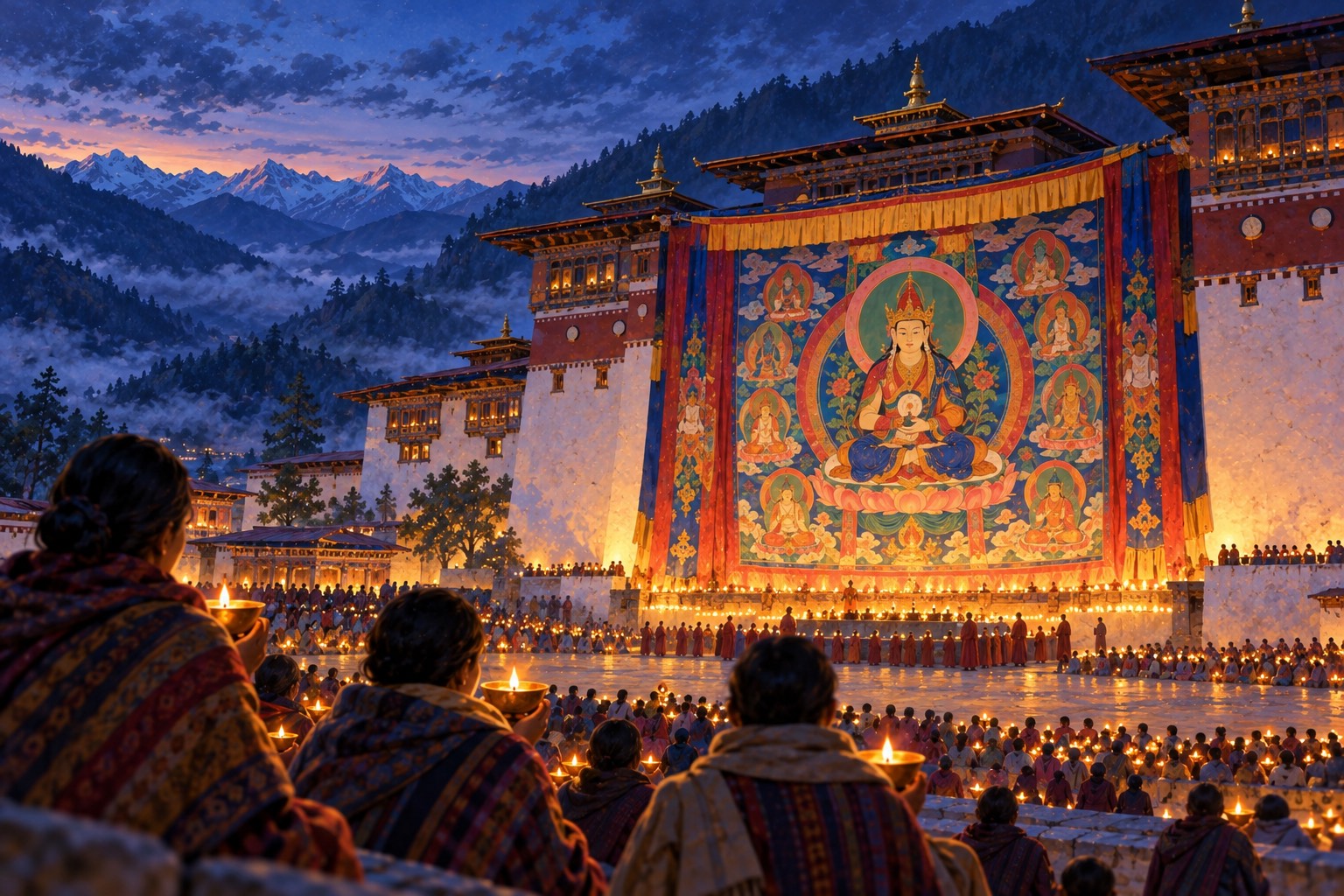
At Paro, on the festival's last morning, a huge appliqué banner of the eight manifestations, about twenty metres wide, is raised on the wall before dawn. It is taken down before the sun can touch it. People come in the dark to see it, and it is said that seeing it washes away wrongdoing.
So the eight names are not only history. Each year they are sewn, painted and danced, and for a few hours a whole valley stands inside the story.
About the art
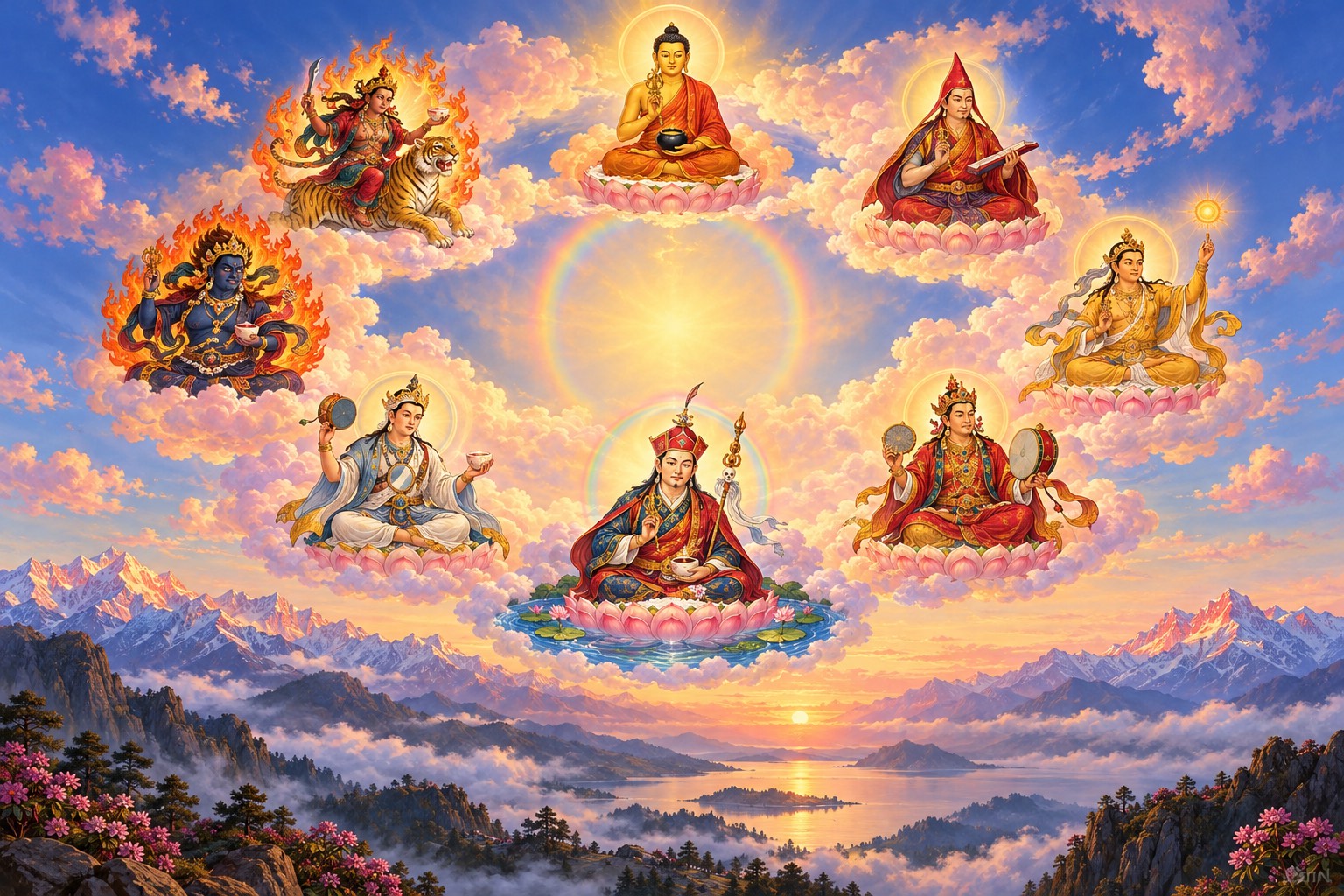
Each of the eight forms on this page is drawn from Himalayan Art Resources, Robert Beer's notes and the Huntington Archive, and each keeps its own marks so they are never blended. Shakya Sengé looks like a buddha: monk's robes, a crown of curls, a vajra and a black alms bowl. Loden Choksé and Pema Gyalpo are both royal, crowned and holding a small hand drum (damaru); Loden holds a skull cup, and Pema Gyalpo holds a round golden mirror, a sign of the mind that reflects everything without clinging.
Nyima Özer is a yogi of the cremation grounds, wearing a tiger-skin skirt and bone ornaments, holding the khatvanga staff upright, while a ray from his finger holds the sun. Padmasambhava in the seventh form is a scholar-monk with a red pointed pandita hat, a skull cup and a basket of books. Tsokyé Dorjé is shown as most painting sets show him, looking just like the familiar main form with the five-petalled lotus hat, vajra, skull cup and khatvanga, rising on a lotus from the lake. Some sets put a blue form, Orgyen Dorjé Chang, in this place instead.
Sengé Dradok and Dorjé Drolö are the two wrathful forms, with three eyes, flaming hair and wisdom flames. Traditional paintings often show beings trampled beneath their feet and garlands of heads. Here those details are left out or kept tiny, because the tradition reads these forms as compassion at its fiercest, not as violence. The tigress Dorjé Drolö rides is a woman of deep realisation in tiger form; tellings differ on who she was.
Traditional sets usually paint each form in its own panel, or arrange all eight around a central Guru by rank. The opening picture sets them instead in a ring of cloud, a storybook echo of a mandala. The masked dancers and the great banner are painted from a distance, with no faces, because they are real people and a real festival today.
Why this matters for practice
The fourth line of the Seven-Line Prayer calls Guru Rinpoche by his name, and the eight names show how much that one name holds: birth, renunciation, learning, kingship, fearlessness, truth, teaching and fierce protection. Knowing them can turn the name from a word into a presence you recognise. And the reason the tradition gives for his many forms, that he meets each being as they need, is quietly encouraging: there is no wrong place to start calling him from.

If something in this story moved you, you might pause and recite the prayer once. When you reach the fourth line and say his name, you are calling, in a single word, the lake-born child, the monk, the scholar, the king, the yogi, the lion, the teacher and the wild flame. They all answer to it.
Sources and further reading
- Eight Manifestations of Guru Rinpoche, Rigpa Wiki (Internet Archive snapshot)
- Padmasambhava, Rigpa Wiki (Internet Archive snapshot)
- Guru Padmasambhava: introduction, Lotsawa House
- A Prayer Recalling the Guru's Life Story, by Jokyab Pema Trinlé Nyingpo (trans. Samye Translations), Lotsawa House
- A Garland of Vajra Words: A Prayer to the Guru, by Dilgo Khyentse Rinpoche (trans. Samye Translations), Lotsawa House
- The Prayer which is the Source of All True Realization, by Mipham Rinpoche (trans. Rigpa Translations), Lotsawa House
- Padmasambhava: Eight Forms (set 209), Himalayan Art Resources
- Padmasambhava life story in chronological order (item 90161), Himalayan Art Resources
- Padma Raja (item 260); Nyima Oser (item 317); Loden Chogse (items 670 and 697); Pema Jungne (item 920), Himalayan Art Resources
- Padmasambhava and his Eight Manifestations, Robert Beer, tibetanart.com
- Padmasambhava and the Eight Manifestations (thangka essay), Huntington Archive
- Guru Chowang (Internet Archive snapshot), The Treasury of Lives
- The Moving Mandala: Inside Bhutan's Sacred Dance Festivals, by Karen Greenspan, Tricycle
- Tsechu, Wikipedia
- Rinpung Dzong, Wikipedia
- Padmasambhava, Wikipedia
This retelling is waiting to be read by a knowledgeable practitioner. Where the traditional accounts differ, the story says so; if you notice a mistake, please tell us through Share Your Story.