The fifth line of the Seven-Line Prayer pictures Guru Rinpoche surrounded by a great retinue of dakas and dakinis. Sooner or later, many people who say the prayer wonder where that gathering is.
The tradition has an answer, and it is one of its loveliest pictures: a mountain the colour of copper, rising out of the sea.
Its Tibetan name is Zangdok Palri, the Glorious Copper-Coloured Mountain. The retinue there is made of dakinis, female embodiments of awakened wisdom often called sky-dancers, and dakas, their male counterparts.
South-west, across the sea
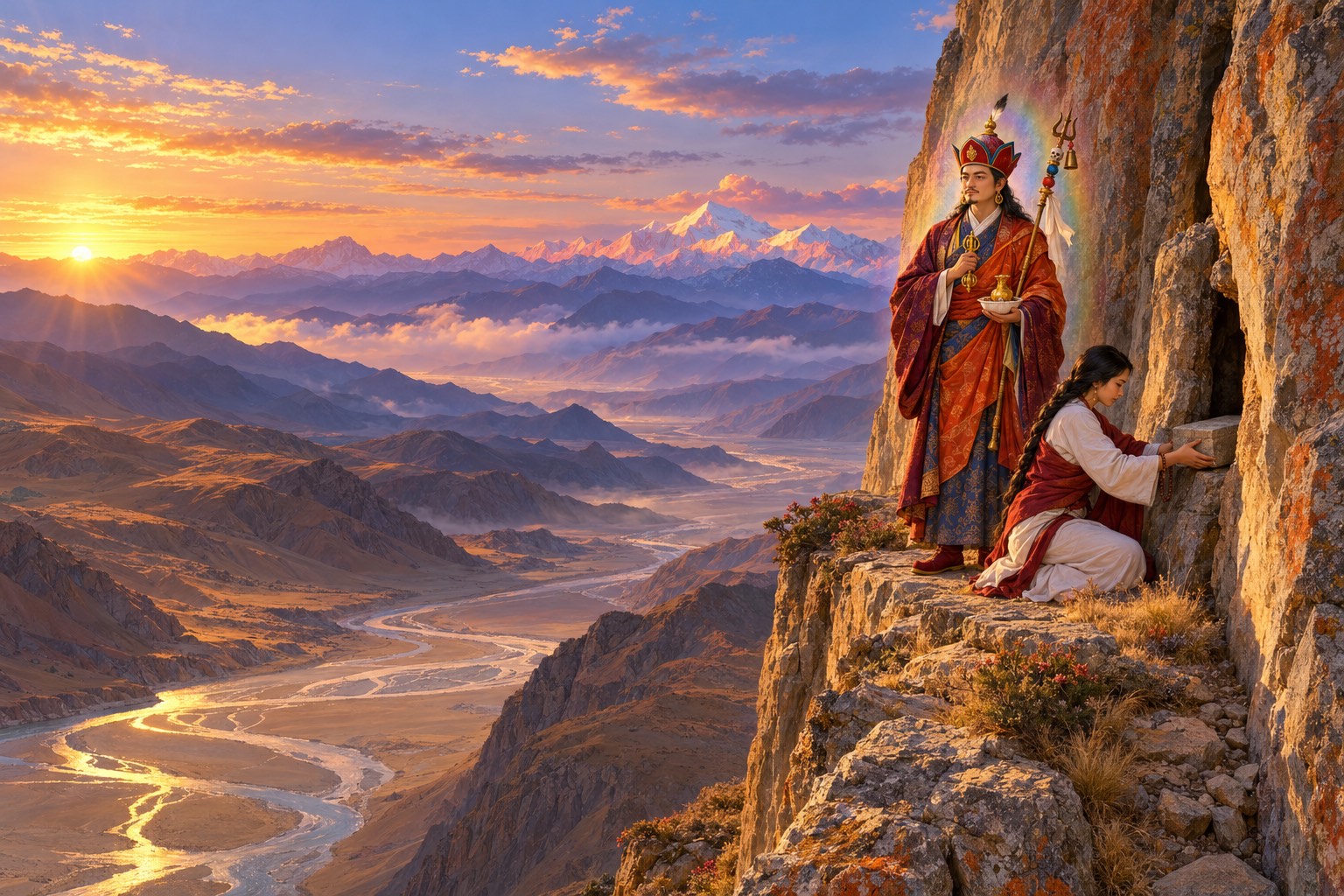
How Guru Rinpoche left Tibet, and the promise he made at the Gungthang pass, is told on this site in The Hiding of the Treasures. This story begins where that one ends, with the direction he turned his face: the south-west.
The traditional accounts say he travelled to Ngayab Ling, called Chamara in Sanskrit, the land of the rakshasas. In Indian and Tibetan lore these are fierce, man-eating beings, and the stories describe them as a threat to the human world.
On the peak of the Copper-Coloured Mountain, Rigpa Wiki relates, he overcame the rakshasa king, Raksha Thötreng, and took on that king's own form. Then, writes Dudjom Rinpoche, he brought forth the Palace of Lotus Light, Pema Ö, where he presides as king, keeping watch over the people of this world.
The pilgrimage site Nekhor gives the tradition's date for his setting out: the tenth day of the monkey month, in the year 864. Historians date his years in Tibet differently, and the tradition does not treat the mountain as a dot on a map.

Where is Chamara, then? Himalayan Art Resources notes that it is sometimes linked with Sri Lanka, an island long associated with demons in old stories. Nekhor gently warns against confusing the two, and recalls that the treasure revealer Chokgyur Lingpa, in a vision, passed Sri Lanka as one of thirteen islands on the way to the true Chamara.
The masters also speak of the mountain in another way. In a short prayer by Chokgyur Lingpa, the realm is called our own experience in its purity. The tradition holds both ways of speaking together, and teachers explain how they fit.
The mountain
The prayers paint the mountain in loving detail. Jigme Lingpa, in a prayer from his Longchen Nyingtik revelations, describes it rising in the shape of a heart, its base resting on the crown of the king of the nagas, the serpent-spirits of the waters. Chokgyur Lingpa calls it a heart-shaped jewel among eight rakshasa islands.
In Dudjom Rinpoche's prayer A Joyful Chariot for the Fortunate, the peak is made of ruby. There are groves of sandalwood, meadows of turquoise, and streams of nectar running into pools. Flowers fall softly from a canopy of rainbows, and dakinis gather like clouds.
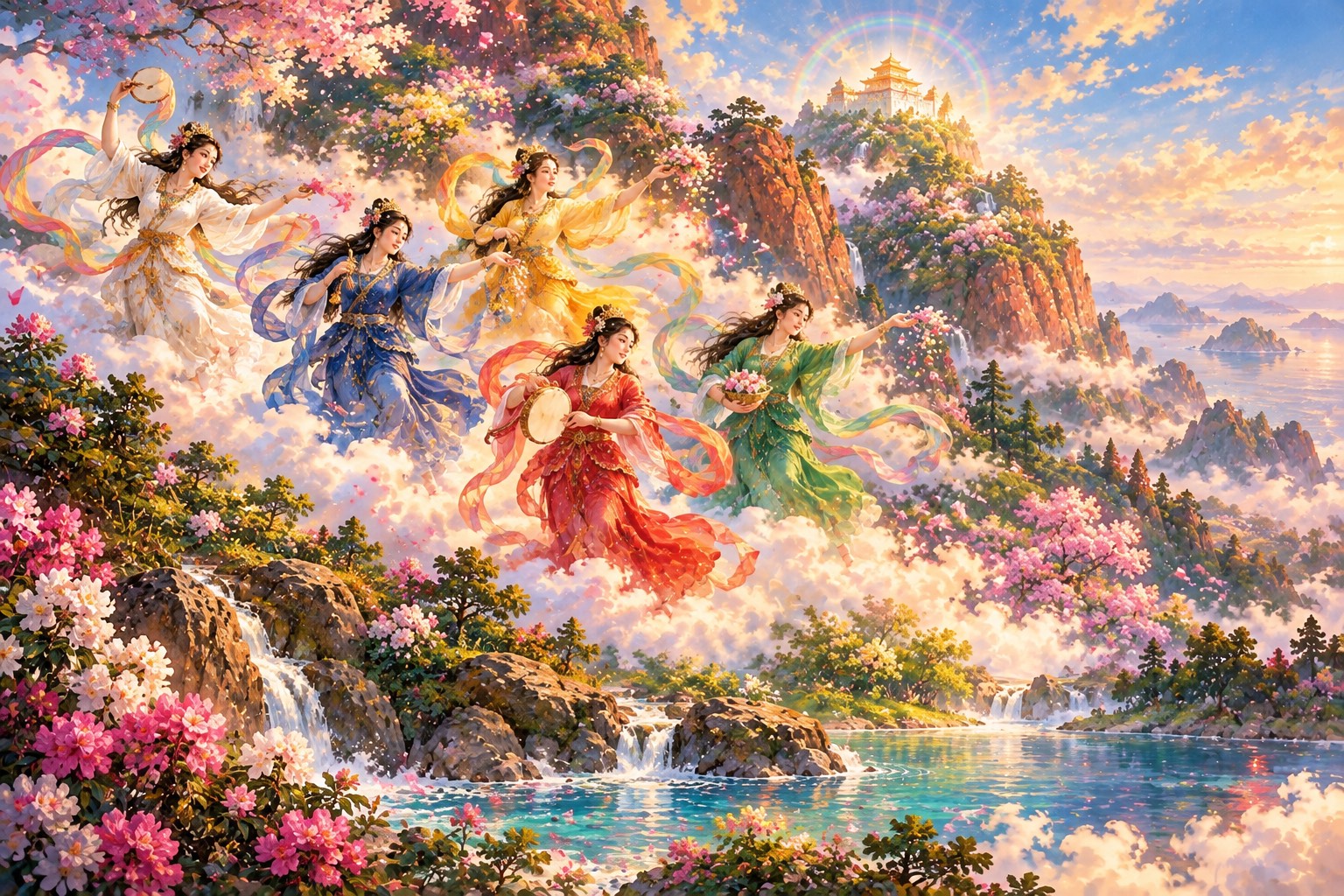
Not every vision sees the same colours. In Phakchok Rinpoche's retelling of the journey of Dudjom Lingpa, a nineteenth-century treasure revealer, the mountain was blue at its foot, white in the middle and red at the top. The tradition keeps such differences rather than smoothing them away.
A palace of three storeys
On the summit stands the palace. In the paintings Himalayan Art Resources has gathered, it rises in three storeys. Jigme Lingpa adds that it is translucent, like a rainbow, with no outside or inside, and that its four sides shine with four jewels: crystal, lapis lazuli, ruby and emerald.
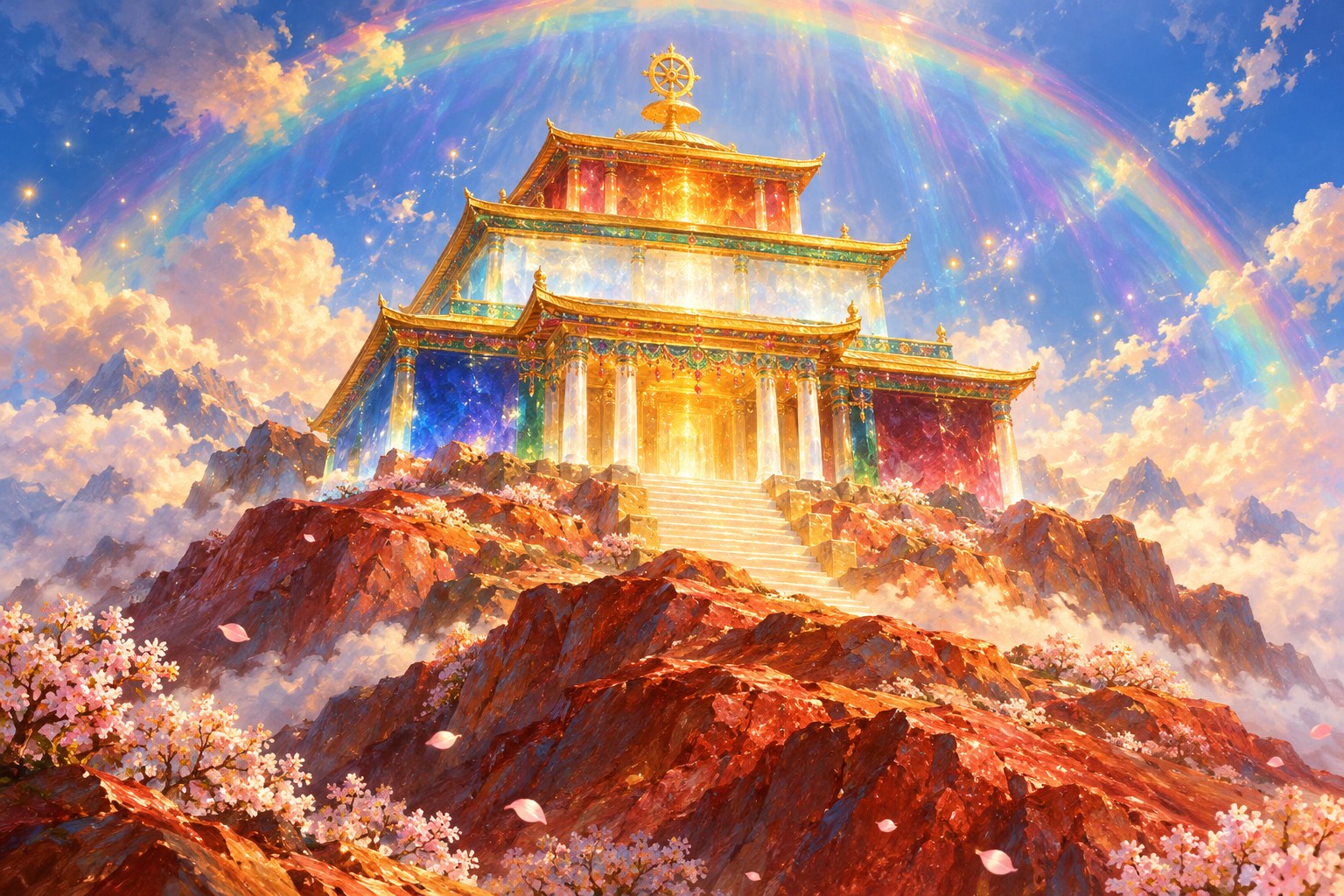
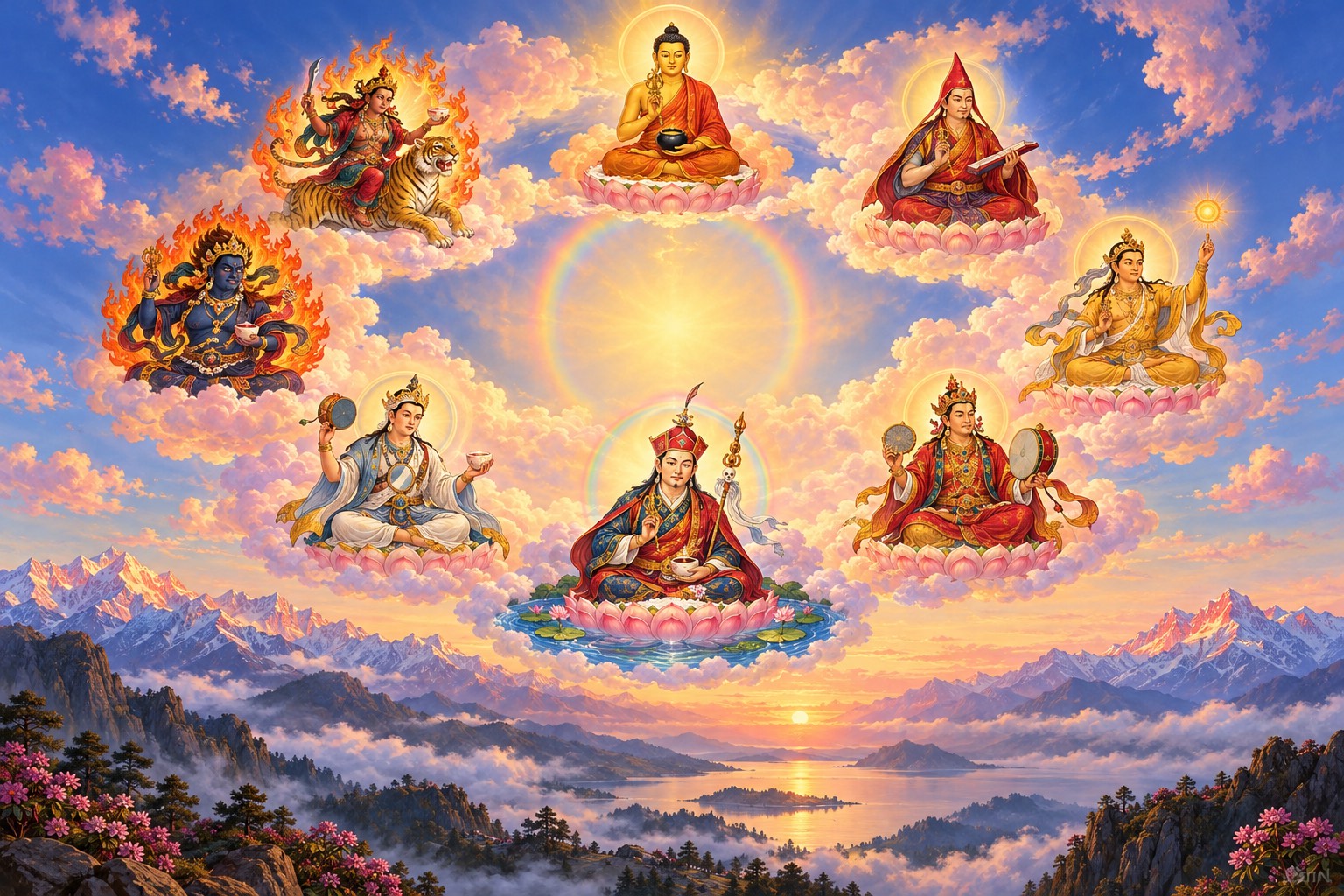
On the ground floor sits Guru Rinpoche, on a lotus with sun and moon seats, wrapped in rainbow light. In many paintings his two consorts, Mandarava and Yeshe Tsogyal, are beside him, and his eight manifestations, the eight forms he is said to have taken in his life, are gathered round.
Jigme Lingpa sees rows of masters and scholars of India and Tibet on his right and left, with the king, the twenty-five disciples and the treasure revealers all around, and dakas and dakinis filling every corner with song and dance. Himalayan Art Resources notes that the companions change from painting to painting, depending on the lineage of the person who commissioned it.
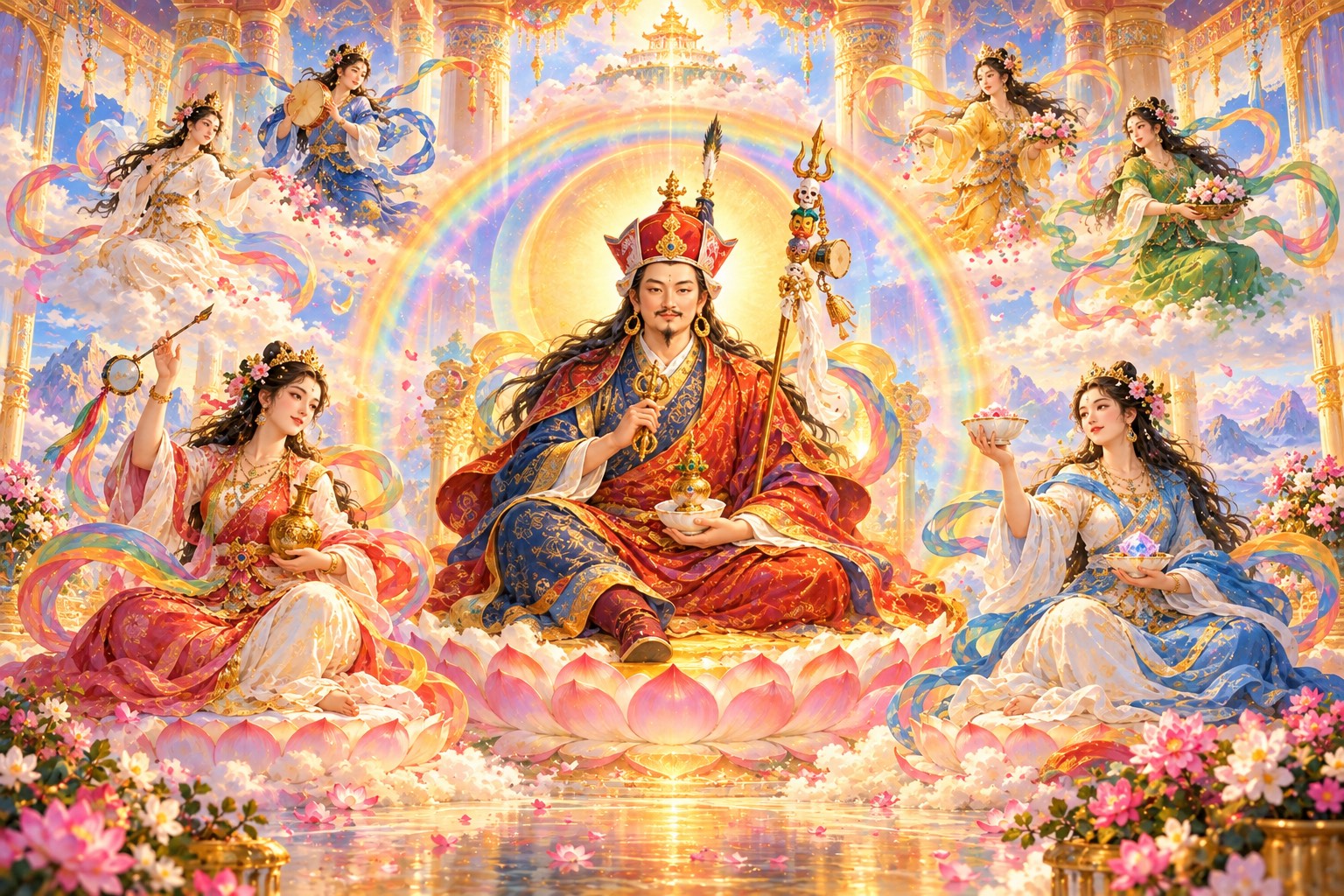
Above him, on the middle storey, is Avalokiteshvara, the bodhisattva of compassion, called Chenrezig in Tibetan; some paintings add Manjushri and Vajrapani beside him. On the top storey is Amitabha, the Buddha of Boundless Light. At the four gates stand the Four Guardian Kings.
Himalayan Art Resources calls Amitabha, Avalokiteshvara and Padmasambhava an important trinity in the Nyingma treasure tradition. Teachers connect them with the three kayas, the three dimensions of awakening, from the formless to the visible. Here too the accounts vary: Dudjom Lingpa saw Amitayus, the Buddha of Long Life, on the top floor.
Born from a lotus
The prayers ask to be born there. Phakchok Rinpoche points to a detail he finds important in Chokgyur Lingpa's threefold aspiration. Since this is the land of the rakshasas, the prayer asks to be born there not as a rakshasa, but from a blue lotus flower, so as to join Guru Rinpoche's retinue.
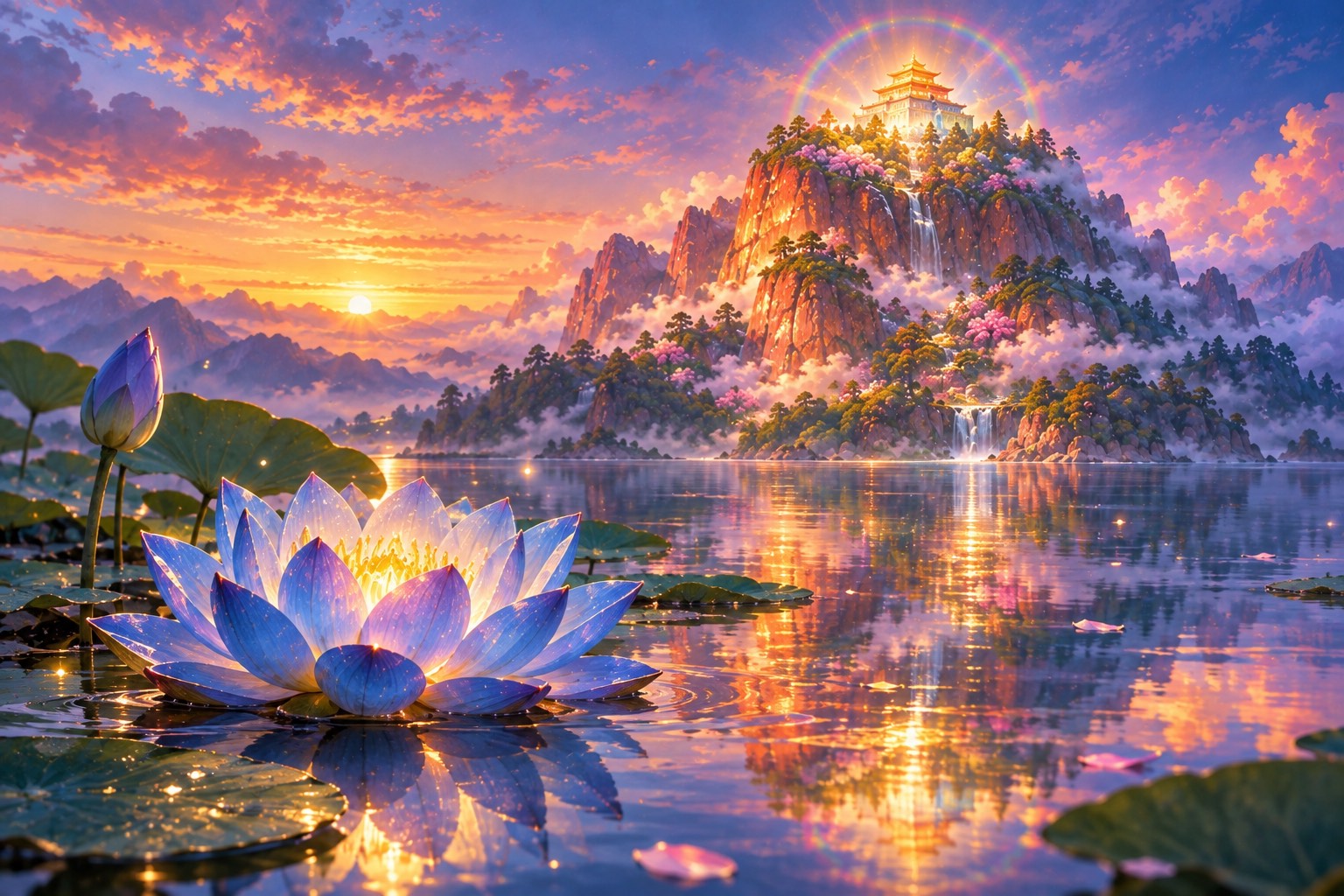
There is something tender in that. The one the Seven-Line Prayer calls Lotus-Born is pictured in a land where those who love him are born from lotuses too.
Journeys in vision
The tradition remembers many masters who, it says, went there in visions or dreams. Through 2019 Nekhor shared several of these accounts as Phakchok Rinpoche retold them.
Pema Lingpa, the fifteenth-century Bhutanese treasure revealer, was in a dreamlike meditation before dawn, the account says, when three dakinis came leading a white horse. From a snowy summit they showed him the Copper-Coloured Mountain, and a bridge like a white silk scarf stretched across to it.

He crossed a great lake and climbed slopes where, the account says, birds sang the Vajra Guru mantra. Inside a palace of light he met Guru Rinpoche, in the form of the rakshasa king, mature and bearded, and received teaching and a secret name. When it was time, he rode home, thought of his own bed, and woke in it.
Dudjom Lingpa's journey began, his account says, when a blue dakini took him by the fingertips of his right hand, led him to a high mountaintop and told him to spread his arms and fly. Like eagles they crossed lands and oceans. In the palace, at the end, Guru Rinpoche took the tertön's head in his two hands in blessing.
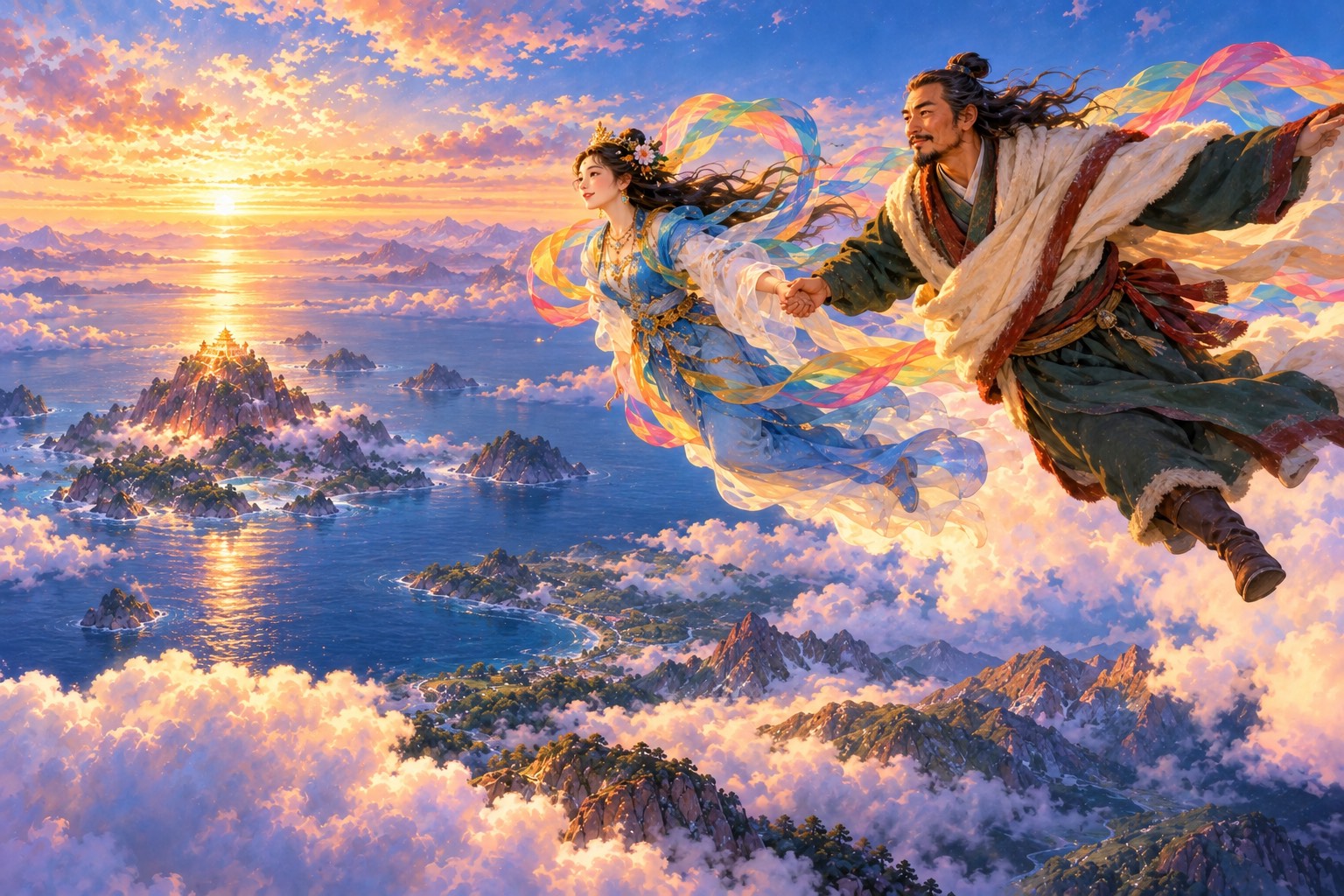
Jamyang Khyentse Wangpo, one of the great masters of nineteenth-century eastern Tibet, was only sixteen, Phakchok Rinpoche writes, when he first went there in a pure vision. Guru Rinpoche, surrounded by dakinis, introduced him to the three kayas and foretold the kinds of teaching he would one day hold.
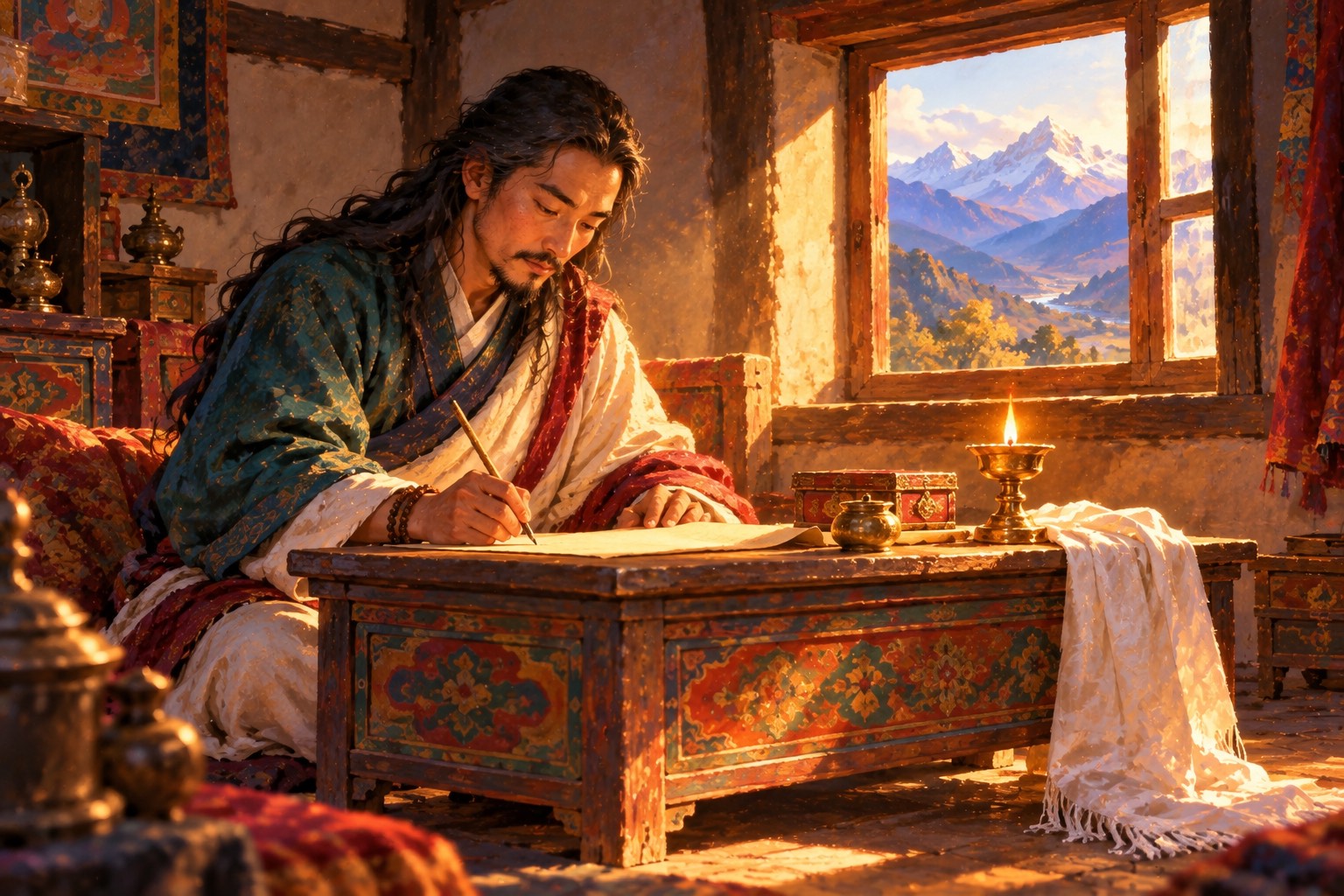
Chokgyur Lingpa, Khyentse Wangpo's close friend, whose story is told on this site in Khyentse and Chokgyur Lingpa, is remembered for a long visionary journey there. Phakchok Rinpoche adds a gentle note: pure visions can happen in the blink of an eye, as dreams do, and with true devotion, he says, one can be there "in a finger snap."
Prayers of aspiration
Out of such visions came prayers. Lotsawa House gathers more than a dozen in English, by Jigme Lingpa, Jamyang Khyentse Wangpo, Chokgyur Lingpa, Mipham, Dudjom Rinpoche and others. Chokgyur Lingpa wrote his threefold aspiration at a patron's request; Khyentse Wangpo's colophon says he wrote his down just as it came to mind, on a tenth day.
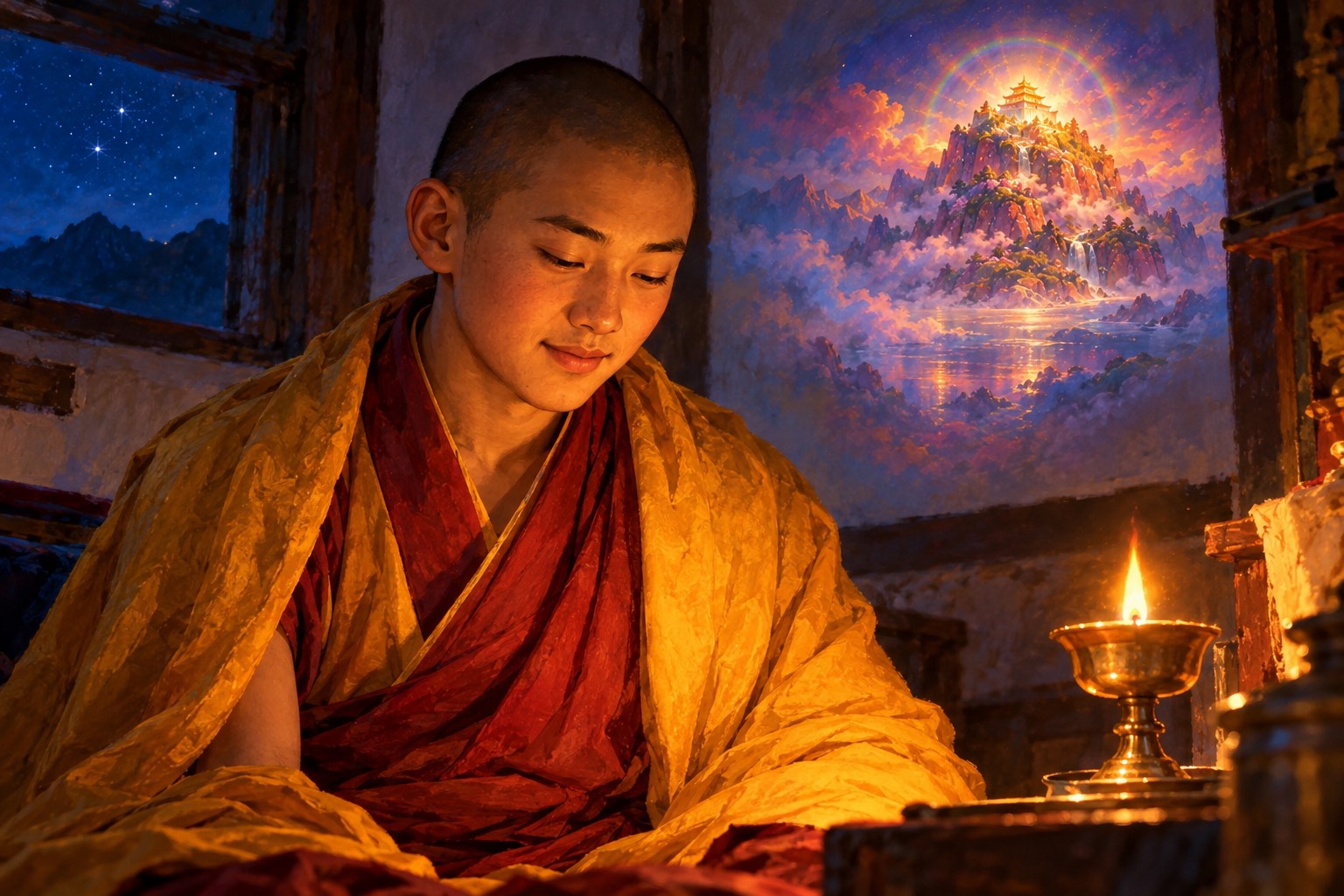
One of the most moving belongs to Dudjom Rinpoche. Lotsawa House notes that he composed it after his firstborn daughter, Dekyong Yeshe Wangmo, had left this world, and that its inspiration is said to have been her parting gift.
Temples on earth
People have also built the palace on earth. On Durpin Hill above Kalimpong, in the hills of West Bengal, Dudjom Rinpoche founded Zangdok Palri Phodang where he settled in exile; Wikipedia, citing the Treasury of Lives, gives 1957. It represents Guru Rinpoche's palace, and the Dalai Lama consecrated it in 1976.
Lonely Planet notes murals in its main hall presided over by Padmasambhava, and Kangchenjunga's snows from the terrace.
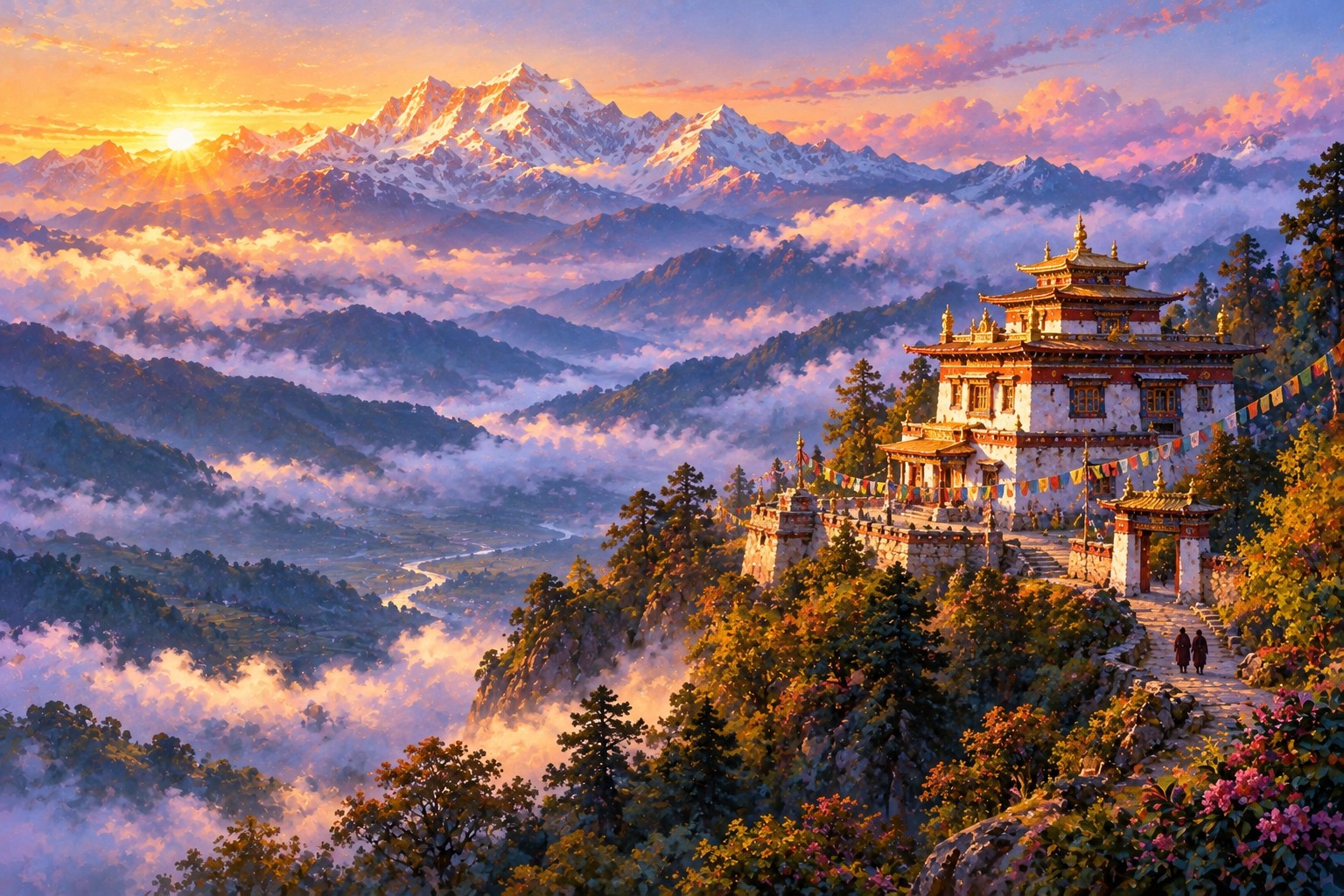
Bhutan, where Guru Rinpoche is deeply loved, has many temples called Zangdopelri. One in Phuentsholing, by the Indian border, is said to date from 1990. In Paro, Bhutan's national broadcaster reported the consecration of a new three-storey Zangdopelri, with Guru Rinpoche, his eight manifestations and his two consorts on the ground floor and Chenrezig on the floor above.
A temple like this is a painting you can walk through. Floor by floor, it sets out the same picture the old paintings show.
Not far away
Why might this matter to someone saying a short prayer at home? Because the tradition does not picture the mountain as a place he went to be far from us. Mipham's brief aspiration asks Guru Rinpoche to remain with the one who prays, from now until awakening, "without ever parting."
Teachers of the tradition say in many ways that those who call on him with devotion are not separated from him, and that the Copper-Coloured Mountain is, in the end, not far off at all. That is their view, offered as encouragement rather than as a guarantee. What it means in practice is something to explore with a teacher.
About the art
The Copper-Coloured Mountain is painted here as Himalayan paintings and prayers describe it: a steep copper-red mountain rising from the sea, ringed by small islands, its slopes full of groves, meadows and streams, and on its summit a palace of three storeys. Jigme Lingpa's prayer gives the palace's four sides four jewels (crystal, lapis lazuli, ruby and emerald), so they are tinted very softly. The traditional paintings place Amitabha on the top storey and Avalokiteshvara, sometimes with Manjushri and Vajrapani, on the middle one; on this page those storeys are shown only as soft white and ruby-gold light. The rakshasas, the Four Guardian Kings and the gold inscriptions of the paintings are left out.
In the hall on the ground floor, Guru Rinpoche appears in his main form: the lotus hat with a half-vajra, a sun and moon and a single vulture feather; layered robes; a five-pronged vajra at his heart; a skull cup holding a long-life vase in his lap; and a khatvanga, a slender staff topped with a trident, against his left shoulder. He sits on sun and moon discs on a lotus within a rainbow sphere. Mandarava sits to his right (the viewer's left), with a long-life arrow and vase; Yeshe Tsogyal sits to his left, offering a skull cup and holding a wish-fulfilling jewel. The dakinis wear the five colours, which teachers connect with the five kinds of awakened wisdom.
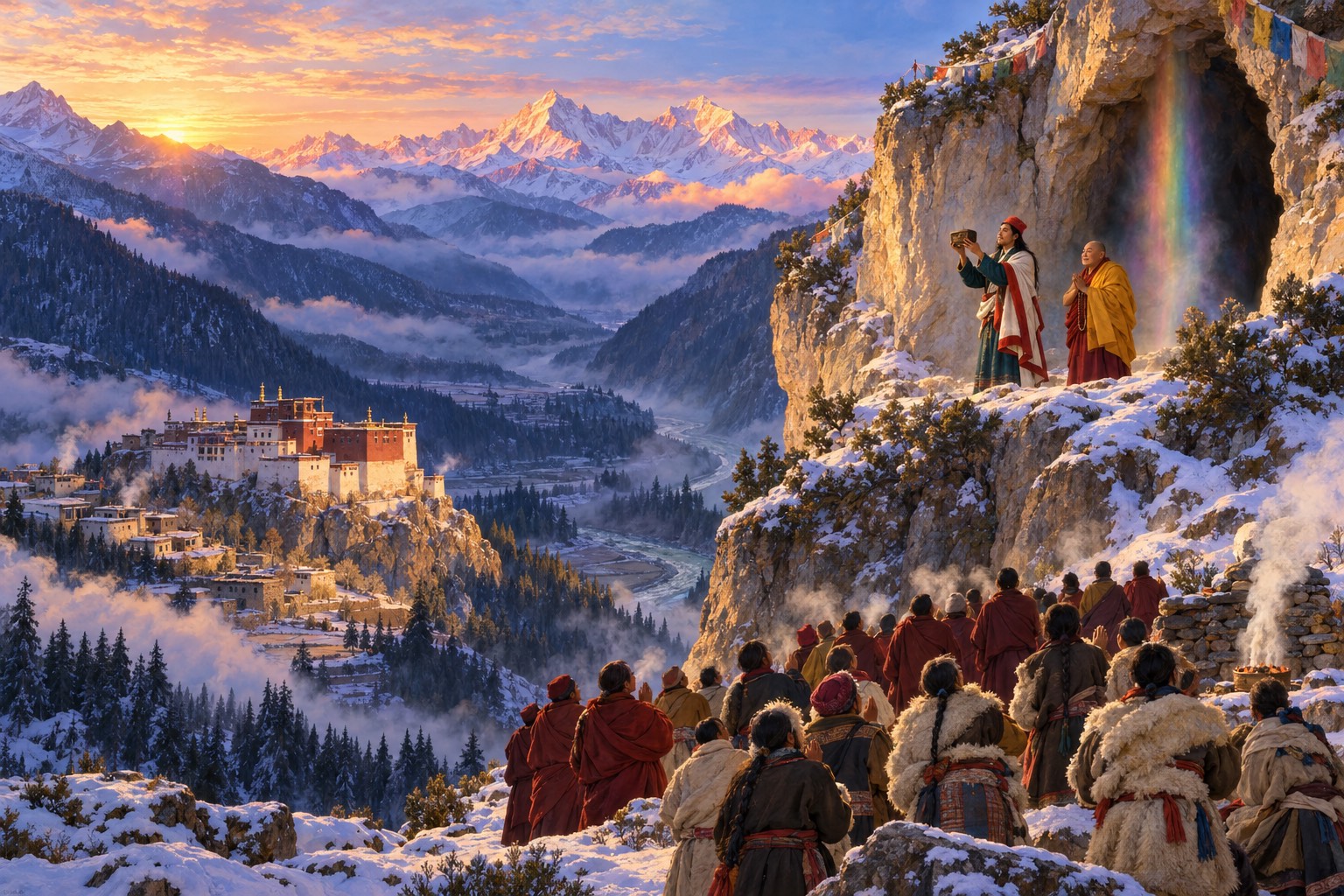
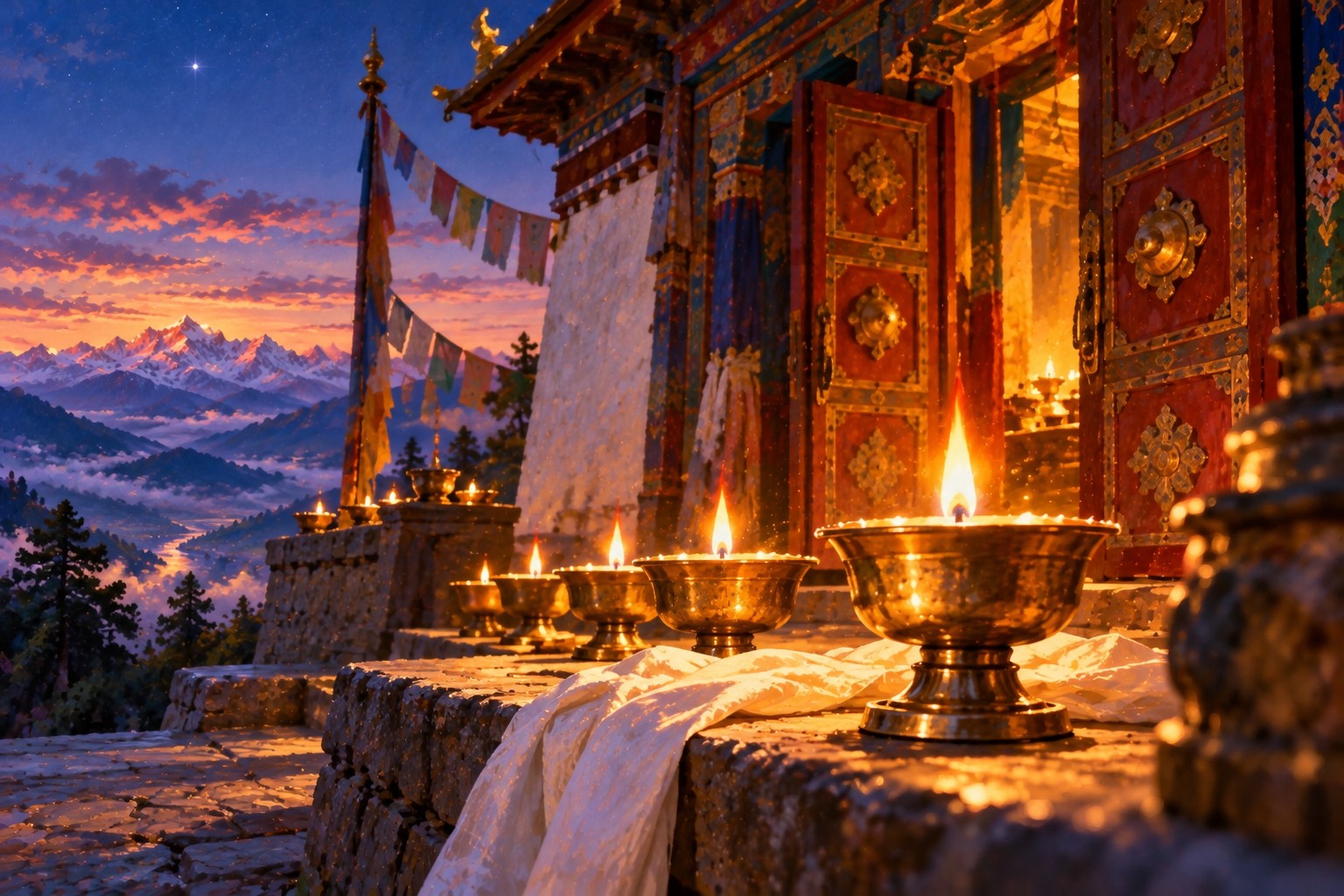
The masters who journeyed there in vision, Pema Lingpa, Dudjom Lingpa, Jamyang Khyentse Wangpo and Chokgyur Lingpa, are painted after the manner of traditional portraits, not as likenesses. The blue lotus recalls Chokgyur Lingpa's prayer to be born there from a lotus. The two temple scenes are of the present day: the hilltop temple stands for the Zangdok Palri temple at Kalimpong and those in Bhutan, but it is not an exact portrait of any building, and people appear only as tiny silhouettes.
Why this matters for practice
The fifth line of the Seven-Line Prayer describes Guru Rinpoche surrounded by dakas and dakinis, and the Copper-Coloured Mountain is the tradition's picture of that gathering. Masters who saw it in vision, and the prayers they wrote, speak of it as close at hand for anyone who calls on him with devotion. Reciting the prayer can be a simple way of turning toward that mountain.

If something in this story drew you toward that mountain, you might pause tonight and recite the prayer once. Its fifth line, with its dakas and dakinis, holds the whole gathering in a single breath.
Sources and further reading
- Zangdokpalri (Copper-Coloured Mountain), Rigpa Wiki (archived snapshot)
- Zangdok Palri Aspirations (topic page), Lotsawa House
- Secret Path to the Mountain of Glory (Jigme Lingpa), Lotsawa House
- A Joyful Chariot for the Fortunate (Dudjom Rinpoche, trans. Rigpa Translations), Lotsawa House
- A Prayer of Aspiration for the Copper-Coloured Mountain of Glory (Dudjom Rinpoche), Lotsawa House
- A Prayer of Aspiration for the Copper-Coloured Mountain of Glory (Chokgyur Lingpa, trans. Samye Translations), Lotsawa House
- Threefold Aspiration for Rebirth in Zangdok Palri (Chokgyur Lingpa, trans. Lhasey Lotsawa), Lotsawa House
- The Secret Path of Wisdom (Mipham Rinpoche), Lotsawa House
- The Chariot of the Vidyādharas (Jamyang Khyentse Wangpo, trans. Rigpa Translations), Lotsawa House
- Padmasambhava: Copper Coloured Mountain (set 491, Jeff Watt), Himalayan Art Resources
- Padmasambhava - Pure Land (Copper Coloured Mountain), item 90908, Himalayan Art Resources
- Padmasambhava - Pure Land (Copper Coloured Mountain), item 83428, Himalayan Art Resources
- Padmasambhava - Pure Land (Copper Coloured Mountain), item 73414, Himalayan Art Resources
- Zangdok Palri, Nekhor
- 2019: A Year of Journeys to the Glorious Copper-Colored Mountain (Phakchok Rinpoche), Nekhor
- The Benefits of the Tenth Day of the Lunar Month (Phakchok Rinpoche), Nekhor
- Pema Lingpa's Visionary Journey to the Copper-Colored Mountain (Phakchok Rinpoche), Nekhor
- Düdjom Lingpa's Visionary Journey to Zangdok Palri (Phakchok Rinpoche), Nekhor
- Do Khyentsé Yeshé Dorjé's Visionary Journey to Zangdok Palri (Phakchok Rinpoche), Nekhor
- Chokgyur Lingpa's Prayers for Rebirth in Zangdok Palri (Phakchok Rinpoche), Nekhor
- Zang Dhok Palri Phodang, Wikipedia
- Durpin Gompa, Lonely Planet
- Durpin monastery, Zang Dhok Palri Phodang, Kalimpong, 1001things.org
- Zangtho Pelri Lhakhang, Phuentsholing, 1001things.org
- Je Khenpo consecrates Ugyen Pema Woeling Zangdopelri temple in Paro, Bhutan Broadcasting Service
- Zangdopelri Monastery, Wikipedia
- 'Zangdok Palri, the Lotus Light Palace of Guru Rinpoche': a book inspired by Her Majesty the Royal Grandmother, The Bhutanese
- The Copper-Colored Mountain: Jigme Lingpa on Rebirth in Padmasambhava's Pure Land (Georgios T. Halkias and Christina Partsalaki, Snow Lion, 2022), Book
- Zangdok Palri: The Lotus Light Palace of Guru Rinpoche (ed. Supawan Pui Lamsam and Kesang Choden Tashi Wangchuck, Gatshel, 2013), reviewed by Robert Mayer, Revue d'Etudes Tibétaines (2015), Book and review
This retelling is waiting to be read by a knowledgeable practitioner. Where the traditional accounts differ, the story says so; if you notice a mistake, please tell us through Share Your Story.