This is an original story, written for this site. It is fiction, not a teaching or a traditional account. Marisol, Nabin, the old woman at the cave and the village they stay in are invented. Yarinak is a real place in Nepal, and what is said about it here comes from a published pilgrim guide.
Slowly
Marisol Vergara had spent thirty years in a herbarium in Valdivia, in the rainy south of Chile, pressing ferns flat and writing their names in pencil. Then she spent a year and a half being ill, which is another way of being pressed flat, and she preferred not to describe it.
When it was over, or over enough, her doctor told her to walk. Slowly, he said, every day. She took him more literally than he meant. In November, at fifty-six, she was in the hills of Kavre, south-east of Kathmandu, walking very slowly towards a cave.
The cave is at a place called Yarinak, which a pilgrim guide translates as “Slate Mountain Forest”. The traditional accounts say that Guru Rinpoche stayed there. He is the eighth-century teacher, also called Padmasambhava, the Lotus-Born, whom Tibetans remember for helping Buddhism take root in their country. By jeep it was a day from Kathmandu. On foot, at her pace, it was three.
The guide
Her guide was Nabin, twenty-four, from Kathmandu. He had a blue down jacket, a laugh you could hear across a valley and strong opinions about football. He usually took trekking groups up into the mountains. She was his first pilgrim.
“Most people go by road,” he said on the first morning. “I am not most people,” said Marisol, and set off at the pace of a tortoise on a long holiday.
Nabin was Tamang, one of the peoples of these hills. His grandmother in Boudha prayed from morning to night. Nabin prayed when his team took penalties.
The book
Marisol had learned the prayer from a book. She had found it in a second-hand shop in Valdivia during the months indoors: a small, worn paperback about Guru Rinpoche, with the Seven-Line Prayer printed in Tibetan, in Latin letters and in English. She could not have said why she bought it. For a year she had read the seven lines most nights, the way some people read the weather forecast.
 Illustration in preparation
On the second morning, climbing between terraces cut to stubble after the harvest, she said them aloud for the first time to another person. Nabin stopped on the path.
“Again,” he said. She said them again. He sat down on a wall and laughed until he had to wipe his eyes.
Illustration in preparation“You are reading it,” he said. “Every letter. Like Spanish.” She had rolled the r in Orgyen, the old Tibetan name for Guru Rinpoche’s homeland, as if it were a street in Santiago. She had turned the ng at the front of another word into a small hiccup.
“It’s like the end of ‘sing’,” said Nabin, “but at the beginning.” She tried. A goat looked up.
What people ask for
They went on through pine woods and down into a valley so deep that the river at the bottom made no sound until they were almost on it. They crossed on a long steel footbridge that swayed more when Nabin told jokes.
Illustration in preparationThat night they stayed in a village house, guests of a woman who cooked on a clay stove and laughed at Nabin, which seemed to be what everyone did. Marisol sat close to the fire with a blanket round her shoulders. Her legs ached in a way she decided to count as good.
“So what will you ask for?” said Nabin, between mouthfuls. “At the cave. People ask for things. Exams. Visas. Babies.”
She thought about it for so long that he thought she had not heard. “I don’t know,” she said. “I think I just want to say it there. Properly.”
“Properly,” said Nabin kindly, “will take more than one more day.”
Illustration in preparationThe last morning
On the third morning she was slow even for her. She stopped every few hundred metres, sat on stones, and looked at whatever grew beside them, because looking at plants was the one thing her body had never forgotten how to do.
Illustration in preparationNabin waited without checking his phone, which she noticed. While he waited he coached her: the r softer, the ng from further back, the last line slower. He knew the whole prayer by ear, from his grandmother, and could not have told her exactly what it meant. She could tell him what it meant, from the book, and could not say it. They agreed this was fair.
Yarinak
Yarinak is on a steep hillside just below the centre of Timal. From the road the path ran down past a few houses and became a long flight of steps with a handrail, along the foot of a cliff, with the whole valley open below.
The pilgrim guide Nekhor describes a place in that cliff where the rock takes the shape of a leg and a boot, as if Guru Rinpoche were stepping out of the stone. Nabin found it at once and pointed. Marisol looked for a long time. She saw rock, lichen and a fern she could name. Then, for a moment, a heel. She decided she did not need to make up her mind.
Illustration in preparationThe cave was a few metres further down. Above its mouth, pilgrims see the head of a tiger in the rock. Below it an old woman with a twig broom was sweeping the step, and beside her, in a small clay burner, a handful of green sprigs was smouldering.
Illustration in preparationJuniper
The smell reached Marisol before anything else did: sharp and resinous, a little like gin, a little like rain on a forest floor. Juniper. In Tibetan custom, juniper branches are burned for their fragrant smoke, as an offering.
She knew the plant before she knew the custom, and she knew one more thing about it: Himalayan junipers grow far higher than this, up where the pine woods give out. Someone had carried it down. Nabin asked. The old woman said that her son brought it from the high hills when he went up, and went back to her sweeping.
Illustration in preparationNekhor tells that Guru Rinpoche practised in this cave in one of his fierce forms, the kind that clears obstacles away, and that pilgrims find shapes in the rock inside: a drum, a conch shell, a horn. Marisol did not go looking for them. She ducked under the overhang and sat down on a straw mat in the cool half-dark.
The last line
It was very quiet. Outside, the broom went on, and a bird she could not name. The smoke came in slowly and settled in the air.
She said the prayer once, slowly, in her own bad Tibetan, with the r rolled after all. The first lines remember where Guru Rinpoche came from, and his birth in a lotus. The middle ones name him, and the great company around him, and the wish to follow where he walked.
The last line asks him to come and grant his blessing. On the walk she had thought that when she got here she might add something to it. She knew the list by heart. Now she found she did not want to. She asked him to come, and to bless, and left it there, like a door left open.
Illustration in preparationNothing happened. The smoke moved. The broom stopped, and started again. After a while she got up, a little stiffly, and went out into the light.
Every accent
The old woman said something to Nabin, and they both laughed. Marisol waited.
“She says she has heard it in every accent,” Nabin said. “Tamang, Sherpa, Tibetan, American, Korean. She says yours is a new one.” “Is that good?” Marisol asked. The old woman shrugged, and pointed with her broom at the ledge below the cave, where there was a place to sit.
They sat there until the sun went down over the ridges, the three of them, not saying much. The valley went gold, then rose, then blue.
Illustration in preparation“You didn’t ask for anything,” Nabin said, as they climbed back up the steps. He was ahead with a torch. It was not quite a question.
“I asked him to come,” said Marisol. “That is the whole line.” He thought about it for several steps.
Near the top, under the first lit windows of the village, she heard him humming the tune very quietly, every sound in its right place. “For my grandmother,” he said, when he saw her looking. “Properly. Not like you.”
Illustration in preparationThe next morning she went back to Kathmandu by jeep, because three days is three days. Her body was the same body it had been on the first morning. She still says the prayer most nights, still badly, and lately in two accents: the one from the book, and a little of Nabin’s.
About the art
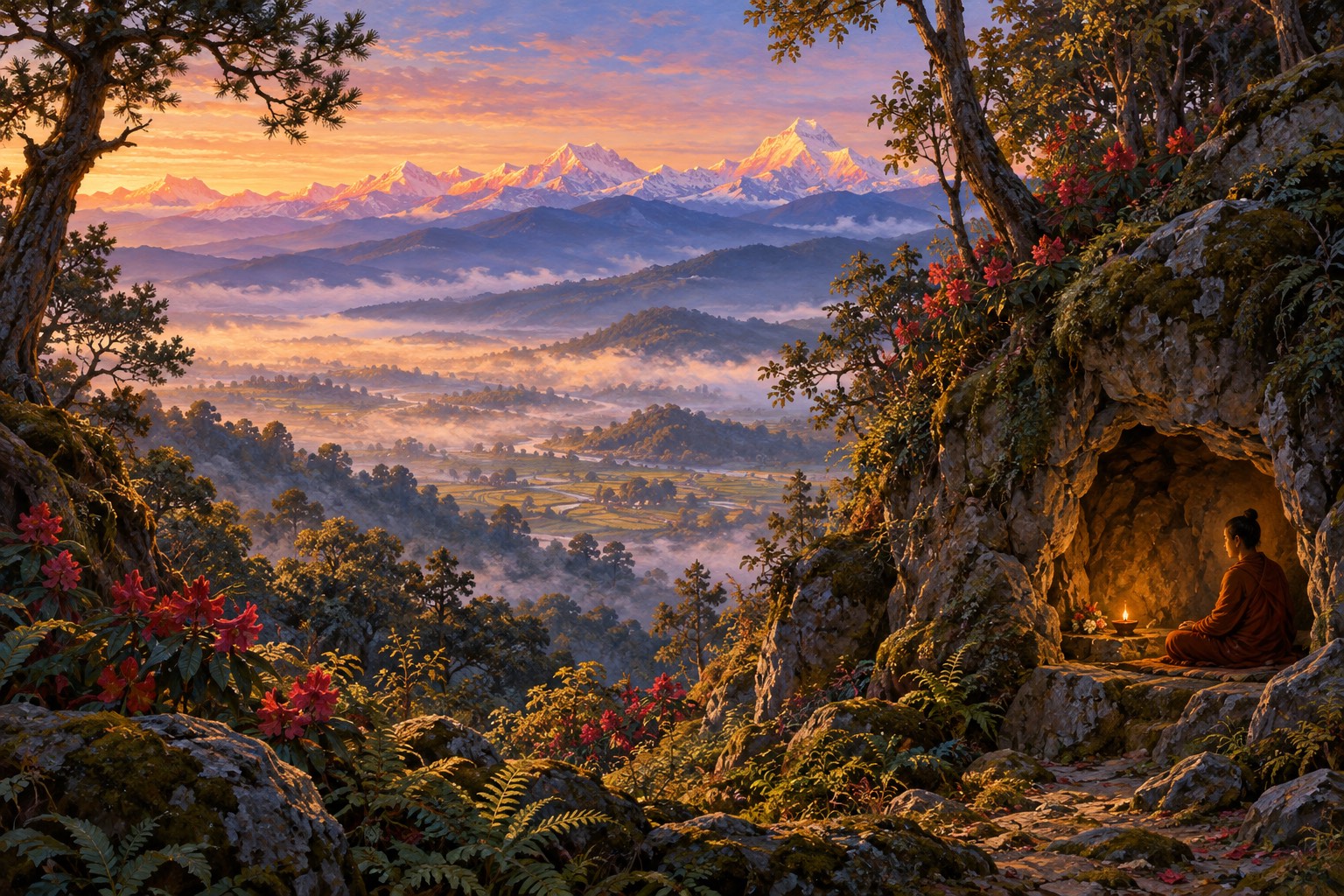
This is an original story, written for this site; it is fiction, not a teaching or a traditional account. Marisol, Nabin, the old woman at the cave, the host family and the walking route are invented, so the pictures show invented people, painted as gentle storybook figures and never as likenesses: small in the landscape, from behind, in three-quarter view, as a hand, and once in soft profile. Guru Rinpoche does not appear anywhere on the page, and nothing shown is a vision or a sign. No halo or rainbow light is used; the light on the snow peaks, the sunset over the valley and the glow at the cave mouth are ordinary daylight.
Yarinak is a real pilgrimage site in Kavre district, Nepal, and the pictures follow the description in the Nekhor pilgrim guide: a cave and a ledge on a steep pine-wooded hillside below a village, reached by steps with handrails along a cliff, with long views over deep valleys. Pilgrims see natural forms in the rock there, among them a leg and boot in the cliff and a tiger's head above the cave mouth; the pictures suggest these only as rock that might or might not be read that way. The small clay burner of smouldering juniper reflects the Himalayan custom of burning fragrant juniper as a smoke offering.
Following the site's rules, nothing on these pages carries writing. The guide also describes sacred syllables in the rock, and a statue of Guru Rinpoche at a small shrine on the ledge; neither is shown, so that no script appears and no sacred image is guessed at. Marisol's book is always closed, its cover blank. No prayer flags, prayer wheels, butter lamps, prayer beads or statues appear; the only fires are the juniper in the burner and the kitchen stove.
Why this matters for practice
The last line of the Seven-Line Prayer asks Guru Rinpoche to come and grant his blessing; Rigpa Wiki's commentary likens it to the way he once came to the palace of the king who invited him. This story is fiction, and nothing in it is a miracle or a cure: a woman who has been ill walks a long way to say the prayer badly in a quiet place, and finds she has nothing to add to that last line. You do not need perfect Tibetan, or a cave, or anything to ask for, to say the prayer once yourself.
If something in this story stayed with you, you might pause wherever you are and recite the prayer once, in whatever accent you have.
Sources and further reading
- Seven-Line Prayer (topic page), Lotsawa House
- Seven Line Prayer, Rigpa Wiki (via web.archive.org)
- Yarinak (Kavre District), Nekhor
- Wind Horse, Wikipedia
- Losar, Wikipedia
- Juniperus recurva, Wikipedia
- Juniperus indica, Wikipedia
- Namo Buddha, Wikipedia
- Kavrepalanchok District, Wikipedia
This retelling is waiting to be read by a knowledgeable practitioner. Where the traditional accounts differ, the story says so; if you notice a mistake, please tell us through Share Your Story.