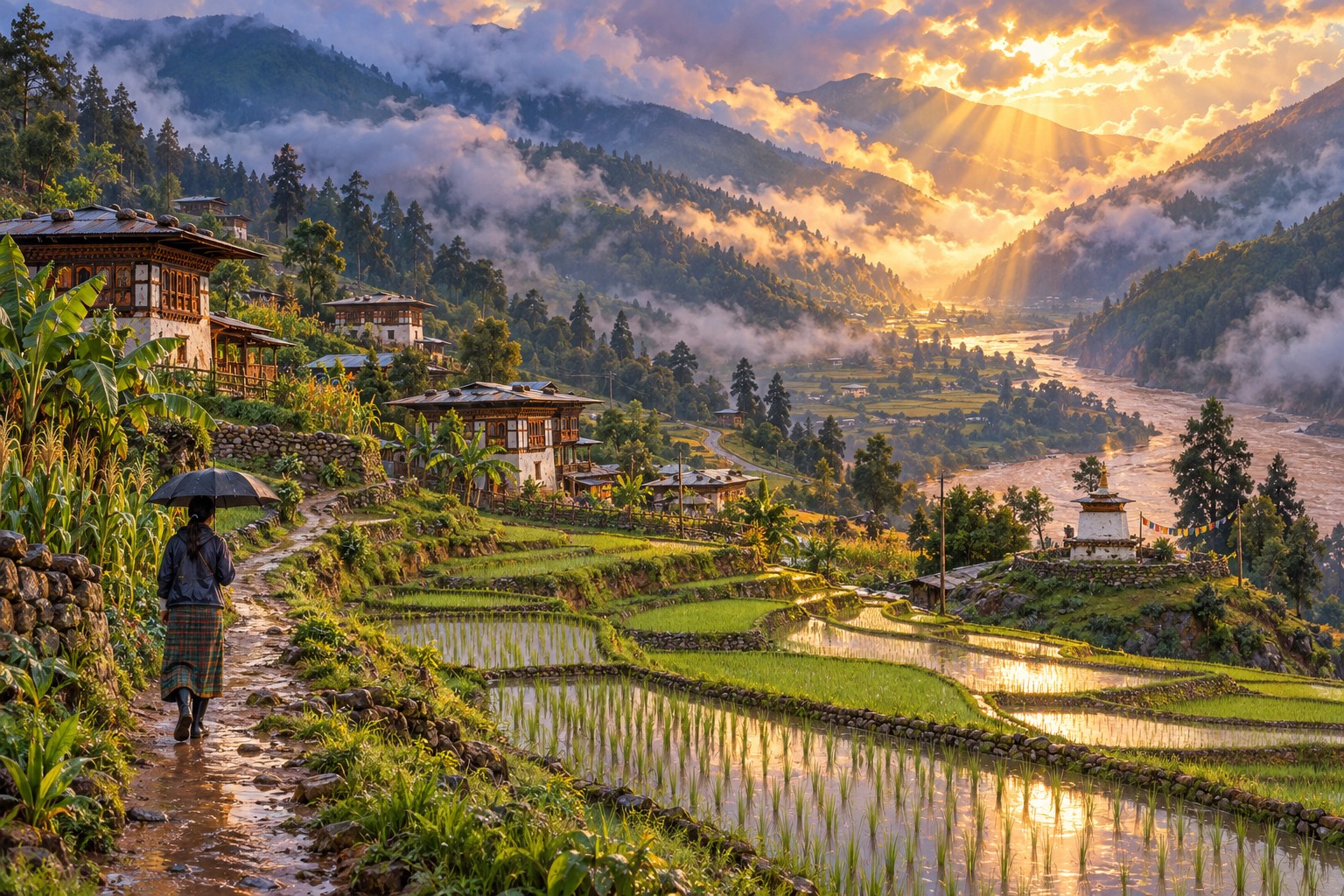
This is an original story, written for this site. It is fiction, not a teaching or a traditional account. Yangdol, Gen Tsetan, the other painters, their workshop and the painting are invented. Bir, its Tibetan Colony, the craft of thangka painting and the Seven-Line Prayer are real, and what is said about them comes from the sources listed below.
The workshop in the Colony
Bir is a farming village in the Kangra district of Himachal Pradesh, in the foothills of the Dhauladhar range in northern India. At its western end lies the Bir Tibetan Colony, founded in the early 1960s for refugees who had left Tibet after 1959. In 1966 a Nyingma lama, the third Neten Chokling, brought his family here and began building a monastery.
In the afternoons the sky over Bir fills with paragliders. In the mornings, in a room above a tailor's shop at the end of a lane in the Colony, four people sit on cushions on the floor and paint.
Their master is Gen Tsetan: sixty-three, thin, exact, with reading glasses on a cord. Gen is a respectful word for a teacher. He has painted thangkas, sacred paintings on cloth that can be rolled up and carried, for forty years, and he has a dry way of speaking that his apprentices take months to recognise as jokes.
Before the paint pots open
Every morning, before anyone touches a brush, the four of them stand facing the small shrine at the end of the room and say the Seven-Line Prayer together, once.
The prayer is addressed to Guru Rinpoche, the Lotus-Born, the teacher Tibetans remember for bringing the Buddha's teaching to Tibet in the eighth century. It was first revealed in the thirteenth century by a master called Guru Chökyi Wangchuk, and it has become the most widely chanted of all prayers to him.
Its seven short lines say where he came from and how he was born in a lotus. They speak of what he attained and give his name. They picture the dakinis, female figures of wisdom, gathered around him, wish to follow where he went, and ask him to come and bless.
 Illustration in preparation
Yangdol always finished first. She was twenty-four, had grown up in Delhi drawing on her phone, and had been in the workshop two years. In that time she had painted clouds, ground colours for everyone else, and painted the clouds again when Gen Tsetan said they looked worried. She wanted, very badly, to paint a face.
One year
In October he gave her a length of white cotton. A family in Kalimpong had asked for a painting of Guru Rinpoche and were in no hurry, which Gen Tsetan said was the rarest thing in the world.
“You will do all of it,” he said. “Cloth, ground, lines, colours. Eyes last. One year.”
“A good painter can do one this size in six weeks.”
“A good painter,” he agreed, “can.”
A field and a lake
Thangkas are painted on cotton, usually a loosely woven kind. She stitched hers to a light inner frame and laced that with cord inside a heavier one, so that it could be tightened when it slackened. Then came the ground: a paste of chalk and glue, worked into the cloth and rubbed down until the weave disappears.
She rubbed it for nine days with a smooth stone. “It's smooth,” she said.
Gen Tsetan drew his thumbnail across it and listened. “It's a field,” he said. “I asked for a lake.” She rubbed for another week.
Illustration in preparationLines
In December she drew the grid. Every figure in a thangka is laid out on measured lines and angles, in small units called sor, roughly a finger's width. The measures were set down over centuries; one great canon, compiled in the eighteenth century by the scholar Zhuchen Tsultrim Rinchen, rests on the work of the fifteenth-century painter Menla Döndrub.
She ruled long lines across the white and measured the diagonals for shoulders, knees and lotus seat. Only then did she draw him: lightly in pencil, then again in fine black ink.
She wanted to start with the face. “Everyone wants to start with the face,” said Gen Tsetan. “The face is the guest. First you build the house.”
Illustration in preparationStones
In January she made the colours. Many of them come from minerals: blue from azurite, green from malachite, red from cinnabar, yellow from orpiment, with indigo and other colours from plants. The stones are crushed and ground with water, then mixed with animal glue and used warm.
Azurite gives a whole range of blues, from deep to pale, depending on how finely it is ground. Yangdol, in a hurry, ground hers to powder in an afternoon, and it came out the colour of a washed shirt.
“Lovely,” said Gen Tsetan. “Now we have sky. I needed the deep blue for his gown.”
She ground the next batch slowly, and on cold mornings the glue set to jelly in its pot whenever she stopped too long.
Illustration in preparationColour by colour
Through the spring she laid the colours in: green hills, blue sky, the pink lotus he sits on, his robes of red-orange, dark blue and maroon, the tall red lotus hat. She learned to shade with a wet brush and with a nearly dry one. Some days she painted for six hours and could not see what had changed.
On those afternoons she took her tea up to the roof and watched the paragliders. They did not go straight up. They circled slowly in the warm rising air, a little higher each time round, until they were specks against the ridge.
Illustration in preparationHer mother rang from Delhi every Sunday to ask whether she had done the face yet. “Not yet,” Yangdol said, and was surprised to find that it did not make her cross.
Rain
The monsoon came to the Kangra valley in June and stayed until September, as it does, in one of the wettest corners of the state. The glue dried slowly. The cotton slackened in the damp, and every morning Gen Tsetan stood behind her while she tightened the cords one by one.
“The rain also has a year to finish,” he said. She decided that was a joke.
Illustration in preparationThe face
In August she painted the face. In this form his complexion is described as white with a reddish hue, so she mixed white with the least possible red, and shaded it, and added the thin moustache, the small beard, the gold earrings, a little each day. He arrived slowly, the way someone walks towards you from far down a long road.
One morning at the shrine she reached the fourth line, the one that simply gives his name, Padmasambhava, the Lotus-Born, and heard herself saying it slowly. For two years she had said that name like a word on a list. Now it belonged to a face she had spent weeks with. The others had finished; she was last.
Illustration in preparationEyes last
Then came the gold, twenty-four carat, for ornaments and highlights. And then, as tradition holds, the eyes. The eyes are the last thing painted in a thangka; this is called opening the eyes. After it the painting is regarded as sacred, though it becomes an object of practice only after a lama has consecrated it, a ceremony called rabné.
Gen Tsetan chose the morning. They said the prayer, the others went quietly to their frames, and Yangdol sat down with the smallest brush she owned. He sat beside her and said nothing at all, which for him was a kind of speech.
Illustration in preparationGuru Rinpoche's eyes are described as piercing and lotus-like, in a face both slightly fierce and joyful. She painted one, then the other, put the brush down, and looked up.
He was looking back. Nothing happened, in the way stories like to say something happens. There was no light. There was simply someone there who had not been there a year ago, whom she had been greeting every morning without quite looking.
She found she was crying a little, and laughing at herself for it.
Gen Tsetan put on his glasses and examined the eyes for a long time. “Good,” he said. “Now wash the brushes. They're older than you.”
Illustration in preparationUp the lane
That evening they wrapped the painting in clean cloth and carried it up the lane to a lama at one of the Colony's monasteries, who would consecrate it later that week. After that a tailor would sew it into its border of brocade, and it would go to Kalimpong, and she would very likely never see it again.
Illustration in preparationShe had thought that would be hard. Walking back down in the dusk, she found it was not, quite. She knew the face now. She did not need to keep the painting to keep that.
The next morning
Next morning there was new white cotton on her frame. She did not ask how long. They stood at the shrine and said the Seven-Line Prayer, and she was last again, and nobody minded. Then she sat down, picked up the stone, and began to make a lake.
Illustration in preparationShe does not know yet what kind of painter she will become. Gen Tsetan, when asked, says only, “Slower.” Nobody has promised her anything else.
About the art
This is an original story, written for this site; it is fiction, not a teaching or a traditional account. Yangdol, Gen Tsetan, Gelek and Kyipa are invented and modelled on no one, so the pictures show invented people, painted as gentle storybook figures and never as likenesses: at mid-distance in the workshop, small on a roof or in a lane, from behind, as a pair of hands, and once, Yangdol, in a soft three-quarter close portrait with her eyes lowered to her work.
The painting at the heart of the story is never shown. The site's pictures are not painted in thangka style, so Yangdol's thangka appears only from the back, as plain cotton laced into its wooden frame; edge-on, with a few ruled lines; as a blank white ground; covered with a cloth; wrapped for the walk up the lane; and, at the moment the eyes are painted, as a soft blur of colour hidden by her head and shoulder. Guru Rinpoche's face, eyes, hat and implements appear only in the words of the story, which follow the traditional description of his main form: white with a reddish hue, a thin moustache and small beard, gold earrings, the tall lotus hat, and eyes described as piercing and lotus-like. No figure has a halo or rainbow light, and no image of him appears on the shrine, whose images are always out of view.
The craft shown follows the sources: cotton stitched and laced into a frame; a ground of chalk and glue rubbed until the weave disappears; a grid of measured lines; mineral colours such as azurite and malachite ground by hand and bound in warm glue; shading; gold; and the eyes last. The smooth stone used for rubbing, the cord lacing and the low tilted stand are reasonable choices that the opened sources do not describe. Following the site's rule against writing in images, there is none anywhere: no labels on jars, no colour numbers or notes on the cloth, no calendars or books, no signs in the lane, nothing on the paragliders' wings, and the back of the canvas is always blank. Prayer flags, which carry printed prayers, are left out of the Colony's skyline for the same reason.
Why this matters for practice
The fourth line of the Seven-Line Prayer simply gives Guru Rinpoche's name, the Lotus-Born. In this story an apprentice who says that name every morning without thinking spends a year painting the face it belongs to, and by the end says it slowly. It is fiction, and it promises nothing: what changes is only how she says the name. A single unhurried recitation is a good place to begin.
If something in this story stayed with you, you might think of a face you have been greeting for years without quite looking, and recite the prayer once, slowly, as if you were saying someone's name.
Sources and further reading
- Seven-Line Prayer (topic page), Lotsawa House
- Seven Line Prayer, Rigpa Wiki (via web.archive.org)
- Thangka, Rigpa Wiki (via web.archive.org)
- Thangka, Wikipedia
- Thangka Painting, Norbulingka Institute
- Painting (Scroll Work), Himalayan Art Resources
- Padmasambhava: Iconography, Himalayan Art Resources
- Guru Rinpoche (artwork notes), Robert Beer, tibetanart.com
- The Thangka painter's palette, Colour chart by Atsuro Seto and Tsering Dhundup, after D. and J. Jackson (via web.archive.org)
- Azurite, Wikipedia
- Artistic canons of body proportions, Wikipedia
- Tibetan Buddhist wall paintings, Wikipedia
- Bir, Himachal Pradesh, Wikipedia
- Dharamshala, Wikipedia
- Paragliding, Wikipedia
This retelling is waiting to be read by a knowledgeable practitioner. Where the traditional accounts differ, the story says so; if you notice a mistake, please tell us through Share Your Story.