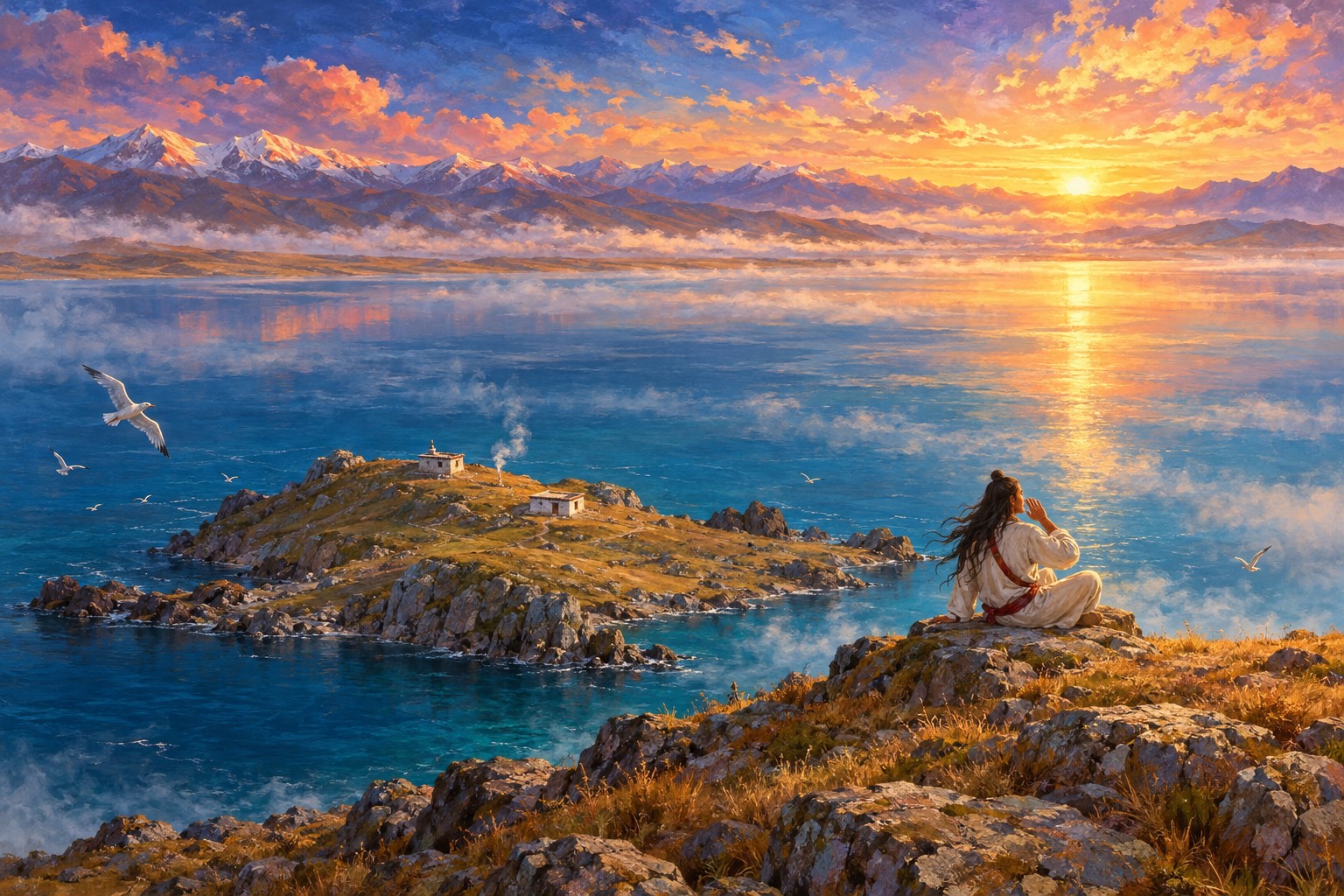
Far out in the west of Tibet, more than four and a half kilometres above the sea, lies a great round lake. To its north rises the snow dome of Mount Kailash. To its south stands the long white massif of Gurla Mandhata.
On a calm morning the water holds both mountains, and the snow seems to lie inside the lake itself.
Wikipedia gives its size plainly: about eighty-eight kilometres around and up to a hundred metres deep, one of the highest freshwater lakes in Asia. To the west, across a narrow neck of land, lies a second lake, salty and darker, called Rakshastal. A small channel carries water from one to the other.
In Sanskrit the lake is Manasarovar, the "lake of the mind." Tibetans call it Mapham Yumtso. The dictionary-maker Sarat Chandra Das, as Wikipedia reports, read Mapham as "unconquered"; the rest of the name is usually taken to mean "turquoise lake."
Each winter the lake freezes and lies white under ice and snow. This page calls it the white lake for that, and for the snows it mirrors. That is our own name, not one the tradition gives.
 Illustration in preparation
A lake held sacred by many
Few places on earth are loved by so many peoples at once. The lake is sacred in Hinduism, Buddhism, Jainism and Bön, the ancient religion of Tibet, and pilgrims come from India, Nepal, Tibet and far beyond.
For Hindus it is the lake that Brahma, the creator, first formed in his mind, as the Ramayana tells it, and Kailash is the abode of Shiva. Jains remember their first great teacher, Rishabhanatha, who they say reached liberation on a mountain nearby. Followers of Bön recall that their founder, Tonpa Shenrab, bathed in the lake when he first came to Tibet.
Each of these is a whole world of meaning, best told by those who keep it. Here it is enough to notice them, and to walk gently on ground that so many hold dear.
Illustration in preparationBuddhists have long linked the lake with Anavatapta, the "lake without heat" of the old Indian texts. John Snelling, in his history of the region, retells a legend that Queen Maya, the Buddha's mother, dreamed that the gods carried her there to bathe before his birth.
Wikipedia sums up one Tibetan way of seeing the pair: the mountain as the father of the world, and the lake as its mother.
Illustration in preparationThe lake's own stories
In 1907 the Swedish explorer Sven Hedin spent a month on the lake. At Tugu monastery on the southern shore, a companion translated for him an inscription written for pilgrims. Hedin gives it only "freely rendered," and it reads like a dream.
In the middle of the lake, it says, grows a tree of a thousand branches that shades the snow mountain and the whole world. Once, golden water was drawn from the lake, and with it the face of Hlobun Rinpoche at Chiu monastery was gilded.
Hlobun is Hedin's spelling of Lopön, "master," one of the names by which Tibetans call Guru Rinpoche. So the oldest story on this page about Chiu is already a story about him.
Illustration in preparationThe hill like a bird
Chiu stands at the north-western corner of the lake, close to where the channel runs out toward Rakshastal. Swami Pranavananda, an Indian monk who spent long seasons by the lake and walked around it nine times, wrote in 1949 that the monastery sits on its steep pyramid of a hill "like a bird." Chiu, he explains, means a bird; hence the name.
At the foot of the hill, hot springs rise in the bed of the channel. From the top, Pranavananda wrote, you can see both lakes and both great mountains at once.
Illustration in preparationGuru Rinpoche's cave
Guru Rinpoche, Padmasambhava, the Lotus-Born, is the eighth-century master to whom the Seven-Line Prayer is addressed. Wikipedia notes that many places around Kailash and the lake are linked with him. Chiu is the one most often named.
The older records agree on the heart of it. Pranavananda wrote that the chief image in one of Chiu's chapels was of Padmasambhava, set in a cave. The Italian scholar Giuseppe Tucci, who came in 1935, found the monastery, as Snelling puts it, built over a cave associated with the great guru.
Many recent descriptions add something more: that Guru Rinpoche stayed in this cave for seven days, near the end of his years in Tibet. The older travellers did not record that detail, and no account says what he did there. They leave us a cave on a hill, a great lake below, and a week of quiet.
Illustration in preparationThe life stories tell the end of those years in their own way. After long work in Tibet, they say, Guru Rinpoche gave his last advice to his disciples and left from the Gungthang pass on the border with Nepal, many days' journey to the south-east, riding south-west toward the land of the rakshasas, fierce beings of old tales. That farewell is told in another story on this site.
So the tellings do not join neatly. One modern travel guide even says he passed away at Chiu, which is not what the life stories tell: in them he does not die but departs. It seems kinder to hold these accounts side by side than to force them into one.
Illustration in preparationPranavananda heard yet another story. Below the monastery, he wrote, right on the shore, is a big cave where Atisha stayed for a week. Atisha Dipamkara Shrijnana was the great Bengali teacher who came to western Tibet in the eleventh century, some three hundred years after Guru Rinpoche.
So in one telling the week by the lake belongs to Guru Rinpoche, and in another to Atisha. Perhaps the hill has kept both. Places like this gather the memories of those who prayed there.
Illustration in preparationThe monastery on its rock
Chiu was one of eight monasteries around the shore. Snelling writes that they were seen as the points where the eight spokes of the Wheel of Life meet its rim, so that walking around the lake past all eight was to turn the wheel once. Tucci, Snelling adds, found them younger than he expected, none more than two or three hundred years old.
When Hedin camped below Chiu in August 1907, it was a small house of fifteen monks. They kept yaks, goats and sheep, and the flocks carried salt to Purang, a market town to the south, to trade for barley. From the water, Hedin noticed, the monastery on its rock could be seen from almost every part of the shore.
Illustration in preparationHe remembered one young monk with special warmth. The young man's mother lived there too and penned the sheep and goats each evening, and from his small bare cell he could look east over the holy lake. Yet he told Hedin the life was hard, every day like the last. Holy places are kept by ordinary people with ordinary tiredness, and they keep them anyway.
Illustration in preparationForty years later Pranavananda found five monks. Chiu then belonged to Drirapuk, a monastery on the path around Kailash. He also noted a loss: the 108 volumes of the Kangyur, the collected words of the Buddha, had been taken away to another monastery in 1946.
Much worse came in the 1960s and 1970s, when many buildings around the lake were destroyed. Some of the lake's monasteries have been rebuilt since, and Chiu stands again on its hill.
Small figures on the shore
People still climb its winding stone steps to the cave. Down on the shore, small figures still walk the long way round the hill and the water, some murmuring prayers, some silent, each carrying a reason of their own.
Illustration in preparationFrom one lake to another
The second line of the Seven-Line Prayer remembers that Guru Rinpoche was born on the heart of a lotus. The traditional accounts place that birth on Lake Dhanakosha in Oddiyana, and one of his names, Tsokye Dorje, means "Lake-born Vajra."
So the tradition sets a lake at the beginning of his story. Chiu, beside the lake of the mind, keeps the memory of a stay near the end of his years in Tibet. Between the two lakes lies everything the tradition remembers him doing for the Land of Snows.
Pranavananda spent years trying to grow lotuses in Manasarovar, without success. The lotus of the prayer belongs to that other lake, far away. Yet the people who walk around this one carry it with them, in the words they say as they go.
Illustration in preparationAbout the art
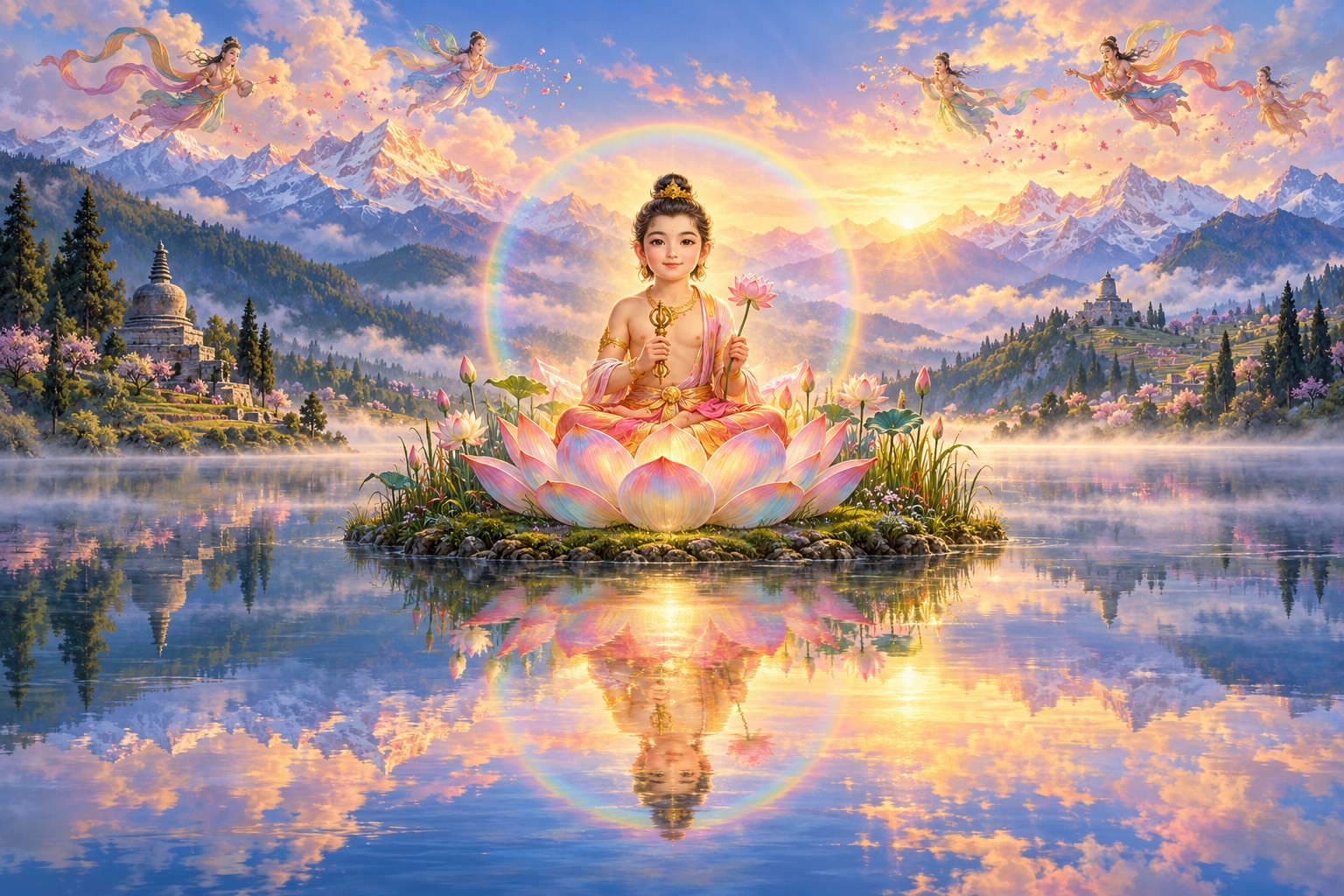
Guru Rinpoche appears in his main, peaceful form: the lotus hat with a half-vajra and one vulture feather, layered robes in white, blue, red-orange and maroon, a golden five-pronged vajra at his heart, a skull cup holding a small long-life vase, and the khatvanga, a slender staff crowned with a trident, resting against his left shoulder. The vajra stands for what cannot be broken, the vase for long life. A soft rainbow glow marks him as an awakened being, and only him. In the final image he sits on a lotus with a sun and a moon disc, the traditional seat of awakened beings.
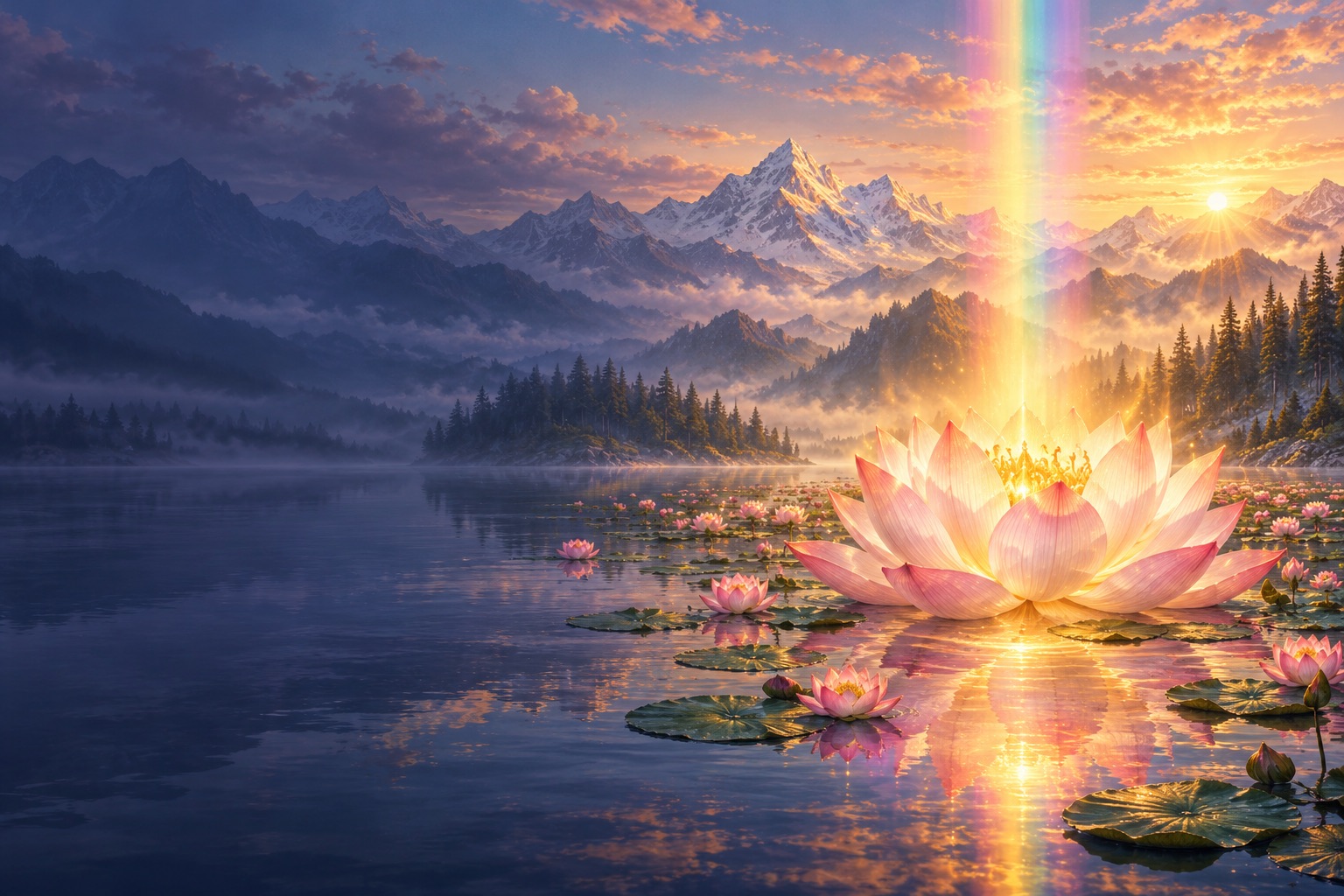
No lotuses grow wild in Manasarovar, as Swami Pranavananda noted, so the lotus in the last image is shown floating just above the water as a visionary seat, not a plant. The gilded statue in the cave chapel follows the same iconography; the gold on its face recalls the old inscription that Sven Hedin was shown, which says the face of the Guru at Chiu was gilded with golden water from the lake.
Atisha wears the tall pointed red hat of an Indian scholar, called a pandita hat, with saffron and red monastic robes, as in his traditional portraits; his raised hand is a teaching gesture. The monastery at Chiu is painted as a small cluster of whitewashed, flat-roofed buildings on its rock, as early photographs and travellers describe it; exact details are the artist's choice. Present-day pilgrims are shown only as small, faceless figures, out of respect for the living, and the prayer flags in the present-day scene carry no writing, since the site never places script in its pictures.
Why this matters for practice
The second line of the Seven-Line Prayer remembers Guru Rinpoche's birth on a lotus in a lake; Chiu keeps the memory of a lake near the end of his years in Tibet. Pilgrims have walked around this water for centuries, holding him in mind as they go. Reciting the prayer is a way to walk that circle from wherever we are, without needing to travel at all.
If something in this story stayed with you, the cave on the bird-shaped hill, the week of quiet, or the small figures walking round the white water, you might pause and recite the prayer once.
Sources and further reading
- Lake Manasarovar, Wikipedia
- Lake Manasarovar, Rigpa Wiki (Internet Archive snapshot, July 2024)
- Mount Kailash, Rigpa Wiki (Internet Archive snapshot, December 2024)
- Trans-Himalaya: Discoveries and Adventures in Tibet, vol. 2 (1909), by Sven Hedin, Internet Archive
- Kailas-Manasarovar (1949), by Swami Pranavananda, Internet Archive (Digital Library of India copy)
- The Sacred Mountain (1983), by John Snelling, Internet Archive
- Gungthang Pass, Nekhor
- Manasarovar, Wikipedia (German)
- Lac Manasarovar, Wikipedia (French)
- Chiu Monastery, Great Tibet Tour (travel guide)
This retelling is waiting to be read by a knowledgeable practitioner. Where the traditional accounts differ, the story says so; if you notice a mistake, please tell us through Share Your Story.