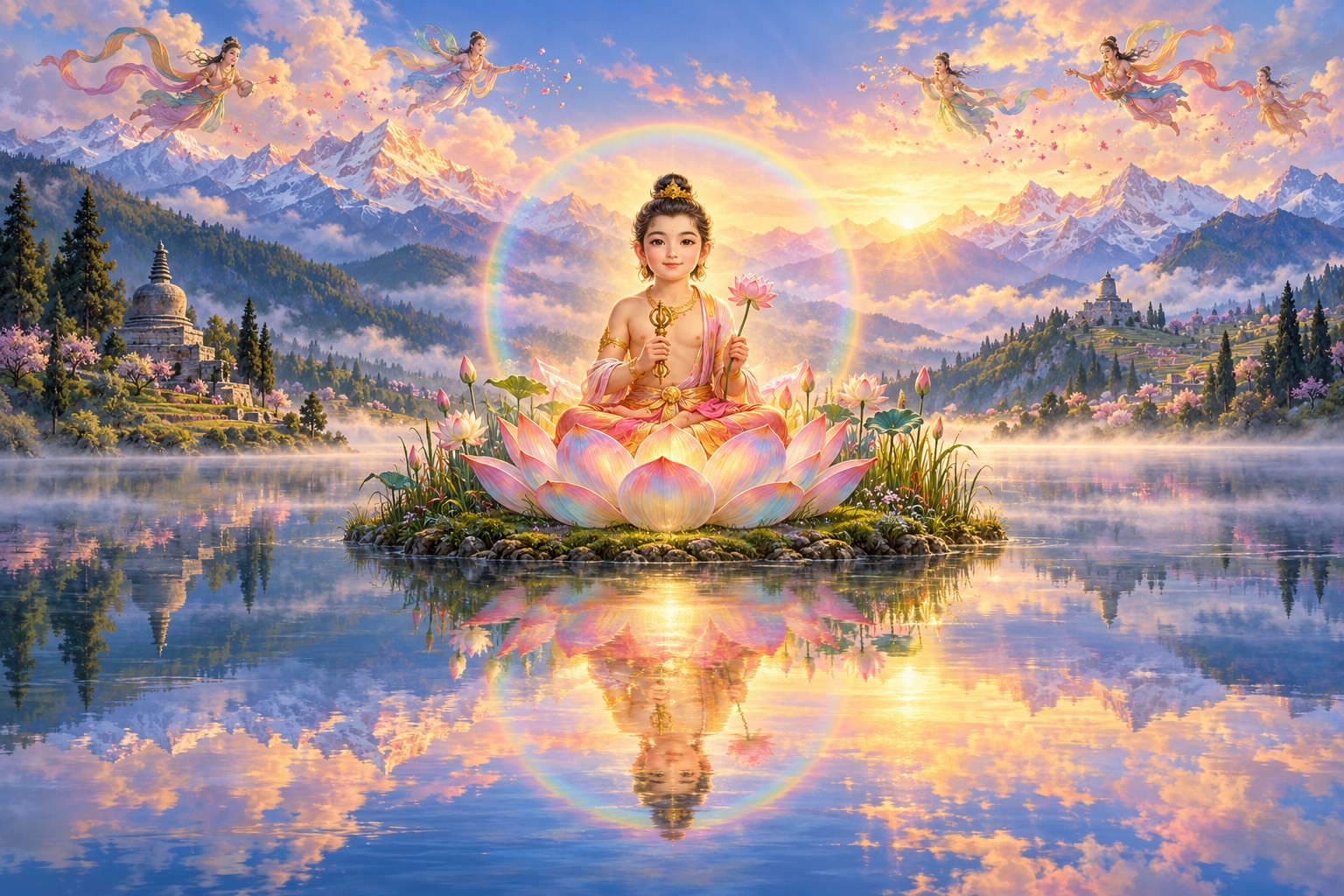
Close your eyes and picture Guru Rinpoche's life: a child on a lotus in a lake, a prince who leaves his palace, a yogi among the charnel grounds, a master taming the spirits of Tibet's mountains. Much of that picture, for Tibetans and for many readers far from Tibet, was painted by one book.
It is called the Pema Kathang, the Chronicle of Padma. The tradition says it lay hidden for six centuries in a small cave above the Yarlung valley, until a young man named Orgyen Lingpa brought it out. This is his story, told as simply as I can.
A treasure and its finder
First, two words. A terma is a treasure: a teaching that, the tradition says, Guru Rinpoche and his disciple Yeshe Tsogyal hid in rocks, lakes and the minds of disciples, for a later time. A tertön is a treasure revealer, the destined person who finds it. The story "The Hiding of the Treasures" on this site tells that part more fully.
The Pema Kathang is counted among these treasures. Its English translation names Yeshe Tsogyal as its author, following the tradition that she wrote down her teacher's life while he was still among the Tibetans.
 Illustration in preparation
A boy from Yarje
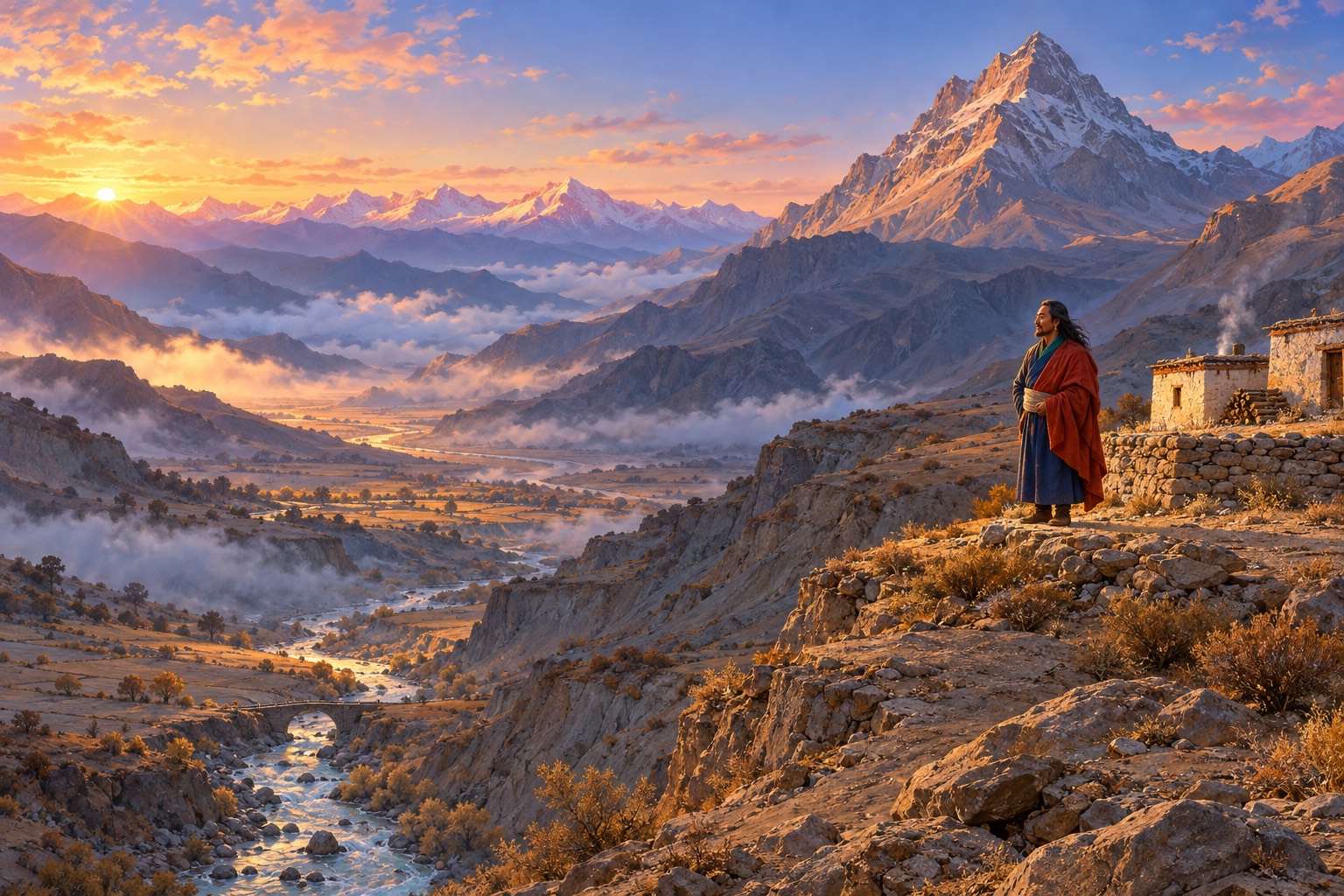
Jamgön Kongtrul, the nineteenth-century master who gathered the lives of the treasure revealers into one great collection, says Orgyen Lingpa was born in the Water Pig year, 1323, at Yarje in Dranang, on the south bank of the Tsangpo river in central Tibet. The Treasury of Lives, a scholarly online encyclopedia, records a second tradition that places his birth farther south, in Lhodrak.
His family were mantra holders, practitioners of the tantras, and his father is remembered as a tantric yogi. Kongtrul adds that the boy trained in powerful rites, in medicine and in astrology.
Illustration in preparationHe is remembered as the seventh rebirth of a son of King Trisong Detsen, the king who invited Guru Rinpoche to Tibet. The sources name the prince differently: Kongtrul calls him Lhase Chokdrup Gyalpo, the Treasury of Lives Murub Tsenpo.
Though he practised the tantras, he lived like a monk. Kongtrul speaks of his pure conduct, and later writers add that he never married and drank no alcohol.
The list in the Red Stupa
When he was twenty-three, Kongtrul and the Treasury of Lives both say, he found a treasure inventory inside the Red Stupa at Samye, Tibet's first monastery. An inventory, kha jang, is a kind of guide: it tells a revealer where treasures lie.
Illustration in preparationIt pointed him toward Yarlung, the valley where the first Tibetan kings had ruled.
The Crystal Cave
At the mouth of the Yarlung valley rises a range of crags called Pema Tsekpa, "Heaped Lotuses." High in it are the caves of Sheldrak, the Crystal Rock. Pilgrim guides say Guru Rinpoche's own meditation cave faces east, Yeshe Tsogyal's faces north-east, and a third, Pema Shelpuk, the Lotus Crystal Cave, faces west.
Illustration in preparationKongtrul calls it a wondrous crystal cave, where Guru Rinpoche is said to have prepared medicinal nectar. There, the accounts say, Orgyen Lingpa brought out a great store of treasure: practices of Guru Rinpoche, of Avalokiteshvara, the bodhisattva of compassion, and of Dzogchen, the Great Perfection, together with a vast cycle called the Kadü Chökyi Gyatso, the Ocean of Dharma that Gathers the Teachings.
Kongtrul even names the spot. In the cave, he says, was a figure of a great guardian that had formed by itself, and each teaching came out from a different part of it. From its heart came the great chronicle of Guru Rinpoche's life.
Illustration in preparationThat chronicle is the Pema Kathang. Because of where it was found it is also called the Sheldrakma, "the one from the Crystal Rock." Rigpa Wiki, a Buddhist reference site, counts 108 chapters.
The sources do not agree on the year. Kongtrul's account moves straight from the inventory at twenty-three to the cave, which would place it in the late 1340s; Wikipedia gives 1352.
Illustration in preparationThere was more than one man could write down. Kongtrul speaks of twenty-eight great treasures and more than a hundred volumes. Much of the Ocean of Dharma, he says, could not be copied out from its yellow scrolls and was hidden again; five centuries later, Jamyang Khyentse Wangpo is said to have rediscovered its heart.
Five chronicles
From hiding places at Samye, the accounts say, came a companion work, the Kathang Denga, the Five Chronicles. Its five books tell of the kings, the queens, the translators and scholars, the ministers, and the gods and spirits of old Tibet. Together they keep alive a picture of the age of the great Buddhist kings.
Smaller treasures came too. One, a short verse history of Guru Rinpoche found at Samye Chimphu, can be read in English on Lotsawa House.
Illustration in preparationA painting reproduced on Lotsawa House shows how artists later pictured him: a white-bearded man in a pointed red hat and gold-dotted robes, a wrapped book held at his chest and a small golden casket in his lap.
A ruler at Neudong
Orgyen Lingpa's Tibet was changing fast. In those same years Tai Situ Changchub Gyaltsen, lord of the Phagmodru family, was rising from his palace at Neudong, near the mouth of the Yarlung valley, to take central Tibet from the Sakya rulers. Tibetan histories date his rule from 1354.
Kongtrul tells what followed. Orgyen Lingpa first opened his teachings to the public at Tradruk, the ancient temple of the Yarlung valley, holding a great empowerment of the Ocean of Dharma, guided, Kongtrul says, by a phrase in a prophecy. The Tai Situ strongly opposed him, and the auspicious circumstances fell apart.
Illustration in preparationWhy, no one quite knows. The Treasury of Lives says only that there is evidence he "fell afoul" of the ruler. Wikipedia, following travel guides, says he was suspected of loyalty to Drigung, the ruler's rivals. Longchenpa, the great Dzogchen master of the same years, whose story is told on this site, was also sent away by the same ruler during a Drigung revolt.
Into hiding
Orgyen Lingpa fled east, Kongtrul says, toward E and Dakpo, districts farther down the Tsangpo. Not long afterwards he died at a place called Lochung, on the edge of E. Wikipedia gives the year as about 1360. If so, he was still in his late thirties.
Illustration in preparationHis body was carried to Dakpo and kept at the monastery of Zhabje. Five centuries later, Kongtrul says, it rested almost intact in an old reliquary in Yarlung, and his family line still continued.
History has a gentle irony here. Wikipedia's article on the Tai Situ notes that he worked to revive the glories of the old Tibetan empire, and that the Five Chronicles, which praise those ancient kings, came to light in his time. The ruler who drove the revealer away governed the very age that treasured his books.
How a book becomes a picture
The teachings did not die with him. Kongtrul says he himself received the reading transmission of the Sheldrakma and the Five Chronicles, an unbroken line of readers passing the text from voice to voice.
His friend Jamyang Khyentse Wangpo wrote a prayer, translated on Lotsawa House as A Beautiful and Wondrous Udumbara Garland, that sums up every chapter of the Pema Kathang in verse, and Kongtrul added its opening and closing verses. Its closing note says that reciting it with faith carries the blessing of reading the whole chronicle.
The book travelled west, too. In 1935 Gustave-Charles Toussaint published a French translation, and in 1978 Kenneth Douglas and Gwendolyn Bays turned his French into English as The Life and Liberation of Padmasambhava. For many English readers it was the first full life of Guru Rinpoche they could hold.
Illustration in preparationScholars read it with care. It grew from older tellings, above all the Zanglingma, the first full life, revealed two centuries earlier by Nyangral Nyima Özer. Wikipedia, summarizing the scholarship, says Guru Rinpoche's "eleven deeds" first appear in full in Orgyen Lingpa's works.
Lewis Doney has studied its kinship with another great life of that century, Sangye Lingpa's Golden Garland. Lotsawa House calls it one of the most important and widely studied sources on Guru Rinpoche.
And it is close to home. On this site, the story of the lotus birth follows its tale of a blind, generous king who sails in search of a wish-fulfilling jewel. From Prince to Yogi, The Eight Manifestations and Vairotsana's story draw on it too. When you picture Guru Rinpoche's life here, part of what you see came out of that small west-facing cave.
Back to the prayer
The fourth line of the Seven-Line Prayer says he is renowned as the Lotus-Born. Renown has to travel somehow: in songs, paintings, festival dances and books. The Pema Kathang is one of the great roads it took, from a cave above Yarlung to villages across the Himalayas, and now to the screen in your hand.
Illustration in preparationAbout the art
Orgyen Lingpa is drawn from a traditional painting reproduced on Lotsawa House, credited to the Tertön Sogyal Trust. It shows a man in a tall pointed red hat dotted with gold, with turned-up orange and gold flaps, a dark green gown, and red-orange robes patterned with small gold dots. He holds a long book wrapped in white cloth and tied with a blue ribbon, with a small golden casket below it in his lap. The book is a Tibetan pecha, loose pages kept between boards; the casket is the sign of a treasure revealer. His robes look monastic because the sources say he kept a monk's conduct. The painting gives him a white beard, but the dates suggest he died before forty, so here he is shown greying, not old.
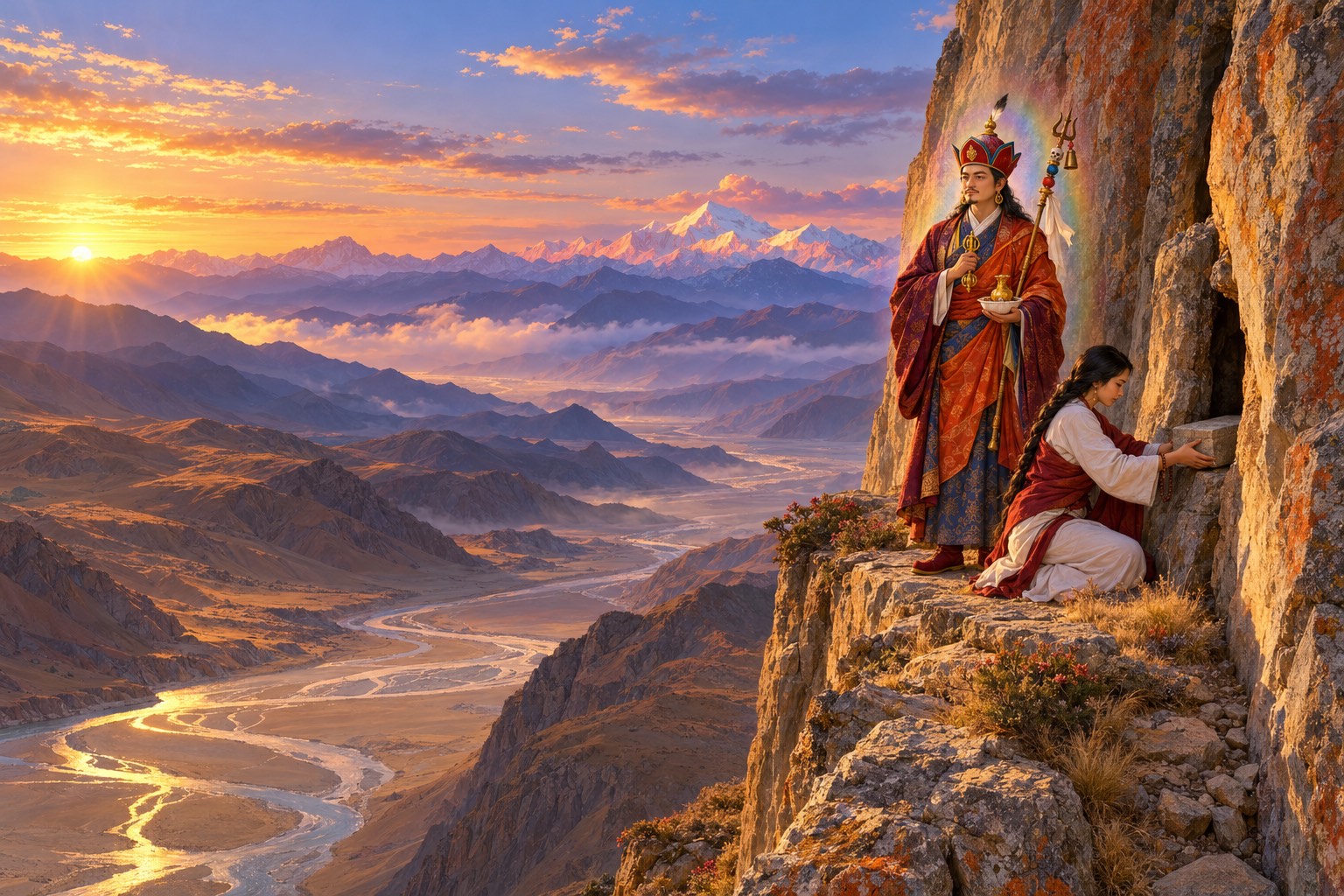
Sheldrak is shown as a range of stacked grey and rust-coloured crags, after its name Pema Tsekpa, "Heaped Lotuses," with a small cave facing west, as the pilgrim guides describe Pema Shelpuk. A few glints of quartz nod to the name "Crystal Rock" without turning it into a fantasy. The temple buildings, railings and prayer flags of today are left out, because the scenes take place in the fourteenth century. The guardian figure that Kongtrul says stood in the cave is shown only as a rounded mass of rock, since no description of it was found.
The treasure appears as tiny rolled scrolls of yellow paper in a plain stone casket, the form the tradition describes, and no writing appears on them, because this site never places script in its pictures. Yeshe Tsogyal wears the simple white robes and red shawl of a yogini. Guru Rinpoche appears once, in his main form, seated on a lotus in a lake inside a rainbow sphere, holding the five-pronged vajra at his heart and the skull cup with a long-life vase, the khatvanga in the crook of his arm: the picture of him that the old chronicles helped make familiar.
Why this matters for practice
The fourth line of the Seven-Line Prayer calls him renowned as the Lotus-Born, and the Pema Kathang is one of the main ways that renown reached ordinary people, in villages, in paintings and now on pages like this one. Knowing where our picture of Guru Rinpoche comes from can make the prayer feel less like words from nowhere and more like a voice passed carefully from hand to hand. You do not need to read the whole chronicle to begin: reciting the prayer once is already a way of joining that long line of readers.
If something in this story stayed with you, you might picture him as the old chronicle does, born on a lotus in a lake in the northwest of Oddiyana, and recite the prayer once. Anything beyond recitation is best explored with a teacher.
Sources and further reading
- Orgyen Lingpa (o rgyan gling pa), from Jamgön Kongtrul's Lives of the Hundred Tertöns (Rinchen Terdzö vol. 1, folios 60b–62a), Tibetan text and English summary, Khyentse Lineage, Tsadra Foundation (archived snapshot)
- Orgyan Lingpa (Jakob Leschly, 2007), The Treasury of Lives (archived snapshot, 2010)
- Orgyen Lingpa, Rigpa Wiki (archived snapshot)
- Pema Kathang, Rigpa Wiki (archived snapshot)
- Orgyen Lingpa Series (with portrait, courtesy of Tertön Sogyal Trust), Lotsawa House
- A Concise History of Orgyen Padma's Enlightened Deeds, by Orgyen Lingpa (Samye Translations, trans. Kaleb Yaniger and Stefan Mang, 2016), Lotsawa House
- A Beautiful and Wondrous Udumbara Garland, by Jamyang Khyentse Wangpo, with verses by Jamgön Kongtrul (Samye Translations, trans. Kaleb Yaniger and Stefan Mang, 2016), Lotsawa House
- Guru Padmasambhava: an introduction (Stefan Mang), Lotsawa House
- Orgyen Lingpa, Wikipedia
- Yarlung Valley, Wikipedia
- Yarlung Sheldrak, Nekhor
- Tai Situ Changchub Gyaltsen, Wikipedia
- Padmasambhava, Wikipedia
- The Life and Liberation of Padmasambhava (Padma bKa'i Thang), credited to Yeshe Tsogyal, trans. into French by Gustave-Charles Toussaint (1935) and into English by Kenneth Douglas and Gwendolyn Bays (Dharma Publishing, 1978), Book
- A Richness of Detail: Sangs rgyas gling pa and the Padma bka' thang (Lewis Doney, Revue d'Etudes Tibétaines), Journal article
This retelling is waiting to be read by a knowledgeable practitioner. Where the traditional accounts differ, the story says so; if you notice a mistake, please tell us through Share Your Story.