
In the dry valleys of Tsang, west of Lhasa, barley grows on narrow river flats between bare brown hills. In the eleventh century a married man with a family lived there, in a district his biographers call Narlungrong. He was not a monk and never wore a monk's robes. Yet later generations would place him among the greatest minds Tibet ever produced.
His name was Rongzom Chökyi Zangpo. Scholars often call him Rongzom Mahapandita, "the great scholar," or by the Sanskrit form of his name, Dharmabhadra. This is the story of how a lay teacher from a farming valley came to defend the old teachings of Guru Rinpoche at the very moment many people doubted them.
A boy who learned while he played
Rongzom was born into a family of religious teachers. His father, Rongben Rinchen Tsultrim, and his grandfather before him held teachings that, as Treasury of Lives puts it, stemmed from Guru Rinpoche. His father gave him his first lessons.
No one is sure exactly when he was born. Rigpa Wiki and several Tibetan teachers give 1012, with his death in 1088. The edition of his writings gathered by Mipham Rinpoche names 1040, and the Buddhist Digital Resource Center gives 1042 to 1136. Treasury of Lives says simply that he flourished in the late eleventh century, perhaps into the twelfth.
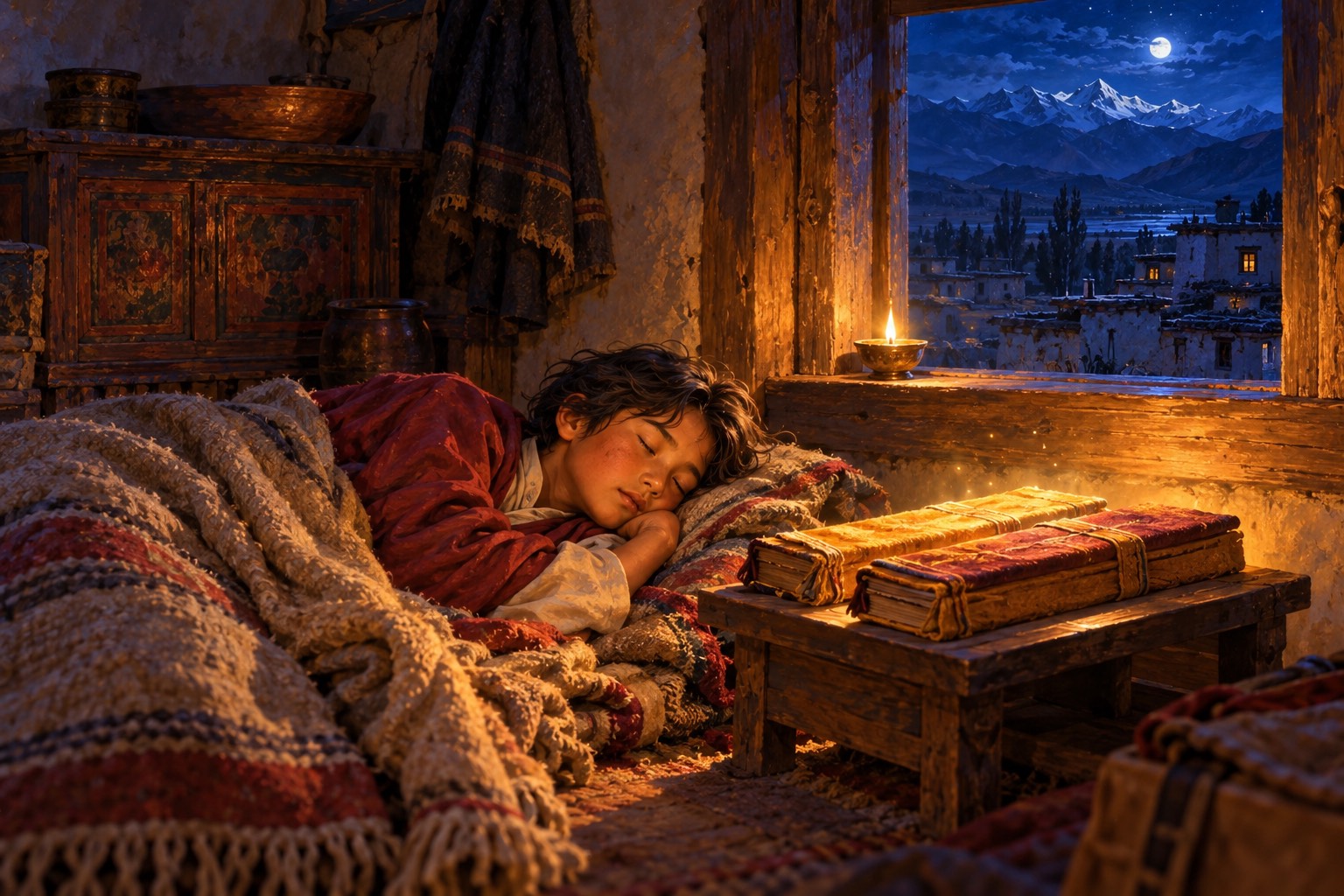
As a boy he studied with a teacher named Garton Tsultrim Zangpo. The Blue Annals, a fifteenth-century history, remembers that he seemed to soak up each lesson at once. After class he would run off to play and recite the whole day's lesson from memory as he went.

He also had a name as a rowdy boy. The story goes that his father, embarrassed, asked the teacher whether he should take his son out of school. The teacher would not hear of it. A mind like that, he said in effect, was not to be sent away.
Tradition says he mastered grammar, medicine, logic and Buddhist philosophy by about thirteen, and that people saw in him an emanation of Manjushri, the bodhisattva of wisdom. Some accounts even add that he could understand even the languages of animals.
One teacher, Doton Sengge Gyeltsen, heard about a dream the boy had. In it, the accounts say, Rongzom ate two great tantras, among them the Guhyagarbha, the "Secret Essence," as if they were food. Tantras are the scriptures of Vajrayana Buddhism. The teacher took the dream as a sign and urged him to write commentaries on them, and in time he did.
The meeting with Atisha
In those years the great Indian master Atisha came to Tibet. He was a monk from Bengal, invited because Tibetan rulers worried that true Buddhism had become muddled in their land. His followers became the Kadam school.
Rongzom's earliest biography, written by one of his own students, tells that Atisha was asked to discuss the teachings with the young Rongzom. Instead, the story goes, Atisha marvelled at the boy's learning and wondered aloud what advice he could possibly give him. He declared that Rongzom was the rebirth of Krishnapada, one of the great Indian adepts known as the eighty-four mahasiddhas.

The dates make this meeting a small puzzle. Atisha lived in Tibet from the early 1040s until his death. If Rongzom was born in 1012, he was a grown man by then; if he was born in 1040 or 1042, he was a small child. Treasury of Lives tells it as a meeting with a child, and Rigpa Wiki says only that it happened in his youth. The tradition treasures it either way, as one great scholar's praise for another.
Learning from India
As a young man Rongzom loved the company of the Indian panditas, learned teachers who travelled into Tibet from Kashmir and Nepal. From them he learned Sanskrit. Treasury of Lives notes that he never left Tibet; the Himalayan Art Resources entry on his portrait says he studied in India.
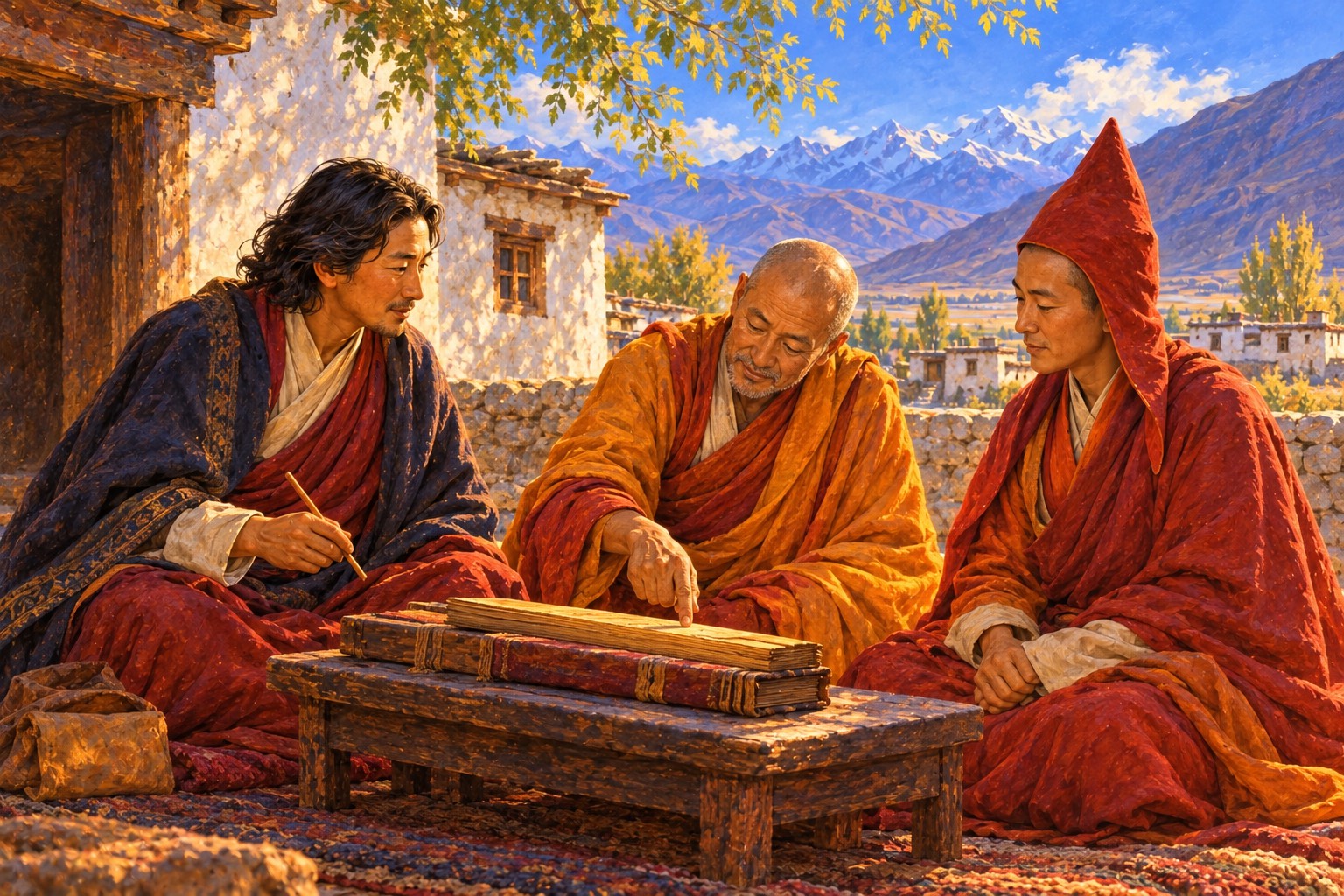
With teachers such as Upayashrimitra, Manjushrijnana and Parameshvara he translated tantric texts from Sanskrit into Tibetan. Some of his translations were kept in the Tengyur, the Tibetan canon of commentaries. His Sanskrit was so fine that he was said to be the rebirth of the first Indian panditas invited to western Tibet.
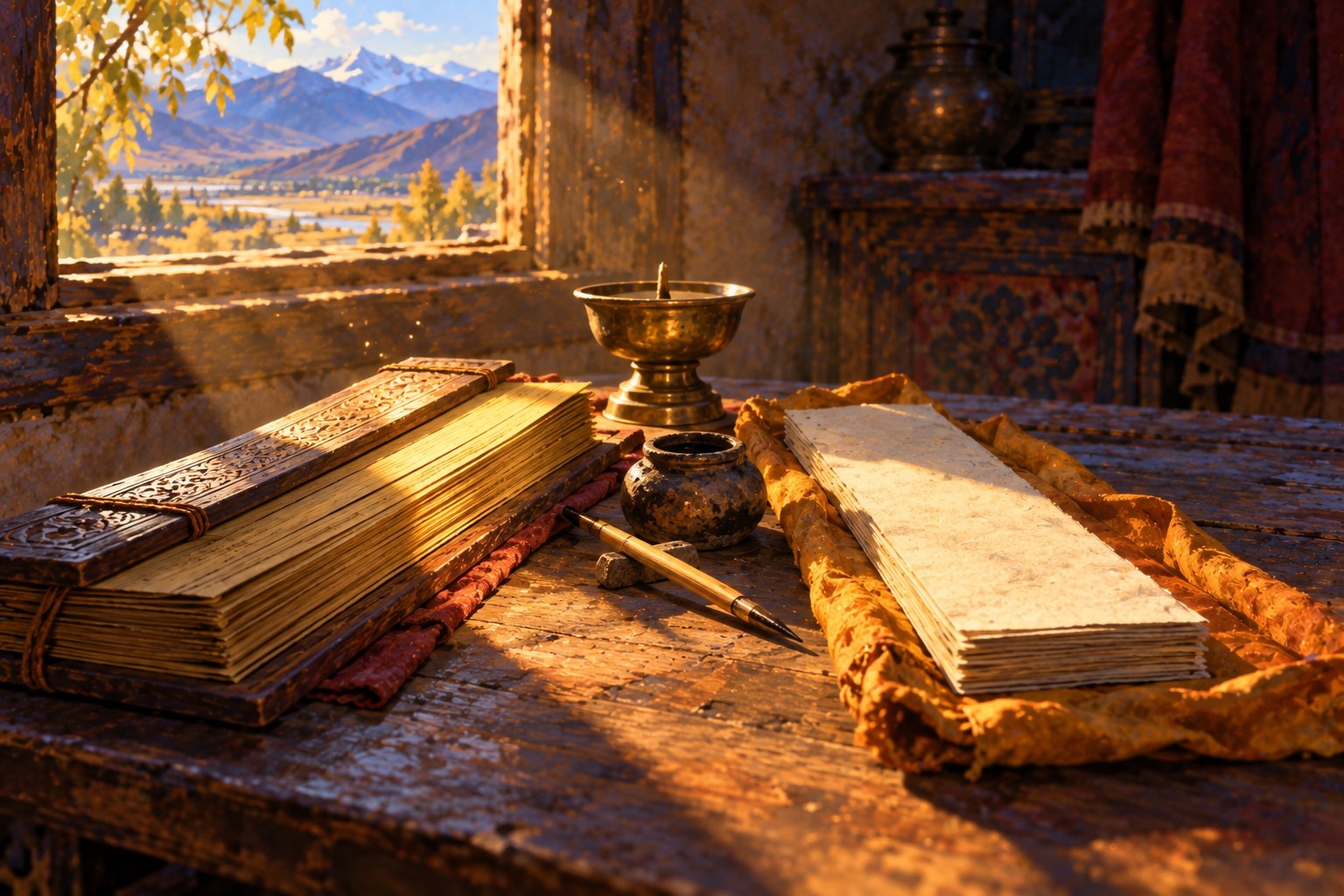
He also received the older lineages of his own land: the teachings of the eighth-century translator Vairotsana, of the Indian master Vimalamitra, and of the Great Perfection, or Dzogchen, the heart of the Nyingma path. The Nyingma, the "Ancient" school, is the tradition that traces itself to Guru Rinpoche.
When the old teachings were doubted
Rongzom lived at the start of what Tibetans call the later spread of the teachings. New translations were arriving from India, and with them a new strictness. Some rulers in western Tibet issued edicts against lay tantric teachers like him, and against tantras of the old translations that they believed Tibetans had made up.
A deeper rule lay underneath: anything that could not be traced to India was suspect. No one born in Tibet, many said, should dare to write a Buddhist treatise.
The Blue Annals tells that learned men from the four regions of central Tibet gathered to examine the scriptures one by one, and agreed to censure Rongzom for writing his own works.

Then they read his books. They sat with him and went through each treatise together. By the end, the story goes, they were so impressed that they asked to become his students. Among them were translators of the new schools, such as Marpa Dowa, Gorub Lotsawa and Go Khukpa Lhetse.
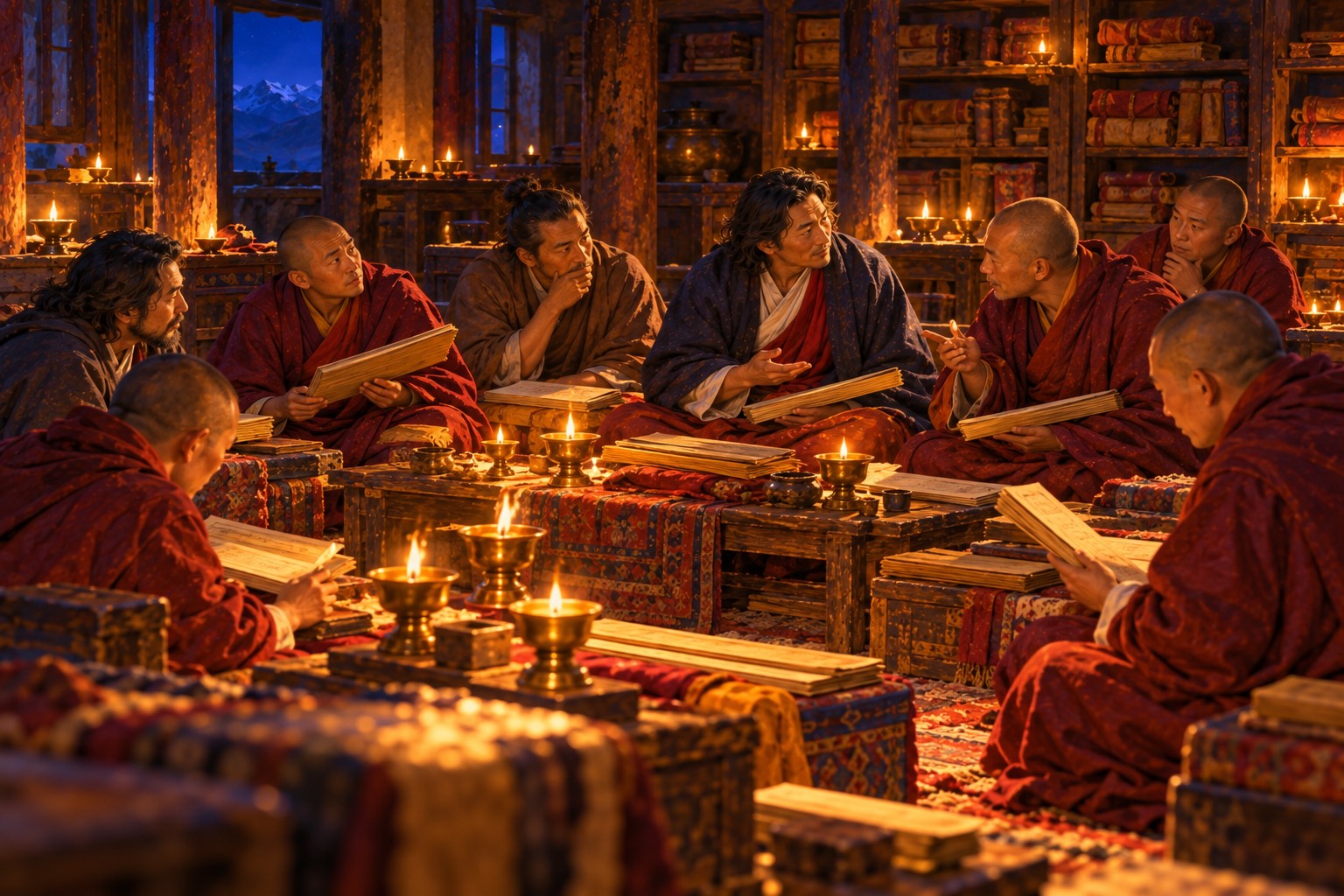
Go Khukpa Lhetse had written a fierce attack on the old tantras. A tradition says that when he first read Rongzom's writings he thought them rubbish, and set out to defeat him in debate. Meeting him face to face, he became his disciple instead, or so Rongzom's biographers say, as José Cabezón gently notes in Treasury of Lives.
The scholar Heidi Köppl has said much the same: we cannot know how far these meetings happened as told. Still, they show what the tradition loves in him. He did not win by shouting. He let people read, and he answered each question.

The books he left
At one time his writings were said to fill sixty volumes. Most are lost; the collection Mipham Rinpoche finished in the nineteenth century holds twenty-three works by him.
Among them is the Jewel Commentary on the Guhyagarbha Tantra, named for its opening words about the Three Jewels. Another is Entering the Way of the Great Vehicle, a careful defence of Dzogchen written in the formal style of Indian scholarship. He also wrote a commentary on the Garland of Views, a short teaching that tradition attributes to Guru Rinpoche himself.
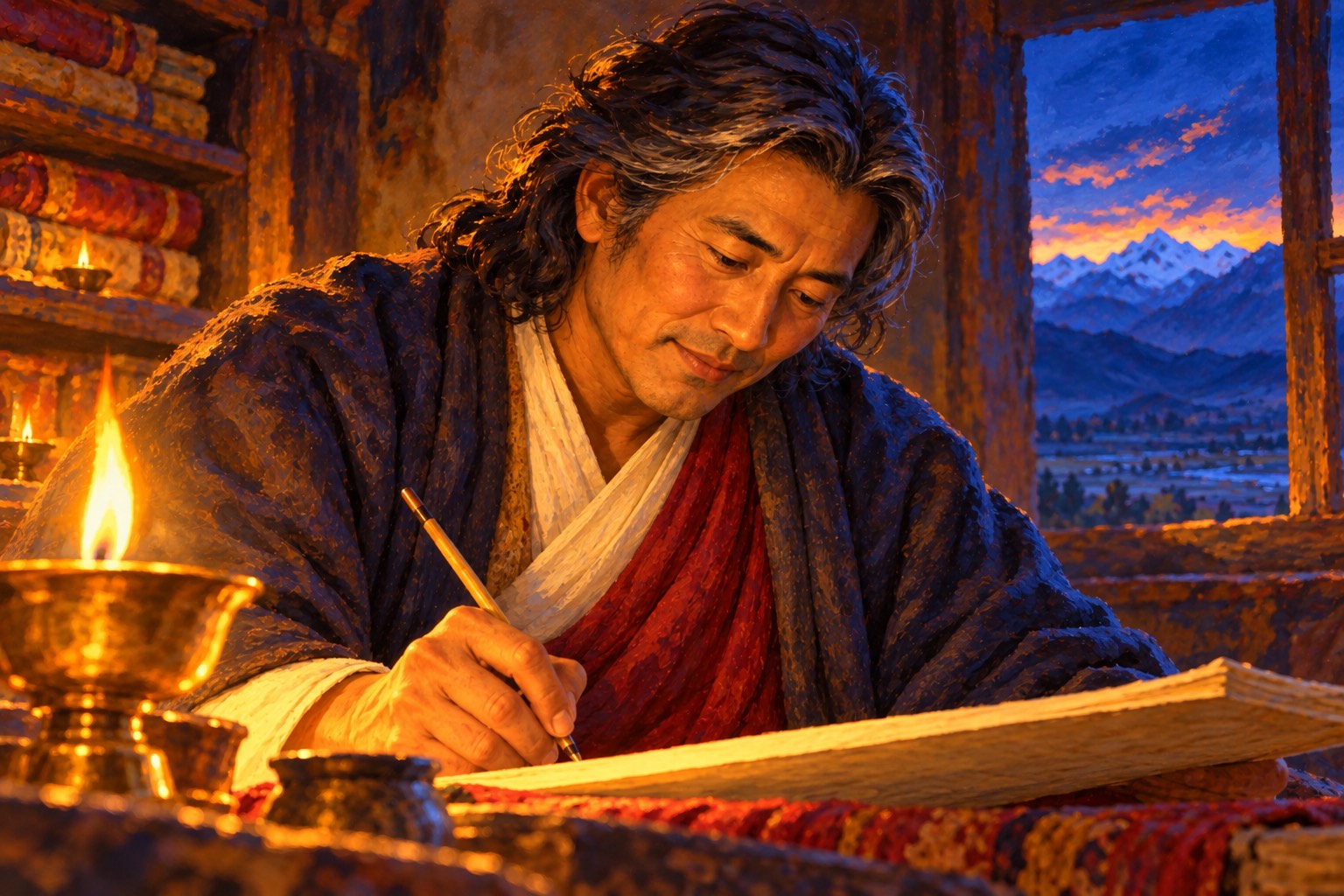
His style was so thoroughly Indian, Mipham later suggested, that some of his works may have slipped into the canon as if they had been written in India. The historian Gö Lotsawa, as Rigpa Wiki quotes him, said: "In this snowland of Tibet no scholar has appeared who has been his equal."
Seeing the jewel
One of his shortest works is called Establishing Appearances as Divine. Its idea, put very simply, is this: purity is not something we add to the world. It is what the world, and our own body, speech and mind, already are, beneath our confusion.
He gives an image. Someone finds a precious jewel but, never having seen it work, sets it aside as an ordinary stone. When an expert shows its worth, the owner cleans it and treats it with care, and its qualities shine out. In Rongzom's view our ordinary lives are like that jewel.

He also points out that different beings can look at the same stream and see different things. Whether the pure way of seeing is the true one is what his reasoning sets out to show. How this view is lived in practice is something to learn from a qualified teacher; the Find a Teacher page can help.
His wit shows in another little text, the Black Snake Discourse. A black snake's reflection lies in still water, and each school of thought reacts to it in its own way. In the Great Perfection, he concludes, a reflection needs no response at all.
The first of three
Rongzom's family carried his teaching on. He had two sons, Zijil Bar and Bumbar, who held his lineage, and a daughter whom later accounts remember as a wisdom dakini. Of his death, nothing certain is known.
The Nyingma tradition honours him with two later masters, Longchenpa in the fourteenth century and Mipham in the nineteenth, as its three "omniscient" writers. Lotsawa House notes that all three are regarded as omniscient, and that Rongzom, the earliest defender of the school, holds a unique place. Each of the other two has his own story in this library.
Mipham gathered and edited Rongzom's surviving books and wrote a short devotion to him, and Jamyang Khyentse Wangpo and Chokgyur Lingpa composed prayers to him.

The first line of the Seven-Line Prayer names the place the teachings came from, the land of Oddiyana, birthplace of Guru Rinpoche. Rongzom spent his life showing that the old teachings from that source were real, worthy and deep, and he did it with patience rather than anger.
About the art
Rongzom is painted from two portraits on Himalayan Art Resources (items 65017 and 30542), both from later sets of paintings of the previous lives of Jonang Taranata. They show a layman, not a monk: bareheaded, with dark hair, a red robe and a dark blue-black cloak, holding a long Tibetan book. He is drawn here the same way, without the halo the paintings give him, and without the ritual dagger that one painting shows in his belt. As a boy he wears a plain red wool robe.
Atisha appears as he does in Kadam paintings and sculpture: a Bengali monk in saffron robes with the tall, pointed red pandita hat that marks a learned scholar, his hand raised in a teaching gesture, and a small travel bag at his left side. The stupa that often stands at his right in paintings is left out of this household scene.
The Indian panditas are drawn in ochre and earth-red Indian monastic robes with wool shawls for the Tibetan cold. Their books are palm-leaf manuscripts between wooden covers; Tibetan books are long, narrow loose leaves of handmade paper wrapped in cloth. No writing is shown on any page.
The valley of Lower Tsang is painted as it may have looked in the eleventh century: barley fields, willows and whitewashed flat-roofed farmhouses, with no great monasteries, gilded roofs or prayer flags yet. The exact place of Rongzom's home district is not known, so the valley is a typical one, not a portrait of a particular site.
The jewel being cleaned and the three lamps are symbols, not scenes from the sources: the first follows Rongzom's own example in Establishing Appearances as Divine, and the second stands for the three writers the Nyingma tradition honours together.
Why this matters for practice
The first line of the Seven-Line Prayer names the origin of Guru Rinpoche and his teachings, and Rongzom spent his life showing that the old teachings from that source were authentic and profound. His patience with his critics is a model for how to hold devotion without anger. And his simplest idea, that the world is purer than our confused seeing of it, is a gentle thing to remember each time we recite the prayer.

If something in this story speaks to you, you might pause tonight and recite the prayer once, remembering the scholar who kept the old lamp burning when others wanted to blow it out.
Sources and further reading
- Rongzom Chokyi Zangpo, by Dominic Sur (2021), Treasury of Lives
- Go Khukpa Lhetse, by José Cabezón (2017), Treasury of Lives
- Rongzom Chökyi Zangpo, Rigpa Wiki
- Rongzom Chökyi Zangpo Series, Lotsawa House
- Establishing Appearances as Divine, by Rongzom, translated by Dominic Sur (2024, revised 2026), Lotsawa House
- Introduction to the Black Snake Discourse, by Patrick Dowd, Lotsawa House
- Rongzom Chökyi Zangpo (copy of the Wikipedia article), Encyclopedia of Buddhism
- Rongzom Chökyi Zangpo, Tsadra Commons
- Teacher: Rongzom Chokyi Zangpo (items 65017 and 30542), Himalayan Art Resources
- Indian Scholar: Atisha Main Page, Himalayan Art Resources
- Dorji Wangchuk, On the Impact of Rongzompa, Longchenpa, and Mipam on the Nyingma Tradition (video, 2021), Buddha-Nature (Tsadra Foundation)
- Sources on the Life and Works of Rong zom Chos kyi bzang po, by Orna Almogi (2002), Tibet, Past and Present (Brill)
This retelling is waiting to be read by a knowledgeable practitioner. Where the traditional accounts differ, the story says so; if you notice a mistake, please tell us through Share Your Story.